Be Wary of Being Wary of Strangers

(Photo by Marco Bianchetti on Unsplash)

In the past few weeks, two strangers have given me hugs. (Notice your reaction.) Strangers and hugs do not always belong together, I realize. And at times, they do. Individuals have a responsibility to be aware of one another without becoming too wary of one another.

STRANGER #1

Church buildings are regularly visited by people looking for financial help. People who have lost jobs, lost a battle with addiction, lost hope might swing by a church to ask for help. In Western N.D., stories abound of the striking increase in these visits during the Bakken energy boom. Young men came in droves treasure hunting for hope. Nowadays, these visits are irregular.

A few weeks ago, one young man stopped by St. John looking for a help. After listening to his story in hopes of assuring him he is seen and cared for, a fellow human being, we provided a bus ticket for the following morning and a motel room for the night. He was overcome with gratitude, which seemed to me to be genuine. When I walked him to the door, with tears in his eyes this stranger carefully reached out his arms to give me a hug.
Hugs with strangers have a long history in the Christian tradition. The Old Testament is structured around one particular commandment that did not explicitly make it into the top ten. The command that drives the story of the Hebrew people is this: Welcome Strangers. The Christian Church only exists because of first century households who welcomed a stranger named Paul, whose sketchy story involved miracles and name changes.

STRANGER #2

Yesterday I had the honor of presiding at a funeral and remembering a beloved child of God who is held forever in Jesus’ arms. It was a sad day for the community gathered around this family I have known and loved a long time. I made it through the service but not out of the building before my face became a wet mess.

I was nearly to the doors, nearly to safety of my car when a woman I do not know saw me and reached out her arms. “Thank you,” I muttered, smearing her shirt with my tears.

The letter to the Hebrews features a famous verse instructing us to show hospitality to strangers. They might be angels in disguise, we learn, which sounds more like a line from a Disney movie than an epistle. Strangers may not look like angels, but they certainly look like human beings. And sometimes, that is reason enough for a hug.


Why Should I Have Coffee While They Flee?

(Photo by Engin Akyurt from Pexels)

While I was writing Spiritual Longing in a Woman’s World, the death of George Floyd set the spotlight on black voices begging to be heard. My eyes were opened by Austin Channing in particular. I began to wonder whether my book had a place at a time like that. Who am I, with my long history of supportive family and pastoral calls that came easily to me, to speak of longing? After more prayerful wondering, I understood there is never a perfect time for anything. If I waited to publish my book, there would certainly be another set of voices longing to be heard.

Today, ordinary women (like me) seek refuge in places far from home while their ordinary husbands (like mine) stay put to make possible their return. And here I am, a half-turn of the globe away, with my hot coffee and apple scone. Yesterday, our congregation prayed for peace from the safety of our building tucked into a quiet, ordinary neighborhood. How are we to live in the luxury of peace while there is no peace for so many ordinary humans?

I offer two responses to living in a world where one person is at peace at the same time another is a victim of war. One response is faithful and the other is not.

  • Be so thankful you are not them. I hear this from parents whose kids go on mission trips. “I just want them to learn how lucky they are.” Yes, that is what happens when we experience someone else’s struggle. We go home because we can, thankful we are not them. Today, we can tell our kids, “Eat your vegetables. At least you are not fleeing Ukraine with your mother.” This is a helpful way to deepen the divide between lucky us and unlucky them.
  • Recognize “them” are actually “us”. (Sorry, grammar people, that can’t be right. It’s the best I can do.) We are all people with families and homes who live in countries and are vulnerable to dangerous leaders. We = each and every one of us. There are no exceptions. The pain of the Ukrainian mother is my pain, too. I might feel thankful to enjoy peace, but more than that I feel deep sadness that someone else doesn’t get to enjoy it, too. Offering my kids this fuller picture points to Jesus in the gospels.

I am still drinking my hot coffee, however. And, I am fervently praying. Prayer shapes our hearts to see beyond ourselves. I am also giving money through Lutheran World Relief and the ELCA’s Lutheran Disaster Response. The latter nonprofit passes along 100% of your giving and retains zero dollars for administrative fees. I trust these two established organizations knowing they will not disappear when the crisis is over.

Teaching kids to recognize “them” are actually “us” takes turning the globe around and introducing them to our neighbors and wondering what “peace” looks like here and there. Most people in the world do not live with the luxury of food, shelter and clean water. We do, which means we have resources to share. Peace is not a luxury to be hoarded. It is what Jesus gave away, so that we might do the same.

We Live Here in 2022

(Photo by Kelly Sikkema on Unsplash)

“Build houses and live in them; plant gardens and eat what they produce…But seek the welfare of the city where I have sent you into exile, and pray to the Lord on its behalf, for in its welfare you will find your welfare.” (Jeremiah 29:5&7)

     The two verses above need context. The surprising words are spoken by the prophet Jeremiah to God’s people who were displaced by the Babylonian army. Far from their homes in Jerusalem, they were now refugees in a foreign land: Babylon. The words are surprising because God’s people did not want to live in Babylon, they wanted to go home to their old, familiar routines.

   I have found myself returning to these verses ever since they showed up in the Narrative Lectionary in November. (If you happen to be a person who reads annual reports, and you know who you are, you will find these verses in mine!) We all wish to return to a pre-March 2020 world where we went in and out of gatherings without worry, and the medivac didn’t constantly traverse from Dickinson to a larger hospital day after day after day. I miss the days when vaccines weren’t so hard to discuss and masks were more about Halloween. I miss the faces of the folks in the congregation I serve parked in the same church pews week after week. I miss the old, familiar routines.

   And so did God’s people stuck in the unfamiliar land of Babylon! It comes as a surprise to me that Jeremiah did not tell God’s people to wait it out. He didn’t say to stay the course and cling to the future promise that they would return to their old, familiar routines. Nope. Jeremiah told them to settle in. Build houses in the unfamiliar land and move in. Plant a garden and wait for it to produce as you make this unfamiliar place your home.

   I can long for the old, familiar routine, or I can embrace these unfamiliar times because I live here now. I can spend time wishing for life to go back to pre-March 2020, or I can settle into this time I might not love and certainly do not understand. I do not understand the division and stubborn stances on both sides. I do not understand why a call to the common good cannot overcome the fences we have all built between one another, even within our own families. While it is true that fences create order in neighborhoods like mine with lots of dogs, fences can be dangerous for communities. Too many fences give us permission to disregard the welfare of the city. We can focus on our own fenced in area, make it beautiful, insulate ourselves in a comfy chair, and become indifferent to the needs of the people we cannot see over our fences.

    Jeremiah instructs God’s people to care for the welfare of the unfamiliar city in which they are now residents! This is strange. God is so caught up in neighborliness that God’s people are to care for their neighbors in a land in which they did not choose to live. They were not allowed to fence themselves in.

   Could this be a guiding verse for 2022? We did not choose to live in this time. We might not like how our society has responded to the pandemic. It is likely we all long for the old, familiar routines. But we live here, and we live here now. The needs of our neighbor matter as much today as they did when  Jeremiah preached these words in chapter 29. How might you peer over a fence and care for the welfare of your city? How might this be the year you settle into this time if only because your neighbor’s wellbeing matters more than your political opinions?

    Jeremiah, as far as we know, was not voted “most popular” in high school. He received no recognition for his community-building work. In fact, he likely had very few friends. But he knew the whole point of a city had to do with watching out for the welfare of the people, even in the time and place they did not choose. At our best, this is what churches do. We set aside our differences, “peace be with you”, and settle in for the sake of our neighbor. Here. Now.

Why You May Never Want to Be Lutheran

(Photo by Trae Gould on Unsplash)

If the term “Lutheran” is unfamiliar, it is a way to practice the Christian faith. There is a wide variety of denominations (branches of the Christian church) within the Lutheran faith that range from more conservative to more liberal, based on how that denomination reads the Bible. I serve as a pastor in the Evangelical Lutheran Church in America (ELCA). As I refer to the Lutheran faith in this post, I am speaking of the ELCA because it is the Lutheran practice most familiar to me.

I am a Christian who is Lutheran, which is something you may never want to be. Yesterday I complained to my colleague how challenging it has become to choose hymns for worship, when the tune that is more familiar might be the one with the term “scepter”. Prior to “Game of Thrones”, that word, for some people, might have called to mind Christ the king, but now, it is less likely.

We love our old hymns and our old ways in this relatively old faith tradition. In the 500+ years the Lutheran faith has existed, the world has experienced droughts and wars and fascist leaders and economic disasters. Hurricanes have devastated countries and native people in parts of the world have been mistaken for objects.

Each time tragedy strikes, the Lutheran faith has had something to say, albeit sometimes too late. You may never want to be Lutheran because we have a deep-seeded belief that this world’s tragedies do not become our story. We need not be consumed by the state of the world, no matter how messy that state may be, because we proclaim a faith not shaped by hand-drawn boundaries. To be Lutheran is to be less caught up in “faith over fear” and much more caught up in “faith for the sake of our neighbor”. A Lutheran’s focus does not land on personal freedoms and rights, but on our neighbor’s well-being.

But that’s just a Lutheran thing. Again, it might not be your thing.

This old world has a way of returning to times of unrest, based on how much we don’t like “the other”. We simply change how we identify “the other”. “The other” has been the Jews, the slaves, the Yankees, the AIDS victims, the women, the immigrants, the homosexuals, the blacks, the Native Americans, the liberals, the conservatives. When Ecclesiastes wrote almost 3,000 years ago that there is nothing new under the sun, he may as well have written that yesterday!

A couple of weeks ago I deleted Facebook from my phone. To post devotional material for Devotions from the Badlands and my writing page, I have to go the long way and log on from my laptop. That simple omission from my iPhone has brought a great wave of relief. I no longer lazily click the blue logo that lures me into the maelstrom of memes and misinformation. I feel so much better! And to tell the truth, I’ve been sleeping better, too.

Even I, who know a few things about the Lutheran faith, can get turned around amid the intensity of this pandemic. Even I can forget that God alone is our refuge and our strength, which Lutherans interpret to mean we wonder how to provide refuge for the neighbor who lacks strength. For example: the immunocompromised, people too young for vaccinations, families who have experienced so many quarantines because they have followed the CDC’s guidelines, long-term care residents, and people who live in impoverished American neighborhoods where the average life expectancy now falls even further behind where you likely live.

The Lutheran faith is not for everyone. It’s much easier to keep the anger streak going on Facebook than it is to face the needs of our neighbor. Logos like “faith over fear” are much more compelling than “faith for the sake of our neighbor”. That would make a terrible meme. It’s not catchy at all. Not even the word “scepter” could redeem it.

I suspect there is a well of good questions that might create conversation with kids to notice how our actions impact the vulnerable. What our faith has to say when we share memes that demean another human being. Who “the other” is right now and when you were growing up. How the needs of our neighbor matter more than our being right and more than our individual rights.

The Lutheran faith is old, but not as old the Savior (with the scepter) whose love was first and foremost for “the other”.

Week 3 of 3: The World Needs You to Pray (yes, the world)

(Photo by Louis Hansel on Unsplash)

Have you noticed lately the size of the world?

A couple of weeks ago, I told you prayer is a conversation and relationship with God. Listen, talk. Talk, Listen. Last week, I told you prayer begins in your home. Prayer for family members changes your relationship with them.

Now, widen your perspective beyond your own relationship with God, beyond your relationships with family members, and take in a view of the wider world. Could your meager prayer really do something in the great big world and universe in which we live?

Madeleine L’Engle write a book called “A Stone For a Pillow”, part of a trilogy commentary on Genesis. In it, she tells the story of a time her friend confided in her, telling Madeleine a secret. Soon after, that friend wrongly and angrily blamed Madeleine for leaking the secret. Madeleine was ticked. She earnestly prayed to process her sense of hurt and betrayal. Who had actually betrayed the secret? She would never know. And would her friend ever confide in her again?

In one of her prayers, she heard herself say and mean, “Oh God, bless the bastard.”

Site IconLisa Lewtonlisalewton.com

Visibility:Public

Publish:Immediately

Suggestion:Add tags

Share this post

Connect and select the accounts where you’d like to share your post.

  • Lisa Lewton
  • @LewtonLisa

Connect an account(opens in a new tab)Customize your message198 characters remaining

Twitter settings

Blessings are sticky business in which human beings are entrusted to one another. If it is the people whom we love and who love us back that receive our blessing, our wide world shrinks. It is easy to bless people who like us, but something else to bless the one who betrays us.

In a time of deep divide and animosity in the world, what might happen if we pray for the ones who think and live differently? Could the world take a deep breath if we replace angry rhetoric with curiosity and humility? If our response to the news is a prayerful question instead of condemnation, you know what changes?

You.

And if you change, and then a few other you’s change, and a few thousand you’s change…you get the idea.

Your prayer means something for you, for your family, and for the world. Your prayer might be no more than, “Bless the bastard.” If you don’t believe your prayer means something, try for a week to pray for people you do not like and if it doesn’t do anything to you, you’ve lost nothing. If it does work…Look. Out. World.

Lent Week 4: Your Kiddo Really Prefers Store-Bought Granola Bars, So You Can Stop Making Them

If there is one thing I now know in the thick of the marathon that is parenting, it’s that I really don’t know much. And the things I do know have been learned only when I unlearned other things.

For example, my child will eat homemade baby food, and then homemade granola bars and mac and cheese, and then homemade everything because this is what I learned in parenting magazines (back when impressionable parents gleaned information from paper pages instead of web pages.) I unlearned much of what I had learned when my kids realized the world is much larger and in it exists a magical kind of Kraft Mac and Cheese and granola bars found in wrappers, like candy bars.

I learned from experienced parents the dream of being the parent who hosts the teenage gatherings in order to know kids’ friends. These wise parents taught me the importance of creating a welcoming, junk-food friendly home to attract teenagers like vape shops with their variety of cereal-flavored options. I unlearned such learning when I began to understand teenagers don’t always gather in the same room. I cannot offer said junk food to a teenager through an Xbox, even though I consider virtual gatherings valuable.

Parenting exists in a steady stream of learning, unlearning, and learning. It never ends. Ever. Which means there needs to be a space for the unlearning. We humans need space for the unlearning to lead to new learning. We learn to overschedule kids and shape our lives around their busyness. We learn to consume too much via cookies or Amazon or alcohol. We learn to work too much, complain too much, and accept the world for what it is too much.

I invite you to make space for the unlearning. In the unlearning, we make space to question what we think we know and let the Holy Spirit stir our imagination into new learning. What do you need to unlearn about the way you spend your time or your money? What might you unlearn about the way you understand your body or your neighbor or your nation or your religion or the world? What parenting practices might you unlearn to avoid making the marathon any freaking harder than it already is?

I have come to imagine Lent as a time when the church makes room for the unlearning to learn again the unlikely ending of the Jesus story. Based on all logic and reasoning and everything we have ever learned, the Jesus story should end on the cross with his last breath. The book should close with the power of death we learn all through life but of course it doesn’t. Instead, we learn an unlikely Easter awakening keeps the book from closing.

Unlearning death’s power means we live an entire life knowing the story doesn’t end as it should. So when I make a wrong parenting move, or realize what I’ve been doing was a sub-par idea, I can turn around (repent is the churchy word) and learn something new. New is the first and last word God speaks. New creation, new life, new wondering, new learning (after the unlearning).

A question for littles

What is one thing you know that grown-ups forget? (Kids can be great teachers of what to unlearn.)

A question for former littles

What is something you thought was true when you were little that doesn’t seem to be true after all?

A spiritual practice

Think back to a time in your life when you felt at peace, and comfortable with your self? Is there something you need to unlearn to return to that sense of peace?

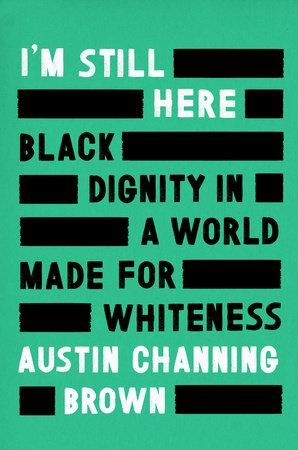
Book Review: “I’m Still Here: Black Dignity in a World Made for Whiteness”

One of our most grievous faults in this season of the world is our generalizations of people. Any sentence containing “those people” kind of words should alert us (as speaker or hearer) to our own sin (mine included) of separating humans based on our own criterion.

“Those Black Lives Matter people”, “those Pro-Trump people”, “those racist people”, “those white supremacists”, “those families”, “those non-maskers”, “those liberals”. (If this does not sound familiar to you, perhaps you substitute the word “people” with more colorful words.

This language can be a drug that distracts us from reality. “Those people” language falsely assures us that we belong to a people that is not “those people”. “My people” are not “those people”, the drug convinces you to believe.

In the past few years with the help of courageous authors, the lines of separation I had previously drawn between people has blurred. I’m not sure sure anymore which people are those people.

I think it started with “Between the World and Me”, by Ta Nehisi-Coates. This book is a letter written from father to son. It is famous and wise and heart-breaking. But I think the book that most profoundly created the blur was written by a woman named Patricia Williams, entitled “Rabbit: A Memoir”. (The Kindle edition is $2.99 for a limited time.) I listened to the audiobook. If you like audiobooks, it is a good read. The author grew up in Atlanta and experienced what is a normal life for many black and brown girls. While I was playing baseball with neighborhood boys at 12, she was having her first baby and her mom was too drugged up to care. Her story is devastating, but because she is a comedian, she has you laughing to crying before you even knew what happened. I could wish I hadn’t read it and didn’t know how awful life is at this very moment for so many young girls, but I did read and now I know. And the line is blurry.

The book I most recently read and loved that persists in wiping out the line of separation between people is Austin Channing Brown’s “I’m Still Here: Black Dignity in a World Made for Whiteness”. Channing Brown is about the same age as me, also raising kids, married, working, trying to make sense of the world and each person’s place in it and how we will leave it for future generations. My story is nothing like hers, which is why I need to hear what she has to say. I need a teacher who speaks from the edges into the comfortable middle where I live.

It is the Christian way to be wary of comfort. If we are comfortable with life, relationships, work, our faith practices, our prayers, watch out. Look around. Chances are, whenever we are comfortable, we begin to understand our own way of life as the ideal way of life. Our home, our routine, our neighborhood, our beliefs all become the right way to do things.

When I picture Jesus in the first century, I imagine him walking around edges, not in the middle. The edges of town, the edges of relationships, the edges of the synagogue and proclaiming the best news to the people outside the edges, on the other side of the blurry line (God willing the line remains blurry as opposed to rock solid).

Among Channing Brown’s wise words are these words about comfort: “Our only chance at dismantling racial injustice is being more curious about its origins than we are worried about our comfort. It’s not a comfortable conversation for any of us. It is risky and messy. It is haunting work to recall the sins of our past. But is this not the work we have been called to anyway? Is this not the work of the Holy Spirit to illuminate truth and inspire transformation? It’s haunting. But it’s also holy.”

The world is not yet as it should be. We have not arrived, but are always on the way. We know this to be true as long as the grievous phrase “those people” remains in our vocabulary.

Advent Wondering: Peace in My Neighbor’s Neighborhood

In 2020, our world became both smaller and bigger.

The world was smaller in the sense that we scarcely moved around in it. I spent much of my time at home with the four people in my immediate family. In shared spaces, we all did our work. We cooked and ate and washed dishes together. I took lots of walks. We watched movies and played games and drove each other bonkers and then we got over it. There is a sense of peace in being connected with the people in your home.

The world also grew bigger. From my living room in June, I watched the burning streets of South Minneapolis on Facebook. Peace may have been something I was enjoying in my small world, but not in my bigger one. More than ever before, 2020 made me aware of the absence of peace for so many of my neighbors whose neighborhoods are not quiet like mine. Not all my neighbors trust the police like I do. Not all my neighbors feel safe going on long walks or stopping at a convenience store like I do.

Injustice against black and brown bodies was not new news to the big world, but it became more tangible news as our siblings in Christ persisted in speaking up about an absence of peace. Perhaps for the first time, I felt invited into the lament of a wide world with a narrow sense of what is normal (white food, song, experience) and what is not (black food, song, experience).

Peace is not reserved for our small world. Peace is not mine, it is God’s dream for the world. Peace requires peering out far enough for the world to become bigger, and neighborhoods to look more like one big world and less like separate worlds.

God arrived in a manger in only one world, after all, in another time when peace was only enjoyed in small worlds. This Advent, as I dream of peace in my small world, I’ll also dream of peace in the world that is unfolding more and more each day.

This is Your Soul. This is Your Soul on Hate

(Photo by Aaron Masaryk on Unsplash)

If you are as old as I am, you may remember the powerful commercial by the Ad Council to illustrate drug use. Above a sizzling frying pan, you saw an egg and heard the monotone words: “This is your brain.” The egg was cracked and dropped onto the pan, followed by these matter-of-fact words: “This is your brain on drugs.”

Drugs fry your brain, we understood without question, yet questioning how much we wanted eggs for breakfast anymore.

What the Ad Council did not mention is drug use that becomes drug addiction can divide families…can alter one’s perception of one’s self and one’s neighbor…can steal hope and shape the future.

That old ad keeps coming back to me because something is happening in Christian communities, or at least in the one I serve as a pastor. The same thing is happening among some groups of friends and certainly among families.

I’ll stick with what I know as a pastor. The one body of Christ I’ve been called to lead has been disrupted not only by a pandemic, but also by a strange strain of sizzling hot hate. It is deep hate against “the other side” and I see it most clearly on Facebook.

Clearly I don’t see many people, so once in a while I will check a person’s Facebook page if they pop into my prayers. Sometimes I can learn something about the person’s life that might need specific prayers.

What I might find is deep anger, mistrust, and sizzling hot hate in shared posts and capital letters. Hating quarantine. Hating a political party. Hating wearing masks. Hating. Hating.

I see it on the pages of people whom I know to be sincerely generous and kind. I have walked with them through tragedy and confirmed their kids and baptized their grandkids. I know them past their Facebook pages and the hate that sizzles on their pages.

And I worry so much about their souls. Not in the “will they go to heaven” sort of way. Jesus already took care of that worry. But I wonder in the “how are you surviving” sort of way. What is such hate doing to the way you are loving Jesus and seeing the world and being in relationship with your neighbor?

I think you can remove the word “drugs” in the egg ad and replace it with the word “hate”. Hate can divide families…can alter one’s perception of one’s self and one’s neighbor…can steal hope and shape the future.

I suspect if you are reading these words, you may not be the hater. But if your Facebook page does reflect sizzling hot hate, take a quick inventory of whether it’s really you in there. Is that really you on your Facebook page, or have you let hate shape who you are on social media because it is what’s trending?

An Instragram post on @henrinouwensociety yesterday reads: “Prayer converts the enemy into a friend.” If that is true, then prayer may be able to take the sizzle out of hate. It may be able to mend broken relationships. Certainly, the death of Christ did something even greater – set forgiveness where there was none, set life where there was death.

Who knew a pandemic that in theory would bring people closer together to fight harder against it, (think The Great Depression and WWII and 9/11) would be the thing that lets loose the hate?

Out of Place

(Photo by Matan Levanon on Unsplash)

I feel out of place. I’m not where I should be.

Each year for the past 14 years I have gathered in Medora with all the pastors, deacons, and synodically-authorized ministers (known as rostered leaders) from the Western North Dakota Synod for a three-day retreat.

Because pastors are creatures of habit and this retreat has been around a long time, I can tell you precisely where I would be at this early hour in Medora: the Little Missouri Saloon. Before you assume we begin the day in the bar, hear me out. Each Monday morning, a couple dozen people meet at the saloon not to wait for the doors to open, but for the fun 5K to begin! There is a chill in the air as people bounce around to stay warm, or drag their feet wondering why they abandoned their cozy beds. (There are a few who may have left that very saloon not too many hours before.)

We meet annually in Medora to worship, learn something new, complain when the Roughrider Hotel can’t keep up with our unreasonable demands for coffee, and most importantly to sit at circle tables together.

And so we have arrived at my out-of-place feeling. I’m not going to sit at a circle table today. If I run out of coffee it’s my own dang fault. And I won’t sit in a pub with some of my favorite people later this evening.

This year, some rostered leaders are in Medora and some of us will Zoom in. From my home, I will join colleagues from my desk and not a table where the shape tells the story of what we’re doing. We are part of this never-ending work to tell an old, old story of God gathering ordinary people. The work goes on and on from generation to generation with no end in sight. None of us will complete the work of proclaiming hope, but we will continue it. We will push through political divisions under the leadership of a narcissistic and vainglorious president. We will cry for justice when people are dehumanized simply for being black and Native American. We will not stop believing God gathers us to do something about the unjust lives of the poor.

Bishop Craig Schweitzer preached last night about our time before Covid, during Covid, and at some point after Covid. It was an encouraging proclamation that we are not stuck for ever in the during part of Covid. There was a time before and of course the circle of time will continue and we will find ourselves on the other side, persisting in the same work.

Although I won’t be at a circle table with them, I give thanks for my colleagues today. I wish we were all in Medora (and so does the Little Missouri Saloon), but more importantly, I know we will gather there again because circles have no end.