Book Review: “I’m Still Here: Black Dignity in a World Made for Whiteness”

One of our most grievous faults in this season of the world is our generalizations of people. Any sentence containing “those people” kind of words should alert us (as speaker or hearer) to our own sin (mine included) of separating humans based on our own criterion.

“Those Black Lives Matter people”, “those Pro-Trump people”, “those racist people”, “those white supremacists”, “those families”, “those non-maskers”, “those liberals”. (If this does not sound familiar to you, perhaps you substitute the word “people” with more colorful words.

This language can be a drug that distracts us from reality. “Those people” language falsely assures us that we belong to a people that is not “those people”. “My people” are not “those people”, the drug convinces you to believe.

In the past few years with the help of courageous authors, the lines of separation I had previously drawn between people has blurred. I’m not sure sure anymore which people are those people.

I think it started with “Between the World and Me”, by Ta Nehisi-Coates. This book is a letter written from father to son. It is famous and wise and heart-breaking. But I think the book that most profoundly created the blur was written by a woman named Patricia Williams, entitled “Rabbit: A Memoir”. (The Kindle edition is $2.99 for a limited time.) I listened to the audiobook. If you like audiobooks, it is a good read. The author grew up in Atlanta and experienced what is a normal life for many black and brown girls. While I was playing baseball with neighborhood boys at 12, she was having her first baby and her mom was too drugged up to care. Her story is devastating, but because she is a comedian, she has you laughing to crying before you even knew what happened. I could wish I hadn’t read it and didn’t know how awful life is at this very moment for so many young girls, but I did read and now I know. And the line is blurry.

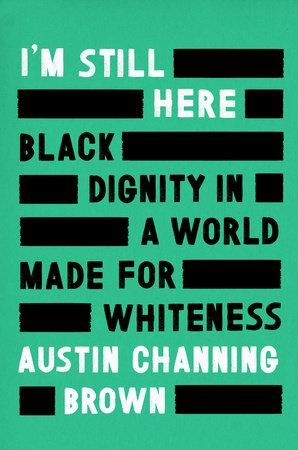
The book I most recently read and loved that persists in wiping out the line of separation between people is Austin Channing Brown’s “I’m Still Here: Black Dignity in a World Made for Whiteness”. Channing Brown is about the same age as me, also raising kids, married, working, trying to make sense of the world and each person’s place in it and how we will leave it for future generations. My story is nothing like hers, which is why I need to hear what she has to say. I need a teacher who speaks from the edges into the comfortable middle where I live.

It is the Christian way to be wary of comfort. If we are comfortable with life, relationships, work, our faith practices, our prayers, watch out. Look around. Chances are, whenever we are comfortable, we begin to understand our own way of life as the ideal way of life. Our home, our routine, our neighborhood, our beliefs all become the right way to do things.

When I picture Jesus in the first century, I imagine him walking around edges, not in the middle. The edges of town, the edges of relationships, the edges of the synagogue and proclaiming the best news to the people outside the edges, on the other side of the blurry line (God willing the line remains blurry as opposed to rock solid).

Among Channing Brown’s wise words are these words about comfort: “Our only chance at dismantling racial injustice is being more curious about its origins than we are worried about our comfort. It’s not a comfortable conversation for any of us. It is risky and messy. It is haunting work to recall the sins of our past. But is this not the work we have been called to anyway? Is this not the work of the Holy Spirit to illuminate truth and inspire transformation? It’s haunting. But it’s also holy.”

The world is not yet as it should be. We have not arrived, but are always on the way. We know this to be true as long as the grievous phrase “those people” remains in our vocabulary.


Advent Wondering: Peace in My Neighbor’s Neighborhood

In 2020, our world became both smaller and bigger.

The world was smaller in the sense that we scarcely moved around in it. I spent much of my time at home with the four people in my immediate family. In shared spaces, we all did our work. We cooked and ate and washed dishes together. I took lots of walks. We watched movies and played games and drove each other bonkers and then we got over it. There is a sense of peace in being connected with the people in your home.

The world also grew bigger. From my living room in June, I watched the burning streets of South Minneapolis on Facebook. Peace may have been something I was enjoying in my small world, but not in my bigger one. More than ever before, 2020 made me aware of the absence of peace for so many of my neighbors whose neighborhoods are not quiet like mine. Not all my neighbors trust the police like I do. Not all my neighbors feel safe going on long walks or stopping at a convenience store like I do.

Injustice against black and brown bodies was not new news to the big world, but it became more tangible news as our siblings in Christ persisted in speaking up about an absence of peace. Perhaps for the first time, I felt invited into the lament of a wide world with a narrow sense of what is normal (white food, song, experience) and what is not (black food, song, experience).

Peace is not reserved for our small world. Peace is not mine, it is God’s dream for the world. Peace requires peering out far enough for the world to become bigger, and neighborhoods to look more like one big world and less like separate worlds.

God arrived in a manger in only one world, after all, in another time when peace was only enjoyed in small worlds. This Advent, as I dream of peace in my small world, I’ll also dream of peace in the world that is unfolding more and more each day.

This is Your Soul. This is Your Soul on Hate

(Photo by Aaron Masaryk on Unsplash)

If you are as old as I am, you may remember the powerful commercial by the Ad Council to illustrate drug use. Above a sizzling frying pan, you saw an egg and heard the monotone words: “This is your brain.” The egg was cracked and dropped onto the pan, followed by these matter-of-fact words: “This is your brain on drugs.”

Drugs fry your brain, we understood without question, yet questioning how much we wanted eggs for breakfast anymore.

What the Ad Council did not mention is drug use that becomes drug addiction can divide families…can alter one’s perception of one’s self and one’s neighbor…can steal hope and shape the future.

That old ad keeps coming back to me because something is happening in Christian communities, or at least in the one I serve as a pastor. The same thing is happening among some groups of friends and certainly among families.

I’ll stick with what I know as a pastor. The one body of Christ I’ve been called to lead has been disrupted not only by a pandemic, but also by a strange strain of sizzling hot hate. It is deep hate against “the other side” and I see it most clearly on Facebook.

Clearly I don’t see many people, so once in a while I will check a person’s Facebook page if they pop into my prayers. Sometimes I can learn something about the person’s life that might need specific prayers.

What I might find is deep anger, mistrust, and sizzling hot hate in shared posts and capital letters. Hating quarantine. Hating a political party. Hating wearing masks. Hating. Hating.

I see it on the pages of people whom I know to be sincerely generous and kind. I have walked with them through tragedy and confirmed their kids and baptized their grandkids. I know them past their Facebook pages and the hate that sizzles on their pages.

And I worry so much about their souls. Not in the “will they go to heaven” sort of way. Jesus already took care of that worry. But I wonder in the “how are you surviving” sort of way. What is such hate doing to the way you are loving Jesus and seeing the world and being in relationship with your neighbor?

I think you can remove the word “drugs” in the egg ad and replace it with the word “hate”. Hate can divide families…can alter one’s perception of one’s self and one’s neighbor…can steal hope and shape the future.

I suspect if you are reading these words, you may not be the hater. But if your Facebook page does reflect sizzling hot hate, take a quick inventory of whether it’s really you in there. Is that really you on your Facebook page, or have you let hate shape who you are on social media because it is what’s trending?

An Instragram post on @henrinouwensociety yesterday reads: “Prayer converts the enemy into a friend.” If that is true, then prayer may be able to take the sizzle out of hate. It may be able to mend broken relationships. Certainly, the death of Christ did something even greater – set forgiveness where there was none, set life where there was death.

Who knew a pandemic that in theory would bring people closer together to fight harder against it, (think The Great Depression and WWII and 9/11) would be the thing that lets loose the hate?

Out of Place

(Photo by Matan Levanon on Unsplash)

I feel out of place. I’m not where I should be.

Each year for the past 14 years I have gathered in Medora with all the pastors, deacons, and synodically-authorized ministers (known as rostered leaders) from the Western North Dakota Synod for a three-day retreat.

Because pastors are creatures of habit and this retreat has been around a long time, I can tell you precisely where I would be at this early hour in Medora: the Little Missouri Saloon. Before you assume we begin the day in the bar, hear me out. Each Monday morning, a couple dozen people meet at the saloon not to wait for the doors to open, but for the fun 5K to begin! There is a chill in the air as people bounce around to stay warm, or drag their feet wondering why they abandoned their cozy beds. (There are a few who may have left that very saloon not too many hours before.)

We meet annually in Medora to worship, learn something new, complain when the Roughrider Hotel can’t keep up with our unreasonable demands for coffee, and most importantly to sit at circle tables together.

And so we have arrived at my out-of-place feeling. I’m not going to sit at a circle table today. If I run out of coffee it’s my own dang fault. And I won’t sit in a pub with some of my favorite people later this evening.

This year, some rostered leaders are in Medora and some of us will Zoom in. From my home, I will join colleagues from my desk and not a table where the shape tells the story of what we’re doing. We are part of this never-ending work to tell an old, old story of God gathering ordinary people. The work goes on and on from generation to generation with no end in sight. None of us will complete the work of proclaiming hope, but we will continue it. We will push through political divisions under the leadership of a narcissistic and vainglorious president. We will cry for justice when people are dehumanized simply for being black and Native American. We will not stop believing God gathers us to do something about the unjust lives of the poor.

Bishop Craig Schweitzer preached last night about our time before Covid, during Covid, and at some point after Covid. It was an encouraging proclamation that we are not stuck for ever in the during part of Covid. There was a time before and of course the circle of time will continue and we will find ourselves on the other side, persisting in the same work.

Although I won’t be at a circle table with them, I give thanks for my colleagues today. I wish we were all in Medora (and so does the Little Missouri Saloon), but more importantly, I know we will gather there again because circles have no end.

Lucky To Be Alive Right Now

(Photo by Tairon Fernandez on Pexels.com)

And…back to “Hamilton”, when Eliza (almost Hamilton) sang again and again, “Look around, look around, at how lucky we are to be alive right now!”

It was the slow birth of America and Eliza was caught up in the excitement of midwifing a country. The people were on the brink of freedom and they felt lucky to be alive to see it.

Today, we are not united by American freedoms, we are divided by them. Divided by narcissistic political ideologies, by Christian extremism, by racism so embodied in our values we miss it, by our fear of the stranger.

And yet, how lucky we are to be alive right now! How lucky we are to be part of the loud cry to dismantle racism; that our kids might see our generational mistakes for what they are, name the pain that has been caused, and pave a path of hope for those dehumanized by the American quest for power.

How lucky we are to be alive in a pandemic when all our busy schedules were put on hold and we, for a moment, glimpsed the truth that relationships and people matter most.

How lucky we are that our kids are experiencing disruption and we have been able to walk with them. Life is a series of disruptions and this time we could encourage them through it.

How lucky we are, if we might live like we are alive right now to the Spirit’s breezes and windstorms. How lucky we are to be alive in the Spirit’s aliveness, calling us out of our stupor to birth a new possibility for the neighbor and the stranger. How lucky.

Faith Over Fear

(Photo by Bára Buri on Unsplash)

“Why wear a mask when I want to live out of faith, not fear?” asked someone else. (Actually, a lot of someone elses.)

The congregation I serve has been both in-person and online for two months after 11 weeks of online only. Leadership has set an expectation now, as COVID-19 case numbers rise in our county and state, to wear masks when we gather in the church building.

My colleague and I wear masks before and during worship except when we are preaching. It is hot as blazes and extremely hard to enunciate through the cloth over my face, but we do it because this is how we are loving our neighbors and inviting our community of faith to do the same.

“But why would I wear a mask if I want to live out of faith and not fear?”

There is conflicting information in the United States about COVID-19. Is it a thing or is it a hoax? Who is making money off of this and why is the government telling me what to do? Why can I stand in line at Walmart but not gather in a crowd at a funeral? Why will my school be social distancing but my high school football team play face-to-face?

“And why is my church telling me to wear a mask when I want to live out of faith and not fear?” asked several someone elses.

It is a lovely question if, and only if, the question is intended to engender conversation and not inflict a political opinion upon someone else. Asking questions is the way we learn; stating uncompromising political opinions is the way we continue to divide.

“Why would I wear a mask when I want to live out of faith and not fear?”

Why? Yes, why? Could that begin a conversation instead of end it? Be shaped as a question and not a closing statement? Could we really wonder why wearing a mask is in fact the way we live out our faith, unafraid of the mean looks and despicable memes?

That is a question that might lead to faithful, not fearful conversation.

Against All Odds: Christian Hope

(Photo by Ylanite Koppens on Pexels.com)

To be a Christian is to carry within ourselves a heavy dose of idealism. Day in and day out we must be idealists to hold hopes for this world that are against all odds.

Against all odds, we hope for a world that recognizes a shared humanity. Where people who are white name our sordid history with people who are not white, and then together propose to make it better.

Against all odds, we (Lutherans) idealistically tell babies at baptism to work for justice and peace throughout their lives, even though my own culture will tell them to perpetuate unjust systems that oppress the poor.

Against all odds, we hope for communities to work together to contend with a global pandemic, even it means wearing a mask to the grocery store and to church. Against all odds, we pray and pray for people to care more about each other than their politics, supporting community leaders and putting a faithful stop to angry Facebook memes.

Today is another day that demands outrageous idealism from each one of us who claims to be a Christian, which means to love our neighbor. Perhaps we might even dare to believe, against all odds, that Jesus Christ would make all things new again today. And maybe even tomorrow. All things. All people. All cultures. All communities.

Against all odds.

Boiling Point

For weeks I waited for the pieces to come together to launch this website and tell you stories. My intention has been to share tales that might encourage people, maybe a person like you, and add levity to the daily work of raising kids, sustaining marriage, and all that you may do as one day spills into another.

And then George Floyd was murdered. Recently before, in my own America were the murders of other black Americans: Ahmaud Arbery, Breonna Taylor, and Dreasjon (Sean) Reed. Boiling point.

The pot had been simmering. For years and years heated by angry words, unchecked bias, and inequality that Martin Luther King, Jr. was murdered for in 1968. The simmering pot of racism in a country someone once called a melting pot is now a boiling pot.

For a couple of years I had fled the Facebook and Twitter scene to avoid this kind of simmering. Social media can be anxiety-producing and I figured there was enough of that in my life so goodbye Facebook and Twitter. I deleted the apps on my phone and said goodbye to my newsfeed.

And that was nice. It was nice not to know all the anxiety-producing news and go about my life. It was nice to narrow my gaze to my own work and get ready to launch a website. It was nice to ignore the simmering pot.

Now the pot boils and there is no ignoring. I need to see the words on Facebook and Twitter. Otherwise, how would I believe the ignorance from my very own president? There is no filter on his Twitter feed. (Except when his words are too violent and Twitter has to take them down. ) There is no news bias on his feed. No one else to blame. As much as his subordinates would love to take away his Twitter account, I hope they never do. It is through those words of his that we see the words that hold true for the people who adore him.

Yearning for a glorified America is to yearn for a colorblind America with no awareness of the tension among people that needs to be named. The famous Twitter feed suggests we let the white people in charge take charge with military force. He stood in front of a medic station on a church lawn where people had been providing water, holding the written word of a God who sets people free.

We are to be color-amazed, as Bishop Eaton has preached. We are to be amazed at the uniqueness of people, the value of each breath, and the strength in each voice. This is not a time of this or that, them or me, us or you. No person is perfect in this boiling pot. We have all sinned. We have leaned on political allegiance instead of the freedom of Jesus Christ that is for each person.

There is a story our nation needs to tell. We can delete the apps and ignore it, but the simmering pot now boils. So pray. Pray all day long as you hear the news and realize we have so much to learn about this boiling pot. Pray, because only prayer (not the news) changes our perspective. Pray and realize the story of rage and racism is indeed your story and mine.

How Do I Explain #GeorgeFloyd to an 8-Year Old?

Photo Credit: @Joshhild

“What are you watching?” asked my daughter, as I stood in our kitchen staring at my phone.

In a moment, I had to decide how to explain racism and riots to an 8-year old. Or, I could turn off my phone and let the moment go. Isn’t that so much easier? To believe whatever is happening on a screen is far away and someone else has to live with it?

I was watching Pastor Ingrid C. A. Rasumussen on Facebook walk through the neighborhood of Holy Trinity Lutheran Church in South Minneapolis. Touring littered streets, she explained the true identity of the damaged buildings that exposed generations of anger. Like vapor, smoke rose up here and there, like injustice that rises up here and there and here and there.

“I am watching a pastor show us a neighborhood where there was a riot.”

“Did they wreck things?” she demanded to know. “Someone is going to owe a lot of money! Why did they do that?”

“His name,” I slowly began, “was George Floyd. And he was murdered by a police officer, and many people are angry about it.”

With my husband, we tried to explain there are police whose job is to keep people safe, and there are people who are black and there is an ugly history we can’t seem to shake off.

In the end, dear daughter, this world is not yet as it should be. People who happen to be black are not as safe as people who happen to be white. Last week was one of many moments the vapor of injustice rose up in a city we know well and love very much.

There is no perfect dialogue to explain George Floyd’s murder to an 8-year old. It would be perfectly easy to believe his story need not be tied up with our story. But I want my kids to know some hurts in the world are not easy to explain, and those hurts are our hurts, too.