A Christian Way to Talk About the World With Kids

Photo by Miguel u00c1. Padriu00f1u00e1n on Pexels.com

Have you ever noticed how you talk about the world with kids? What age-old words or phrases do you let slip without realizing? Do you call the world “dangerous”? Or explain tragic events by concluding, “The world can be a terrible place,” or, “There are bad people in the world.”

I also wonder how you refer to decision-makers. Are all politicians awful? And lawmakers corrupt? How do your own headlines and editorials shape the way kids around you understand the function of the government?

As any teacher will tell you, kids speak of the world with the narrative they learn at home. Your family’s unique language is their first tongue to articulate an understanding of the world around them. If at home you speak of a corrupt government, your child will do the same at school. If all politicians are distrustful as you process the news at home, distrust may plant a seed that will later blossom into endless conspiracy theories.

The Buddhist are perhaps the first to point out that humankind is aptly named. Our early orientation toward strangers is most often kindness. If you smile at a toddler, that child will naturally smile back. It happens every Sunday during the sermon when people sitting near a baby will hear almost none of the sermon due to the steady, heartwarming exchange of glowing smiles.

We live in a time in the United States when deeply-rooted conspiracy theories are shaping events and nurturing distrust. In my corner of the world, generations-old distrust of the government has placed a filter over information related to the pandemic. And that makes me wonder about younger generations that continue to learn distrust as a first language. I suspect conspiracy theory is handed down and learned at home.

All that is to say, what might be the Christian way to talk about the world with kids, particularly at home. Here a few ideas:

  • Do not avoid the words “I don’t know.” We are inundated with both true and false information and we do not always know the difference. A shrug of the shoulders prevents us from thinking we are always right.
  • Check out the Bible. It blows my mind whenever I read Old Testament stories of how God used “the bad guy” to deliver his word. Jonah was sent into “enemy territory.” Jesus befriended the wrong “political parties.” The fall of the Berlin wall is a good illustration of how God responded to separating humans based on political allegiance.
  • Start a conversation. Ask kids, “How is God in the world right now?” As we watch the terror unfold in Afghanistan, how is God with the people? What does God need from us to care for the strangers we see in the news? Even a prayer for people far away makes us more than strangers. Also, asking kids a question reminds us that they know far more than we assume!
  • Scan yourself for anger. Anger can be productive, but it can also be wildly unproductive. If your anger makes you feel self-righteous, keep that in check. Your kids may learn to be angry with people only because they think differently than they do. Warning: Self-righteous kids are the most annoying friends in high school and college. Try to avoid raising those.
  • Remind kids a basic tenet of the Christian faith. Our faith does not put our absolute trust in a human leader, but only in our Lord. Only God deserves our total allegiance. Only God will save us. Only God will lead us through this life into the next one. Human leaders cannot promise salvation, so if you sense yourself buying into such a promise, back up a bit.

While it is a challenging time to raise kids, it is an excellent time to be in conversation with them. We all need help processing what we see in the news. It is easy to avoid, but we need to talk about why there are people who drive around our neighborhood with flags in their pick-up trucks for my 9-year old to read F— Biden. I wonder why that person feels so strongly? I don’t know, but I’m sure there is a reason. He/she is a child of God, too.

Focus Beyond the Family (Part 3/3): “Kids, the world is bigger than your baseball game.”

My kids and I spent Memorial Day in my hometown of Sherwood, North Dakota. Two miles from Canada, I grew up understanding a border to be peaceful, and international neighbors to be neighbors. Each year, roughly a week after joyfully arriving at the last day of school, students were called back to school to take part in the annual Memorial Day program. You can read more by clicking on the link in the photo caption.

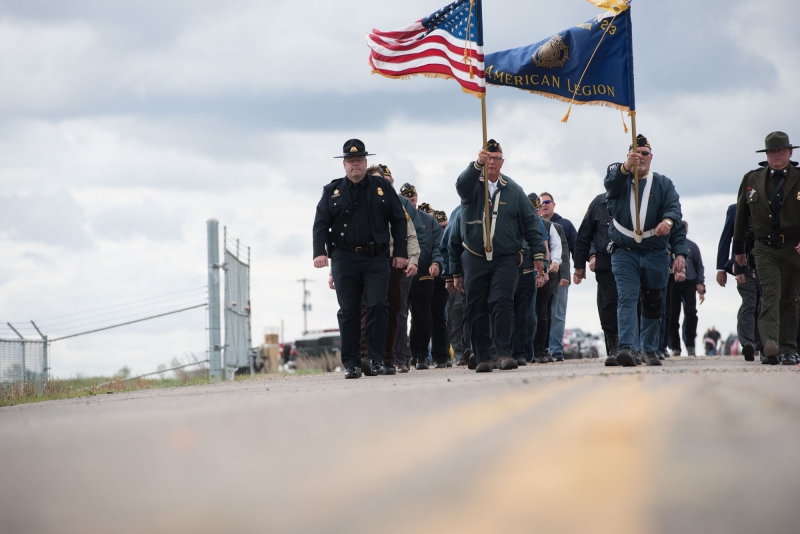
In a nutshell, Memorial Day in Sherwood typically begins at the Canadian/American border, where Canadian veterans and members of the Royal Canadian Mounted Police, and American veterans and local police officers march from their respective ports to the borderline, where they exchange their nations’ flags.

People my age and older recall riding a bus from Sherwood School those freezing mornings (my memories involve freezing rain, but maybe I’m exaggerating) with our instruments and joining the march to play…something…I can’t remember…I’m sure it was “lovely”.

The program continued at the school, with a choir singing each country’s anthem as well as the songs of each branch of the military. A slideshow, which has evolved into an impressive video production, displays pictures of each of Sherwood’s veterans who are now deceased.

Next, the program moves from the north end of Main Street where the school is located, to the south end where a stone memorial at the city’s fire hall commemorates two men who died fighting an oil fire near Sherwood in 1991. The program concludes at the city cemetery, where a designated person places a wreath on the tomb of the unknown soldiers.

Each of the 84 years of this program has drawn a crowd, often including the governor of our state. It requires a great deal of planning and manpower, even though the number of volunteers to pull off such a program has dwindled over the years, in proportion to the shrinking of a small town like my hometown.

This year, even though the border portion of the program could not take place because of the pandemic and closed borders, I wanted my kids to spend Memorial Day in Sherwood. We sat on the bleachers, just as I had for so many of these programs, just as I had for the funerals of the two men who perished in the oil fire.

“Kids,” I try to remind my own, “The world is bigger than your baseball games, your jobs, your hobbies, your accomplishments.” When a moment arises to gather for something that is not kid-centered, I find those moments invaluable. Every kid, every grown-up, every human needs to know we are small parts of something larger than ourselves.

Not long ago, I admired the parents who spend so much of their time and money coaching kids’ sports teams. Volunteer parents receive very little gratitude for the sweat equity they have in their kids’ sports. Now, however, I am not so sure. I am starting to wonder about the danger of living in communities where we spend much of our free time and money watching our kids’ activities. Kids learned to be watched and adored or yelled at. They get to be part of a team, and that offers good life learning. But the humble act of sitting in the bleachers and hearing a story you’ve heard so many times about people whom you will never know, but whom you do know played a part in your living where you live…I suspect this is how we practice being human together.

Regardless of how I feel about war and politics and American flags, I need my kids to know they live in a community. You live in a community. Every one you know lives in some kind of community. A community functions best when we all proclaim a singular hope to make them community better for everyone.

My generation has often exchanged shared communal activities for kids’ sports, my own family included. I wonder what that means for the next generations. Who will set out the chairs for the community program? Who will organize the order of the program? Who will do the work of telling our story? It is a story that is not mine or yours or theirs, but ours. A story we may not even tell precisely the same way. (All family stories are like that; we do not remember things the same.)

I hope to raise kids who know that the responsibility of living in a community falls on them. Jesus’ call to love a neighbor is a call to them. The yearning for peaceful borders is not something to entrust to someone else.

Kids’ busy lives are not the whole world. The world is bigger as much as it is filled with possibilities for them to make it better. I only believe that because a community taught me, year after year on freezing Memorial Day mornings when I thought school was over but apparently it wasn’t because I needed to sing “O Canada” and play taps and occasionally I found it all very boring.

Now, I get it.

Focus Beyond the Family (Part 2): Watch Your (Jesus) Language at the Table

(Photo by Dan Gold on Unsplash)

In my last post, your homework was to imagine yourself in your church home, or in your church homelessness. “Where are you from?” How did you arrive at the place where you are, rooted in or uprooted from church. I am suggesting that your faith walk, as you turn and look back on the path, influences how you raise your own kids or grandkids in the faith.

We know only what we know, and what we know shapes how we might talk about Jesus in our homes. Talking is teaching. You might talk to your kids about nutrition, money, and time management. Talking about Jesus is a way of inviting kids into a wider lens of the Christian faith.

Let me break up that babbling with a story. Maybe 20 years ago, I first laid eyes on the colorful, elastic WWJD bracelets. Soon, those bands were everywhere! Whenever you had a moral dilemma, the bracelet, like the proverbial angel on your shoulder, would remind you to ask: “What Would Jesus Do?”. With one easy question, you would know how to act like a Christian!

At around the same time, churches that teach easy answers began to grow. The bracelet and this-or-that kinds of churches offered an easier way to be Christian. “Be good,” the bracelet whispered to wearers all day long. Christians who appeared to follow the bracelet’s orders were called “good Christians”. If anything bad happened to them, bystanders were perplexed. “Why would something so bad happen to someone like her (him)? She (he) is so nice?”

Kate Bowler is an associate professor of the history of Christianity in North America at Duke University. At the virtual Festival of Homiletics last week (a geeky preacher gathering), she described WWJD Christianity this way: “Our lives are meant to be proof of God’s work and love, so our lives must be put together.”

Put-together lives prove that the bracelet works; that the Christian faith promises a better life. Lives that do not look put together are questionable. “Why don’t they just slip on the bracelet? It’s so easy!” WWJD Christians wonder, looking at empty wrists from their lenses obstructed by logs.

If faith were a series of moral questions and easy answers, how easy it would be, indeed. Listen to the bracelet. Follow the commandments (all 613 of them), and life will go your way. And teaching kids something easy is much, much easier than teaching them something hard.

All might be well until the perfect future unravels, one string at a time. The easy answers will not stand up to our own human brokenness. The bracelet cannot save the WWJD Christian from addiction, abuse, divorce, war, racial injustice, cyber-bullying, cancer, bankruptcy, and on and on. Life has a way of spinning a tornado, even through the put-together lives.

At the table with kids, watch your Jesus language. If Jesus rewards those who are good (how could something so bad happen to her), if faith promises a better life (we need to try harder to be good so God will give us a better future), how would we explain the truth about being human? Every kid needs to know the difference between a fairy godmother and Jesus Christ. Conversation points abound, so find one and wiggle into it.

~At the table, when the conversation turns to “the bad kid” in your kid’s classroom, Jesus language would wonder what is going on in that kid’s life? How could your child pray for her or his classmate instead of join in the easy work of vilifying?

~At the table, when the conversation turns to politics and “the abhorrent other side”, Jesus language points us past this-or-that language and recognizes the holes in our own argument.

~At the table, when a kid (or maybe a grown-up) expounds on the next new thing to buy, Jesus language might match that question with a story about a time your family was generous with money. Chip away at changing the narrative around money in your home.

In the next post, also the last in this series, we will focus farther beyond the family, as the Christian faith is meant to do. We will point kids to a lived faith in a broken world, recalling the origins of the Christian story. Our story began with sermons that preached a kind of mercy, Jesus language, that does not fit on a bracelet.

Focus Beyond the Family (Part 1): Erasing Easy Answers to Faith Questions

(Photo by Justyn Warner on Unsplash)

*Welcome to a three-part series called “Focus Beyond the Family”, meant to widen the lens on the wild work of raising kids in the Christian faith. In the next three posts, I hope to get you wondering: (1) what you expect from church, (2) how you might talk about Jesus at home, and (3) understanding faith as an arrow that points us beyond our own families.

If your faith orientation is Christianity, you might have hopes of raising your kiddo(s) or grandkiddo(s) in the Christian faith. This is not easy work. Perhaps your child was baptized, goes to (went to) some Sunday School or Confirmation classes, and you sit (sat) together at church. Either you chose that church or your (your spouse’s) extended family chose it for you.

If you are doing the hard work of raising kiddo(s) in the Christian faith, here is a quick tip regarding churches. There are two kinds of churches: one kind provides all the answers, and the other kind does not. One kind quotes a singular verse from the library of books that is the Bible, the other tells you the mysterious, broad-stroke story of God who loved the world so much that God slipped into skin to experience it close up. One kind preaches morality (“be good”), the other preaches that you can never be good enough, so welcome to grace. One kind talks in “this or that” language, the other relies on the two words: “and yet”.

One kind of church promises that faith will make your life better. The other kind of church will never, ever make such a promise. The former kind of church, through the voices of beautiful faces and blindingly white teeth, proclaims that having faith will make your marriage better, your kids more obedient, and will pave the way toward a better future. The latter kind of church promises that you, child of God, are both beloved and broken, and Jesus Christ will always put you back together, and yet life will not always be better. The Christian life is a series of broken roads with no easy-to-follow answer signs, and a never-ending promise of Jesus’ mercy.

What does all of this distinguishing between two kinds churches have to do with you? With your faith? With your life?

I’m enjoying the book, Share Your Stuff. I’ll Go First. It is written by Laura Tremaine, who invites you into thoughtful conversation and reflection. I’ve been journaling my answers as I reflect and I’m looking forward to raising her relationship-deepening questions with friends. One question Tremaine asks is: “Where are you from?” This is a standard, yet telling question.

While she asks the question more generally, I invite you to wonder from a church perspective.

~If you are (or are not) part of a church community, how did you arrive at that decision? From where have you come along your faith walk?

~How has your past experience with the Christian Church shaped what you might expect from the church?

~Do you expect easy answers or more obedient kids or a better life?

~Do you expect church to help fix your problems or to help you live with your problems?

Today, peel the layers of what you expect church to be or do for you and your family as you recollect your own church origin stories. In the next two posts, we will use what you learned to erase the easy faith answers. Then, with a blank canvas, we can create a more lasting portrait of a life of Christian faith.

Week 3 of 3: The World Needs You to Pray (yes, the world)

(Photo by Louis Hansel on Unsplash)

Have you noticed lately the size of the world?

A couple of weeks ago, I told you prayer is a conversation and relationship with God. Listen, talk. Talk, Listen. Last week, I told you prayer begins in your home. Prayer for family members changes your relationship with them.

Now, widen your perspective beyond your own relationship with God, beyond your relationships with family members, and take in a view of the wider world. Could your meager prayer really do something in the great big world and universe in which we live?

Madeleine L’Engle write a book called “A Stone For a Pillow”, part of a trilogy commentary on Genesis. In it, she tells the story of a time her friend confided in her, telling Madeleine a secret. Soon after, that friend wrongly and angrily blamed Madeleine for leaking the secret. Madeleine was ticked. She earnestly prayed to process her sense of hurt and betrayal. Who had actually betrayed the secret? She would never know. And would her friend ever confide in her again?

In one of her prayers, she heard herself say and mean, “Oh God, bless the bastard.”

Site IconLisa Lewtonlisalewton.com

Visibility:Public

Publish:Immediately

Suggestion:Add tags

Share this post

Connect and select the accounts where you’d like to share your post.

  • Lisa Lewton
  • @LewtonLisa

Connect an account(opens in a new tab)Customize your message198 characters remaining

Twitter settings

Blessings are sticky business in which human beings are entrusted to one another. If it is the people whom we love and who love us back that receive our blessing, our wide world shrinks. It is easy to bless people who like us, but something else to bless the one who betrays us.

In a time of deep divide and animosity in the world, what might happen if we pray for the ones who think and live differently? Could the world take a deep breath if we replace angry rhetoric with curiosity and humility? If our response to the news is a prayerful question instead of condemnation, you know what changes?

You.

And if you change, and then a few other you’s change, and a few thousand you’s change…you get the idea.

Your prayer means something for you, for your family, and for the world. Your prayer might be no more than, “Bless the bastard.” If you don’t believe your prayer means something, try for a week to pray for people you do not like and if it doesn’t do anything to you, you’ve lost nothing. If it does work…Look. Out. World.

The Church is Not Perfect, But…

The Christian Church is many things. Perfect is not one of them. Going to church may or may not be your thing. I respect you where you are. When I talk about church, that I do not speak of it idealistically. I am aware of its flaws and messiness.

And yet, I love the Christian Church. Going to worship for me is like being a student in what Anne Lamott has called “forgiveness school.” Church gives me practice at forgiveness school. The best way to practice forgiveness is to be around people. People like me need a lot of forgiveness. I am as far from perfect as ice cream is from being diet food.

Which is why I gather weekly with others who are far from perfect. Our imperfection is heard in our communal music. You know what I mean if worship is your thing. Some people are meant to sing. They should sing aloud throughout the day, beginning with their grocery lists. Other singers are embarrassed, some refuse. We are altogether a messy choir, reflecting the way we move about our lives and come back again and again to forgiveness school.

At forgiveness school that looks like worship, we say much the same thing from week to week. It is not unusual to sing 200 year old hymns, which is nothing compared to the 2,000 year old Lord’s Prayer. From decade to decade, many of our words are the same, not because we ran out of creative juices but because there is comfort in speaking the same words my great-grandmother spoke at forgiveness school.

When I lead the 2,000 year old prayer, I step back from the microphone and listen. I let my words get tangled up in the words of the other imperfect people in the room, worshipping over the radio, or with me on Facebook live. The beauty is in the cloud of familiar words stretching from that moment to so many moments before.

All the words lead to the one word, forgiveness, a song in itself.

To Know and Be Known

(Photo by Gabby K on Pexels.com)

This is not a schmaltzy Valentine’s Day post, lest the photograph mislead you. Tomorrow is not my favorite day of the year, although I have found it to be a good excuse to buy my kids a new book and chocolate. The point of Valentine’s Day is to express our human love for one another, but with that comes heaps of opportunities for missed expectations (disappointment) which can lead to not loving moments on such a lovely day of the year. At least there is chocolate!

Because our staff is reading The Road Back to You: An Enneagram Journey to Self-Discovery, I better understand my relationship with Valentine’s Day. Turns out, Valentine’s Day, it’s not you, it’s me! Have you heard of this tool to understand our personalities? The Enneagram, as Ian Morgan Cron, co-author of the book explains, is “a tool that awakens our compassion for people just as they are, not the people we wish they would become so our lives would become easier.”

Yikes. Have you ever wished someone would be different and therefore easier to love? Guilty. Have you crossed your fingers hoping someone you love might change as the years go by? Guilty. Learning my enneagram number taught me that although I am a unique human being created in the image of God like no other human being, I am also like many other human beings in the world. We are people who avoid Valentine’s Day because it can be accompanied by disappointment. When we encounter disappointment on Valentine’s Day, we distance from the very person who is trying to love us.

Like other people who identify as a 5 (The Observer), I prefer to think more than feel. I have to work hard to process my feelings. I like learning and listening as long as it isn’t small talk, and when someone says, “Tell me about yourself”, I wish I had an invisibility cloak. I will know a hundred things about a friend or conversation partner before they know 10 things about me. Anyone who identifies as a 5 would describe themselves similarly.

This new understanding of myself has been clarifying in a life-giving way, just in time for Valentine’s Day. I know myself more truly as a pastor, mom, wife and friend. Most importantly, I know to be more gentle on myself and others, especially on Feb. 14th. I am a 5, my husband is a 2, and that could lead to a whole series of blogposts.

For now, remember you are known by the Maker as your true, broken, messy self, which makes slightly more sense when you know your own true, broken, messy self.

Book Review: “I’m Still Here: Black Dignity in a World Made for Whiteness”

One of our most grievous faults in this season of the world is our generalizations of people. Any sentence containing “those people” kind of words should alert us (as speaker or hearer) to our own sin (mine included) of separating humans based on our own criterion.

“Those Black Lives Matter people”, “those Pro-Trump people”, “those racist people”, “those white supremacists”, “those families”, “those non-maskers”, “those liberals”. (If this does not sound familiar to you, perhaps you substitute the word “people” with more colorful words.

This language can be a drug that distracts us from reality. “Those people” language falsely assures us that we belong to a people that is not “those people”. “My people” are not “those people”, the drug convinces you to believe.

In the past few years with the help of courageous authors, the lines of separation I had previously drawn between people has blurred. I’m not sure sure anymore which people are those people.

I think it started with “Between the World and Me”, by Ta Nehisi-Coates. This book is a letter written from father to son. It is famous and wise and heart-breaking. But I think the book that most profoundly created the blur was written by a woman named Patricia Williams, entitled “Rabbit: A Memoir”. (The Kindle edition is $2.99 for a limited time.) I listened to the audiobook. If you like audiobooks, it is a good read. The author grew up in Atlanta and experienced what is a normal life for many black and brown girls. While I was playing baseball with neighborhood boys at 12, she was having her first baby and her mom was too drugged up to care. Her story is devastating, but because she is a comedian, she has you laughing to crying before you even knew what happened. I could wish I hadn’t read it and didn’t know how awful life is at this very moment for so many young girls, but I did read and now I know. And the line is blurry.

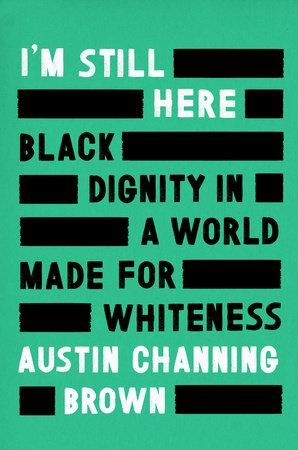
The book I most recently read and loved that persists in wiping out the line of separation between people is Austin Channing Brown’s “I’m Still Here: Black Dignity in a World Made for Whiteness”. Channing Brown is about the same age as me, also raising kids, married, working, trying to make sense of the world and each person’s place in it and how we will leave it for future generations. My story is nothing like hers, which is why I need to hear what she has to say. I need a teacher who speaks from the edges into the comfortable middle where I live.

It is the Christian way to be wary of comfort. If we are comfortable with life, relationships, work, our faith practices, our prayers, watch out. Look around. Chances are, whenever we are comfortable, we begin to understand our own way of life as the ideal way of life. Our home, our routine, our neighborhood, our beliefs all become the right way to do things.

When I picture Jesus in the first century, I imagine him walking around edges, not in the middle. The edges of town, the edges of relationships, the edges of the synagogue and proclaiming the best news to the people outside the edges, on the other side of the blurry line (God willing the line remains blurry as opposed to rock solid).

Among Channing Brown’s wise words are these words about comfort: “Our only chance at dismantling racial injustice is being more curious about its origins than we are worried about our comfort. It’s not a comfortable conversation for any of us. It is risky and messy. It is haunting work to recall the sins of our past. But is this not the work we have been called to anyway? Is this not the work of the Holy Spirit to illuminate truth and inspire transformation? It’s haunting. But it’s also holy.”

The world is not yet as it should be. We have not arrived, but are always on the way. We know this to be true as long as the grievous phrase “those people” remains in our vocabulary.

Advent Week Four: Love’s Story

(Photo by Kaboompics .com from Pexels)

Advent candles flickering toward hope, peace, joy and finally love have been lit. We are two millennia past and two days away from love’s story.

Now, a story about stories.

It used to be we were limited to understanding the world and its people by where we lived and who we knew. B.I. (before internet) we were limited in knowledge to the dictionaries and encyclopedias we could access. We knew only the stories told on famous radio programs, a handful of television shows, and a limited number of books depending upon the ingenuity of the local librarian.

Long ago, Abraham Lincoln made time each morning to hear people’s stories. Franklin Delano Roosevelt did not read headlines of the newspapers he collected from across the country each day. He read editorials in order to understand people’s stories.

Now, you and I live in a land of innumerable stories. They fall into your lap each day. We are not limited to understanding the world and its people by a limited number of sources. But this is what we do when we depend on the news or your Facebook feed to tell stories. Stories need to be told by the bearers of the stories.

I’ve learned about the world and its people through stories, not the news. Ta Nehisi-Coates and Ibram X. Kendi taught me my micro-contributions to racism. Glennon Doyle helped me understand bulimia and addiction. Kristin Howerton gave me language for adoption and families with kids of different colors. Joel Stein visited folks in Roberts County, Texas and folks at elite conferences at ski resorts to teach me how America reached the unlikely conclusion to elect Donald Trump in 2016. Malcolm Gladwell, a storytelling wizard, blew my mind with his collection of stories that make sense of why violence befalls our black and brown siblings in Christ in shameful proportion to whites. Ada Calhoun listened to the stories of so many women in my generation and then broke the news to us that feminism did not free us to do everything all at once.

Stories are how we understand each other. They open a door to mingle in each others truths so that we might become a bit truer ourselves. Stories, when told so bravely, crack open love for one another.

Two millennia ago and two days from now, love became a story. It’s the story we tell about a starry night and a desperate couple. We tell the story freely and often, but we miss the love unleashed in it. Perhaps this year you might hear it differently. The story is not a love story, but love’s story, calling us to see love in all our stories.

Advent Joy: Ode to My First Playground

(Photo by Kelly Evans on Unsplash)

Remember the elementary school playground, if that is part of your story? The playground I grew up on was the most amazing place. It was far too massive for playground protocol today. 

The playground at Sherwood School (where K-12 fit snuggly in a single building), showcased slightly ancient yet timeless equipment such as the wood and metal merry-go-round, where I overindulged in spinning on the first day of third grade and went home after losing my stuff in the doorway into the bathroom. (Blessed be the janitors.) Metal slides towered into the clouds like skyscrapers, and the swings were for swinging but mostly for girls to chatter about boys.  

Behind the equipment was a mowed area nearly the size of a football field where baseball, soccer and football took place, long before we understood the long-lasting effects of concussions. You are welcome, next generations, for all the inadvertent experimenting we did with head injuries in order for you to know, today, that getting hit in the head is not a good thing.  

To the east of the land of head injuries was, you might not believe me, a forest. A Sherwood Forest, yes, clever you. The forest became off limits late in my elementary days for obvious reasons, but before that, we built forts and did business. We coldly ripped bark from trees and made it our currency to purchase pretend food and pretend supplies. We told secrets in those woods and I’m sure drove the teachers on recess duty into utter exhaustion. We ran from bullies, made weapons with sticks, and how did none of us die in there during recess? 

Today marks the last day in the week of Advent set aside for joy. We await the joy Christ will usher in when he comes again to gather us as one. In the meantime, would you share a story today about your first playground?