Is There Ever Enough Coffee?

What is coffee but a dip in the eternal river with the communion of saints? Since its invention, most gatherings in churches have involved a percolator. My cup of coffee connects me to the generations before me who also often relied on coffee to fuel their dreams.

Dreaming is what churches are meant to do. At least, I hope that is still true. If you have been a devoted member of a congregation in the last three years, you might wonder. Along with other public gathering spaces, we stopped serving coffee for a couple of years. When the coffee stopped percolating, I wonder if it halted the percolating of dreams along with it.

Deacons and pastors of your churches can tell you that since Covid, our work now includes an intense and important ministry called digital ministry. If our budgets look the same as they did at the start of 2020, between the lines there are new expenses related to the time spent troubleshooting stream keys and researching digital hospitality. Because of digital ministry, people who are homebound or immunocompromised or too ashamed to walk into a church building or unable to get to the building are an active part of the worshipping body. Digital ministry is an incredible gift from God and I am grateful churches quickly learned to make it happen.

Beginning a new year, however, I now wonder if the intensity of this new ministry, along with other post-pandemic demands has made it difficult to be a church that keeps dreaming. Looking back, these have been busy years simply learning to move from one month to the next. Dreaming is the very best medicine for a church plagued by busyness and troubleshooting.

Is there ever enough coffee to keep fueling all the dreams? Of course. I can’t say what kind of triple espresso John the Baptizer consumed, but he was full of dreams. He proclaimed the news that the greatest dreamer of all was around the corner. And then he baptized the dreamer with water, as the Holy Spirit bestowed on him a renewed power to dream. With the Spirit as Jesus’ guide, he dreamed out loud that the addicted might find a home in the church. He dreamed that power would not be concentrated among people, but would concentrate on the redeeming love of God. He dreamed that children would be cared for, women would have a voice, and the abused would be healed.

That’s a lot of dreaming.

While we drink our coffee at churches, may we be fueled by the Spirit and filled with caffeinated dreams. May our dreams reach people on the other side of the screen, and those who have not yet heard about the dreamer who has come among us. The dreamer not only dreams of mercy for the broken, but became mercy for the broken. Lord, keep your church from becoming too busy to dream. Amen.

Photo Credit: Merve Sehirli Nasir on Unsplash

An American Advent: Esther

You will find them in the reeds when Moses floats down the river. She is the unseen young girl whose parents were taken during the war. Before anyone else finds out, the angel first proclaimed the good news for all the world to her.

The Bible is nothing if not shocking. When something big is about to happen, it does not first happen among the mighty and powerful. Elected leaders do not shape the story of Scripture. Those with political importance are only center stage when they have messed it up.

The infant Moses was saved when two young girls took charge. It is teenage Mary who first received the good news of Jesus’ coming. And no one suspected Esther.

Esther’s story is told in ten chapters that famously make no mention of God. She was a Jew raised by her Jewish cousin, Mordecai, after her parents were taken in the Babylonian Exile. When the non-Jewish king went on the hunt for a new pretty face, Esther won his favor. Later, Mordecai overheard a plot to exterminate the Jews and urged Esther to use her place in the king’s favor to stop it. He said, “Who knows? Perhaps you have come to royal dignity for just such a time as this.”

This Advent series challenges you to notice an Advent hope for our own nation. In America, the land of the divided and the home of finger-pointers, we tend to look for hope in all the wrong places. We look for hope among the wealthy, the mighty, and within our own political party. We blame and bicker, boo and belittle.

And no one suspects Esther.

Upon Mordecai’s urging, Esther went to work. When no one suspects you of changing the world, you have plenty of permission to do so. And she did.

As America waits for a better economy, a better selection of political candidates, a better nation, Esther is a story of what to do while you wait. She wasted no time blaming or bickering. She, a young woman in a man’s world, the unseen girl with tragedy as her backstory, hatched a Shakesperean plan that concluded: “…and if I perish, I perish.”

While we spend these Advent weeks waiting for the birth of a Savior and waiting for Jesus to come again and waiting for a better America, how are you waiting? Are you blaming the leaders you elected because America does not look how you want? Are you bickering with those who see the nation differently when all this time you could be the unsuspecting whisperer of hope?

Let’s move the spotlight from the nation to the Christmas dinner table that awaits you. You know, the table you may be dreading because the very people who bother you most will be seated beside you. People who see the nation differently, or your family history differently. People you successfully avoid most of the year. I recently listened to a podcast in which a listener asked if it is possible to just end it with her family because she’d had enough of them. If you are dreading the Christmas dinner table, it appears you are not alone.

Esther saved a nation, and perhaps you could save Christmas dinner. How did she do it? She believed that what made her unique was exactly what was needed. Out of love for her people, she was brave and honest. She did not wait for someone more important to make a difference, she understood the one who could make a change was her.

Photo Credit: Akira Deng on Unsplash

An American Advent: What Does Justice Have to Do with Advent?

Fighting for justice is the daily work of a mom of young kids.

While the word justice addresses big concerns such as hunger, poverty and racism, justice is also a concern at the Lego table. Years ago, the 19-month difference in my little boys’ ages nearly did me in, especially when Legos were involved! The more aggressive brother hoarded the Legos or disassembled his brother’s creation. Whatever each one had was never fair enough and the tantrums that erupted were Vesuvian. My job as a mom was to advocate for justice at the Lego table by asking questions of my two little boys:

  • Why can’t you at least let me shower before you fight?
  • But seriously, why are you so angry?
  • Can you tell your brother what you want?
  • How can you share what you have so the Lego table can be a fun place for both of you?

Justice is what happens when people work toward the same equitable goal. Justice is two little boys sharing Legos, even though it lasts only long enough for a mom to take a shower.

In America, justice is a touchy word. Currently, Americans are rather possessive of their notion of justice, applying the word only to their own political party – blaming the opposing party for threatening justice. But justice is not a partisan word, it is an Advent word.

The Narrative Lectionary reading for the first Sunday in Advent is spoken by the prophet whose name is pronounced more than one way. Habakkuk (HAB-ah-kuk or Hah-BAK-kuk) is advocating for justice. He is waiting for God to bring about equity for God’s people caught between the superpowers of the day: Babylon and Egypt. The future for God’s people is grim, so Habakkuk turns to God and says, “O Lord, how long shall I cry for help, and you will not listen?”

This is the faithful cry of Americans today, waiting for justice. How long, Lord, will our nation cling to their political parties? How long will we stand for the news to be delivered without integrity, deepening the divide between neighbors? How long will everything that’s wrong be the fault of everyone but our own selves? Lord, how long?

Next week, I will share the story of someone who believed it was her responsibility to advocate for justice. It was not the responsibility of the political powers of the day, or even the more powerful gender. She believed it was her own work to advocate for justice, which changes everything.

This week, consider your own understanding of justice.

  • In a journal or a conversation with a person or the Lord, what would justice in America look like and how much does your own political preference shape your understanding of justice?
  • Turning back to the questions at the Lego table, but seriously, why are you so angry?
  • Can you tell your brother and sister in Christ who may disagree with you how you want justice to look?
  • How can you share what you have so the Lego table America can be a fun place for both of you?

Eventually God responds to Habakkuk. In 2:1-5, God’s response threatens anyone who depends on wealth and pride. Wealth and pride do not bring about justice. Justice requires as much giving as getting, which is very difficult to teach both at the Lego table and in America. May justice begin in our own nation with your own honest reflection.

Photo credit: Markus Spiske on Unsplash

Time Capsule Trumpet

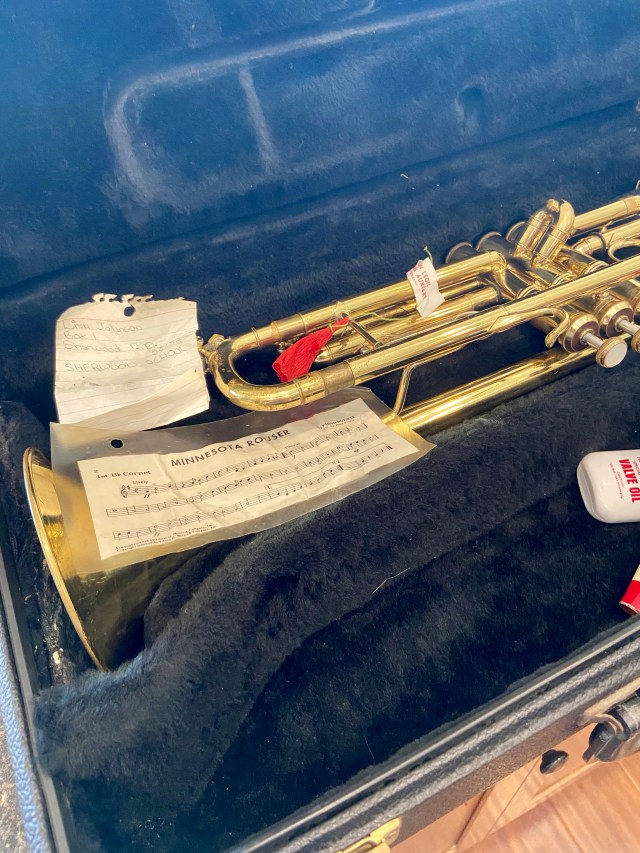
When a friend mentioned her daughter asked to play trumpet in 6th grade band, I was happy to offer my old Selmer. This is the trumpet I’ve packed up, left untouched and moved to four different homes in the last couple of decades. It’s the one I played most days of the week during the school year for roughly eight years.

Opening up the case before taking it to the professionals for a tune-up was like cracking open a time capsule. There was our school song, laminated and crumpled after years of basketball games. (“Sherwood High School, hats off to thee!”) There was the crepe paper, red poppy and American Legion label twisted around the brass for Memorial Day “Taps”. There was my 7th grade handwriting with my name, school and address in the event my trumpet and I were separated at a competition. (Was my mailing address actually Box 1? It’s true!)

Looking back, it seems my trumpet and I were rarely separated during that long stretch of time. Eight years is an extremely long stretch of time for a kid! My recollection of high school band (grades 7 – 12 seated across the gym stage, curtain closed) involves heaping sympathy for the music teachers who, let’s be honest, had little to work with. Yet every day he or she showed up, waving a small not-so-magic wand and hoping for a miracle. I also played for two years in college under the direction of the incredible Gordy Lindquist, a northcentral N.D. legend, made legendary by his ability to tickle the ivories while they were covered up by a sheet, or playing behind his back and in a variety of other contorted and hilarious moves including upside down. You couldn’t help but love being in the room with him, your classmates and your instrument which you played in the ordinary, boring way and not upside down.

Then I tucked the Selmer trumpet into its velvet outline, latched the black case and moved it to four homes until finally, finally a girl will play it. With the “Minnesota Rouser” and “Taps” tucked into the horn’s history, now it will learn new tunes. In the beginning, each note will come painstakingly slow until suddenly, a song will emerge, a new life lived.

Has Neighborliness Lost its Value?

(Photo by Nick Hawkes on Unsplash)

A couple of years ago, Marcus and I planned a neighborhood get-together. We know most but not all of our nearest neighbors and we both believe neighborhoods are safer when we know one another. And familiarity with neighbors makes it easier to locate a cup of flour at the last minute for cookies.

Because delivering invitations is a thousand times easier with a cute 8-year old, Karis and I left invitations in a dozen of our nearest neighbors’ doors. They could RSVP to my cell to host part of a progressive party or simply attend. Two neighbors responded (who also happen to be members of St. John) that they were bummed they would miss it. A week or so later, another neighbor asked if anyone responded to me. When I told him no, he knowingly said, “I didn’t think anyone would go to something like that.” (At least he was honest!)

I am so curious what it might mean when neighborliness loses its value. When we are less inclined to gather, what are we missing? When we do not need our neighbors in the same way as the first generations in the Midwest, what is lost?

It has always mattered to me for our kids know at least some of our neighbors so they have trusted adults if something happens when Marcus and I are not home. In my head, we do actually need our neighbors. And if I need those neighbors, I also care for their well-being. I care that my kids are safe and I care that my neighbors are safe.

“And who is my neighbor?” the first century lawyer asked Jesus to clarify. Anyone who needs help, Jesus began to explain, making the answer more broad until it became specific. Your neighbor, Jesus zeroed in, is anyone who needs help whom you would rather not help.

Humanity has never been great at following Jesus’ command to love our neighbors, especially the ones we would rather not help. It is not new that neighborliness demands more of us than most of us can give. However, what does it mean that bearing arms seems to be easier than neighborliness in particular corners of our nation? Have we become so suspicious and even fearful of our neighbor that someone may be more inclined to purchase an assault weapon than attend a friendly neighborhood gathering with snacks? Are we failing at neighborliness?

Let me be clear, I am not advocating for gun control. I am part of a family who hunts animals. We can have conversations around gun laws without extreme solutions. I am more interested in conversations around neighborliness, which I suspect are just as hard but yet more productive.

As we move through this devastating time of mass shootings in my own country, I promise to pursue discussions around neighborliness. I promise to practice inviting my neighbors to gather, even if it may seem a ridiculous idea to some of them. If Jesus was ridiculous with his mercy, I can lean in that direction, too.

Be Wary of Being Wary of Strangers

(Photo by Marco Bianchetti on Unsplash)

In the past few weeks, two strangers have given me hugs. (Notice your reaction.) Strangers and hugs do not always belong together, I realize. And at times, they do. Individuals have a responsibility to be aware of one another without becoming too wary of one another.

STRANGER #1

Church buildings are regularly visited by people looking for financial help. People who have lost jobs, lost a battle with addiction, lost hope might swing by a church to ask for help. In Western N.D., stories abound of the striking increase in these visits during the Bakken energy boom. Young men came in droves treasure hunting for hope. Nowadays, these visits are irregular.

A few weeks ago, one young man stopped by St. John looking for a help. After listening to his story in hopes of assuring him he is seen and cared for, a fellow human being, we provided a bus ticket for the following morning and a motel room for the night. He was overcome with gratitude, which seemed to me to be genuine. When I walked him to the door, with tears in his eyes this stranger carefully reached out his arms to give me a hug.
Hugs with strangers have a long history in the Christian tradition. The Old Testament is structured around one particular commandment that did not explicitly make it into the top ten. The command that drives the story of the Hebrew people is this: Welcome Strangers. The Christian Church only exists because of first century households who welcomed a stranger named Paul, whose sketchy story involved miracles and name changes.

STRANGER #2

Yesterday I had the honor of presiding at a funeral and remembering a beloved child of God who is held forever in Jesus’ arms. It was a sad day for the community gathered around this family I have known and loved a long time. I made it through the service but not out of the building before my face became a wet mess.

I was nearly to the doors, nearly to safety of my car when a woman I do not know saw me and reached out her arms. “Thank you,” I muttered, smearing her shirt with my tears.

The letter to the Hebrews features a famous verse instructing us to show hospitality to strangers. They might be angels in disguise, we learn, which sounds more like a line from a Disney movie than an epistle. Strangers may not look like angels, but they certainly look like human beings. And sometimes, that is reason enough for a hug.

The Best Summer Job

(Photo by Tegan Mierle on Unsplash)

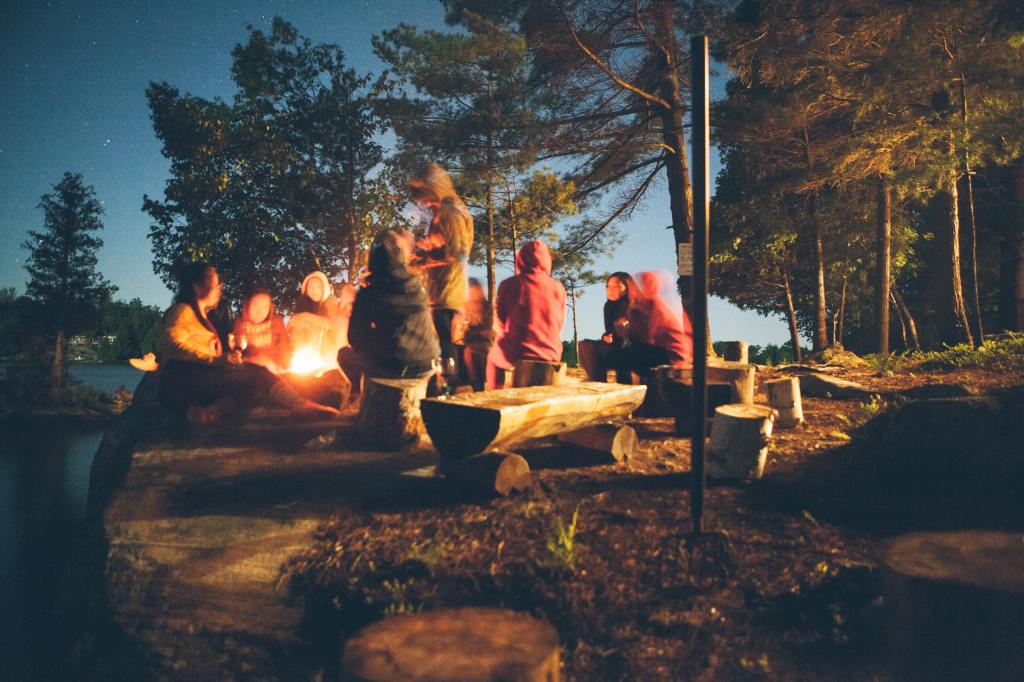
Seats around a campfire are sacred. Since the invention of fire, humans have encircled them to swap stories, learn from one another, and stay warm. I recently read Tish Harrison Warren describe their backyard firepit as the place her family has felt particularly connected since the beginning of the pandemic. Campfires illuminate the dark night with pops and crackles, often a soundtrack of belonging. Add an additional soundtrack of your favorite Bible Camp campfire tune and you have discovered the best summer job!

The denomination to which I belong, the ELCA, has a strong tradition of outdoor ministry. It is likely some of the most unique and creative pastors you know were once counselors at a Bible Camp. No job description for a camp counselor could capture all the job entails, but a simple phrase might suffice: “Be ready for anything, including exhaustion and elation in the very same minute!”

I had zero desire to be a Bible Camp counselor. My singular experience as a camper was the summer between 7th and 8th grade when I went to camp knowing almost no one and mistakenly hoping junior high girls would be kind and welcoming. You can imagine how that went!

But by the time I finished my second year of college, the sting had gone away. A beloved professor at my college was married to the Executive Director of Metigoshe Ministries. His need for additional counselors converged with my lack of summer employment, so off I went to camp, again knowing almost no one. This time, however, I would not leave camp sad, but changed.

Camp staff often explain their work by saying the days are long, and the weeks go quick. A day of camp is filled to the brim, making your daily life a constant pouring out of Jesus’ love. This work is not easy, but no work that truly matters ever is. Work you do that changes lives requires your whole life, not a few hours of it, not a little bit of your energy or time, but all of you. Your heart, your mind, the very self God has created is meant to be shared.

My own experience as a camper sharpened my vision for campers who felt left out. In fact, that very camp skill has followed me around, keeping an eye out for the forgotten ones. Much of the skills I acquired at camp, however, are not all directly transferable. I don’t get to give mud facials even though I wasn’t too bad at that. I don’t dress up in crazy outfits, chase children at night, shingle a roof, toss greasy watermelon, or help construct outhouses in my work as a pastor. Those remarkable skills have gone untapped.

So much of what I learned took place in the same type of circle in which people have been learning since the invention of fire:

  • One fire is enough for everyone, even better if you have to squeeze together.
  • Whether or not you can sing, music gets to you with the promise that you belong right where you are.
  • Life is not lived in your own seat but in a gathering of seats among people meant to be different from you.

The nightly campfire tradition of Bible Camps is perhaps what makes the transition from Bible Camp to whatever is next for camp staff profoundly difficult. Outside of camp, days rarely end around the sacred space of something equivalent to a campfire.

Right now, there is a young adult whom you know (or maybe are) who is waffling about summer plans. Tell that person there is a seat at a campfire just for them, as long as they desire to do work that matters. If money gets in the way of their decision, could you do what I know a camp staff dad often did, and subsidize that person’s income with a little of your own money? That’s an investment in the work of the Spirit, I assure you. Maybe you could get a mud facial in exchange! Maybe.

So Broken I Need Jesus

Really, Iowa? What the heck, Kentucky! I’m getting my butt absolutely kicked in the family March Madness competition. I didn’t really need that $20 anyway, right?

Oh well. The truth is, I am one of those annoying fans who jumps into men’s college basketball at the very end. Only after the players have sweated through an entire season do I even sort of begin to care. The losses that broke their hearts, the injuries they recovered from, the victories along the way. I know none of it. I do know my bracket is completely broken and I am currently in 18th place of the 18 people in our group!

Nonetheless, I have come to terms with my brokenness over the years. A broken bracket, like broken me, is not the end of things. I have come to terms with life as it waffles between easy and hard, joyful and sorrowful, hopeful and disheartening. Tomorrow will come and I will mess it up/get something right all over again. I am so broken, I need Jesus, and there he is.

Preachers of mainline congregations tend to wonder how much that particular truth resonates with people who gather with us for worship. Do they come to worship (online or in-person) for the familiar tunes or for the tunes that find the crack in our hearts and seep in? Do they come for words to comfort them or to comfort the poor and forgotten? Do they come for a deep drink of the Spirit of life or to become vessels for others to take their own deep drinks?

Maybe they come because they are in 18th place and lost their $20 and are processing the shock of their brokenness. How did it come to this? I thought Iowa would see me through, but none of us are immune to disappointment. And yet, the one who has come to put our broken selves together does not join us only in the end, like I do in this tournament. The one who cares most deeply for your brokenness is there through every broken heart, injury, and victory. Now. Later. Always.

In the Noise and in the Silence

It took me years upon years to learn why parenting littles was absolutely exhausting. Aside from the sleep deprivation and the fact that often our most demanding work years fall in the same season, kids require every iota of an introvert’s energy. Did my sons, whose birthdays fall within twenty months, care that I identify as an introvert?

Toddler Sons: “Mom, play cars, trucks, tag, push me on the swing, read me that book, watch me, watch me, watch me!”

Mom: “Actually, the introvert that is me requires blocks of quiet time and alone time, so I’m just going to sit by myself for a while as you risk your life being a toddler.”

Toddler Sons: “We completely understand. Go and feed your soul while we sharpen knives in the kitchen.”

There is no “tv timeout” that allows for an introvert to recover from so much people time. Even time with our own family in our own home as any introvert knows, can be over the top exhausting.

I’ve been recalling this as my kids are older and do actually allow introvert recovery time. They do their own thing, have their own friends and do not demand, “watch me, watch me, watch me” all the live long day. I can sit and read chapters of a book. I can take a walk. I can drink a cup of coffee while it’s steaming hot.

It is easy for me, too, to do my own thing. And yet, a fundamental need for all humans beings requires sitting together some of the time. Even if no words are exchanged, each one of us needs someone to regularly look us in the eye to assure that we have not mistakenly put on an invisibility cloak. I need your eyes to assure me I matter to you.

I recently sat with an elderly dude whose entire world is about to change. He told me his story a few times in the half hour or so we sat together. I didn’t need to say anything, but my eyes (and I suppose my ears) assured him he was heard. Words matter less when the person you sit with knows he matters to you. I did not know him well, but I did know we are both beloved children of God who need someone else’s eyes to remind us God sees us, too.

In the noise of life with young kiddos, we assure them they matter with our songs and silly conversations and with pushes on the swings that surface the giggles. As we grow older, it is often in the silence that we come to know and remember someone notices we are still here. Hanging out in this life, as unsure as anyone else what comes next.

We Live Here in 2022

(Photo by Kelly Sikkema on Unsplash)

“Build houses and live in them; plant gardens and eat what they produce…But seek the welfare of the city where I have sent you into exile, and pray to the Lord on its behalf, for in its welfare you will find your welfare.” (Jeremiah 29:5&7)

     The two verses above need context. The surprising words are spoken by the prophet Jeremiah to God’s people who were displaced by the Babylonian army. Far from their homes in Jerusalem, they were now refugees in a foreign land: Babylon. The words are surprising because God’s people did not want to live in Babylon, they wanted to go home to their old, familiar routines.

   I have found myself returning to these verses ever since they showed up in the Narrative Lectionary in November. (If you happen to be a person who reads annual reports, and you know who you are, you will find these verses in mine!) We all wish to return to a pre-March 2020 world where we went in and out of gatherings without worry, and the medivac didn’t constantly traverse from Dickinson to a larger hospital day after day after day. I miss the days when vaccines weren’t so hard to discuss and masks were more about Halloween. I miss the faces of the folks in the congregation I serve parked in the same church pews week after week. I miss the old, familiar routines.

   And so did God’s people stuck in the unfamiliar land of Babylon! It comes as a surprise to me that Jeremiah did not tell God’s people to wait it out. He didn’t say to stay the course and cling to the future promise that they would return to their old, familiar routines. Nope. Jeremiah told them to settle in. Build houses in the unfamiliar land and move in. Plant a garden and wait for it to produce as you make this unfamiliar place your home.

   I can long for the old, familiar routine, or I can embrace these unfamiliar times because I live here now. I can spend time wishing for life to go back to pre-March 2020, or I can settle into this time I might not love and certainly do not understand. I do not understand the division and stubborn stances on both sides. I do not understand why a call to the common good cannot overcome the fences we have all built between one another, even within our own families. While it is true that fences create order in neighborhoods like mine with lots of dogs, fences can be dangerous for communities. Too many fences give us permission to disregard the welfare of the city. We can focus on our own fenced in area, make it beautiful, insulate ourselves in a comfy chair, and become indifferent to the needs of the people we cannot see over our fences.

    Jeremiah instructs God’s people to care for the welfare of the unfamiliar city in which they are now residents! This is strange. God is so caught up in neighborliness that God’s people are to care for their neighbors in a land in which they did not choose to live. They were not allowed to fence themselves in.

   Could this be a guiding verse for 2022? We did not choose to live in this time. We might not like how our society has responded to the pandemic. It is likely we all long for the old, familiar routines. But we live here, and we live here now. The needs of our neighbor matter as much today as they did when  Jeremiah preached these words in chapter 29. How might you peer over a fence and care for the welfare of your city? How might this be the year you settle into this time if only because your neighbor’s wellbeing matters more than your political opinions?

    Jeremiah, as far as we know, was not voted “most popular” in high school. He received no recognition for his community-building work. In fact, he likely had very few friends. But he knew the whole point of a city had to do with watching out for the welfare of the people, even in the time and place they did not choose. At our best, this is what churches do. We set aside our differences, “peace be with you”, and settle in for the sake of our neighbor. Here. Now.