A Trail of Two Words

Two words emerged as a refrain last week when I met via Zoom with my spiritual director. The words wove their way through our prayer and conversation, a pair insistent upon staying together and staying in front of us.

My spiritual director introduced the words, or so I thought. “What a brilliant set of words!” I reflected. The perfect pair for prayer.

Later, I realized he had in fact borrowed the words from me! I found them in my previous blogpost and in my journal. “Wow,” I congratulated myself.

Later still, I noticed the two words in the confession our congregation prayed together on Sunday. The pair of words I thought I had come up with were the brilliant creation of a liturgist.

If I were to follow the trail even further, I would find the words elsewhere. I would find them dripping off the pen of a poet, a theologian, and who knows who else. Probably you.

When my spiritual director and I were in prayer and conversation, we moved through the heaviness of the past month: the weight of goodbyes we said to saints who have gone before us, the long and yet lovely stretch of Christmas worship services.

Prayer may be like this for you, too. Moving along in prayer, you find a side road and without even noticing, you follow the side road away from the main road of your prayers. Suddenly you are sunk in a ditch of worry and regrets.

That’s when my spiritual director said two words that I will keep close by in the year ahead. A pair that is perfect for prayer:

Begin again.

The two words are nothing new. The words are so old, in fact, they are ancient.

Begin again.

The trail of these two words reminds me that the wisdom you need most may not be in front of you but behind you. God may have abundantly scattered quiet wisdom in a long-ago moment of hardship, or in a past season of celebration. The forgotten seeds grow in the Spirit’s time, a sign of new life.

Begin again.

You cannot see far into the year ahead, yet you can hold onto wisdom God has already given you in years behind.

Photo by Judy Beth Morris on Unsplash

The Way

As a seminary student, I remember discussing with classmates how long a pastor should serve a congregation. The lore was that a pastor’s call should conclude around seven years, seven being a number that reflects completion in the Bible.

Growing up, one of my pastors practiced the seven-year model. My Methodist colleagues are often transferred at the seven-year mark. If God created everything and even rested within seven days, seven years as a pastor in the same congregation should do it. Marcus and I entered this life of pastor/teacher expecting to move if not every seven years than at least every so often.

And yet, here I am in the same congregation for 17 years, long past not only one seven-year mark but two. Perhaps this is on my mind because it was 18 years ago, around this time of year, when Marcus and I travelled from our home in the Twin Cities to Dickinson to interview. I interviewed at a congregation that astoundingly had called only two senior pastors within a stretch of 50 years. They had completely rebelled against the unwritten seven-year rule! Who were these people?!?

Any long-term pastor can tell you the gift of a long-term call is that relationships grow deeper, which can serve to further a congregation’s mission to follow Christ. You become more aware of someone’s quiet gifts and someone else’s profound wisdom. You learn who has a genuine desire to learn or to serve in Jesus’ name. You have the privilege of entering into multiple generations of a family’s life and proclaim God’s hope through Christ.

On the flipside, the goodbyes get harder as the relationships grow deeper. You must witness more people join the communion of saints, people you have grown to love as you serve alongside them. It becomes like watching the introduction to a television show. The intro moves you through the years to give you a flashback of all that has happened in the lives of the characters. This way, by the time the episode begins, the characters are more familiar.

Being a pastor for a long time is like that. God brings new staff members to a congregation, yet you are the one who has lived through much of the introduction.

  • You can see the group of people who once gathered for coffee before worship on Sunday mornings. Now, they are no longer living, or no longer able to come to the church building to worship. Their absence is felt each week.
  • You can see that group of people who served in leadership roles. Their wisdom continues to be beneficial, but you have to know who they are.
  • You can hear the sounds of worship that both changed and stayed the same from one generation to the next. You endured some of the trials and tribulations through the changes and the sameness; you felt the impact on the community of faith; you have lost enough sleep over the years to know what is at stake.

How long should a pastor serve a congregation? Like perhaps any question in the universe that relates to relationships, the answer is less important than the question.

The question is not how long, but how now?

This question is not reserved for pastors. How does a pastor, a deacon, a lay person, a young person, an old person, a new person, a seasoned person, serve a congregation now? What difference does it make that God gathered these people at this time for this community of faith, which ever community it might be?

The answer is less important the question, the question is less a question than a prayer.

Lord, you are the way, the truth, and the life. Guide our feet, you who are the way. Instill in us wisdom, you who are the truth. Renew us by your grace, you who are life. Amen.

Photo by Aron Visuals on Unsplash

Hey, Don’t You Live Up There?

One Wednesday night at St. John is an adventure story. Within three hours, there is an intensity to the volume of delightful, multi-generational conversation, mishaps, tears and giggles. I love how this gathering reflects life as it truly is: imperfect.

Luther described a theology of the cross as God meeting us not in the positive, perfect moments, but in the thick of life. Call a thing what it is, Luther instructed. And so, we call our lives what they are: hurried and haggard at times, each day our best effort and nothing more. Christ did not die for our sins because we have our lives together, but because we do not.

I love Wednesday nights because this is what we live out – a theology not based on rewards for how well we are living, but a theology that solidly trusts in God’s grace through Christ. This gift of grace is enough. You do not need to do more, try harder, or get better.

Where you live, with your weariness and wondering, is exactly where God meets you. In the adventure story of Wednesday nights, we live out our imperfect lives fully trusting in God’s perfect grace.

The number of stories manifested on a single Wednesday night could fill a book, that is, if you could be on all three floors and in every corner of the building at the same time. Since I cannot, I can only report this small chapter.

I sat behind a young, conversational kiddo at worship. I was doing my best to listen to Christina preach, but my worship neighbor has not yet perfected the art of whispering.

“Hey, what’s your name?” she wanted to know.

“Lisa,” I whispered quietly, dropping a hint.

She gave me a hard look and then threw a glance toward the front of the church where Christina was speaking.

“Hey, don’t you live up there?”

“What?” I whispered, trying to set an example and failing.

“Don’t you live? Up there? Why aren’t you up there?”

Oh, I realized! She thinks my home is the chancel. That I make my bed beside the altar and eat bread and wine for breakfast, lunch and dinner. That I had left my home up front to sit in the back of the church.

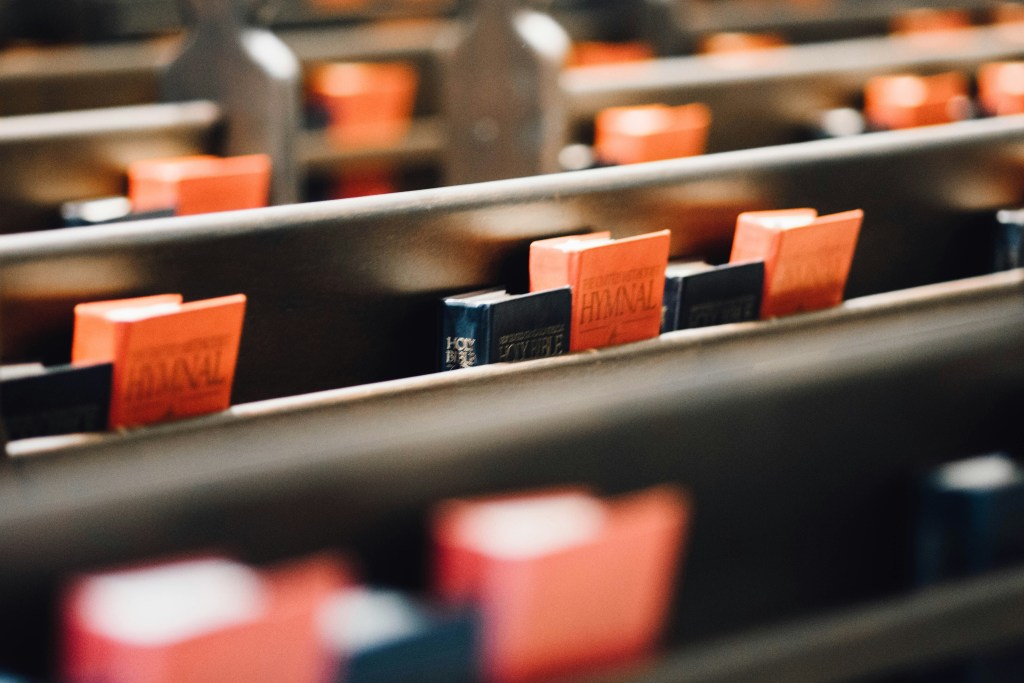
She accepted my whispered answer, that it wasn’t my turn to be “up there,” and the night went on. During Communion distribution, she had one more thing to say to me, as she paged through the heavy hymnal.

“I like this book,” she announced. “And this is my church.”

There she was in a community of people who astound me each week. Parents and grandparents who have decided that passing along the Christian faith is worth the work of getting a young family to church, which can be a great deal of work. Many of these parents wear their fatigue on their faces, their time at church a brief intermission from running between kids’ activities.

Because my worship neighbor’s family almost never misses worship, this little girl may not be proficient at whispering, but she is wise enough to know St. John is her church.

The adventure book would capture other moments: grandparents teaching grandkids how to hold their hands for Communion; single parents who visit with their kiddos over supper with no cell phone in sight; a cook who lets nothing get in the way of her dedication to the ministry of the Wednesday night meal; kids who woke up that morning and announced to their moms that they can’t wait to eat at church; ordinary people who extraordinarily teach, mentor, sing, wash tables, bring dessert…

We do none of this perfectly. Perfect is not the goal, not the requirement, indeed not even a helpful aspiration. Perfect is the love of God, who also does not live “up there,” but here, among us, now and always.

Photo by CHUTTERSNAP on Unsplash

Pray to the Lord on its Behalf

At this moment (along with many other moments) one of my neighbor kiddos is swinging in her backyard. She spends hours swinging – up and down, again and again. And again.

It has to be peaceful for her, which is ironic because it is the squeakiest, most annoying-sounding swing in the entire universe! It’s enough to drive a neighbor into insanity. Don’t believe me? Play this soundtrack in your head: squeak, squeak, squeak, eighty-five thousand more times! Perhaps tonight I can sneak over with some WD-40, like a thief in the night to steal the squeak.

And yet, the squeaking swing and the person on it are part of my neighborhood and part of my community. They both belong, despite the irritating squeak. My neighbor loves to swing and I love my neighbor (so do you if you do what Jesus says) and so all manner of things shall be well.

Neighborhoods and communities include squeaky sounds and squeaky voices. Bring people together, whether there are two or two hundred or two million and it quickly becomes a challenge to be next-door neighbors who belong to the same community.

We might forget that we belong to the same community. We might stick with our own tribe of people, live life through a Facebook group, or imagine that the community and the world were better years ago.

Associating only with people who are like us, communicating heavily through a screen, or betting on nostalgia are guaranteed ways to hinder community-building.

The people of God who had been exiled to Babylon were not interested in their new community. (Jeremiah 29) When they preferred to stick with their own people and recall their days back at home in Jerusalem, God gave this instruction:

"But seek the welfare of the city where I have sent you into exile, and pray to the Lord on its behalf, for in its welfare you will find your welfare." (Jeremiah 29:7)

God breaks the news that this is their community, even with its squeaky swings and voices.

When we pray to the Lord on the community’s behalf and work toward the well-being of the community, we work toward our own well-being.

This can only mean that whenever we neglect to work toward the well-being of the community, we neglect our own well-being. When your neighborhood suffers, so do you. When the community is not well, nor are you, so connected are neighbors in a neighborhood even if we do not know/speak/or appear to care for one another.

Daily, the Spirit issues invitations for you to be a conductor of well-being in your neighborhood.

  • Meet a next-door neighbor you haven’t yet met. Chocolate chip cookies are an excellent ice breaker.
  • Go somewhere in your community you’ve avoided because it might feel uncomfortable. Talk to someone who isn’t like you to see your community from a different angle.
  • And that Facebook group – Lord help us all. What might you do to work toward community well-being in the toxic Facebook groups? I tend to avoid it, but fortunately not all of you do. Some of you with great courage speak truth into lies.

Pray to the Lord on its behalf, God instructed God’s people. May our prayers lead us to actions that bring healing, presence that brings peace, and squeaky, persisting sounds of mercy. Again. And again.

Photo by Kaleb Kendall on Unsplash

Berry Season Forever Prayer

Dear Lord,

Please could it be berry season forever? Could all lands be lands of perpetual strawberry and blueberry harvest? I wouldn’t mind. I’d trade it for root vegetable season any day of the week! Potatoes and parsnips are no fun in yogurt parfaits.

This world is not as it should be. Berry season is temporary, much to my dismay.

On the list of complaints you will hear today, this is on the low end. Better that you tend to war refugees, among them thousands of Ukrainian children snatched up by the Russian army, an injustice that should get all our hearts racing. Could you, Lord, deal with corrupt governments, the production of opioids, and the disproportionate number of foster kids to foster parents? Your to-do list is long, I get it. My list is mostly laundry.

One human response to your long to-do list is fear, as though the world only recently became broken and the way through is to be afraid for the future, afraid of our neighbor, afraid of losing assets, afraid you’ve jumped ship and found another universe you like better.

Another response requires the long view, a look at your creation that takes the viewer back to the beginning. This response is more work, thus less desirable. We’re human, you made us, you get it. The long view reveals a season and a time for all things: a time for sweet berry harvests and another for hearty root vegetables; a season for peace but not for everyone, everywhere at the same time; a season for long days, another for long nights.

Like us, you long for the world to be as it should, to match your original dream. Out of love, you create scientists to contend with disease. You raise up an agency to fight for the safety of children and another to set up refugee camps. You call prophets and poets to speak truth. Again, your to-do list is lengthy and I see only in part, as Paul writes.

For today, I will enjoy the berry season. I will miss it when the days grow shorter. Then, the sun will set earlier and I will go to bed at a decent time and so will the rest of us, except for the teenagers. Lord, why did you make them so weird?

Thank you for berries, Lord, and all the ways you add sweetness to this life. Amen.

Photo by Will on Unsplash

Faith and Online Shopping

Over the weekend, with a gallon of paint and some help from Amazon, I updated one of my kiddos’ bedrooms. It had been a while. A bright orange wall is cool when you’re five, but ten years later it’s just obnoxious.

I had so much fun! I gave this kiddo four color options, washed an absurd amount of laundry in order to actually get to each wall, and listened to the Twins win while feeling quite victorious myself.

Bedroom updates are a quick click away with two-day-ish delivery in these parts of the world. And quick is ideal. We are busy people, shuffling from one busy day to the next. Who has time to go into a store and touch the fabric and look closely at the colors? Who has time to read a care tag to see where the item was made and look into whether the human beings making the item were treated fairly? Why bother when Amazon is so quick?

I questioned my own Amazon usage while listening to a Tsh Oxenreider podcast episode called “Making Things.” She makes a great argument for the importance of creating rather than going into autopilot and buying something new, even though it’s faster.

She also said something that was common practice perhaps before online shopping: When something breaks, try to fix it instead of immediately replacing it. I remembered this when the end of my old, small Pampered Chef spatula kept sliding off yesterday. “I’ll buy a new one,” I said to Marcus. “Or you could just glue it,” he suggested. He hadn’t even listened to the podcast! Anointed with super glue, the broken spatula has been made whole again, which required less time than scrolling and clicking.

The book “Being Consumed: Economics and Christian Desire” also has me reflecting on my online shopping practices. Quick clicks often leave no time to consider whose hands did the work of creating. Were those hands treated well? Were they hands that belong to a child? What was the cost of my quick (often cheap) click?

I appreciate the efficiency of online shopping, as well as the variety. I do not want to live without it.

This would take time, but what if shopping also became a way to practice your faith?

  • Pray for the creators of what you wear and use.
  • Dig deeper for more ethical or fair trade options.

These ideas require slowing down, an un-American suggestion. And these ideas might limit your options, also un-American. However, you might remember there is a human being on the other end of each and every thing you consume, and God has an opinion about that.

Before I rushed ahead and ordered cool wall hangings for my kid’s room, I realized I was carelessly clicking. Chances are I could make something cheaper, although probably not as cool. I would just need to slow down and think about it first, which I am.

Photo by Firmbee.com on Unsplash

What is Saving Your Life Now?

Barbara Brown Taylor shared this question in her book, “An Altar in the World.” A priest asked her to speak at his church in Alabama. “What do you want me to talk about?” Taylor asked him.

“Come tell us what is saving your life now,” he answered.

His answer was freeing for her. Her assignment was not to pinpoint a message that would be helpful for everyone, which is impossible. Instead, she could articulate how she understood her life at that time.

I once heard an author recall a conversation she had with Sylvia Boorstein, a more seasoned writer. She explained to Boorstein how she felt inadequate as a writer. She was younger and so many writers had more experience, both in life and as writers. Who was she to put words on paper?

Boorstein’s response sticks with me. She advised the new author to write what she knew so far.

Wonder today: “What is saving your life now?” Or, “What do you know so far?”

What might you learn if you slow down enough to stir these questions around in your heart and your mind?

  • What is keeping you going?
  • How does Jesus come alongside you these days?
  • What have you learned so far in your life?

When you reflect on these wonderings, you may be surprised at all that you know! Articulating what you already know offers you a road map for everyday living. Knowing what is saving your life now will help you decide what to do next and what to avoid. Recalling what you know so far will keep you from relearning the same annoying life lessons. Self-reflection keeps you from retaking the same tests over and over again.

But the reflection itself takes time. If you are “too busy” for self-reflection, your own wisdom is left behind. Perhaps you could take 20 minutes to journal your thoughts. Or find one person who will listen to you reflect aloud.

I’ll do the homework first.

  1. Parenting is exhausting. Parenting littles is physically tiring. Parenting olders is mentally tiring, but it’s essential that they know how much you love them even when they do dumb things. I’ve learned that hanging around is key. Be in the kitchen when they’re in the kitchen (which is often). Be in the room without being annoying. (This is hard for me because I like to ask questions.) Don’t ask too many questions.
  2. Yesterday I listened to a podcast that unpacked the importance of relationships. What I heard was how challenging marriage becomes when we expect our spouse to be our primarily emotional and intellectual connection. That one person cannot meet all of our human needs. I now understand, 46 years into life, how essential a friendship can be. Friendship, I learned in this podcast, is an indicator of longevity. And, healthy friendship encourages a healthy marriage because it helps us recognize our spouse is not responsible for meeting all of our needs for connection.

Right now, I know at least two things. And that is enough for now.

Photo by Milan Popovic on Unsplash

Let My Prayer Rise Up

“Let my prayer be set forth as incense before thee; the lifting up of my hands as the evening sacrifice.”

Psalm 141:2 (English Revised Version)

It. Is. So. Cold outside!!!

I say this as a person who gets to experience the cold by looking out the window. For the most part, I am safely tucked in a house where the furnace works properly, and I have an excuse to wear pajamas and drink hot beverages all day!

Yesterday was Sunday, which did require non-pajama pants. I wondered out loud at the start of the 8:00 am service, “What are we doing here?” Those of us in the pews had gone in and out of -30 degree weather. “This sermon better be good,” I thought to myself as I prepared to preach. Surely I was not the only one.

This day dedicated to Martin Luther King, Jr. is wonderfully a no-school-for-students day at my kids’ school. Staff had to go out in the cold, but buses did not. No one trudged to a bus stop, no one sat behind the wheel opening and closing a door while trying not to run behind schedule. No crosswalk supervisor had to bundle up and keep traffic moving.

The cold is an equalizer. We are, each of us, vulnerable to its fearsome bite. Creatures of every kind need prayers of mercy in weather like this.

As I witness the exhaust emerge from the furnace pipe of our house, I am reminded to pray. Thank you, Lord, for the luxury of indoor heat. For the protection of insulation hiding within the walls. For hot coffee in the cup keeping my hands blessedly warm.

It is often the case that looking around the interior of our own lives leads to prayers of gratitude. Faith begins with a word of thanks. Thanking God for heat and all manner of daily bread. Thanking God for faith in a Savior whose death and resurrection checked “Get to Heaven” off my to-do list.

Gratitude, however, is not the intent. Living a grateful life may be popular, #blessed, but love for the neighbor is Jesus’ intent. How is your impoverished neighbor in this cold weather? How are those working in emergency management and human services in this cold weather?

Let those prayers rise up like incense.

Photo by Julian Hochgesang on Unsplash

What Your Laundry is Telling You

Your laundry has something to tell you. And no, it has nothing to do with your favorite brand of detergent.

In 2014, Marie Kondo wrote “The Life-Changing Magic of Tidying Up.” That’s when I learned to fold clothes. Her method is truly magical and involves setting each article of clothing from socks to sweatshirts upright in drawers. Instead of laying clothing flat, allowing only the item on top to be seen, Kondo’s method enables all the clothing equal opportunity.

Her method is partly informed by her Japanese religion, Shintoism. In the Shinto religion, every physical item contains the sacred. As Kondo folds pajamas in the morning, for example, she thanks the pajamas for a good night’s rest, acknowledging the sacred woven into the fabric.

In the Christian faith, pajamas are pajamas, although a good night’s sleep is certainly sacred! And yet, Kondo’s practice might inspire us. Your laundry can tell you how to pray for your neighbor.

  • When I fold my pajamas (the Kondo way of course!), I thank God for warmth and rest, for a safe place to lay my head, for the luxury of shelter. I pray for my neighbors who slept outside without the protection of a roof and the extravagance of a pillow and clean sheets.
  • Folding towels reminds me to pray for my neighbor far away who will never experience a hot, soapy shower; women who would do anything to bathe their babies if only clean water was readily available.

You get the idea. All around you the Spirit is stirring up prayer cues. Listen to your laundry. You will get to know your neighbor, the one whom Jesus loves so much.

Photo by Sarah Brown on Unsplash

The Story of the Christmas Cards

What do you do with Christmas cards after you pull them out of their cozy envelopes? Do you lay them in a basket on your table? Hang them up?

Early in our marriage, opening Christmas cards addressed to Mr. and Mrs. felt so very grown-up! The first couple of years, I kept each card in a photo album. Then I stopped. What would I do with all those albums?! Instead, I set the cards in a basket and then stored them away after Christmas, like time capsules.

These days, we hang the cards on a kitchen wall to savor. Later, they will enter the world of the recycling bin, but for now our friends and family hang out with us through Advent from the wall, their photos a collection of real-life stories intertwined with our own.

Christmas cards tell a story. The real story of life. The photos insist that amid the despair of real life, it is possible to lock eyes with a camera. It is possible, despite the real hardships of our lives, to appear in a photo as evidence of how life can go on. Through miscarriage and divorce, cancer and job loss, deep grief and fierce betrayal, one day stubbornly leads into the next. There is one more day, and then another.

The story of the Christmas cards is one of hope. We can put on our best clothes and smile at the camera, but the real hope comes in the mess of a manger birth. The real hope is the child who would not avoid the real hardships of life, but live them, one day stubbornly leading to the next.

Christmas cards can lure a person into believing that life can look perfect; we can all have our tidy lives. But there are no tidy lives. Every relationship is hard at times. Your relationship with your own self can be trying! Each and every person is touched by the messiness of life.

The story of Christmas is this: Immanuel (God-with-us) in the mess, in the hardship, in the despair – hope evident in the Christmas cards on your wall, in a basket, but I hope not in an album unless you have tons of space!

Photo by Annie Spratt on Unsplash