In the Weeds of the Facebook Ranting Groups

It wasn’t long ago that everyone read the daily newspaper. The inky pages were dropped at your door in the morning so when you arrived at work you and your coworkers knew the same information. The Minot Daily News informed my small town day after day.

Early in America’s lifetime, there were several newspapers. Based on your political preference, you could choose to read the conservative, moderate or liberal bend of the news. These days, we do much the same thing on social media.

What’s new, however, is the way social media has made people into sources of news. This wasn’t the intent of the internet, but it happened anyway. YouTube, for example, was first motivated to share media, but it was surprised when so many people became novice creators of content. Suddenly, any ordinary person can become an expert on make-up, home repairs, relationships, or politics.

I mentioned yesterday that I’ve wandered carefully into the weeds of social media Rantville, trying to better understand my own community and its values. My heart beats extra fast at the heartless comments in one of our community’s ranting Facebook groups.

Last night I visited with one of the people who speaks truth into the untruths of this particular site. He reminded me that Facebook does have standards that enable the rest of us to report comments that are slanderous. It is imperative that we report comments that harass leaders or claim all elections are rigged. (Or “rigid” if you get that joke.)

I would prefer never to enter the muddy mess of immaturity that is Rantville. However, I also know the 8th commandment holds me accountable to “fear and love God so that we do not betray, slander or lie about our neighbor, but defend him, speak well of him, and explain his actions in the kindest way.” (Luther’s Small Catechism)

What would happen if we took turns braving the heartless social media groups to uphold the 8th commandment? I say take turns because this is tiresome work. But what if we showed up with integrity and mercy to carry out our baptismal promise: “to care for others and the world God made, and work for justice and peace”.

I absolutely loved the interview on Kate Bowler’s podcast with David Brooks, who is one of my favorite authors. He pointed out how each and every person simply needs to be known. I have a hunch the Facebook haters feel overlooked, as though their concerns have gone unheard. I do not appreciate slander, but I would like to look into their eyes and tell them they matter. Out of faithfulness to the 8th commandment, I might even assume their expression is a concern for our community. Maybe.

Community, Peter Block explains, is not a problem to be solved but a way in which we are citizens together. Much like we can’t pick our family members, we cannot pick the people who are citizens with us. However, we can share our faith by showing up, even in the weeds, to invite others to be citizens instead of ranters with us.

Credit: Photo by Jonny Caspari on Unsplash

Fear, Community and the Church’s Voice

Recently at a conference, my colleague shared her experience moving to a new community. As a pastor, she knew her community well – not only the people, but practical things like the clinic phone number, her dentist, the way around the grocery store. When she moved, she explained, she felt like she knew nothing. Nothing at all! Well, she went on, she did know things. But what she knew no longer applied.

Communities are unique. Like families, communities have a dynamic. The size of the community is irrelevant. Small towns or large towns can be connected or disconnected. Urban areas or rural can be progressive or resistant to progress. Medium-sized cities or big cities can be fun and exciting or dull. I’ve lived in a very small town, a big city, a really big city, a suburb and a large town/small city, where I’ve lived now for nearly 17 years.

Yesterday, my city approved a bond to renovate and expand the public high school (particularly to replace the 1960’s original boiler which has broken down and requires parts that are now obsolete) and enhance security in the city’s public elementary schools. Perhaps because my role with a Congregation Council is to steward an old property for generations to come, I am confused why this was a difficult question in our community. Would you replace the boiler in your own home if the people who built the boiler explained they can no longer repair it?

I’ve reflected on the uniqueness of my community, which is impacted by the not-so-unique toxic presence of fear. There was fear that passing a bond would raise property taxes. Maybe there was fear of admitting that our community has grown and is projected to keep growing. Growth means change and change tends to make us fearful. Was there fear that city leaders don’t understand financial struggles experienced by some in our community – do those individuals fear they are invisible?

A common phrase in the Bible is “Do not fear.” Spoken by angels to surprised and fearful recipients of God’s important message, spoken by Jesus to the disciples: “Do not let your hearts be troubled and do not let them be afraid.” (John 14:27c) Jesus did not say this to one disciple, but to the community of disciples. If the community became fearful, it would break apart. Fear sends us in different directions and brings out our worst. Facebook rants and Thanksgiving dinner arguments generally stem from fear, when we have let our hearts be troubled and afraid.

Gil Rendl is a leader in the Methodist denomination whose latest book calls the church to attention. How might the whole church find its voice in this time of toxic fear and vulnerable communities? What, Church, do you have to say to a people who are being sent in different directions by fear? My colleague reflected upon what she knew, that it no longer applied to her new community. But the church has been here before. We’ve struggled through cultural divides over the centuries. We have heard Jesus caution the community not to be afraid. What we know applies to this moment, when the voice of fear bemoans the problems of a community without calling us to be caring citizens of that community.

I gingerly perused some social media last night, waiting for a word on the vote count. It is encouraging to see the courageous few speak truth into the untruths that enflame social media followers. The gift of truth is that it disarms fear. It invites all of us into a higher level of maturity to rely on facts and not fear. This, of course, is much less exciting. But best for a community, or even, it is the way we are a community built on hopes and dreams, facts and figures, refusing to let fear take the lead.

Photo by Riley Edwards on Unsplash

Watch Out, Neighbor

In “Big Daddy,” the 1999 comedy with Adam Sandler, there is a scene in which Sandler’s 32-year-old character and a five-year-old boy he’s caring for go to a park. In classic 1990’s Sandler fashion, the two roll in laughter when they toss sticks on a path and watch the oncoming rollerbladers trip and fall.

Throughout the movie, Sandler’s character matures. Later, he and the boy go back to that very spot with a sign warning rollerbladers not to trip.

Everyone trips, even those of us too clumsy to put on rollerblades! We all trip and then furtively glance around hoping we’re the only one who noticed. Unless we’re under the age of four, tripping is embarrassing, and tiny band-aids tend not to make it all better.

We would rather not trip, and as Sandler’s matured character portrays, we would rather our neighbor not trip, either. Perhaps this movie line was inspired by the Apostle Paul, minus the rollerblades.

Let us therefore no longer pass judgment on one another, but resolve instead never to put a stumbling block or hindrance in the way of a brother or sister. 

Romans 14:13

Chapter 14 of Romans calls people who follow Jesus to warn others not to trip. Jesus followers are charged with the responsibility to pick up the sticks on the path and keep an eye out for oncoming neighbors who may be vulnerable to a fall.

Paul had tough words for people who had already begun to follow Christ and were getting in the way of new followers’ faith. The already-followers were creating stumbling blocks for those who were new to the Christian faith by instituting old laws related to food and drink. Jesus’ death had changed the importance of those laws. Instead of watching your neighbor trip, Paul offered:

Let us then pursue what makes for peace and for mutual upbringing.

Romans 14:19

In order for the Christian faith to grow, Christians had to stop getting in their own way with judgement and rules that had been overshadowed by Jesus’ death. The cross Christ died on had become the path on which all are welcome. The further down the path we go, the better we need to be at watching out for the followers around us; the more determined we must be to pursue peace and mutual upbringing.

I suspect this is an important reminder in a time when the Christian faith has failed to pick up the stumbling blocks and lovingly clear the path for our neighbor to follow Jesus. As Christians, we are charged with the enormous responsibility of meeting each and every neighbor with mercy and not judgement, to clear the path particularly for the neighbor whom you may not like – perhaps because it is the neighbor whom you do not understand.

Together, let us clear the path for the person who will enter the church for the first time in a long time, or who will log onto worship because it feels safer to join from home. Christians, let us pursue peace and mutually build one another up. Is someone missing from worship? What stumbling blocks have gotten in the way of that person’s faith? You might be the very one to clear the path and invite them back.

Everyone trips. By the love of Jesus Christ through you, everyone has a way back up.

Photo by Alexas_Fotos on Unsplash

Who Are Your People?

Prior to becoming a parent, I pictured our home as a welcoming space for our kids and their friends. I hoped ours would be the home where tweens and teens would hang out, eat snacks, and watch movies. I imagined I would stock the pantry with their favorite foods and every friend could grab their favorite soda and chips and feel at home in our home. The bottomless cookie jar would be a way for me to connect with my kids’ people – the peers who would surely influence my kids in many ways. 

Across the generations, every person needs people. Ideally, your people are a support while at the same time they challenge you to grow. Your people have a deeper understanding of you than others. They know you are a normal human being who falls apart, yet they do not judge you for it. Your people encourage you to think beyond yourself and they forgive you when you fail. 

I imagined encouraging my kids to gather with their people in our home because I know the importance of hanging out with your people. Your people shape who you become. 

One of my favorite definitions of church comes from a guy my age. He felt most at home one Sunday at worship when he looked around at the guys in his Bible Study group, also at worship with their families. These are my people, and this is my church, he explained. 

You, fragile human being, need people to call your own. People to reflect Christ’s mercy and remind you not to hustle through life or push through alone. Having people to call your own takes time. 

You, busy human being, need people to bring out your best. People with whom you can be comfortable in your own skin – the most honest and hopeful version of yourself. 

With a new season of fall and an academic year around the corner, how would you like to hang out with your people? How about… 

  • Create a standing, weekly appointment for morning or evening drinks. 
  • Take turns hosting in your homes each month. The host provides the space and the guests provide all the food. 
  • Go to church together and then donuts. No planning needed. 

It turns out, my kids do not gather often with their people at our house. I hope not, but there is a slim possibility that kids might be scared off by the superintendent and pastor in residence! Which is ironic. Our particular jobs can be lonely at times and my husband and I understand the importance of gathering with our people. We are most grateful for the people whom we call our people.  

I hope that we are modeling for my three favorite kids the importance of hanging out with trusted friends. Your people shape your life and you must be choosey and encourage your kids to do the same. Although my kids’ people are not often at our house, the cookie jar is almost always full, just in case. 

Photo by Gaelle Marcel on Unsplash 

Last Minute Ketchup (and a book recommendation)

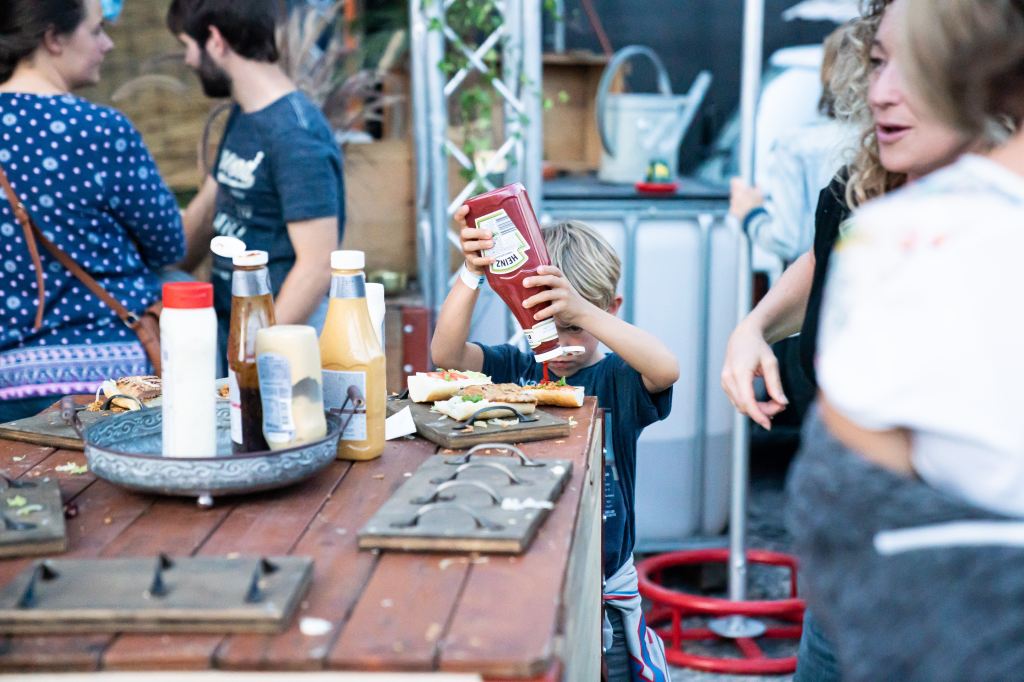
We were moments away from a dinnertime-disaster. Special guests who had accepted a last-minute invitation were soon to arrive. The hot dogs and brats were finishing their sweat session on the grill. And we…had no ketchup! A key ingredient was missing.

After double and triple-checking for a sneaky bottle hiding in the pantry, I texted my lovely neighbor who replied, “I don’t have an unopened bottle but you can have the open bottle in the fridge.” Deal. Neighbor to the rescue.

Neighbors can be the way to avoid disaster, at least the dinner-variety disaster. Neighbors can offer ketchup, a friendly wave, a kind word, and understanding when your teenager plays his music at an un-neighborly volume. Like ketchup makes a hot dog, neighbors make a neighborhood, or something like that.

I’m nearing the end of the book: “Start with Hello (and Other Simple Ways to Live as Neighbors)”, by Shannon Martin. I have really liked the audiobook, even more because her voice sounds exactly like Angela Martin from “The Office.” This would be a fun book to read in a group and form neighborhood experiments from her stories.

Martin (not Angela, but Shannon), provides an honest picture of what happens when we get to know our neighbors. She names the awkward parts, the fear of rejection, the reasons we talk ourselves out of it.

I appreciate how she explains the “toxic independence” of our culture, which would first encourage a quick trip to the store before texting a neighbor for ketchup. In truth, I am dependent upon my neighbors for more than ketchup.

  • I need my neighbors if my kid is home alone and suddenly requires help from an adult.
  • I need my neighbors to let me know if something fishy is going on.
  • I needed my neighbor this endless winter to scrape the mountain of snow off our driveway with his blessed tractor.

Living independently is not neighborly and also not good for hot dogs. Or for the guests who will be eating them. A neighborhood of neighbors needing and caring for one another looks a whole lot like God’s dream for the world.

Photo Credit: dimitri-photography-jMgoWJKnBcw-unsplash

When Does Worship Actually Start?

There is an abundance of confusion in the Christian church concerning worship. The root of the confusion has to do with how we live the rest of our lives. We live much of our lives as consumers. Passively, we consume media, products, services, and entertainment. When we passively receive something, little is expected of us. We simply receive what is offered.

Particular Christian churches thrive by selling entertainment in the form of worship music. It is not uncommon for Christians to gravitate toward congregations with entertaining musicians and impressive lighting. It allows worshippers to sit back and be entertained, just as we have come to expect in most areas of our lives. This kind of worship teaches people to passively receive, or consume what the church has to offer. Little is expected of the consumer.

Eugene Peterson spent many paragraphs pointing out the dangers of creating consumers in worship. There is a danger in passively depending on the product a worship leader can offer for spiritual renewal. The worship music might be excellent, but choosing a church based on what it offers, on what you might consume, will inevitably disappoint.

Instead, worship is a co-creative act. Passive worship is not worship.

At St. John where I serve, by the time worship begins, worship in many ways began months before. Could we wonder whether worship actually begins when the planning and discerning begins? In that case, by the time the worship service starts, the Worship and Music Director has studied at least a couple of resources, carefully chosen music to encourage people into a deeper focus on the Scriptures, and coordinated with a number of members helping lead the service. The preacher has spent hours pouring over the text. For me, sermon prep averages between 8-12 hours.

If we say worship begins when discerning the service begins, then I wonder if the worship service is still being created when people gather and the bell rings, marking the start of the service. It is at this point when those who are gathering shape the service: engaging in music and prayers, welcoming newcomers, noticing who is missing, and expressing some connection to the sermon with your face. (People, preaching to stoic faces is incredibly hard! Please smile or nod to indicate that you are indeed alive.)

This kind of participation in worship demands something of those who gather. Worship, then, is not a one-person or one-band “experience”. Worship is a communal expression of our faith in Jesus Christ and our yearning for deeper faith. It is not something we rate, like an Amazon purchase, nor is worship something we complain about when it doesn’t “meet our needs.”

Worship is not meant to meet your needs. That is Christ’s job. In worship, the Holy Spirit invites you not to sit back, but to dig in. To open your heart and let the Spirit do its work in you. There is too much at stake to sit back even for a single worship service.

If you become a worship consumer, what does that mean for your neighbor who is hungry, addicted, tired, imprisoned, or depressed? Your neighbor needs the Spirit to deepen your faith as you worship in order to share the deep love of Christ with your life.

Photo by Eliecer Gallegos on Unsplash

Our Kids

Imagine you are a spectator at a baseball or softball game in which you really want to watch the third baseman who is your niece/nephew/neighbor/grandkid/kid. Do you mostly cheer for the entire team or your favorite player?

Let’s say you attend a dance competition because you happen to be the chauffer of one of the dancers. In the three short minutes of the dance, do you watch the entire team or your favorite dancer?

Yes, I was my daughter’s chauffer over the weekend. If you have watched a group performance like dance, then you know it is slightly overwhelming to decide where to land your eyes. The whole performance goes by so quickly. Each movement has been thoughtfully choreographed by coaches and repeatedly practiced by each dancer. There is so much hard work to appreciate in any competition, including dance.

I want to watch my own hard-working kiddo kick, but if I focus only on her, I miss the movement of the entire team. I miss what a wonder it is when a team moves together. Watching a dance requires a spectator to appreciate the favorite dancer while at the same time zooming out to appreciate the team she is part of.

Watching my son play baseball over the years, the fans who cheer only for their own kid or grandkid slightly annoy me. Sure, each individual kid deserves a good shout out and encouragement. But that one kid is part of something larger. It is the something larger that is the point of the gathering. Not the individual, but the team.

My mom is a great cheerleader for the entire team. Each summer, she tries to memorize the names of all the baseball players and cheers for each one. She loves encouraging not only one kid but all the kids, including but not limited to her favorite, the right-fielder. Perhaps I’ve learned from her. In her cheering, my mom reminds kids they are part of something larger.

It’s been many years since I’ve been a kid, that’s for sure. My hunch is that is hard enough to be a kid competitor without a well-intentioned family fan cheering exclusively for her or him. This may be a stretch, but cheering for a team asks the adults to see all the kids as our kids. Spectating is a moment set apart when all our kids are encouraged, congratulated and forgiven, as needed.

And then maybe, maybe we might continue to practice encouragement, congratulations and forgiveness for all kids, even when no one is keeping score.

Photo by Kenny Eliason on Unsplash

The Warm Embrace of 2 Words

On Sunday evening I began to open thank you cards. Each day, a few at time until my eyes become too teary to read the blurred words. Today I managed a bigger stack, although I have no desire to rush through them. Like my savoring of Louise Penny’s Inspector Gamache series, there is far more reason to slow down than hurry up!

In January, I picked up a weekly habit I’d set aside for a year, writing 4-5 thank you notes on Tuesday mornings. Calling/texting or emailing each member of St. John on their birthdays replaced this practice in 2022. This year, it’s back to the routine I learned from Chick Lane. Tuesday thank you’s recognize how members of St. John live out our mission of Living in Service to Christ. The child who smiles at someone new at worship, the person who shares an offering of music or advocates for justice in a public way set the mission in motion. Deacons and pastors often witness faith-filled moments and I find it so fun to point them out.

Thank you are words that offer a warm embrace, a friendly bear hug. Perhaps the Spirit draws us closer together when we recognize human generosity. Amid the busy landscape of people’s lives, these two words given or received slow us down enough to notice how much we all need each other.

I’m not sure how other industries recognize 15 years of service. But these cards are by far the greatest gift of all! Thank you.

Photo by Helena Lopes: https://www.pexels.com/photo/four-person-standing-on-cliff-in-front-of-sun-697243/

Logs, Specks and Blame Validation

We all know them: Christians who bubble over with judgement, who hold people to impossible standards, whose words of criticism set a bushel basket over the gleam of Christ’s mercy. Not only do we know them, we are them.

“You hypocrite, first take the log out of your own eye, and then you will see clearly to take the speck out of your neighbor’s eye.”

Matthew 7:5

Ugh! It might be the disturbing image of a log lodged in a person’s eye that makes this verse unforgettable. How careless must a person be to end up with log in the eye? The logistics baffle me.

Sure, Jesus is being hyperbolic. Stretching the illustration to ridiculous proportions, he wants you to realize that at the very moment you are judging someone, you are ignoring the many reasons you could be judged.

I know, I don’t like it either!

Today I learned a new term: “blame validation”. It means that first we find someone to blame and then we create reasons to justify it. We live out our toddler years again and again when we point blame and judgement far away from our own selves.

  • The country’s deficit dilemma? It’s those politicians on the other side.
  • The murder of Tyre Nichols? It was ___ fault. Not my problem.
  • My own home state is facing extreme legislation related to gun laws and abortion. Blame validation fills the space between each line of the bills.
  • The toaster waffles are gone? It’s my brother’s fault.

While it may appear to make our lives easier to point blame and judgement, it actually makes our lives more complicated. Judgement is corrosive to our hearts. Where compassion is needed, we paste over the corrosion with self-righteousness. Practicing blame validation, we continue to come up with reasons to justify the blame. This is particularly dangerous if we hang around people who agree with us.

This is always a good question for self-reflection. Who do I visit who does not agree with me politically? Visiting with people who are willingly to challenge you in a respectful way will always make you wiser. They will help you see the log you somehow got stuck in your eye. If you are courageous enough to keep the conversation going, you will then help them see the speck in their own eye. The following week, the roles will be reversed: you with the speck and your conversation companion with the log.

In Matthew, chapter seven, it helps to keep reading. Jesus follows up the log and speck illustration with instructions for prayer.

“Ask, and it will be given you; search, and you will find; knock; and the door will be opened for you.”

Matthew 7:7

And a few verses later, the “golden rule”.

“In everything do to others as you would have them do to you; for this is the law and the prophets.”

Matthew 7:12

Jesus moved from warning against judgement, to instructions to pray persistently, to the ancient law to love your neighbor as yourself. We may want to rephrase that verse to say, “judge your neighbor as yourself,” but that would put us out of bounds. As much as we feel drawn to the judge’s seat, we do not belong there. Ever.

Notice yourself today when you slip into blame validation. Then check your eye for a log.

Photo by Atlas Kadrów on Unsplash

When Your Friend Hands You a Tissue

When your friend hands you a tissue, you may want to wonder why.

When you take the tissue, even though your nose is not running, you follow your friend to meet the surprise that is your parents who have flown from sunny Arizona to frigid North Dakota.

When you hug your parents and take your tissue and your seat, you are even more surprised when your community has conspired to recognize a 15-year milestone as their pastor.

When you have been people’s pastor for 15 years, you have not stopped to look all the way back at the privilege of these relationships.

When you do look back, you are thankful your friend gave you a tissue.

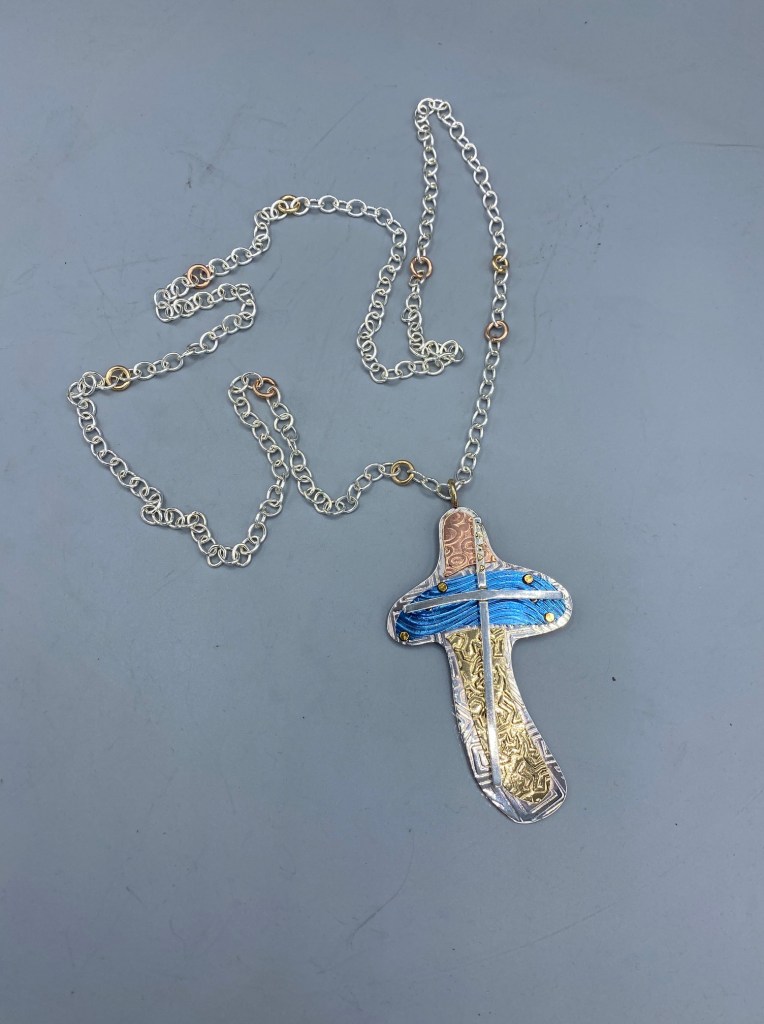
  • Thank you, Audrey, for contacting my parents, for working with an artist to design a stunning pectoral cross, and for the tissue.
  • Thank you, Council Member and especially Jean.
  • Thank you, sneaky staff members for creating an underground card receptacle. I had no idea you were so sneaky! I am very afraid.
  • Thank you, parents, for trading your lighter jackets for your winter jackets for a few days.
  • Thank you, St. John community. I am so humbled as I read your gracious cards. I open only a few at a time, until my eyes are too blurry to read the words.