A Time for Every Matter…But Not Every Matter Matters

If you were to ask me what a pastor does, I would say we tend to the matters named in Ecclesiastes, chapter three: birth and death, planting and harvesting, weeping and laughing, tearing (broken relationships) and sewing (mending relationships), love and hate, war and peace.

I was 26 when I was ordained at Holy Nativity Lutheran Church in New Hope, Minnesota, a most welcoming and gracious first call congregation. With them, I tended to the chapter three matters: walked with the grieving, celebrated the new births, prayed with those tearing or mending relationships, and prayed for peace in this forever war-torn world.

Twenty-six!!!??!!! Good Lord, who was I to walk with people through these matters that matter so much in our lives? “You are a pastor? You look like a teenager.” I did! Who was I to help people comprehend life matters?

The privilege of seeing all at once so many matters that mattered shaped my understanding of what matters. Not every matter matters. Some do, some do not.

My spiritual director might point out here that I am speaking of letting go. What matters in life is what we keep and what we throw away (Ecclesiastes 3:6b). We tend to keep matters that do not matter.

What matter matters so much to you when perhaps you should let it go?

  • It is a physical matters matter? Are you holding onto possessions that get in your way? Or spending money on things that serve little purpose in your life? Are you keeping house more than you are keeping relationships with the people who live with you or near you?
  • Is it a relationship matter? Does an old grudge matter so much that it gets in the way of your other relationships? Or are you so swept up in work matters that you go home without truly connecting with another human being?
  • Is it a faith matter? Imagine your life as though you could trust God more than anything or anyone else. Imagine your life as though the things that don’t really matter, really do not matter! This gives you margin to tend to the matters that do matter.

Perhaps there are few things that do matter, once we sift through what doesn’t matter.

  • What we have does not matter as much. What matters is that we take care of what we do have.
  • Where we live does not matter. What matters is that we live with love for our neighbors.
  • The one to whom you belong matters – the one in whom you can put your trust, who has claimed you as one who matters.

To God, your every matter matters.

Photo by Jorgen Hendriksen on Unsplash

A Cookie Contradiction

My daughter baked these lovely sprinkle cookies. She is a near-master of the Crumbl knock-off recipes, which was the answer to my husband’s question a few months ago: “Why in the world do we have so much flour?”

The cookies are as good as they look…most of the time.

Always the willing taste-tester, she handed me one after it had cooled. At first, I could not describe what I was tasting. It looked sweet, yet the taste did not match. A weird contradiction clung to the roof of my mouth.

“You should try these,” I told her, or warned her, before she took them over to her grandpa for his birthday.

“What do you mean?”

“Just…try one.”

When she did, her face matched my perplexed tastebuds. What was this odd, perhaps even savory flavor competing with the rainbow specks of sweetness?

After some deliberation, we realized the culprit was the cutting board. She had asked if I thought it was okay to set the cookies to cool on the cutting board instead of dragging out the cooling racks, an act of injustice we will never again commit.

I did not consider the onions and garlic that had been chopped up for something, probably soup, just a few days before. Those savory flavors rose up in delight, invading the warm sweetness of the cookies like a sneak-attack, flavor-massacre.

Luckily, setting them back on the baking sheet for an hour or so seemed to undo the disaster. I did appreciate the lesson.

Human beings, like those cookies, are absorbent. Without realizing it, we soak up the sweet or spicy flavor of the spaces in which we gather. We can easily absorb both loving and unloving attitudes toward the world and our neighbor from those with whom we spend our time in-person and online.

“You are what you eat,” is perhaps a simpler way to say all of this. Hang out with angry people and we absorb that anger. Hang out with joyful people and we absorb that joy. Hang out with people who are curious, or kind, or bitter, or hateful and we will find ourselves like that cookie: one thing on the outside and another on the inside.

The slipperiest part of being human is that you think you can change another person, but you cannot. You can try to make the angry person less angry, or the bitter person less bitter, however, without even noticing, those exact flavors have a way of sneaking in from the cutting board and shaping who you are and how you see the world and your neighbor.

What flavors would you like to absorb as you live your life with people?

For years, I have prayed with this New Zealand Prayer Book, a prayer book my internship supervisor first introduced. The ELCA lacks in prayer books, unlike our friends in Christ who are Roman Catholic or Episcopalian, which is the source of this prayer book. A few months ago, I tried to be more disciplined in reading the morning and evening prayers daily. As these things go for me, most days I remembered and other days I did not. I am no champion of perfection.

I can tell you that on the days I start and end with these prayers, it feels as though the day fully begins and ends with the Lord. Dare I say it is absorbing! The morning and evening prayers of each day are tied together and somehow, each prayer has spoken directly to my life, as the Holy Spirit has a habit of doing.

Here are two wonderings for you to absorb:

  • Consider the people with whom you spend your time at home, work, and wherever you go for fun. What might you be absorbing? What is the same or different in each setting?
  • What are you absorbing in the time you spend online? Does it make life sweeter when you spend time wherever you do online? Or would you like to reconsider what you prefer to absorb when you travel around the internet?

Imaginary Enemies

I hope I wasn’t the only one who grew up with imaginary friends. I also had real live friends, but my two imaginary friends were the most reliable. Always there when I needed them!

Since then, both of them have moved on, or I have moved on. Perhaps both.

There comes a time when the imaginary people must move on, and we must move on. Definitely both.

Just as there are reliable, imaginary friends, there are reliable, imaginary enemies. People we have pitted against us, even though they may not even exist. Imagined enemies we have learned to hate.

I noticed when our president spoke against imaginary enemies in his eulogy for Charlie Kirk. His words reminded me of Fredrick Backman’s definition of hate in his novel, “Beartown.”

Hate can be a deeply stimulating emotion. The world becomes much easier to understand and much less terrifying if you divide everything and everyone into friends and enemies, we and they, good and evil. The easiest way to unite a group isn’t through love, because love is hard. It makes demands. Hate is simple.

At about minute 24 of the eulogy, the president referred to debates he’d had with Charlie Kirk. According to the president, Kirk did not hate his opponents. That, the president explained, was where they disagreed. “I hate my opponent, and I don’t want what’s best for them,” the president proclaimed to a cheering funeral crowd.

Like any president ever, ours has a long line of opponents, enemies he has made here and there. And yet, I’m not sure all of his enemies are real. I wonder if his love for having an enemy can threaten to create imaginary enemies, enemies that invite people to hate even further.

Hate is so powerfully stimulating, it can baptize a crowd of Christians in an amnesia bath, foregoing a substantial pillar of the Christian faith: love thine enemies (real or imagined), do good to those who hate you, offer the other cheek, and so on.

When there is tension in the air in our society, in your family, or in your work, you are in charge of only one person: You. You cannot change the people around you, especially your enemies, but you can decide how you will move through the tension.

  • How do I want to show up in this anxious time of our country?
  • What emotion do I need to notice in myself, so that it does not get the best of me?
  • Am I watching too much news? (I appreciated Danielle Webster’s words in this episode of The Prairie Beat podcast.)

Blessed are you as you wrestle with your place in this anxious time, for you will be filled with the real live love of the God who came to live among you in a real live body simply to love. Love. Love.

Photo by Gaelle Marcel on Unsplash

The Story of Things

Not long ago, I brought Holy Communion to a man in his assisting living apartment. Prior to settling there, he had moved several times, packing and unpacking boxes in a number of places throughout the years. His last few moves required fewer boxes.

Atop his kitchen cabinets sat a handful of interesting items. They were random and quite old. There had to be a reason he kept these particular things, packing and unpacking them again and again.

“Tell me about these things,” I asked.

He explained what he had kept and why: the first gift he gave to his mother at ten-years old, purchased downtown with his own money; a dish she often used in their kitchen when he was growing up…

I was riveted. That he had managed to hold onto these few special things for so many decades, each with its own story, was touching. Perhaps because I am not a keeper. What stories have I haphazardly left behind in my diligence to minimize?

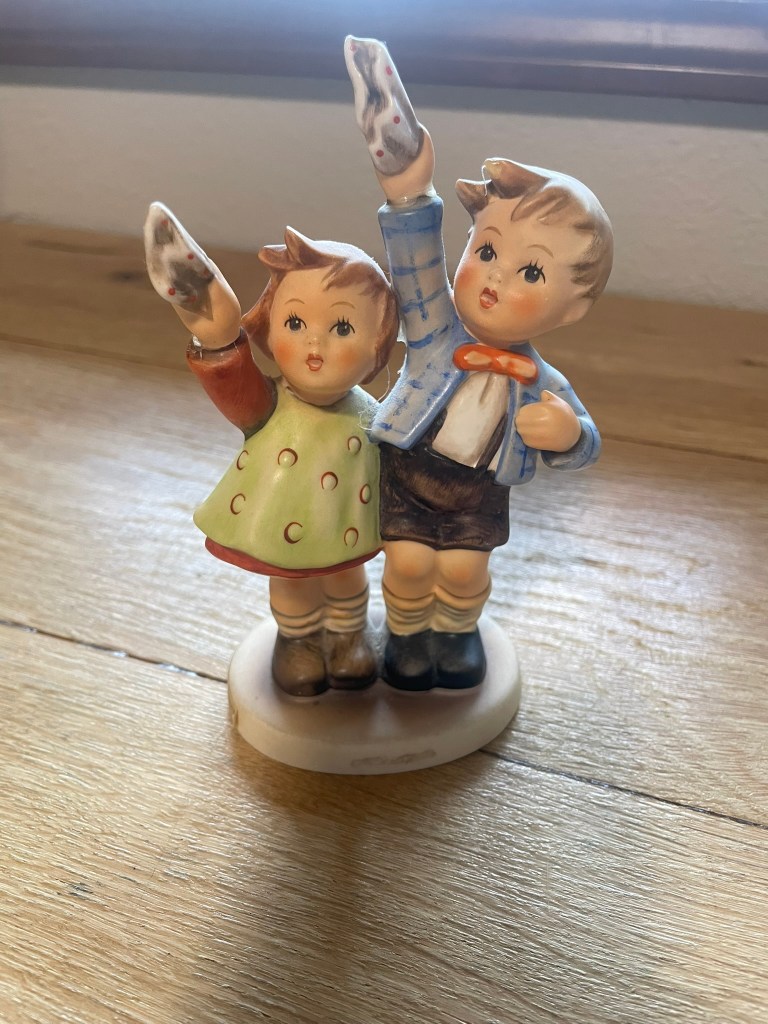
The two kids waving handkerchiefs and forever frozen as Hummels also tell a story. When my mom and I visited my aunt and uncle before they moved from their home to an assisted living apartment, my aunt handed me this story. She had babysat both my older brother and me when we were little. When I went off to kindergarten, she explained, my mom gave her this Hummel as a thank you gift. “Now you get to have it,” my aunt told me.

I promise to keep it.

Later on in that house, my cousins would discover this photo as they did the hard work of deciding what to keep…

and what not to keep! A time to keep and a time to throw away…

Your most special things tell a story that piece together your own story: gifts given and received, mementos, each a landmark in your life, each a reminder of a precious relationship or milestone. Each one evidence of God’s faithfulness to guide you through life.

Back in that man’s assisted living apartment, I shared with him the sacrament and the ancient story of God’s love for him in Jesus Christ. In bread and wine, he tasted the promise that God will keep him forever.

Why Confirmation?

‘Tis the season of fall sign-ups! Parents and guardians of teens and younger are at it again, working out the complex matrix of drop-offs and pick-ups that often stretch from dawn to well past dusk.

In a perfect world, the designated person operating the matrix is entitled to a personal assistant. Coordination of kid schedules can be that complicated! (I can’t remember my password! Did I really miss the deadline? Weeping and gnashing of teeth!)

There is an abundance of pressure to sign kids up for a plethora of activities to “keep them busy” or “help them find their thing” or whatever was suggested in the latest book we read or advice we took.

Some parents and guardians will sign a teenager up for faith formation. In mainline Protestant churches we name this animal Confirmation.

Why add Confirmation to the matrix, usually an extra night of every week throughout the school year? Why Confirmation?!? Here are 3 potential parent/guardian responses to this question:

  1. I had to go to Confirmation, so my kid should have to go to Confirmation, even though I’m not exactly sure the point.
  2. I want the pastors to peel open my kid’s brain and drop some Jesus in there. It can’t hurt.
  3. There was an open spot in the matrix and teenagers need to be busy, busy busy!

Would someone please hit the annoying game show buzzer? These answers are LAME! Even so, I suspect these lame answers are the most common.

Consider this: Practice.

Anyone who has ever formally competed understands that before a performance, practice is required. Skipping out on practice is a recipe for disaster and injury.

Practice teaches our body the proper way to warm up and to move: how to act out that one scene, hit that note, or swing, throw, kick, shoot or hurdle. By the time we arrive at competition, our bodies and minds are likely to know what to do, at least much of the time.

The Christian faith is practice for life.

We practice faith through rituals such as prayer, worship, Bible study, and Confirmation, for example. Memorizing Bible verses (peeling open brains and dropping in a little Jesus) is a poor substitute for practice. Dropping a kid off at worship is a poor substitute for practice. (This annoys me every time.)

Faith is a practice meant to steady your life when it gets rough, as life tends to do. Rituals are a steadying tool.

I pray for Confirmation to be a ritual that steadies a teenager’s life especially when that beloved one feels left out, or like a failure, or hopeless, or angry, which also happen to be storms that frequent an adult’s life. Rituals steady all ages.

Life can be so stormy! Faith can clear away the clouds and make room for the Son to move in.

Faith is not one more thing to keep a teenager busy, it is a practice to keep a teenager steady. Potentially, even a household steady.

Confirmation is practice for the Christian faith. Faith takes practice. So much practice, as well as coaches, like parents and guardians, pastors and mentors, and an entire congregation of people praying cloud-clearing steadiness in the lives of these beloved ones.

Photo by Tom Barrett on Unsplash

A Chasm Has Been Fixed – Great. What’s a Chasm?

There are some strange words in the Bible. Actually, you can find a lot of them. I suppose a collection of books that spans thousands of years will deliver a handful unfamiliar terms.

Among the strange words: chasm.

I dare you to use this word in ordinary conversation today. No, I triple-dog dare you! First, what is this word?

Chasm appears but once in the Bible, referring to a gulf, or a great big separation. In Luke 17:26 it describes the empty space that stands between the rich man and Lazarus (the poor man) in the afterlife.

Can you imagine it?!! A monumental gulf between the rich and the poor? As if.

The rich man likes it not one bit. “Yo, Abraham,” he bellows from the fiery side of the chasm, as though Abraham is the bouncer. “Can you fix this chasm? Get me across?”

“Nope,” comes Abraham’s reply before reminding the rich man how he spent his life on earth ignoring Lazarus, stepping over his suffering body each day. The rich man’s control on earth did not accompany him into the afterlife.

On the news, I have seen this rich man. I have seen him cut programs that will primarily impact the poor and leave him and his ivy league cronies in the safety zone of wealth. I have seen him.

He has sent innocent immigrant families into a dangerously chaotic panic, even though these many (not all) of these families have improved my community with their hard work and dedication. I know this rich man.

The problem, as you well know, goes beyond the chasm between the rich and the poor. The more troublesome chasm in the United States runs between truth and baseless lies, between those who are loyal to President Trump and those who are less impressed with the past two months.

The real problem is not the chasm, but the fact that the chasm exists at all.

What is a chasm? It is the human presumption that “they” are wrong and “we” are right. No matter who is cast as “they” and “we”, the chasm is hugely problematic for the poor.

The gospel writer of Luke consistently points to the injustice of those who are left systemically poor. It is the unique spirit of this particular book. The writer concludes this chapter by insisting that not even a resurrection could fix the chasm that stands between the rich and the poor, which is a dismal forecast, yet more than 2,000 years later, seems correct.

Not even the resurrection of Christ reduced the gulf between the rich man and Lazarus. Not even religious wars or world wars or the invention of the internet. Not the expanse to the west or even into outer space fixed the chasm between those who have enough and those whose children will not survive past the age of one because their water is unclean.

Chasms are stubborn that way. Fed by the fertilizer of fear, the chasm between the rich and the poor, between versions of the truth, between political sides is not a far-away problem, but a here-and-now-problem.

  • How might the way that you speak of “them” and “us” affect the chasm? Who is listening and learning from your rhetoric?
  • Is there a news source you have not explored, a side of the coin you might explore in order to keep the chasm from expanding?
  • Name it. What are you afraid of as you stand on your side of the chasm? What is it about “them” that incites fear in you?

If the Bible teaches us anything, it is that hate and bitterness are not change agents. Only mercy engenders change.

Mercy. There’s a word. That word makes avalanches of appearances in the Bible. It is spoken and acted out repeatedly. Perhaps mercy could make more appearances among us today, beginning in our homes, on our devices, and among our next-door neighbors.

Photo by Jon Tyson on Unsplash

Everything is Fake

Late last night, my daughter and I flew home from a lovely vacation with my mom in New York City. It was so great! The city resembles the kingdom of God, just as Elizabeth Passarella describes it. Every kind of people reside within the five boroughs. Elbow-to-elbow, they share sidewalks, subway trains, and tiny apartments. I squeezed my eyes shut while vehicles squeezed around remarkably tight corners, narrowly missing bikers and pedestrians.

Thousands of religions are represented in the city. In Times Square, we listened to the Muslims chant the mysterious Ramadan prayers. Skull caps and head coverings move through the crowds. Today, my Manhattan friend, Pastor Marsh pointed out, the Christians will be visible with their ashy crosses.

To witness New York City is to see the kingdom of God at work. We are not intended to be a nation of Christians, but a nation of God’s people reflecting God’s limitless glory.

On this Ash Wednesday, I am drawn to a particular story from our trip. We spent much of one day on a bus tour to see some of the major sights that one must see in New York City.

The city that holds every kind of people also holds people with sketchy intentions. We drove by perfectly lined up purses on the sidewalk. Nearby were women with black coats and black bags. Next to them were young men selling AirPods.

“Everything is fake,” our snarky tour guide translated the scene for us. “Those purses,” he explained, “just look closely before buying. The purse might say ‘Couch.’ See the woman with the bag? She will tell you her best handbags are in a building down the street. And who knows what you might buy. Oh, and the box with the AirPods just might be empty.”

He had been a detective once, he explained as he went on to identify a number of other scams we might encounter.

Everything is fake, we remember on Ash Wednesday. The handbags that make us feel as though we have arrived; the purchases that appear to be a good deal when they are no more than an empty box.

Everything is fake. The skincare products that promise to keep us young; the news that convinces us to fear our neighbor; the abundant salary that tricks us into a job we know will leave us miserable.

Everything is fake. The snake in the garden. The voice in our heads that whispers we will never fit in. The machine you work for that never ceases to demand more of you.

Everything is fake. Except for…

the ashy cross someone will draw on your forehead today. This is not fake. It is real. It is as real as the death of Christ for you, as real as God’s promise that you belong to God for all eternity. In fact, the cross is a symbol of the very real promise that no matter how many times you get tricked by the Couch purse or the snake in the garden, you have been claimed forever by the God who remains genuinely faithful.

Photo by Andreas Niendorf on Unsplash

“You do not understand,” said all kids ever, even Jesus, to their parents.

The age of 12 is magical. A handful of my favorite novels are written from the perspective of a person around the age of 12, including Because of Winn-Dixie and The Bartender’s Tale.

Age 12 is a tipping point. At 12, we wobble between life as a kid who plays with toys, and life as a teenager making sense of relationships and greater responsibility. Twelve years in, we begin to see a glimpse of a future independent from our family of origin. We may even look at our beloved parents and guardians who have known us from the very beginning and tell them, “You do not understand!”

That’s what Jesus did, anyway. (Luke 2:41-52) He looked at his parents, the people who were not much older than age 12 when they each met an angel to help them understand the son who was coming, and told them, “You do not understand.” (When I imagine Jesus speaking, he usually takes on an aloof, when-will-you-ever-get-it tone. What does Jesus sound like in your head?)

Mary and Joseph did not understand why their 12-year-old son suddenly disappeared from their family procession home from the Passover. They did not understand his ostensible disobedience, which turned out to be complete obedience to God.

On behalf of all parents ever, we do not always understand. Thank you, Mary and Joseph, for joining us in the humbling work of parenting!

Consider the 12-year-olds you know. You may assume to know them well because you have known them their entire lives. You may have had a front row seat as they learned to walk and talk. Perhaps you even had the privilege of encouraging them along the way.

But hold on here. If Mary and Joseph did not fully understand Jesus, that makes me wonder. Do I assume to know the 12-year-olds better than I do? I was 12 once, but it was quite a while ago and the world was different. Not better or worse, but different. I do not actually know what it’s like to be 12-years-old in 2025.

Is there someone in your life, maybe or maybe not a 12-year-old, whom you would like to get to know, even though you think you know them already? Staying interested in the people close to us may bring us closer together.

Here are some starter questions if you’d like to take that person out for ice cream.

  • What is the longest line you have ever waited in?
  • Would you rather go to the moon or to the South Pole?
  • What is one thing few people know about you?
  • What is something people often get wrong about you?
  • What is one new thing you would like to try this year?

You, beloved human, are profoundly interesting! And so are the people around you. We will never fully understand one another. Not Mary, Joseph, or any of us. And yet you are fully known by the Creator, whose son was so divine, and also so incredibly human.

Photo by Michael Skok on Unsplash

A Trail of Two Words

Two words emerged as a refrain last week when I met via Zoom with my spiritual director. The words wove their way through our prayer and conversation, a pair insistent upon staying together and staying in front of us.

My spiritual director introduced the words, or so I thought. “What a brilliant set of words!” I reflected. The perfect pair for prayer.

Later, I realized he had in fact borrowed the words from me! I found them in my previous blogpost and in my journal. “Wow,” I congratulated myself.

Later still, I noticed the two words in the confession our congregation prayed together on Sunday. The pair of words I thought I had come up with were the brilliant creation of a liturgist.

If I were to follow the trail even further, I would find the words elsewhere. I would find them dripping off the pen of a poet, a theologian, and who knows who else. Probably you.

When my spiritual director and I were in prayer and conversation, we moved through the heaviness of the past month: the weight of goodbyes we said to saints who have gone before us, the long and yet lovely stretch of Christmas worship services.

Prayer may be like this for you, too. Moving along in prayer, you find a side road and without even noticing, you follow the side road away from the main road of your prayers. Suddenly you are sunk in a ditch of worry and regrets.

That’s when my spiritual director said two words that I will keep close by in the year ahead. A pair that is perfect for prayer:

Begin again.

The two words are nothing new. The words are so old, in fact, they are ancient.

Begin again.

The trail of these two words reminds me that the wisdom you need most may not be in front of you but behind you. God may have abundantly scattered quiet wisdom in a long-ago moment of hardship, or in a past season of celebration. The forgotten seeds grow in the Spirit’s time, a sign of new life.

Begin again.

You cannot see far into the year ahead, yet you can hold onto wisdom God has already given you in years behind.

Photo by Judy Beth Morris on Unsplash

The Way

As a seminary student, I remember discussing with classmates how long a pastor should serve a congregation. The lore was that a pastor’s call should conclude around seven years, seven being a number that reflects completion in the Bible.

Growing up, one of my pastors practiced the seven-year model. My Methodist colleagues are often transferred at the seven-year mark. If God created everything and even rested within seven days, seven years as a pastor in the same congregation should do it. Marcus and I entered this life of pastor/teacher expecting to move if not every seven years than at least every so often.

And yet, here I am in the same congregation for 17 years, long past not only one seven-year mark but two. Perhaps this is on my mind because it was 18 years ago, around this time of year, when Marcus and I travelled from our home in the Twin Cities to Dickinson to interview. I interviewed at a congregation that astoundingly had called only two senior pastors within a stretch of 50 years. They had completely rebelled against the unwritten seven-year rule! Who were these people?!?

Any long-term pastor can tell you the gift of a long-term call is that relationships grow deeper, which can serve to further a congregation’s mission to follow Christ. You become more aware of someone’s quiet gifts and someone else’s profound wisdom. You learn who has a genuine desire to learn or to serve in Jesus’ name. You have the privilege of entering into multiple generations of a family’s life and proclaim God’s hope through Christ.

On the flipside, the goodbyes get harder as the relationships grow deeper. You must witness more people join the communion of saints, people you have grown to love as you serve alongside them. It becomes like watching the introduction to a television show. The intro moves you through the years to give you a flashback of all that has happened in the lives of the characters. This way, by the time the episode begins, the characters are more familiar.

Being a pastor for a long time is like that. God brings new staff members to a congregation, yet you are the one who has lived through much of the introduction.

  • You can see the group of people who once gathered for coffee before worship on Sunday mornings. Now, they are no longer living, or no longer able to come to the church building to worship. Their absence is felt each week.
  • You can see that group of people who served in leadership roles. Their wisdom continues to be beneficial, but you have to know who they are.
  • You can hear the sounds of worship that both changed and stayed the same from one generation to the next. You endured some of the trials and tribulations through the changes and the sameness; you felt the impact on the community of faith; you have lost enough sleep over the years to know what is at stake.

How long should a pastor serve a congregation? Like perhaps any question in the universe that relates to relationships, the answer is less important than the question.

The question is not how long, but how now?

This question is not reserved for pastors. How does a pastor, a deacon, a lay person, a young person, an old person, a new person, a seasoned person, serve a congregation now? What difference does it make that God gathered these people at this time for this community of faith, which ever community it might be?

The answer is less important the question, the question is less a question than a prayer.

Lord, you are the way, the truth, and the life. Guide our feet, you who are the way. Instill in us wisdom, you who are the truth. Renew us by your grace, you who are life. Amen.

Photo by Aron Visuals on Unsplash