
Beginnings

Each of the four gospels begin differently. Mark hits the road of Jesus’ ministry running by beginning with his baptism. John begins in the very beginning with the Word that was there when the very first wind blew over the face of the earth. Luke begins with the Christmas story as we hear it each Christmas Eve in churches. And Matthew begins with a tree, a family tree that is.

At first glance, the first chapter of Matthew’s gospel is booooring. It resembles the terrible stretches you encounter if you’ve ever determined to read the Bible from cover to cover. Begat, begat, be-oring. Yet Matthew’s beginning, like all our beginnings, matters. In the long line of the faithful, the fearless, and the forgotten, Matthew draws a line from the beginning to Jesus. He establishes Joseph’s and then Jesus’ credibility as a member of the tribe of Judah. Like a bouncer perched at the door of the world’s most exclusive club, Matthew is letting Jesus in by uncovering the Messiah’s beginning.

Christmas is the story of Jesus’ beginning, which I find so interesting because your feelings around this holiday are profoundly shaped by your own beginnings. The way you celebrated Christmas (or didn’t) as a child shapes how you approach every single December 25th. Did you gather with few or far too many family members? Was it delightful or dreadful? Did you eat ham, turkey, or something nonconforming? How were gifts exchanged? Did you open them on the 24th or 25th or another day? Was church a part of your party? If so, was that delightful or dreadful?

These happen to be rich questions for pre-marriage counseling. They give each partner a glimpse of the other’s beginning. We can piece out expectations, hurts, and joys of each unique family, and conversation is carefully cracked open around the distinct dysfunction of each of our families.

Looking back to my own beginnings, I have fond memories of Christmases with cousins and cookies and my Grandma Florence’s outrageously oversized tree. I grew up in a small town where much of my family resided within three blocks of my house, including my grandparents. This meant we celebrated Jesus’ birth three times each year in under 24 hours: at each grandparent house and our own. There was a consistent and equitable routine to our Christmas celebrations. My husband’s memories are similar and yet different. It took a few years to recognize that the differences in our Christmas beginnings created differing gift-giving expectations. Gifts were a big deal in my family and not so much in his. Food was also a point of discussion. His family ate tiger meat (raw seasoned hamburger) and my family ate lefsa.

Once my husband and I understood the diverse rituals that marked our own beginning Christmases, we could establish some of our own. Remembering our beginnings clarified some of our feelings around this feelings-filled holiday. Christmas is filled with feelings. Like emptying a stocking (a big deal at my house and not so much at my husband’s), admire each feeling as it comes. What do you miss about your beginning Christmases? What are you thankful to shed?

The birth of a Savior, the beginning of Christmas, assures you the beginning matters less than the ending. Your ending is full of feelings of joy and joy alone for families of every level of dysfunction. Yes, even yours.

PRAYER PRACTICE

  • Light a candle. Tell God in writing or out loud a childhood memory that shapes your understanding of this season. Do you need to let it go? Create a new practice? Celebrate the memory? Share it with God, the Word who was in the beginning, who became flesh to write your ending.

The Stories We Tell Ourselves

(Photo by CHUTTERSNAP on Unsplash)

You, Beloved One of God, are a library of stories.

You are a story of courage and loss. A story of hope and despair. A story of dumb things you did when you were young. You are a story of passion, of adventure, and hope.

I wonder, however, what story you tell about yourself. Several times I have encountered research about the difference between the ways men and women tell their own stories. Men often identity success in their stories while women do not. Women, I’m sorry to say, can be poor storytellers. I know that is true of myself. I’ll look back on the day and the headline will sting with words I’d like to take back and things I would do differently. My story is shaped by my own mistakes, fears, and insecurity.

How do you tell your own library of stories? Can you look back on the past few days and see the light of Christ that beamed in you? The way you were the hands of Christ for someone else? The words you spoke that were shaped by your deepest prayers?

Investigate the story you tell about yourself, you who are made in the image of God. Remember God made all kinds of cool things in the creation story, but only when God made human beings did God say, “Wow, that is good. That is very good.”

God did not call you perfect and has never instructed you to be perfect. Instead, you are very good because God has made you very good. All other stories are in the shadow of the story of the God who made you very good and calls you very good.

Might that be the story you tell about yourself today?

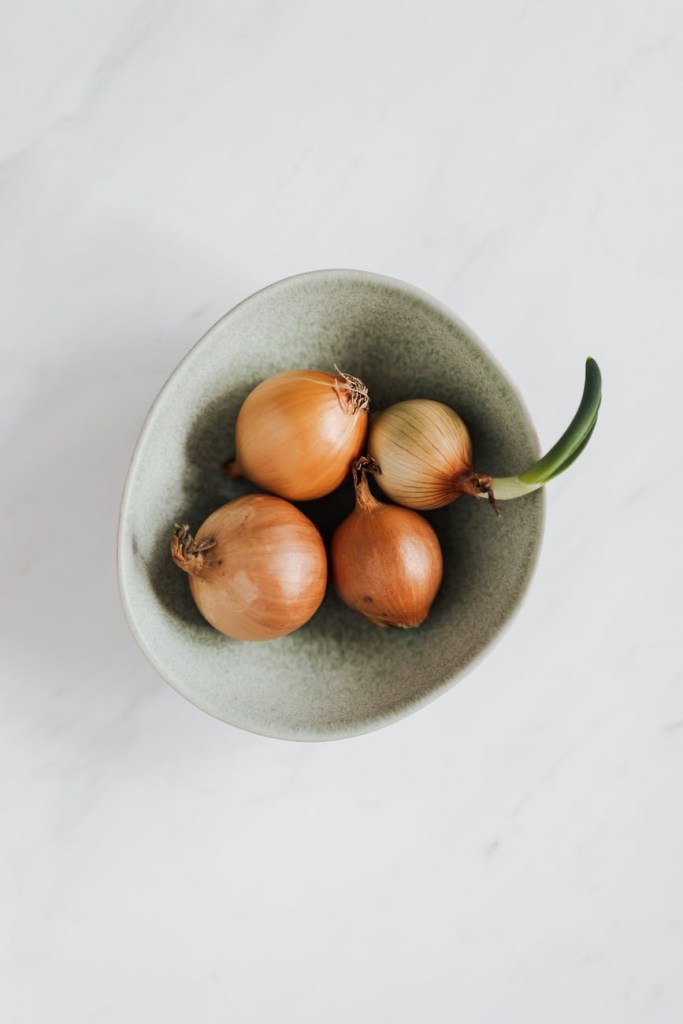
How These Days Are Like an Onion

So how was your day? Really.

Did you jump to conclusions with someone else was talking? I did.

Did you finish someone’s sentence without letting that person finish it? I did.

These days. They are really something. These days are such an onion!

Did you wish it could magically be January 21st? I did!

Did you get short with someone in a conversation? I did.

Stop and consider what is stressing you out right now. Or are you worried about kids going back to school? Is your job extra hard? Are you fretting over summer plans and not knowing what the summer will look like? Are you doom scrolling too much news? Are you worried about a family member consumed by a conspiracy theory?

These days are like an onion with layers and layers. Layers of political angst, layers of work worry, layers of extraordinary family anxiety.

Churches may be worried about budgets, members who may or may not drift back, staff retention, how to preach in this political climate, a future with in-person and online community.

These days. When they seem like too much, that is, when you find yourself wishing this season was a different season, remember these days are like an onion. You and your neighbor are walking around with layers and layers. Peel them back one at a time. Be gentle on yourself and your neighbor.

Onions can be overwhelming. But not if we do the peeling together.

Someone Else Can Unload the Dishwasher, and Other Magic for Today

(Photo by Artem Maltsev on Unsplash)

There are days when being a mom feels like wizardry.

It is slightly magical what a wizard can do in a meager amount of time in the morning. Mom the Wizard notices she can finish a load of laundry and get supper cooking in the crock pot before anyone opens their eyes from beneath their covers.

Not only that, but the Wizard can plow through several work emails, order the groceries, and finish last night’s dishes. Of course, the coffee has been made and a cup or two consumed and the Wizard has also scheduled a few of her kids’ doctor appointments.

Then someone rolls out of bed and the Wizard realizes it’s still only morning! Wow, it is amazing to be a wizard.

But soon, the Wizard’s magic spells become a hindrance. The Wizard’s apprentices expect the Wizard to empty the dishwasher when it isn’t exactly the Wizard’s chore. But the Wizard’s apprentices are left spellbound, so the Wizard begins to open the dishwasher door and dry off the tops of the glasses that never get dry, when she stops.

“Wait,” it occurs to the Wizard. “Someone else can unload the dishwasher.”

The “Hallelujah Chorus” can be heard, just barely, coming from nowhere.

This has the Wizard thinking. “Someone else can probably do most of the laundry. And wash the dishes. And get supper going.”

The Wizard realizes that even with a book of magic spells, raising kids in a global pandemic is intense, demanding, and emotional.

It is as though someone has cast a magic spell on her, the Wizard. She fully knows not all things are for her to do. Wizards work best in good company, and even wizards are only magical when they give their magic away.

The Wrong Way For a Parent to Pray

If you were to skim through job descriptions and happen upon the one that demands every ounce of your energy, the full capacity of your heart and then some, and a skillset that ranges from first aid to nutrition to anger management to activity director, you would be reading about the work of a parent.

Of course, there is no job description in the same way there is no manual. And so, one way through the humbling privilege of parenting is prayer.

This morning, I caught myself praying the wrong way. (I usually say there is no wrong way to pray, but just as there are actually stupid questions, there is actually a wrong way to pray.)

I prayed my kiddo would be a certain way and do certain things that would make my life a whole lot easier.

Oops, I realized. That’s not exactly how a parent’s prayer works. At some point in a parent’s life, we are forced to admit we actually have little control over the outcome of our child’s life. The sooner we come to this revelation, the better we are for it. We can shower a human with unconditional love and challenge them to be better, but only the emerging adult in your midst directs the path. It sucks, I know, you pour your heart out only to let it be broken again and again.

A parent’s prayer, then, is best centered on the parent. God, I pray, what do I need in order to parent this child of God so he or she can be his or own person? Do I need more patience? Or more hobbies so I stop worrying so much?

My spiritual director lately broke the news that when we worry about someone else too much, we tend to keep that person stuck where they are. Worrying too much is not a good solution for either the worrier or the target of those worries.

I’m not saying to give up, or not to care deeply about the people whom God as entrusted to you. But instead of praying for our kids to be a certain way, we can pray for God to shape and change us, the parents who most of the time can only hope we are doing the right thing. And in that prayer, ask for forgiveness. Parenting is like living in a laboratory and we sometimes mix the wrong stuff together. God can help with that.

Dear God, you thought I could be a parent? What were you thinking? Okay, then you’d better go to work on me. Give me wisdom to know when to step in and when to step back. Give me a deep, deep breath when I get judgey or when I do that thing with my eyes that tips toward shaming. Thanks, God, for hanging in with these kids now and in all their days to come, and for not expecting to me to be the perfect parent. I like that a lot. Amen.

Dependence

Photo by Kyle Cottrell on Unsplash

I come from a long line of fiercely independent women. It never occurred to me growing up that a boy could do something I couldn’t (aside from standing up to pee). I have no memory of someone in our family suggesting boys are smarter or stronger than girls. I learned to be independent watching the generations of women ahead of me as they went to college, raised kids, and worked in their communities.

Independence was inherited, which at some point, (possibly like all inheritances), can become a rather complicated companion.

If the independent one marries, for example, the heir of Independence must evaluate how to be both independent and somewhat dependent at the same time. This is how partnerships work. They are a fluid mix of dependence and independence, with each partner taking turns being the leader.

It would have been advantageous to have a conversation with my inheritance early on in my marriage. Something like this:

Me: There you are again, inherited Independence. I’m glad you tell me I can do stuff all on my own, but…

Independence: But what? I’m sure you can come up with the words all on your own.

Me: It’s just. Well, I don’t understand how to be both independent and dependent at the same time, and it seems kind of important.

Independence: I suppose that’s true. What are you going to do, since you can do it!

Me: (sigh) So, let’s say I need my handsome husband to help me get the dog to the vet. Then what?

Independent: You just do it yourself. You’re Independent!

Me: Okay, well, what if I’m sick or something? Or just super tired? Then can I ask for help?

Independence: (snorts)

Me: The thing is, I wonder if this is going to be lonely, this whole independent-not-dependent thing. If I just do all the stuff, is that really a partnership?

Independence: I don’t speak your language right now. All the women before you did it.

Me: This is all so confusing.

[19 years later]

Me: This is all so confusing.

(Confusion personified, er, pug-sonified)

See what I mean?

In a time in the life of the world when so many women before me, both in my own family and in the history of women, have shown fierce independence, it is complicated for this woman to know when to ask for help. And on some occasions when I leaned on independence and not my own spouse, did I miss out? Independence, as important as it is, can be a lonely companion compared to partnership.

These thoughts roll through my brain each Independence Day, wondering how much Independence becomes a sort of god.

In my daily life, how much do I teach my sons and daughter a mixture of independence and dependence? Do they know the value of dependently bearing one another’s burdens (Galatians 6:2)? Do they know we are created to be dependent upon one another more than we are made to be fiercely independent? That was God’s dream after all, entrusting us to one another’s care, perfectly imperfectly and fiercely loved by the God on whom we eternally depend.