Mom, wife and pastor relying on the gentle love of Jesus. Writing about being in relationships, not losing yourself in them, and Bowen theory. Author of Spiritual Longing in a Woman’s World and Wait: An Advent of the Familiar.
And…back to “Hamilton”, when Eliza (almost Hamilton) sang again and again, “Look around, look around, at how lucky we are to be alive right now!”
It was the slow birth of America and Eliza was caught up in the excitement of midwifing a country. The people were on the brink of freedom and they felt lucky to be alive to see it.
Today, we are not united by American freedoms, we are divided by them. Divided by narcissistic political ideologies, by Christian extremism, by racism so embodied in our values we miss it, by our fear of the stranger.
And yet, how lucky we are to be alive right now! How lucky we are to be part of the loud cry to dismantle racism; that our kids might see our generational mistakes for what they are, name the pain that has been caused, and pave a path of hope for those dehumanized by the American quest for power.
How lucky we are to be alive in a pandemic when all our busy schedules were put on hold and we, for a moment, glimpsed the truth that relationships and people matter most.
How lucky we are that our kids are experiencing disruption and we have been able to walk with them. Life is a series of disruptions and this time we could encourage them through it.
How lucky we are, if we might live like we are alive right now to the Spirit’s breezes and windstorms. How lucky we are to be alive in the Spirit’s aliveness, calling us out of our stupor to birth a new possibility for the neighbor and the stranger. How lucky.
“Why wear a mask when I want to live out of faith, not fear?” asked someone else. (Actually, a lot of someone elses.)
The congregation I serve has been both in-person and online for two months after 11 weeks of online only. Leadership has set an expectation now, as COVID-19 case numbers rise in our county and state, to wear masks when we gather in the church building.
My colleague and I wear masks before and during worship except when we are preaching. It is hot as blazes and extremely hard to enunciate through the cloth over my face, but we do it because this is how we are loving our neighbors and inviting our community of faith to do the same.
“But why would I wear a mask if I want to live out of faith and not fear?”
There is conflicting information in the United States about COVID-19. Is it a thing or is it a hoax? Who is making money off of this and why is the government telling me what to do? Why can I stand in line at Walmart but not gather in a crowd at a funeral? Why will my school be social distancing but my high school football team play face-to-face?
“And why is my church telling me to wear a mask when I want to live out of faith and not fear?” asked several someone elses.
It is a lovely question if, and only if, the question is intended to engender conversation and not inflict a political opinion upon someone else. Asking questions is the way we learn; stating uncompromising political opinions is the way we continue to divide.
“Why would I wear a mask when I want to live out of faith and not fear?”
Why? Yes, why? Could that begin a conversation instead of end it? Be shaped as a question and not a closing statement? Could we really wonder why wearing a mask is in fact the way we live out our faith, unafraid of the mean looks and despicable memes?
That is a question that might lead to faithful, not fearful conversation.
To be a Christian is to carry within ourselves a heavy dose of idealism. Day in and day out we must be idealists to hold hopes for this world that are against all odds.
Against all odds, we hope for a world that recognizes a shared humanity. Where people who are white name our sordid history with people who are not white, and then together propose to make it better.
Against all odds, we (Lutherans) idealistically tell babies at baptism to work for justice and peace throughout their lives, even though my own culture will tell them to perpetuate unjust systems that oppress the poor.
Against all odds, we hope for communities to work together to contend with a global pandemic, even it means wearing a mask to the grocery store and to church. Against all odds, we pray and pray for people to care more about each other than their politics, supporting community leaders and putting a faithful stop to angry Facebook memes.
Today is another day that demands outrageous idealism from each one of us who claims to be a Christian, which means to love our neighbor. Perhaps we might even dare to believe, against all odds, that Jesus Christ would make all things new again today. And maybe even tomorrow. All things. All people. All cultures. All communities.
For weeks I waited for the pieces to come together to launch this website and tell you stories. My intention has been to share tales that might encourage people, maybe a person like you, and add levity to the daily work of raising kids, sustaining marriage, and all that you may do as one day spills into another.
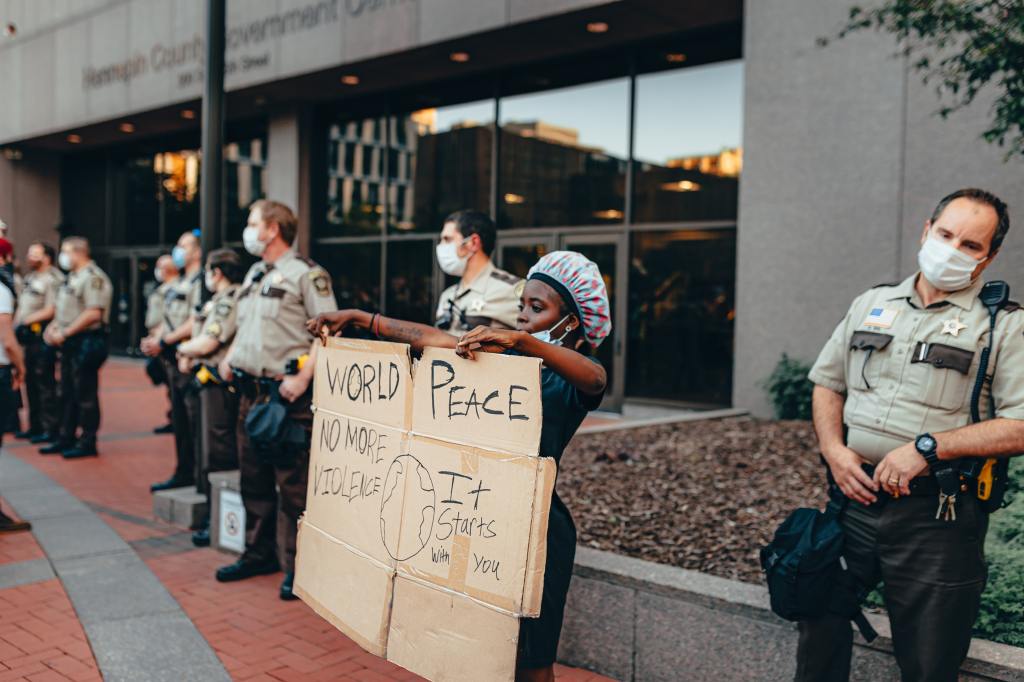
And then George Floyd was murdered. Recently before, in my own America were the murders of other black Americans: Ahmaud Arbery, Breonna Taylor, and Dreasjon (Sean) Reed. Boiling point.
The pot had been simmering. For years and years heated by angry words, unchecked bias, and inequality that Martin Luther King, Jr. was murdered for in 1968. The simmering pot of racism in a country someone once called a melting pot is now a boiling pot.
For a couple of years I had fled the Facebook and Twitter scene to avoid this kind of simmering. Social media can be anxiety-producing and I figured there was enough of that in my life so goodbye Facebook and Twitter. I deleted the apps on my phone and said goodbye to my newsfeed.
And that was nice. It was nice not to know all the anxiety-producing news and go about my life. It was nice to narrow my gaze to my own work and get ready to launch a website. It was nice to ignore the simmering pot.
Now the pot boils and there is no ignoring. I need to see the words on Facebook and Twitter. Otherwise, how would I believe the ignorance from my very own president? There is no filter on his Twitter feed. (Except when his words are too violent and Twitter has to take them down. ) There is no news bias on his feed. No one else to blame. As much as his subordinates would love to take away his Twitter account, I hope they never do. It is through those words of his that we see the words that hold true for the people who adore him.
Yearning for a glorified America is to yearn for a colorblind America with no awareness of the tension among people that needs to be named. The famous Twitter feed suggests we let the white people in charge take charge with military force. He stood in front of a medic station on a church lawn where people had been providing water, holding the written word of a God who sets people free.
We are to be color-amazed, as Bishop Eaton has preached. We are to be amazed at the uniqueness of people, the value of each breath, and the strength in each voice. This is not a time of this or that, them or me, us or you. No person is perfect in this boiling pot. We have all sinned. We have leaned on political allegiance instead of the freedom of Jesus Christ that is for each person.
There is a story our nation needs to tell. We can delete the apps and ignore it, but the simmering pot now boils. So pray. Pray all day long as you hear the news and realize we have so much to learn about this boiling pot. Pray, because only prayer (not the news) changes our perspective. Pray and realize the story of rage and racism is indeed your story and mine.
“What are you watching?” asked my daughter, as I stood in our kitchen staring at my phone.
In a moment, I had to decide how to explain racism and riots to an 8-year old. Or, I could turn off my phone and let the moment go. Isn’t that so much easier? To believe whatever is happening on a screen is far away and someone else has to live with it?
I was watching Pastor Ingrid C. A. Rasumussen on Facebook walk through the neighborhood of Holy Trinity Lutheran Church in South Minneapolis. Touring littered streets, she explained the true identity of the damaged buildings that exposed generations of anger. Like vapor, smoke rose up here and there, like injustice that rises up here and there and here and there.
“I am watching a pastor show us a neighborhood where there was a riot.”
“Did they wreck things?” she demanded to know. “Someone is going to owe a lot of money! Why did they do that?”
“His name,” I slowly began, “was George Floyd. And he was murdered by a police officer, and many people are angry about it.”
With my husband, we tried to explain there are police whose job is to keep people safe, and there are people who are black and there is an ugly history we can’t seem to shake off.
In the end, dear daughter, this world is not yet as it should be. People who happen to be black are not as safe as people who happen to be white. Last week was one of many moments the vapor of injustice rose up in a city we know well and love very much.
There is no perfect dialogue to explain George Floyd’s murder to an 8-year old. It would be perfectly easy to believe his story need not be tied up with our story. But I want my kids to know some hurts in the world are not easy to explain, and those hurts are our hurts, too.




 Lisa Lewton