Beginnings

Each of the four gospels begin differently. Mark hits the road of Jesus’ ministry running by beginning with his baptism. John begins in the very beginning with the Word that was there when the very first wind blew over the face of the earth. Luke begins with the Christmas story as we hear it each Christmas Eve in churches. And Matthew begins with a tree, a family tree that is.

At first glance, the first chapter of Matthew’s gospel is booooring. It resembles the terrible stretches you encounter if you’ve ever determined to read the Bible from cover to cover. Begat, begat, be-oring. Yet Matthew’s beginning, like all our beginnings, matters. In the long line of the faithful, the fearless, and the forgotten, Matthew draws a line from the beginning to Jesus. He establishes Joseph’s and then Jesus’ credibility as a member of the tribe of Judah. Like a bouncer perched at the door of the world’s most exclusive club, Matthew is letting Jesus in by uncovering the Messiah’s beginning.

Christmas is the story of Jesus’ beginning, which I find so interesting because your feelings around this holiday are profoundly shaped by your own beginnings. The way you celebrated Christmas (or didn’t) as a child shapes how you approach every single December 25th. Did you gather with few or far too many family members? Was it delightful or dreadful? Did you eat ham, turkey, or something nonconforming? How were gifts exchanged? Did you open them on the 24th or 25th or another day? Was church a part of your party? If so, was that delightful or dreadful?

These happen to be rich questions for pre-marriage counseling. They give each partner a glimpse of the other’s beginning. We can piece out expectations, hurts, and joys of each unique family, and conversation is carefully cracked open around the distinct dysfunction of each of our families.

Looking back to my own beginnings, I have fond memories of Christmases with cousins and cookies and my Grandma Florence’s outrageously oversized tree. I grew up in a small town where much of my family resided within three blocks of my house, including my grandparents. This meant we celebrated Jesus’ birth three times each year in under 24 hours: at each grandparent house and our own. There was a consistent and equitable routine to our Christmas celebrations. My husband’s memories are similar and yet different. It took a few years to recognize that the differences in our Christmas beginnings created differing gift-giving expectations. Gifts were a big deal in my family and not so much in his. Food was also a point of discussion. His family ate tiger meat (raw seasoned hamburger) and my family ate lefsa.

Once my husband and I understood the diverse rituals that marked our own beginning Christmases, we could establish some of our own. Remembering our beginnings clarified some of our feelings around this feelings-filled holiday. Christmas is filled with feelings. Like emptying a stocking (a big deal at my house and not so much at my husband’s), admire each feeling as it comes. What do you miss about your beginning Christmases? What are you thankful to shed?

The birth of a Savior, the beginning of Christmas, assures you the beginning matters less than the ending. Your ending is full of feelings of joy and joy alone for families of every level of dysfunction. Yes, even yours.

PRAYER PRACTICE

  • Light a candle. Tell God in writing or out loud a childhood memory that shapes your understanding of this season. Do you need to let it go? Create a new practice? Celebrate the memory? Share it with God, the Word who was in the beginning, who became flesh to write your ending.


Advent Week 1 – Promises

My daughter finds it funny to remind me of the time her principal called our home during the day to tell me she had fallen from the monkey bars and, we would later learn, fractured a bone in her arm. For whatever reason, Caller ID described the school’s number as “Private Caller,” ostensibly “Annoying Solicitation.” My choice to let the phone ring will be an everlasting tale for her to hold over my head. Forever and ever. “Whatever you do,” she instructs her brothers, “don’t call mom if you break your arm!”

In some way, I had broken an unspoken promise that whenever my six-year-old called or needed me, I would immediately answer the phone. Of course, it did turn out fine after the school called my husband who called me. She did not wait long for her mom to rush to her side! But it did seem the world shifted ever so slightly. She gained some awareness that our lives are not one life but two separate lives.

Parents make many promises to a child, perhaps each of them unspoken. There are basic promises to feed, clothe and show love. And there are social promises to equip a child to make friends and swim in the larger world of peers. There is a promise to be present for the conversation that needs to happen, to listen to a worry, to talk through a dilemma, to help navigate the tough spots, to keep the cookie jar from an empty state.

It could be that parents construct an entire foundation under kids with our promises. No parents keeps them all perfectly, so as we build the foundation with promises, we also build it with empathy and forgiveness. Promise-keeping happens to be the language of Holy Baptism. God promises to hold onto the baptized from this life into the next, and to love us even when we let God down. In turn, hearing God’s unconditional promise of love for us, we make promises, too. Our promises are designed for the well-being of our neighbor.

At weddings and baptisms, I take delight in disclosing to the people making promises (couples and parents/guardians) they are making promises that are impossible to keep. I assure them they will not keep every promise made in the rites of marriage or baptism. They giggle nervously, but I hope my disclosure relieves some pressure.

If we were meant to keep promises perfectly, God would have improved the prototype for humanity. But we are broken people who break the promises we make to one another, even though we know we should not. We act selfishly and out of resentment. We struggle with addiction or get tangled up in an abusive relationship. We get too busy and out of the routine to take our kids to church. Being human requires forgiveness and new starts, or to quote Ann Lamott, earth is forgiveness school. Which is why God’s promise of unconditional love will hang over your head like my daughter’s everlasting tale of the time I chose not answer the phone! This umbrella promise covers you and any mistake you make, including the small mistakes like neglecting to answer the phone, along with the bigger and heavier ones.

In this first week of Advent, we inch closer to a promise God had made long before Jesus was born. Throughout the Hebrew Scriptures, the promise of Jesus’ coming is whispered on each page. The patriarchs of the first book of the Bible tried to follow God and failed, just like the Israelites who entered the story later on, and the promise remained. Through creation and judges and prophets, through insignificant and unnamed people and rich and famous ones, the promise of a Savior is carried from page to page until finally, the promise is a child. On the page we discover an impoverished couple on an obligatory journey into Bethlehem because a king had promised to harm them if they didn’t.

God’s unending promise to love you can be, at times, difficult to hear. The whisper is too low, like a handful of lovely people in their seasoned years who have admitted to me after worship: “I can hear the man’s voice but not yours.” The Bible is like that, too. We can hear God’s promise loud and clear on some pages but not others. We hear it in Isaiah, but turn the pages back and the pitch is too low in the book of Judges (not bedtime reading, that book.) And yet the promise is on that dreadful page, too!

God’s promise cannot be erased or compromised, and I wonder if the is so gracious as to become hard to believe. Can you believe you cannot undo God’s promise of mercy? It is a wild and unwieldy promise, and it is yours to keep.

PRAYER PRACTICE

  • Light a candle and write a list of promises you are trying to keep. One by one, name them and remind yourself, beloved child of God, how God’s promise to love you is an unconditional promise of mercy. Let God’s forgiveness bring you to forgive yourself, too. With a marker, write “I Love You, I Promise. Love, God” over all of your words.

Thank You For Endings & Beginnings

(Photo by Cathryn Lavery on Unsplash)

It is with a touch of embarrassment that I admit to you the podcast episode I chose the other day. Among the bazillions of entertaining, educational, and inspiring episodes, I chose to listen to…the episode all about paper planners.

Because I am a nerd.

Allow me to demonstrate.

Every turn of the planner page to a new week or new month is delicious, like discovering a new blend of coffee or new trail to walk. Oh, the possibilities! New flavors, new sights and sounds to explore, blank pages on which to transcribe my day-to-day life as I expect it might unfold. Notice, a blank page can only be found when the previous page is finished. For a new thing to begin, another must end.

The end of December will be accompanied by another ending for myself and our congregation. We will say goodbye to my excellent pastoral partner and his excellent family. Together, St. John will bless them on the way to his next congregational call and to the place where God is calling their family to begin. The turn of the paper planner to 2022 will mark a significant ending and beginning for me as a pastor and for the church I serve.

I’ll admit with less embarrassment than my earlier admission that it wasn’t long ago I dreaded the idea of this particular ending. Pastors are human and we come and go and no goodbye comes as a complete surprise. Even so, transition and change you well know, can be tiring. Prior to my current pastoral partner, three pastors came and went in five years while I remained on staff. As trying as the changes were, those beginnings and endings, endings and beginnings, led to my current partner and a partnership that has been joyful and fun.

Goodbye might be no one’s favorite word, yet at the same time, it might be a word that turns the page to something new. To be clear, new is not always better or easier or more fun. New might fit like the wrong size of tights!

When someone retires, it often takes time for it to feel right. The new is confusing, like finding your way in a new school, or when the grocery store does this terrible thing and shuffles food around and all you want is your favorite box of crackers. Or when someone you love dies and the new page of that planner is missing entirely because you don’t even know how another day could begin.

What occurred to me as I listened to the paper planner people is the silly comfort I find in having words on the page of my planner. It brings such comfort when my daily plans and wider dreams are words on the page of a lovely Rifle Paper Co. spiral bound, for example. As though writing down plans and dreams will assure that they happen, as though the loveliness of the paper will protect me from the endings.

Life, of course, is more than plans and dreams. It is endings and beginnings, pages and pages of the planned and mostly unplanned. It pains me to admit that the unplanned may be the most valuable of all. Probably not in the thick of it, but looking in the rearview mirror, you can see growth and maturity and deeper faith is written where you expected ordinary, stable plans.

Which is why the type of paper planner you buy isn’t as important as using a pencil. At least the pencil might remind you that plans are subject to change, and beginnings follow endings.

Thank You, Friends

(Photo by Yutacar on Unsplash)

There are a handful of decisions that change everything. Looking in the rearview mirror of your life, you can spot a choice you made that led to this, while chances are a different choice would have led to a significantly different that. Where you live, how you spend your time, whether to work outside your home, whom you married or didn’t, whether to have kids, whether you go to church. Just as Annie Dillard sagely said, “How we spend our days is, of course, how we spend our lives,” the choices we make accumulate into a life.

Once upon a time, we moved to this town and settled into a house. After many months, Marcus and I made a decision to invite a few couples for a wine and cheese party. I vaguely remember handwriting invitations asking people to bring a favorite bottle of wine and dropping the invitations in the mail. I also vaguely remember a long Google search to learn how to pair wine and cheeses, due to the fact I knew nothing about either.

Roughly 14 years later, these friendships are like roots that keep us planted. Whenever my husband and I imagine life in a different town, we cannot imagine life without these friends. They have helped us move to a new house, they have cared for our kids, brought us homemade food in busy and stressful seasons, held us in prayer, vacationed with us, and have frankly made us better humans. It is a profound privilege to be welcomed into someone’s life, and a generous gift to discover mutual encouragement and grace.

We seem to be getting older, this group of friends. One by one, our kids graduate and move away and through each change, we are steadied by our friendship roots. Last night, we celebrated Friendsgiving. I saved time and stamps by texting them an invitation. I asked them to bring both food and a story. Using Priya Parker’s 15 Toasts, I nervously asked if they would come with an origin story from their own life, and suggested bonus points if it was a story their spouse hadn’t heard.

We drew back the curtain on our lives and raised our glasses to our moms, to healing, to choices that led to something good. And we raised our glasses to decisions that led to a moment of friends gathered around a table. I use the word decision, and yet I am not certain that word fits.

Another look in the rearview mirror suggests God has a way of surrounding you with the people you need at just the right time. Although we did make a decision to invite people to our home so long ago, a decision that fills me with gratitude, God had already brought these particular people to this town, just like us.

Trusted friends are worth more than anything money could ever buy, even though it is a risk to open the door and let them see your life for real. What you may discover in doing so is that life requires good company. And toasts.

I Just Texted My Kid During School

Photo by fauxels on Pexels.com

Not so long ago, I could not fathom why a parent would send a text message to their own kid knowing that kid is at school. Can’t it wait until after school? I haughtily inner-commented. I mean really, they’re in school!

I remembered those haughty inner-comments this morning when I texted my kid a question related to Thanksgiving break…while he was at school. Thanksgiving is several weeks away, deeming this question non-urgent. And yet, texting often leads to quicker answers which leads to quicker knowing and isn’t that normal?!

Immediacy is the new normal. Would I wait eight hours to ask my son a quick question? If it meant avoiding disruptions in school, absolutely yes. The truth is, however, any number of people outside of the school building also have access to him via his phone. My not sending a quick text does not mean he won’t be disrupted.

Like so many phone-related shifts in our lives, this one happened fast. Suddenly, a student could be anywhere in the world and in a classroom at the same time. With peers inside and outside of the building all at once. Which sounds like most workplaces. We can simultaneously be in a work meeting with colleagues and in a family vacation text string. Digital life often allows/requires us to be in two places at once.

Perhaps texting my kid while he is at school is prepping him for the 21st century work world. Ours is a world unlike any worker or workplace has ever seen before. It requires the ability to maintain eye contact in a conversation happening in the room, and to know how to navigate the other perhaps dozens of conversations unfolding more slowly on your phone. You are constantly triaging which conversation requires your attention.

Exhausting!

But here we are. We live in this time with particular people doing particular work using a particular kind of technology. It isn’t perfect, but neither were telegrams, or the party line system, or any other kind of technology humans have invented. As always, kids adapt quicker than adults. My kids can probably help me learn how to better find my way, after he answers the non-urgent Thanksgiving question.

Do I Really Know My Kids?

Occasionally I wonder which conversations with me my kids will remember. Will they remember our conversation related to their grades or their friends? Will they remember telling me the story of what happened one day at school? Will our talk after they failed at something stick with them?

Parenting is basically hugs and a series of conversations, both of which become trickier as kids get bigger. At the same time hugs and conversations grow trickier, kids’ worlds rapidly widen. Their friends become more worldly and so do they. There are dangerous rabbit holes on their screens and in all of the places their freedom leads them into. In teenage-dom, there may be a direct proportion between how much kids need to talk and how little they actually do.

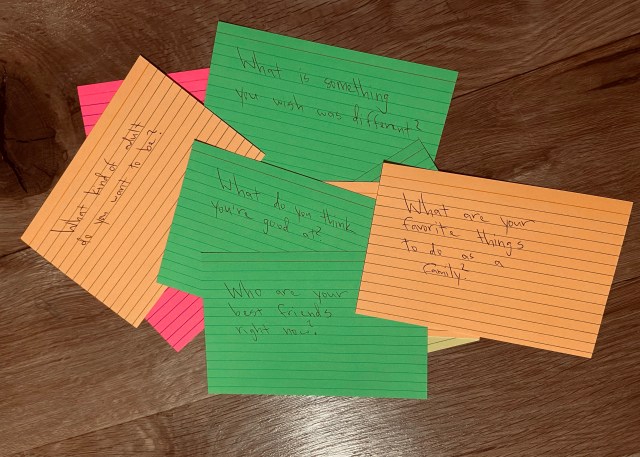
This is why I loved the latest podcast by Laura Tremaine called “10 Questions To Ask Your Kids”! Her kids are slightly younger than mine, but her 10 questions still fit. I wrote each down on an index card to park at our kitchen table. Will my kids be excited to discover these questions I will try to ask them? I am sure at least 1/3 of them will! Really, all that we ever do as parents is try things. We try to be present, try to be patient, try to serve vegetables, try to understand. And so, I can try to ask questions that I hope might help me better know these humans whom I see and usually eat with on a daily basis.

While her 10 questions are a tool to hear from kids, they are also a way for kids to get to know their parents (or grandparents). If you were to tell them who your best friends are these days, what might you say? As Tremaine points out, will your kids (or grandkids) know the answer? Maybe, maybe not. Maybe you stay connected with someone whom they do not know or haven’t met. You have a story to tell to explain the people with whom you are choosing to share your time.

You have plenty of stories to tell, and so do the younger people in your life. What an amazing moment for them to know you really want to hear their stories! I hope Tremaine’s questions inspire you, too.

When One Feeling Isn’t Enough

(Photo by Tengyart on Unsplash)

Last week, I spent a few days with my colleagues in Western North Dakota at an annual theological retreat. We both retreated by resting and catching up, and engaged in theological learning and discussion. It’s no secret that Western North Dakota is not the most desirable location in the country to do ministry! Lutherans leaders often prefer to land in a metro area, and so what leaders in other areas might miss is a tight-knit collegial community. It is tight-knit because we know we need each other to survive! There is no sense of competition among churches, but instead a culture of support.

And so when the conversation at our retreat centered around processing the past year and looking ahead at the work yet to do, there was a flood of feelings. There was grief and hope, disappointment and gratitude, mercy and frustration, all at once.

Did you know you can feel at least two feelings at once? You do it all the time. You feel love for your spouse and also utter shock that the two of you are still married. You feel gratitude for your child and ongoing irritation that said child continues to leave a trail of messiness throughout the house. You feel content in your life at the same time you feel curious that there might be something more.

There are so many feelings in the world right now! It might be helpful to remember your neighbor may be as confused about her feelings as you are about yours. I live in one of the Covid-sickest parts of the country, so while I’m grateful people have started reconnecting at the church I serve, I feel deep concern for people’s health. Should we be gathering? I think, yes. Should we be cautious? Also yes. Is it good for our souls to gather in the same space? Absolutely yes. Even now? I think, yes.

Argh. It’s no small task to be human these days, with so many feelings bubbling inside of us. I encourage you today to take note of your feelings. Here is a link with a list of feelings if you need some help. Then, you might ask a friend or people in your family to do the same. My very favorite tool to engage you in conversation around feelings with your own self or with others feelings are GROK cards.

There is a lot going on in your life if you start to dig around a bit. As I learned in a room full of pastors, deacons and a flood of feelings, naming the truth of what we are experiencing is an invitation for Christ’s healing love.

A Christian Way to Talk About the World With Kids

Photo by Miguel u00c1. Padriu00f1u00e1n on Pexels.com

Have you ever noticed how you talk about the world with kids? What age-old words or phrases do you let slip without realizing? Do you call the world “dangerous”? Or explain tragic events by concluding, “The world can be a terrible place,” or, “There are bad people in the world.”

I also wonder how you refer to decision-makers. Are all politicians awful? And lawmakers corrupt? How do your own headlines and editorials shape the way kids around you understand the function of the government?

As any teacher will tell you, kids speak of the world with the narrative they learn at home. Your family’s unique language is their first tongue to articulate an understanding of the world around them. If at home you speak of a corrupt government, your child will do the same at school. If all politicians are distrustful as you process the news at home, distrust may plant a seed that will later blossom into endless conspiracy theories.

The Buddhist are perhaps the first to point out that humankind is aptly named. Our early orientation toward strangers is most often kindness. If you smile at a toddler, that child will naturally smile back. It happens every Sunday during the sermon when people sitting near a baby will hear almost none of the sermon due to the steady, heartwarming exchange of glowing smiles.

We live in a time in the United States when deeply-rooted conspiracy theories are shaping events and nurturing distrust. In my corner of the world, generations-old distrust of the government has placed a filter over information related to the pandemic. And that makes me wonder about younger generations that continue to learn distrust as a first language. I suspect conspiracy theory is handed down and learned at home.

All that is to say, what might be the Christian way to talk about the world with kids, particularly at home. Here a few ideas:

  • Do not avoid the words “I don’t know.” We are inundated with both true and false information and we do not always know the difference. A shrug of the shoulders prevents us from thinking we are always right.
  • Check out the Bible. It blows my mind whenever I read Old Testament stories of how God used “the bad guy” to deliver his word. Jonah was sent into “enemy territory.” Jesus befriended the wrong “political parties.” The fall of the Berlin wall is a good illustration of how God responded to separating humans based on political allegiance.
  • Start a conversation. Ask kids, “How is God in the world right now?” As we watch the terror unfold in Afghanistan, how is God with the people? What does God need from us to care for the strangers we see in the news? Even a prayer for people far away makes us more than strangers. Also, asking kids a question reminds us that they know far more than we assume!
  • Scan yourself for anger. Anger can be productive, but it can also be wildly unproductive. If your anger makes you feel self-righteous, keep that in check. Your kids may learn to be angry with people only because they think differently than they do. Warning: Self-righteous kids are the most annoying friends in high school and college. Try to avoid raising those.
  • Remind kids a basic tenet of the Christian faith. Our faith does not put our absolute trust in a human leader, but only in our Lord. Only God deserves our total allegiance. Only God will save us. Only God will lead us through this life into the next one. Human leaders cannot promise salvation, so if you sense yourself buying into such a promise, back up a bit.

While it is a challenging time to raise kids, it is an excellent time to be in conversation with them. We all need help processing what we see in the news. It is easy to avoid, but we need to talk about why there are people who drive around our neighborhood with flags in their pick-up trucks for my 9-year old to read F— Biden. I wonder why that person feels so strongly? I don’t know, but I’m sure there is a reason. He/she is a child of God, too.

The Magic of the 20-Second Hug

When I was a little girl, I had a persistent light cough that was attributed to dust. Among the many tactics we tried to eliminate allergens in our house to limit the coughing was a mostly strict ban on stuffed animals. Only my two plush puppies, Rover and Scrappy, survived the ban.

While no allergy is ideal, this one had its perks. No stuffed animals were allowed to move in. Meaning, my mom could say no to any and every such request.

Thirty-years later, my mom says yes to every such request from her granddaughter, which is how I ended up with a giant, red, heart pillow with the words “100% Huggable” from a garage sale last week. Where, I ask you, does one put a giant, red, heart pillow with the words “100% Huggable” in one’s home? Oy vey.

While the pillow is not my favorite, it is cool because my daughter picked it out for me, and because the words have a ring to them. I recently learned of the 20-second hug. Perhaps I read it somewhere or caught it in a podcast. Simply put, hugging your partner for at least 20 seconds (in one continuous hug) is magical. Consider. You cannot naturally hug someone you are annoyed by for 20 seconds. Eventually in those 20 seconds, you probably decide he/she is not so bad after all.

Please test the theory and if it doesn’t work for you, I have a pillow that could be your consolation prize.

Thanks for the Who

In the book, Burnout: The Secret to Unlocking the Stress Cycle, authors Amelia and Emily Nagoski suggest two lovely gratitude practices.

  1. WHO: Give thanks for someone(s) in your life.
  2. WHAT HAPPENED: Give thanks for something that happened that day.

These two practices are inspiring and avoid an icky result of most gratitude practices. Giving thanks for a who and a what happened prevents us from giving thanks for things. Giving thanks for things leads us to be thankful that we have things. Then we notice people in the world who don’t have things, which leads us to feel guilty that we do have things while others don’t. And gratitude becomes an exercise in guilt.

I am excited to practice giving thanks for some of those who are who in my kids’ lives. (You made it to the end of that weird sentence. Good for you.)

*Thank you, Lord, for Driver’s Ed instructors. What were they thinking? Keep them safe.

*Thank you, Lord, for coaches who set aside a ginormous amount of time for an often thankless job. Keep them sane.

*Thank you, Lord, for grandparents. May the trade-off of too-much sugar for so-much sweet grandparent love all work out in the end. Keep them smiling.

*Thank you, Lord, for gracious strangers who reveal comforting kindness at just the right moment, such as when a kid on a bike needs to cross a busy street. Keep them plentiful.

*Thank you, Lord, for the moms who are absolutely real when my kids come over to hang out. For the way they feed my kids with food, hospitality and an honest glimpse at the truth that all our homes are often hot messes. Keep them real.

*Thank you, Lord, for Faith Formation Directors (Christina Jorgensen) who mail my kid a cute card after an amazing week at Bible Camp, who promise that faith in Jesus is cool both at camp and everywhere else. Keep them in that particular job for a very long time. Please.

Thank you, Lord. Thank you.

The End.