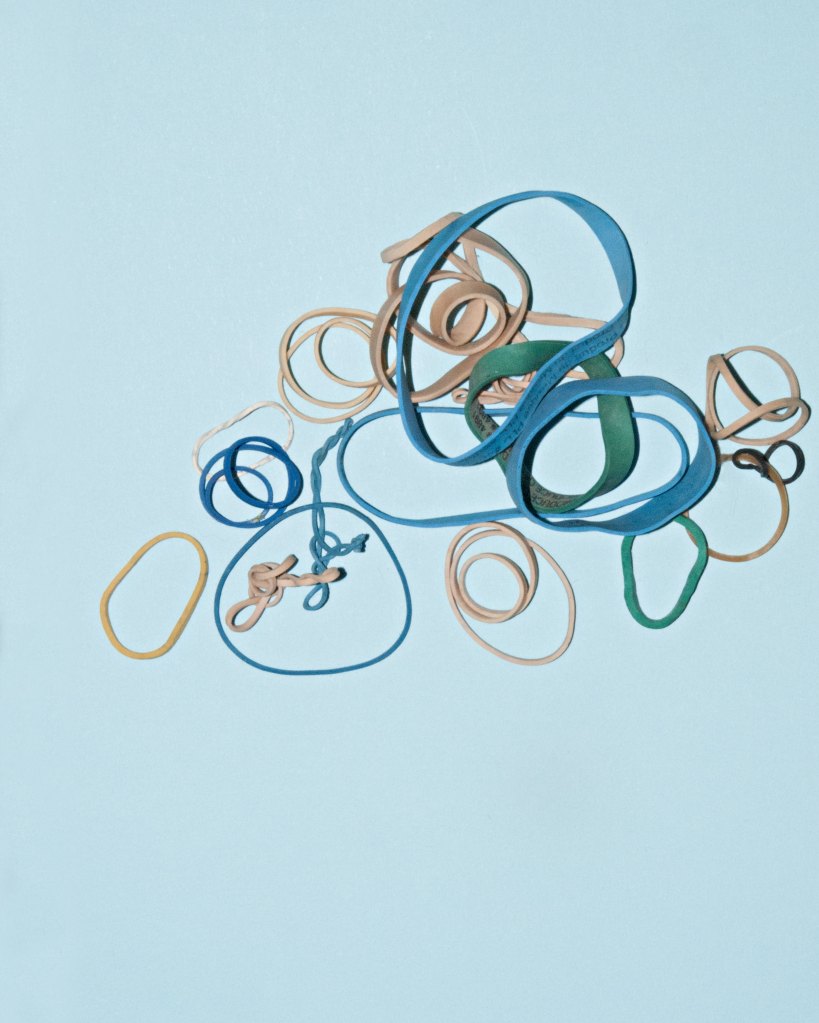
Don’t Worry. It’s a Rubber Band

Life is both a box of chocolates and a rubber band. But because we’re all tired of chocolate and some of us even lost our Halloween chocolate moments before the arrival of trick-or-treaters and had to make a mad dash to Walmart to replenish said chocolate, let’s say that life is more like a rubber band than a box of chocolates.

Life is a rubber band. There are seasons in which the rubber band is stretched tightly:

  • when you or someone close to you is dealing with a health crisis
  • when work is wild
  • when a family member is struggling through a hard time
  • when you are the one struggling through a hard time.

A rubber band stretched too tightly can even break, not unlike people. We do and do, stretch ourselves farther and farther, until our human bodies speak up. My spiritual director will ask where in my body I am carrying my worry and anxiety. The person I see for infrequent massages will answer: in her neck. That place in your very human body that is tight or unsettled or chronically in pain may be your body telling you the rubber band is stretching too far.

When the rubber band stretched too far in Jesus’ life, he went away for a while. He prayed by himself. He even fell asleep on a boat during a storm, much to the horror of his freaked-out friends. How could he sleep through a storm? He was that tired. The rubber band had stretched and stretched.

When life is overwhelming, don’t worry. It’s just a rubber band. You are not in charge of the world, only your own self and the rubber band that is your life.

  • What might you let go to loosen the tension in your life?
  • Who might you ask for help? Who might pick up your groceries or kid after school. In fact, even the hard work of asking for help retracts the rubber band. You are admitting you are only human, and although this is a hard truth, it is also a relief.
  • Whose voice is in your head telling you to do more or do it more perfectly? Have a meeting with that fictitious person and explain that they can have the day off today. You are practicing the gentle love of Jesus.

It’s only a rubber band. The world is not falling apart or coming to an end. Instead, you are being invited to admit your human limitations and accept Jesus’ limitless grace – even better than a box of chocolates.

Photo Credit: Michael Walter on Unsplash

In the Weeds of the Facebook Ranting Groups

It wasn’t long ago that everyone read the daily newspaper. The inky pages were dropped at your door in the morning so when you arrived at work you and your coworkers knew the same information. The Minot Daily News informed my small town day after day.

Early in America’s lifetime, there were several newspapers. Based on your political preference, you could choose to read the conservative, moderate or liberal bend of the news. These days, we do much the same thing on social media.

What’s new, however, is the way social media has made people into sources of news. This wasn’t the intent of the internet, but it happened anyway. YouTube, for example, was first motivated to share media, but it was surprised when so many people became novice creators of content. Suddenly, any ordinary person can become an expert on make-up, home repairs, relationships, or politics.

I mentioned yesterday that I’ve wandered carefully into the weeds of social media Rantville, trying to better understand my own community and its values. My heart beats extra fast at the heartless comments in one of our community’s ranting Facebook groups.

Last night I visited with one of the people who speaks truth into the untruths of this particular site. He reminded me that Facebook does have standards that enable the rest of us to report comments that are slanderous. It is imperative that we report comments that harass leaders or claim all elections are rigged. (Or “rigid” if you get that joke.)

I would prefer never to enter the muddy mess of immaturity that is Rantville. However, I also know the 8th commandment holds me accountable to “fear and love God so that we do not betray, slander or lie about our neighbor, but defend him, speak well of him, and explain his actions in the kindest way.” (Luther’s Small Catechism)

What would happen if we took turns braving the heartless social media groups to uphold the 8th commandment? I say take turns because this is tiresome work. But what if we showed up with integrity and mercy to carry out our baptismal promise: “to care for others and the world God made, and work for justice and peace”.

I absolutely loved the interview on Kate Bowler’s podcast with David Brooks, who is one of my favorite authors. He pointed out how each and every person simply needs to be known. I have a hunch the Facebook haters feel overlooked, as though their concerns have gone unheard. I do not appreciate slander, but I would like to look into their eyes and tell them they matter. Out of faithfulness to the 8th commandment, I might even assume their expression is a concern for our community. Maybe.

Community, Peter Block explains, is not a problem to be solved but a way in which we are citizens together. Much like we can’t pick our family members, we cannot pick the people who are citizens with us. However, we can share our faith by showing up, even in the weeds, to invite others to be citizens instead of ranters with us.

Credit: Photo by Jonny Caspari on Unsplash

Fear, Community and the Church’s Voice

Recently at a conference, my colleague shared her experience moving to a new community. As a pastor, she knew her community well – not only the people, but practical things like the clinic phone number, her dentist, the way around the grocery store. When she moved, she explained, she felt like she knew nothing. Nothing at all! Well, she went on, she did know things. But what she knew no longer applied.

Communities are unique. Like families, communities have a dynamic. The size of the community is irrelevant. Small towns or large towns can be connected or disconnected. Urban areas or rural can be progressive or resistant to progress. Medium-sized cities or big cities can be fun and exciting or dull. I’ve lived in a very small town, a big city, a really big city, a suburb and a large town/small city, where I’ve lived now for nearly 17 years.

Yesterday, my city approved a bond to renovate and expand the public high school (particularly to replace the 1960’s original boiler which has broken down and requires parts that are now obsolete) and enhance security in the city’s public elementary schools. Perhaps because my role with a Congregation Council is to steward an old property for generations to come, I am confused why this was a difficult question in our community. Would you replace the boiler in your own home if the people who built the boiler explained they can no longer repair it?

I’ve reflected on the uniqueness of my community, which is impacted by the not-so-unique toxic presence of fear. There was fear that passing a bond would raise property taxes. Maybe there was fear of admitting that our community has grown and is projected to keep growing. Growth means change and change tends to make us fearful. Was there fear that city leaders don’t understand financial struggles experienced by some in our community – do those individuals fear they are invisible?

A common phrase in the Bible is “Do not fear.” Spoken by angels to surprised and fearful recipients of God’s important message, spoken by Jesus to the disciples: “Do not let your hearts be troubled and do not let them be afraid.” (John 14:27c) Jesus did not say this to one disciple, but to the community of disciples. If the community became fearful, it would break apart. Fear sends us in different directions and brings out our worst. Facebook rants and Thanksgiving dinner arguments generally stem from fear, when we have let our hearts be troubled and afraid.

Gil Rendl is a leader in the Methodist denomination whose latest book calls the church to attention. How might the whole church find its voice in this time of toxic fear and vulnerable communities? What, Church, do you have to say to a people who are being sent in different directions by fear? My colleague reflected upon what she knew, that it no longer applied to her new community. But the church has been here before. We’ve struggled through cultural divides over the centuries. We have heard Jesus caution the community not to be afraid. What we know applies to this moment, when the voice of fear bemoans the problems of a community without calling us to be caring citizens of that community.

I gingerly perused some social media last night, waiting for a word on the vote count. It is encouraging to see the courageous few speak truth into the untruths that enflame social media followers. The gift of truth is that it disarms fear. It invites all of us into a higher level of maturity to rely on facts and not fear. This, of course, is much less exciting. But best for a community, or even, it is the way we are a community built on hopes and dreams, facts and figures, refusing to let fear take the lead.

Photo by Riley Edwards on Unsplash

You’ve Probably Watched the Same Movie Twice

Even though there many movies, chances are you have watched the same one twice. You could fill your day with new movies for the rest of your life and never catch up! And yet there are those movies you will sit through over and over again.

  • Which movies will you watch more than once? Why those movies?
  • And why is it more common to rewatch a movie than it is to reread a book?

It takes less time to rewatch a movie than to read a book, unless the movie is “The English Patient.” Most books require more time than a movie. But. Let’s say you decide it is worth the time to reread one book.

  • What book would you reread?
  • Why that book?

What might be worth reading more than once?

There may be Scripture verses or passages or stories that are significant to you. You might return to those words for a particular reason. I repeat Psalm 63 to slow down my mind when it gets too overactive, like a time-out for a toddler.

While on internship, my supervisor introduced me to Bowen theory, a way of understanding our relationships. He lent me his case of eight cassette tapes, which I listened to in my car. Remember those plastic cases that held the cassette tapes in place? Retro. Remember when you slid cassette tapes into your tape deck? Remember when your cassette tape got stuck in your tape deck and you had to jimmy it out with a butter knife?

Anyway after I listened through the lectures, I ordered my own case of cassettes and listened to the lectures once a year. Then I had them converted into CD’s and now CD players live in the land of tape decks. But for a dozen years, I relistened to the lecture to keep learning the theory that has proven most helpful for me in ministry and daily life.

This morning, I looked through the books in my study at church and wondered which ones would I reread and why? The initial stack is a few books tall. There is a book on Bowen theory, an enneagram resource, a theology book on Luther’s writing, and a preaching resource. This exercise will take a second look to curate a stack of yearly reading. With podcasts and audiobooks, it would not be difficult to set aside time for rereading. No cassette tape hazards.

What we read/watch/listen to shapes our thinking and shapes our doing. You reading this blog puts ideas in your head – yikes! How might your reading shape your life in a way that nourishes your faith? In a way that nurtures your true self? In a way that encourages you to be gentle on yourself and let go of what needs letting go?

If you are willing, look back and find one book or podcast, poem or lecture got you thinking. Choose one passage of Scripture and reread it each morning for a month. Enjoy the words enjoyed once before. They may tell you something new the second (or sixth) time around.

Photo by Edgar on Unsplash

What Did You Learn This Week?

The kids may have been the ones returning to school the last week or two, but you, beloved child of God, must have learned something, too!

Turn around to see the past week. What did you learn?

  • What did you learn you could do that you hadn’t thought you could do?
  • What did you learn that you miss?
  • What did you learn about someone you love?
  • How did you spend your time? What does that teach you about your values?
  • How did you spend your money? What does that teach you about your values?
  • What did you learn about yourself that actually you had learned before, maybe several times?
  • What did you learn that made you change your mind about something (or someone) you thought you knew?

Being human is such an experience in lifelong learning! Here are a few things I learned in the past week:

  1. The job of a teacher continues to be one of the most remarkable jobs in the world. So often in America we make the mistake of valuing jobs based on pay. But the indelible mark a teacher can make on a student is, I hope, a great reward. Thank you to the teachers who have made my kids more confident and wise.
  2. In England, cilantro is known as coriander. Who knew! Thank you, Cody Rigsby. Perhaps someday I may need this information.
  3. Tweens REALLY prefer not to listen to their mothers. “Are you sure you want to wear a sweater when the high is 85 degrees?” Yes she was sure. And then she was hot.
  4. Letting go happens in fits and starts. My boys are now more like men, my daughter is settling into middle school. It is easy to step too far back, or easy to hover too closely. Yet like all relationships, what matters is a particular kind of presence. A presence that is not demanding. A presence that exhibits how you both care deeply and respect the other person’s boundaries.

Learning can be exhausting, which may be why kids don’t like to talk through their day the moment they get in the car, even though I want to hear all about it! But thank goodness for learning. How else would I know that cilantro goes by more than one name! What a world.

Photo by Eric Brehm on Unsplash

Your Homework: What to Set Aside

Thus the heavens and the earth were finished, and all their multitude. 2And on the seventh day God finished the work that he had done, and he rested on the seventh day from all the work that he had done. 3So God blessed the seventh day and hallowed it, because on it God rested from all the work that he had done in creation.

Genesis 2:1-3 (NRSV)

God was the first to intentionally set aside time. After six days of creating, the seventh day was set aside as a time to rest, disrupting the steady flow of one day spilling into the next.

Have you noticed how one day spills into the next? One week turns into the next one? The years run together.

God’s intentionality in the early moments of creation deserves our attention. God did not let the days run together, instead God set one of them aside. Just one.

It could not have been easy. God had plenty more work to do, and yet God set aside time to rest and then blessed that day. It is so wild that even God needed rest! But God did. To make rest happen, God was purposefully set some aside.

If you look ahead to the days and weeks on your calendar, can you set aside a time to rest? Can you schedule a two-hour block to visit with a friend and go for a walk by yourself? Can you find a day to hang out and relax with your favorite people? Is there a weekend you might block off for a mini-vacation?

Typically, these things do not magically happen, they require setting aside time before the days and weeks spill into one another.

Long before 21st century busyness, the writer of Ecclesiastes devoted most of a chapter to time. He argued there is enough time for what matters.

For everything there is a season, and a time for every matter under heaven.

Ecclesiastes 3:1 (NRSV)

The same is true for you. There is a time for every matter that matters in your life. So here is your homework: Set the time aside, like God’s seventh day, and let it be a blessing.

Photo by Malvestida on Unsplash

Not-So-New

It is the season of the new, yet no-so-new.

A new school year begins, surrounded by millions of school years that have come before and the millions that will come after.

New pencils and notebooks find new homes in desks previously occupied by other students, and someday occupied by other students.

The lockers frustrating this new class have seen those frustrated faces before, and not for the last time!

While a new school year may produce anxiety in kids, there are helpful reminders that what is new is also not-so-new. The new school year begins with the not-so-new presence of Christ. The new schedule unfolds with the not-so-new promise that Jesus hangs out in classrooms and hallways, on playgrounds and monkey bars, at lunch tables and lockers.

Jesus keeps us company with his not-so-new peace, not-so-new mercy, not-so-new tender love. With his not-so-newness, we begin a new school year, just as we did before, just as we will again. And we will see, not for the first or last time, that Jesus is already there.

Photo by moren hsu on Unsplash

Watch Out, Neighbor

In “Big Daddy,” the 1999 comedy with Adam Sandler, there is a scene in which Sandler’s 32-year-old character and a five-year-old boy he’s caring for go to a park. In classic 1990’s Sandler fashion, the two roll in laughter when they toss sticks on a path and watch the oncoming rollerbladers trip and fall.

Throughout the movie, Sandler’s character matures. Later, he and the boy go back to that very spot with a sign warning rollerbladers not to trip.

Everyone trips, even those of us too clumsy to put on rollerblades! We all trip and then furtively glance around hoping we’re the only one who noticed. Unless we’re under the age of four, tripping is embarrassing, and tiny band-aids tend not to make it all better.

We would rather not trip, and as Sandler’s matured character portrays, we would rather our neighbor not trip, either. Perhaps this movie line was inspired by the Apostle Paul, minus the rollerblades.

Let us therefore no longer pass judgment on one another, but resolve instead never to put a stumbling block or hindrance in the way of a brother or sister. 

Romans 14:13

Chapter 14 of Romans calls people who follow Jesus to warn others not to trip. Jesus followers are charged with the responsibility to pick up the sticks on the path and keep an eye out for oncoming neighbors who may be vulnerable to a fall.

Paul had tough words for people who had already begun to follow Christ and were getting in the way of new followers’ faith. The already-followers were creating stumbling blocks for those who were new to the Christian faith by instituting old laws related to food and drink. Jesus’ death had changed the importance of those laws. Instead of watching your neighbor trip, Paul offered:

Let us then pursue what makes for peace and for mutual upbringing.

Romans 14:19

In order for the Christian faith to grow, Christians had to stop getting in their own way with judgement and rules that had been overshadowed by Jesus’ death. The cross Christ died on had become the path on which all are welcome. The further down the path we go, the better we need to be at watching out for the followers around us; the more determined we must be to pursue peace and mutual upbringing.

I suspect this is an important reminder in a time when the Christian faith has failed to pick up the stumbling blocks and lovingly clear the path for our neighbor to follow Jesus. As Christians, we are charged with the enormous responsibility of meeting each and every neighbor with mercy and not judgement, to clear the path particularly for the neighbor whom you may not like – perhaps because it is the neighbor whom you do not understand.

Together, let us clear the path for the person who will enter the church for the first time in a long time, or who will log onto worship because it feels safer to join from home. Christians, let us pursue peace and mutually build one another up. Is someone missing from worship? What stumbling blocks have gotten in the way of that person’s faith? You might be the very one to clear the path and invite them back.

Everyone trips. By the love of Jesus Christ through you, everyone has a way back up.

Photo by Alexas_Fotos on Unsplash

Who Are Your People?

Prior to becoming a parent, I pictured our home as a welcoming space for our kids and their friends. I hoped ours would be the home where tweens and teens would hang out, eat snacks, and watch movies. I imagined I would stock the pantry with their favorite foods and every friend could grab their favorite soda and chips and feel at home in our home. The bottomless cookie jar would be a way for me to connect with my kids’ people – the peers who would surely influence my kids in many ways. 

Across the generations, every person needs people. Ideally, your people are a support while at the same time they challenge you to grow. Your people have a deeper understanding of you than others. They know you are a normal human being who falls apart, yet they do not judge you for it. Your people encourage you to think beyond yourself and they forgive you when you fail. 

I imagined encouraging my kids to gather with their people in our home because I know the importance of hanging out with your people. Your people shape who you become. 

One of my favorite definitions of church comes from a guy my age. He felt most at home one Sunday at worship when he looked around at the guys in his Bible Study group, also at worship with their families. These are my people, and this is my church, he explained. 

You, fragile human being, need people to call your own. People to reflect Christ’s mercy and remind you not to hustle through life or push through alone. Having people to call your own takes time. 

You, busy human being, need people to bring out your best. People with whom you can be comfortable in your own skin – the most honest and hopeful version of yourself. 

With a new season of fall and an academic year around the corner, how would you like to hang out with your people? How about… 

  • Create a standing, weekly appointment for morning or evening drinks. 
  • Take turns hosting in your homes each month. The host provides the space and the guests provide all the food. 
  • Go to church together and then donuts. No planning needed. 

It turns out, my kids do not gather often with their people at our house. I hope not, but there is a slim possibility that kids might be scared off by the superintendent and pastor in residence! Which is ironic. Our particular jobs can be lonely at times and my husband and I understand the importance of gathering with our people. We are most grateful for the people whom we call our people.  

I hope that we are modeling for my three favorite kids the importance of hanging out with trusted friends. Your people shape your life and you must be choosey and encourage your kids to do the same. Although my kids’ people are not often at our house, the cookie jar is almost always full, just in case. 

Photo by Gaelle Marcel on Unsplash 

You Need More Than a To-Do List

“For everything there is a season, a time for every matter under heaven.”

Ecclesiastes 3:1

This verse has been rattling around in my brain. It is the upcoming Scripture reading in the Narrative Lectionary, one of the readings for a wedding tomorrow, and the passage I shared earlier this week for chapel at the nursing homes.

Yet even without those connections, Ecclesiastes’ words hit home in August. For many of us, this is the season of school shopping and new schedules. The matters under heaven have to do with bus stops and books, phones and friends.

Last night I had a mini-date with my planner, where the seasons and matters under heaven are written.* Paging through the symmetry of the days and weeks, you can see Ecclesiastes is right – there is a box on the page for every matter. The seasons fit onto pages. We move from one box to the next, one page at a time. There is a sense of peace in seeing what comes next, at least according to what we’ve written out.

In Ecclesiastes, chapter three, he writes out the seasons as though he is constructing a planner page. There is a time for this and a time for that – a box, a page, a space. But his planner pages have no registration deadlines or meetings or medical appointments or early release days! In chapter three, there is more of a to-be list than a to-do list. The boxes and pages of the planner Ecclesiastes is writing contain instructions for how to be human.

  • One day you, you will laugh and be filled with joy. On another day, there will be time to weep.
  • In this space of time, be sure to keep silent, and over on this day speak up.
  • Take time here to dance, and take time there to mourn.

Does your planner remind you simply to be, amid all there is to do? In the busyness of the days and weeks, do you remember to laugh, weep, stay silent or speak? Is there a day for dancing and a day for mourning?

And whose planner is it, I might add? We can look at the days to come with only our best guesses. It is less of a planner and more of a guesser…which still won’t stop me from having a mini-date with my planner because it’s one of my favorite things.

But like most aspects of our lives, if we hold on too tightly, we miss what is important. With our eyes glued to the planner (or the guesser) we cannot also see what will make us laugh, or weep, or leave us speechless or emboldened to speak. The planner will tell you what to do, and Ecclesiastes will remind you to be.

If the upcoming months feel full, how might you remind your future self to take a moment in the mayhem to keep company with Jesus?

*If you are a person who nerds out over planning and planners enough to have a date with your planner, you might also find wisdom from Sarah Hart-Unger.

Photo by 2H Media on Unsplash