The Jesus I Follow and Hashtags to Avoid

(Photo by Jon Tyson on Unsplash)

When writing Instagram posts, I have learned to be skeptical of hashtags with Jesus’ name. This is how it goes.

My Instagram post is about Jesus’ mercy. But #JesusMercy is overwhelmed by creepy Jesus images.

#Jesus isn’t so bad…as long as you are convinced men have the most authority in the pulpit. (Example: a bazillion pictures of a man preaching. #Jesus)

#JesusLovesYou is a library of Christian platitudes. (“God has a plan.” #JesusLovesYou)

#JesusAndCoffee is the perfect blend if you are looking for posts from Jesus’ cheer team. (“It’s Friday, don’t forget to be fabulous!” #JesusAndCoffee)

This is not the Jesus I follow. He cares not that I am fabulous nor that I know the most platitudes. (Someone please initiate #JesusPlatitudes.) I chose the hashtag #SpiritualLonging for at least two reasons to tell you about the Jesus I follow:

  1. Jesus hashtags often present a shallow Jesus. Any hashtag that inspires you to be your best, fabulous self is leaving out your primary call to serve your neighbor. We do not serve our neighbor out of our best selves, but out of our broken selves. Only because Jesus became broken, and I am as broken and my life is as messy as yours can we together follow the Savior who makes us whole. He does not tell us to get fabulous and take away the mess of our lives. He entered the mess, died for you, and lived to tell about it.
  2. An important distinction in any proclamation of Jesus is this: Don’t tell me what Jesus does, instead let me see it, feel it, taste it, yearn for it. The only difference between a good sermon and a bad sermon is whether those words tell you about Jesus, or give you Jesus. Do the words point to Jesus, or do the words put Jesus in your heart, your mouth, and your bones? That is the Jesus for whom I long and the Jesus whom I follow. You cannot receive that proclamation via Instagram posts. You need a preacher, so a church community becomes helpful. (“How, then, can they call on the one they have not believed in? And how can they believe in the one of whom they have not heard? And how can they hear without someone preaching to them?” Romans 10:14.

There is no room in #SpiritualLonging for only one gender and sexual orientation of preachers, or Christian platitudes, or a fabulous you. Instead, we are filled with longing in a world that is not yet as it should be for our neighbor. And in our brokenness, we are washed in the promise that we are all on the way, and you are beloved, just as you are. #BeYourBestForJesus

The Stories We Tell Ourselves

(Photo by CHUTTERSNAP on Unsplash)

You, Beloved One of God, are a library of stories.

You are a story of courage and loss. A story of hope and despair. A story of dumb things you did when you were young. You are a story of passion, of adventure, and hope.

I wonder, however, what story you tell about yourself. Several times I have encountered research about the difference between the ways men and women tell their own stories. Men often identity success in their stories while women do not. Women, I’m sorry to say, can be poor storytellers. I know that is true of myself. I’ll look back on the day and the headline will sting with words I’d like to take back and things I would do differently. My story is shaped by my own mistakes, fears, and insecurity.

How do you tell your own library of stories? Can you look back on the past few days and see the light of Christ that beamed in you? The way you were the hands of Christ for someone else? The words you spoke that were shaped by your deepest prayers?

Investigate the story you tell about yourself, you who are made in the image of God. Remember God made all kinds of cool things in the creation story, but only when God made human beings did God say, “Wow, that is good. That is very good.”

God did not call you perfect and has never instructed you to be perfect. Instead, you are very good because God has made you very good. All other stories are in the shadow of the story of the God who made you very good and calls you very good.

Might that be the story you tell about yourself today?

The Stowaways in My Backseat

Karis’ dolls named Grace, America, and Canada properly buckled up

One day when I parked my car at church after dropping kiddos off at school, I discovered these three stowaway passengers. Was it momentarily creepy, you ask? Why yes it was. Only momentarily. They are well-behaved and do not mind subzero temperatures while waiting for hours in the car for Karis.

Like I have done for eight years, Karis had made sure her dolls were snuggled into their seatbelts. Day after day kids watch and learn whether we are in our car, house, neighborhood, church, grocery store, or anywhere else. When I visit with parents whose child will soon be baptized, I love to remind them they are their child’s most prominent teachers about God. Again when a couple is preparing for marriage, I say a similar thing. You know what you know about marriage based on what you learned from your parents (or other adults who raised them) about relationships growing up. For good and for worse, kids learn what they know primarily from parents.

Karis buckled her dolls seatbelts. She also grows impatient all of a sudden. She wants to do things right and likes to help people. When her feelings get hurt she shrinks inward. All that she learned from me.

What is your kiddo or grandkiddo learning from you? You might ask them. I like to ask my kids once in a while, “What’s it like to have me as a mom?” Like any performance review, I often hear things I’d rather be oblivious to, but I truly need to know. Those truths are edifying, even if they are hard to swallow.

If you are unsure about asking your kids such a vulnerable question, you can also watch the backseat of your car to see who is lurking there.

The Mom Drama of Kids and Video Games

(A rare moment of all three Lewtons playing a game together.)

It might be best if we kept this under wraps, but one of my favorite Sega Genesis games (circa 1995) was Mortal Kombat. Girls are stereotypically often more dexterous than boys, which is the only logical reason I can come up with that I would “Finish Him!” more often than the boys who gamed much more than I ever did.

Sonic the Hedgehog was more enjoyable (and less gory), along with Ren and Stimpy (happy, happy, joy, joy). While I did not spend most of my time with any of these characters within the orange shag-carpeted walls of our basement growing up, I did spend some.

Video games have become a million times cooler with realistic sound and visual effects and the ability to play with friends from their own homes (a great perk during a pandemic). Even so, for years I didn’t want my kids to be gamers. Why was that? Is it a Midwestern mindset that sitting down and looking at a screen to play a game is somehow bad? Where did that come from? How many wonderful people play Candy Crush? I played Mortal Kombat and I didn’t want my kids to play Mario Carts? Being a parent is a constant exercise in self-reflection.

Ours was the house without a gaming console until I changed my mind. Sometimes my kids play video games. We have regular conversations to determine how much is appropriate and how to self-regulate. Both are important life skills. How do we understand moderation and practice it? Again, questions applicable throughout our entire lives.

Most importantly, the video game self-reflection and conversations have taught me never to identify my kid (or someone else’s) based on what they do or do not do. Kids are not “gamers”, they are kids who play video games. If we see a kid as a “gamer”, we see only a part of his or her whole self. Parents carry the power to shroud a kid in shame by narrowing their kid down to what they do or do not do. And, parents carry the responsibility to tell kids the story of who they truly are: beloved by God, made in God’s image, already forgiven, bearers of Christ’s light.

My kids are just like their mother: flawed, fully freed and forgiven by Jesus, and forever learning. (Unlike me, they are not triumphant Mortal Kombat players, but that’s only between you and me.)

Easier Not To Have Them, Better If You Do

(Credit: Photo by Brett Jordan on Unsplash)

I know only part of the truth about me. I need others to help me know the rest.

I know part of the truth about myself, so I need you to help me know more truth about myself. I know part of the truth about the congregation I serve and I need others to uncover other truths I do not know or see (or that I ignore). I know part of the truth about my relationships with my kids, spouse, and family. I need them to help me understand the whole truth.

We walk around knowing only part of what is true. Only conversation brings out the truth.

I challenge you to think more deeply about your conversations this week, including conversations you have with yourself and with others. I’ve been inspired by Susan Scott’s book “Fierce Conversation: Achieving Success in Work and in Life One Conversation at a Time”.

Scott shares her revelation that conversations do not shape a relationship, but conversations are in fact the relationship. One conversation at a time, we see beyond our own perception of what is true about ourselves and others. You can guess by her title she suggests bold, honest, curious conversation. It has made me wonder how many truth-provoking conversations I actually have with staff, congregation members and myself. It is so much easier to err on the side of nice. Not only is it easier, in the Midwest polite conversation is culturally expected.

Today, what conversation needs to happen to let the truth be free? What honest words would bring growth to your own self or a relationship? What is keeping you from speaking those honest words? If we fear the relationship will be damaged, Scott suggests chances are it is already slowly happening. Truth is oxygen to a relationship. Too much of it all at once is dangerous, but a steady stream is life-giving.

In honor of a famous truth-teller who honestly proclaimed his dream, today is an appropriate day to imagine a world full of truth, one conversation at a time.

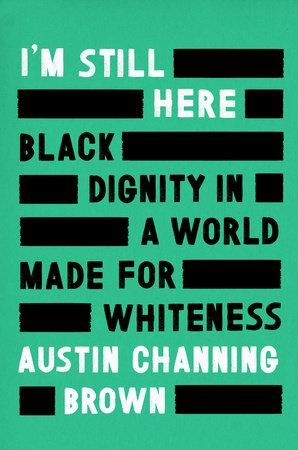
Book Review: “I’m Still Here: Black Dignity in a World Made for Whiteness”

One of our most grievous faults in this season of the world is our generalizations of people. Any sentence containing “those people” kind of words should alert us (as speaker or hearer) to our own sin (mine included) of separating humans based on our own criterion.

“Those Black Lives Matter people”, “those Pro-Trump people”, “those racist people”, “those white supremacists”, “those families”, “those non-maskers”, “those liberals”. (If this does not sound familiar to you, perhaps you substitute the word “people” with more colorful words.

This language can be a drug that distracts us from reality. “Those people” language falsely assures us that we belong to a people that is not “those people”. “My people” are not “those people”, the drug convinces you to believe.

In the past few years with the help of courageous authors, the lines of separation I had previously drawn between people has blurred. I’m not sure sure anymore which people are those people.

I think it started with “Between the World and Me”, by Ta Nehisi-Coates. This book is a letter written from father to son. It is famous and wise and heart-breaking. But I think the book that most profoundly created the blur was written by a woman named Patricia Williams, entitled “Rabbit: A Memoir”. (The Kindle edition is $2.99 for a limited time.) I listened to the audiobook. If you like audiobooks, it is a good read. The author grew up in Atlanta and experienced what is a normal life for many black and brown girls. While I was playing baseball with neighborhood boys at 12, she was having her first baby and her mom was too drugged up to care. Her story is devastating, but because she is a comedian, she has you laughing to crying before you even knew what happened. I could wish I hadn’t read it and didn’t know how awful life is at this very moment for so many young girls, but I did read and now I know. And the line is blurry.

The book I most recently read and loved that persists in wiping out the line of separation between people is Austin Channing Brown’s “I’m Still Here: Black Dignity in a World Made for Whiteness”. Channing Brown is about the same age as me, also raising kids, married, working, trying to make sense of the world and each person’s place in it and how we will leave it for future generations. My story is nothing like hers, which is why I need to hear what she has to say. I need a teacher who speaks from the edges into the comfortable middle where I live.

It is the Christian way to be wary of comfort. If we are comfortable with life, relationships, work, our faith practices, our prayers, watch out. Look around. Chances are, whenever we are comfortable, we begin to understand our own way of life as the ideal way of life. Our home, our routine, our neighborhood, our beliefs all become the right way to do things.

When I picture Jesus in the first century, I imagine him walking around edges, not in the middle. The edges of town, the edges of relationships, the edges of the synagogue and proclaiming the best news to the people outside the edges, on the other side of the blurry line (God willing the line remains blurry as opposed to rock solid).

Among Channing Brown’s wise words are these words about comfort: “Our only chance at dismantling racial injustice is being more curious about its origins than we are worried about our comfort. It’s not a comfortable conversation for any of us. It is risky and messy. It is haunting work to recall the sins of our past. But is this not the work we have been called to anyway? Is this not the work of the Holy Spirit to illuminate truth and inspire transformation? It’s haunting. But it’s also holy.”

The world is not yet as it should be. We have not arrived, but are always on the way. We know this to be true as long as the grievous phrase “those people” remains in our vocabulary.


How These Days Are Like an Onion

So how was your day? Really.

Did you jump to conclusions with someone else was talking? I did.

Did you finish someone’s sentence without letting that person finish it? I did.

These days. They are really something. These days are such an onion!

Did you wish it could magically be January 21st? I did!

Did you get short with someone in a conversation? I did.

Stop and consider what is stressing you out right now. Or are you worried about kids going back to school? Is your job extra hard? Are you fretting over summer plans and not knowing what the summer will look like? Are you doom scrolling too much news? Are you worried about a family member consumed by a conspiracy theory?

These days are like an onion with layers and layers. Layers of political angst, layers of work worry, layers of extraordinary family anxiety.

Churches may be worried about budgets, members who may or may not drift back, staff retention, how to preach in this political climate, a future with in-person and online community.

These days. When they seem like too much, that is, when you find yourself wishing this season was a different season, remember these days are like an onion. You and your neighbor are walking around with layers and layers. Peel them back one at a time. Be gentle on yourself and your neighbor.

Onions can be overwhelming. But not if we do the peeling together.

A Break From All That

(Note by Karis about her favorite animal.)

It’s been five days since all of it happened at the U.S. Capitol. Five days of news, photos, posts, and tweets, slowly moving us from disbelief to a bit of muddy clarity. Five days and let’s take a break from all that.

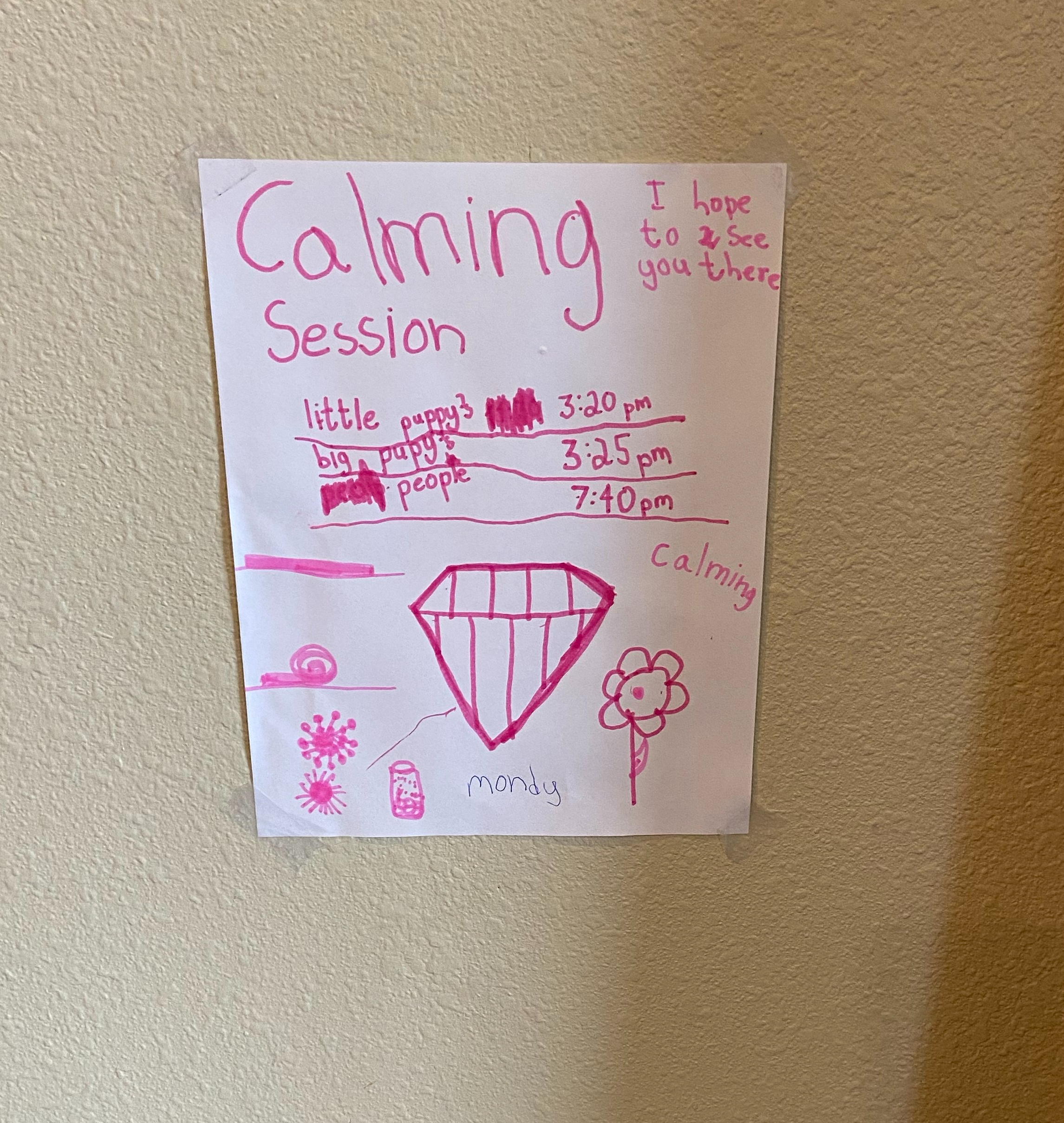
At my daughter’s elementary school, I am incredibly grateful to the teachers of Yoga Calm. She has several tools in her toolbelt to help her catch her breath and find some grounding when we need it, including calming bottles, deep breaths, and stretches.

Some evenings, she leads “calming sessions” with anyone in our house who wants to join in. Her dad and I both find it refreshing and we do actually sleep better! Her Yoga Calm skills have recently reached a new audience.

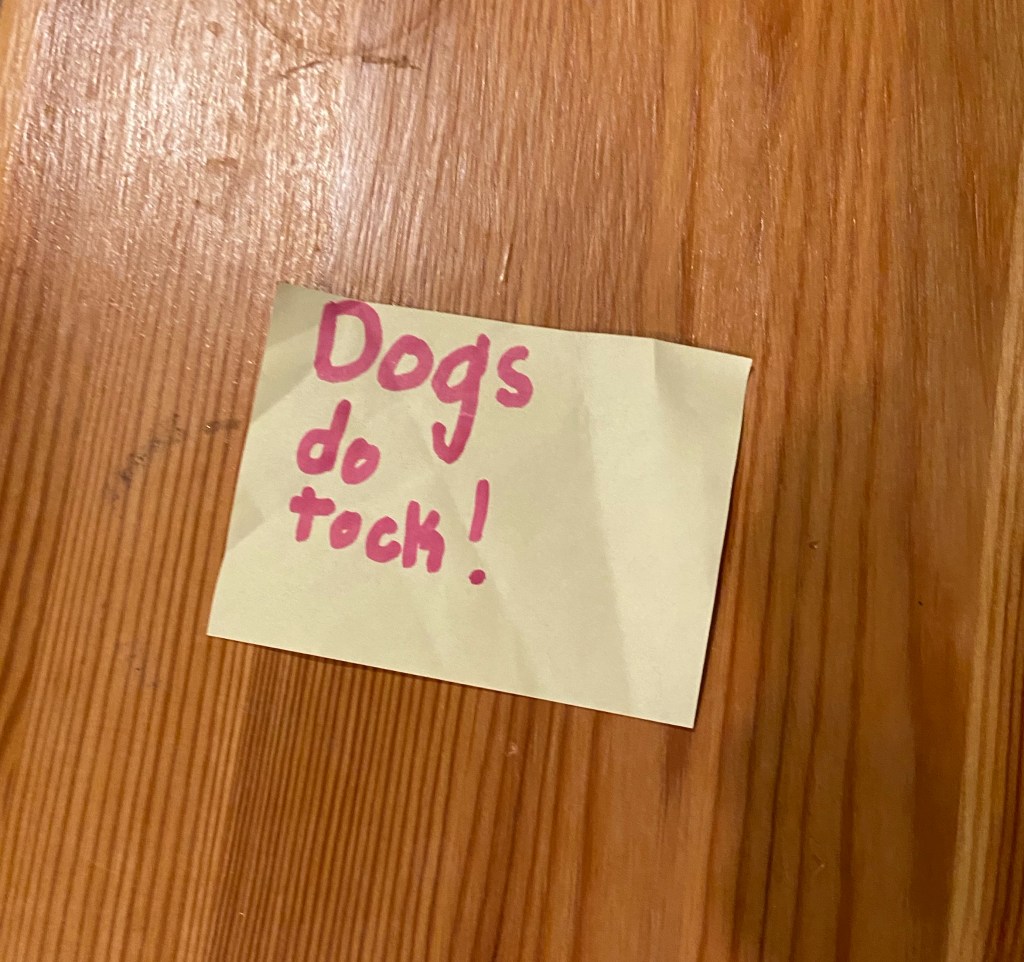
There are three dogs who live at our house. We call two of them the “big dogs”, whose hobby is bird hunting. And the “little dog” who only hunts for trouble. All three have been invited to calming sessions. Some time ago, she wrote the note insisting dogs do [talk]. If dogs can talk, of course they can do Yoga Calm. Today, she taught the class to all three dogs in the backyard, a feat equivalent to teaching 35 kindergarteners. In the unusually warm January air, she expanded their repertoire of calming tools. (She lures them in with treats, making her a very effective instructor. )

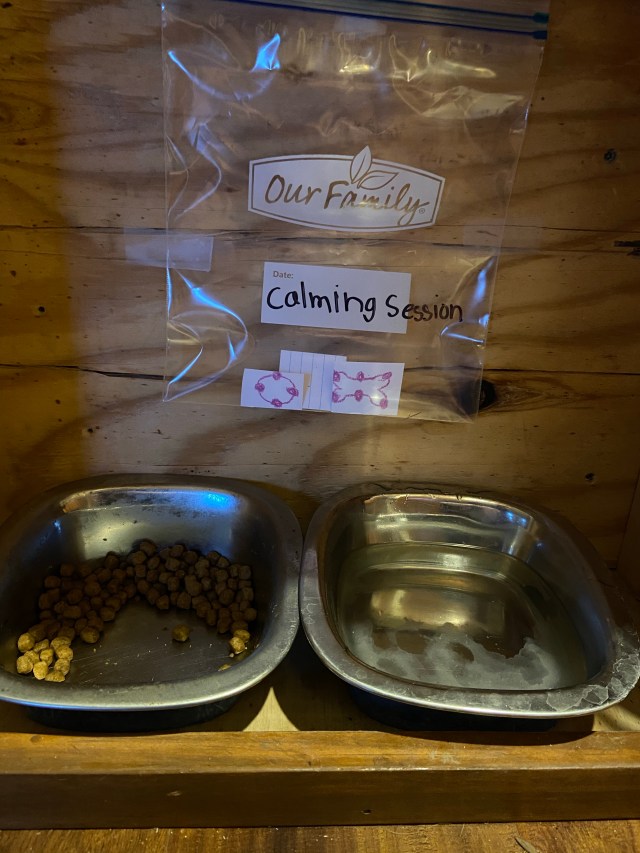
She also leaves tools where the dogs can easily see them, for example beside the little dog’s food and water. The tools in this bag encourage slower breathing, moving your finger (sorry, paw) from one dot to the next, one breath at a time.

The little dog hasn’t figured out how to open the bag yet, but I’m quite sure the sight of the bag is calming enough.

You should try it. On a piece of paper, draw a shape and scatter dots anywhere on the lines. Breath in from one dot to the next, exhale from that dot to the next one. And you, too, can be as calm as a Springer Spaniel, Yellow Lab, and Lassapoo.

A Most Memorable Day of Epiphany

(Photo by JOSEPH PREZIOSO/AFP via Getty Images)

As you know, this has been quite a day. What began as the Day of Epiphany and light unfolded into chaos, terror and darkness in the United States.

In that city, I fell in love…with coffee. At a Starbucks a short train ride from the U.S. Capitol Building, a dark roast with a splash of cream became the flavor of the city. Recalling my time in Washington, D.C. brings back the taste of that cup of coffee. My eyes were open to the delight of a cup of coffee.

When I indulged in that cup of coffee, I was between sessions at a preaching conference where I heard preachers with black, brown and white skin, women and men proclaim the unsettling peace of Jesus Christ. I’d heard the story before, but never from those voices, with as much depth as my dark roast with a splash of cream, and enough delight to make an old story new again.

The sing-songy words of the glorious preachers proclaimed a peace that does not emerge from power, but in spite of it. Jesus, their words taught me, ushered in God’s dream for the world, overcoming might not with more might, but with peace.

Jesus, I stake my life on it, is a teacher of humility and peace. When Christians sing of success and power and privilege, I know their tune is off. If only they could hear Rev. Jacqui Lewis, Rev. Richard Rohr, Rev. Walter Brueggemann, and the Most Rev. Michael Curry. If only Christians set on power could hear sermons making clear that any hope in success and power and privilege is precisely what killed the Savior.

Jesus spoke on behalf of people left behind by the quest for success, power and privilege. Today, watching the horror unfold in the capitol, I felt deep remorse for the people left behind in my own day, 2,000 years later. I am sorry I have been part of leaving behind my black and brown siblings in Christ. I am sorry violence in my own country’s capitol escalated to waving Confederate Flags in sacred spaces, carrying out a mission to make America the country it had been back when racism was even more normalized.

This is not the Christian way. There is no Jesus in that song of might, no Christian freedom where there is no humility and peace.

If you read the Epiphany story, you will find startling similarities to today’s events. Power is a most dangerous motive. Peace has more depth. And doesn’t need the splash of cream.

Book Review: “Bless This Mess” *****

Beware of parenting books. They should all be read cautiously and with acute awareness that no parent is perfect, no two kids are the same, and we are all parenting with only our best guesses.

This book, however, is a breath of fresh air and an unfolding of wisdom. I’ve been a parent for quite a few years and I know stuff. After reading this book, I know more. I would love to hang out with these two witty and honest authors! Even the story of how a cool pastor and curious child psychologist became friends and united in the front line craziness of parenting and then co-wrote a book is Spirit-filled.

If you are wondering how to talk to your kids about money or sex or sexuality, read this book. If you are wondering whether to take kids to church and why you would even wonder whether to do that, read this book. You will find a healthy theology not based on protecting kids from everything “of this world”. The premise is to accompany kids rather than shield them. The answer isn’t “go to church” or “monitor screen time more”. I found both grace and guidance in these pages.

Parenting is an exercise in intensity. The younger years are intensely exhausting. The older years appear to be emotionally intense. It is so easy to sit back and cross my fingers, but much wiser to stay in the ring. The authors of “Bless This Mess” provide some of the moves and strength to do just that for each state of parenting preschoolers, middle schoolers and high schoolers.

Beware of parenting books, for sure. But this one is an exception.