Sabbatical Last Corner

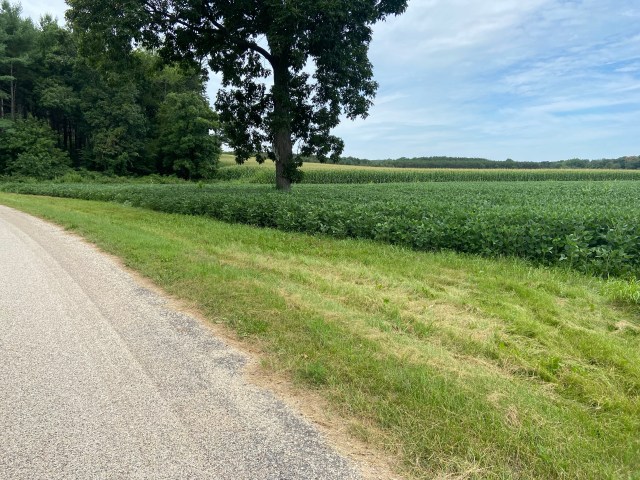
(Rounding a curve on a walk near Wisconsin Dells,
where my family vacationed last week.)

Here it is! The final day of sabbatical before re-entering congregational life. These past three months have been, as I have told you so many times, a gracious gift to my family and to me. What I haven’t made clear is how a sabbatical is a gracious gift to a congregation as well.

The last corner of a sabbatical begins tomorrow when I open the door to my cozy office for the first time in 12 weeks, set the books I read on their shelves, find a home for a new little sign I found in a thrift store, and finally, encounter people’s faces.

I have missed the staff at St. John and I have missed my worshipping community. In our time apart, so much has happened! The staff did their work week after week without me. What inside jokes did I miss? What went right/wrong that now makes for a great story? Who bought them coffee while I was away? (I sure hope someone did that!)

And what was worship like Sunday after Sunday? How did Jesus show up in the lives of the people in the pews and on Facebook and on the other side of the radio broadcast? They heard a faithful and creative line-up of preachers. And I missed the funerals of beloved members of our community. What else did I miss? And what did the congregation miss from me as I took a deep sabbatical breath and wasted so much time with Jesus? They will hear those stories from the pulpit. Hearing their stories is the trickier business.

Story-swapping is the last curve on the sabbatical trail. In the stories, we will hear what Jesus has been up to in our lives and in our community of faith. Those stories will shape the next leg of our journey together. Will my realization that I don’t take enough time to pray and reflect impact our community? What difference might my ponderings around worship, after worshipping in many communities in-person and mostly online, make in the one hour people are most likely to gather as members of the body of Christ at St. John?

The answers, I hope, will be found in our story-swapping conversations. So be ready, folks at St. John, to tell me what I missed, what you noticed, what you now ponder, too. And Jesus will meet us there.

Sabbatical

(Photo by Raúl Nájera on Unsplash)

A few pages back on the calendar, two things happened. I began my sabbatical and we entered road construction season! Near my house, a significant project continues where crews have been sweating it out week after week. Thanks be to God for people who make it possible to get from here to there.

The conclusion of the project near my house will be most welcomed by everyone. For workers, an end to the sun brutally beating down on them throughout this inordinately sweltering summer. For businesses nearby, easier access for customers. For moms, no more worry that kind-looking SLOW/STOP sign-holders are judging how often they drive by (sports practices, the pool, camps, coffee dates, repeat).

None of us will freely admit that sometime “down the road” in the future, we will do this all over again. No road is fixed forever! Roads, like people, require a substantial amount of regular maintenance to smooth things out. We never leave behind all the bumps. Always they exist, most noticeable when they rise to the surface, next to the patched-up cracks.

I am a couple of weeks away from my last day of sabbatical, which will happen before the end of the construction project is celebrated. Before the road is ready and perhaps before I am ready, I will enter the church building for the very first time in three months. (Such a sabbatical, by the way, is made possible by extraordinary ordained and lay staff and an encouraging Council. Thank you, Jesus, for every one of these people.)

These months have set me firmly in the slow lane. I have learned to look around and notice people, such as the people who live in the same house as me. I know them so much better now. I even talk more slowly most of the time. I learned to rest more, ask for help (that’s a fib, I didn’t learn that, I just wish I did), and to take time to write.

I like the slow lane. It’s quieter here and I don’t spend so much time worrying about running out of time.

It will take a few days or more, but I will merge back into the faster lane, even as I miss the slow lane. There is just as much to see in any lane you choose. What I learned in the slow lane will not be easily lost. I am too grateful.

So, down the road when the bumps present themselves, when cracks need patching, I can remember there is always a slow lane. It is open for any day trip, hour trip, minute trip to remember that we, like any road under our wheels, are never fixed forever. We wish repairs would happen faster and maintenance wouldn’t be so much work. But being human does require slow lanes, along with Jesus’ merciful maintenance of the bumps, and entire seasons of constructing self-compassion around the cracks. And somehow, that is enough to move you from one day to the next, from here to there.

Blessed Are the Curious Children, for They May Properly Embarrass the Grown-Ups

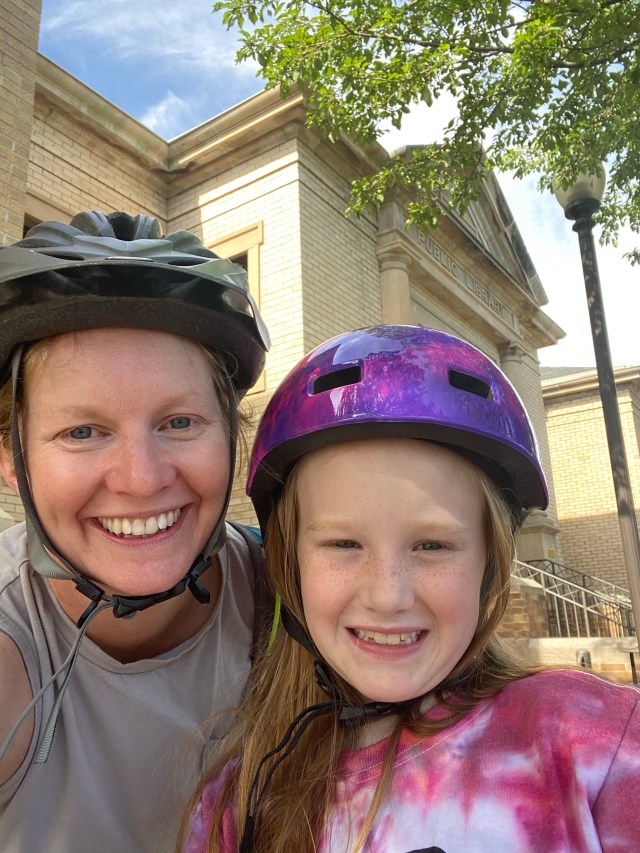
(After a bike ride to the public library)

You have one or have met one: The child who simply oozes with questions.

If my daughter were a Nerf Dart Gun, she would fire continuously. Some darts might be soft and painless while others would be oversized and spikey. And you would never know which dart was about to fire until it hits. She once asked a woman in public whether she was a boy or girl. She has asked two people who happen to be standing next to each other whether they might get married. And of course, the usual array of uncomfortable questions: how much a person paid for a house, how much money a person makes, why a single person isn’t married, when the newly married person will have a baby, and on and on, painting my face a deeper shade of red with each and every dart.

It is in a child’s job description to embarrass parents. That way, when the child grows to be a teenager it all evens out. Any embarrassment a teenager laments is simply returning the favor.

For most parents, we deal with moments of curiosity-induced embarrassment understanding this is how kids make sense of the world. They ask their way into the moment. They wildly wonder out loud.

Today’s Nerf Dart came in the form of: “Mom, why did dad marry you?”

This is a dart I had not seen before. I’m not sure I’d ever pondered the question! Why did he marry me 20 years ago? I had no answer. “Because we were young and didn’t really know anything” didn’t seem the appropriate response! She’ll have to ask her dad.

Isn’t it crazy that a 9-year old can pose brand new questions to a 43-year old? Age might invite wisdom, but adding years is not exclusively the formula to becoming wiser. Curiosity does that. Even if the curiosity makes you blush in front of strangers and friends! If nothing else, those who are curious are contagious with wonder and wonder might call us to see one another in a new way.

I hope to overhear my husband’s response to today’s question. It makes me curious. Perhaps I might ask it myself.

DELETED BOOK CHAPTER: Shoes

(Photo by Tamas Pap on Unsplash)

The book I wrote is a mere 1/4 inch tall when it lounges on its back. I kept it brief in order to be more accessible to women whose lives leave little margin to pick up a book. In the year it took to write all the words, with my audience in mind I may have deleted as many words as I kept. One chapter I nixed had to do with shoes.

Before exiting the hospital with a baby, I had no idea the plethora of pairs of shoes required per set of growing feet per year. Soft-sole shoes for learning how to walk. Hard-sole shoes for walking outside. Shoes for soccer, baseball, basketball, gym, and dance. Boots for hunting. Boots for winter. Shoes for running. Sandals for summer. Shoes for church and other such occasions that require looking spiffy. I can NOT remember needing so many pairs of shoes when I was growing up! Perhaps feet have gotten needier?

Growing feet belong to growing bodies belong to human beings who are constantly changing…growing! And requiring shoes that fit their feet. A child puts on a pair of shoes and notices his toes are pinched. And finally, you rest your eyes on the teenage human with size 11 shoes who fits in the driver’s seat of the car where his giant feet push actual pedals!

Each time the shoe size increases, so does all the stuff they can do in those shoes. Drive a car. Walk into high school, college, a job. Judging from the growth of their shoes alone, kids experience a steady and astonishing stream of change. Just when their shoes get broken in and comfortable, they are suddenly too small.

“It’s okay,” loving adults around them say with words and sometimes cookies and also hugs (whenever allowed). “No matter what changes you are still you. You are so loved in each and every shoe size. You are a wonder in that growing body God made. You are expensive, you shoe wearer-outer and out-grower! Even so, you will never outgrow God’s love, wrapped more tightly around you than a too-small shoe. Which…I can see you have going on there.”

Messy Make You Awesome

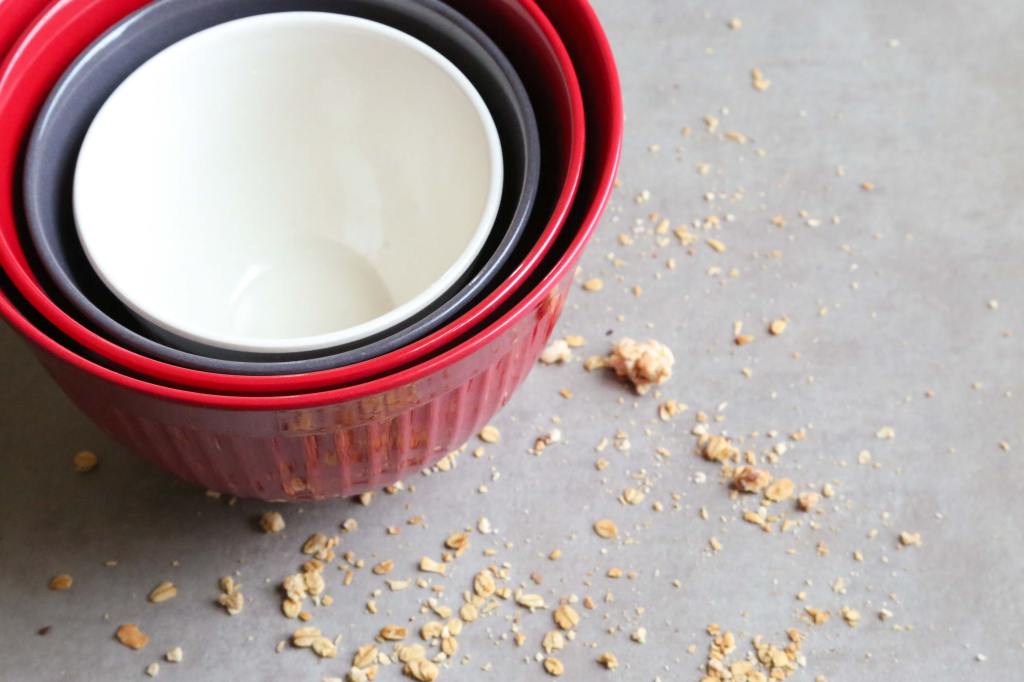
Oh, how I would love to open my kitchen cabinet doors to discover a gleaming oasis of organization. Instead of moving mixing bowls to get to a serving bowl, all bowls would be equally accessible. Some people’s dreams are inspired by dramatic home renovations on HGTV. I simply long for less crashing when I reach for a bowl.

Until the day arrives when only my husband and I open the kitchen cabinets, the crashing will persist. There is no possibility of an oasis for now. Like the lives we live, the cabinets will be messy, imperfect, oasis-less.

I have rounded the corner to the last third of my congregation’s gift of a sabbatical. The abundance of time I have to hang out with Jesus in prayer, to say yes to late night conversations with kiddos and my husband, and to Uber my kids here there and everywhere will shift in a month.

In my morning devotions, a question posed was whether I carry around heavy burdens from my past. Whether old sins linger and weigh on my shoulders. For me, it is the little things that snowball into a heavy burden. It is the everyday obnoxious, pestering questions:

Did I do enough for my family? For the church?

Whom did I disappoint?

Why did I say that?

Why didn’t I say that?

Could I have done that better?

Those are the pesky questions that keep me up at night and scratch at my soul, more than heavy burdens from my past.

And so, when I opened the kitchen cabinet and moved three things to get to a bowl this morning, I wondered if God was reminding me there is no oasis here. No organization or perfection to simplify life. As long as your heart is involved and your daily work (at home or anywhere) involves leading with your heart, you are in for messy cabinets, messy calendars, messy moments, messy sleep schedules. As long as you deeply care for people, do not expect perfection in your pantry.

This is why I wrote myself a note today. While the previous paragraph makes complete sense to me right now, in a couple of months when the messy cabinets are messier and I long for more time just to sit with Jesus, I will need a reminder. I will need a reminder that life with people involved is like needing the bowl that happens to be tucked into the corner, behind three other things. Always there is reaching and crashing. Remember, the note will nudge me, messy cabinets accompany life. The reaching, perhaps, could sound like Jesus’ reaching for me when I get stuck in the pestering questions. The crashing, perhaps, could sound like the slippery waters of baptism protecting me from the sticky burden of worrying whether I have done enough, or whether I am enough.

The moral of the story: If your cabinets are messy, you are awesome. Or more importantly, you are enough. And that is awesome.

Thanks for the Who

In the book, Burnout: The Secret to Unlocking the Stress Cycle, authors Amelia and Emily Nagoski suggest two lovely gratitude practices.

  1. WHO: Give thanks for someone(s) in your life.
  2. WHAT HAPPENED: Give thanks for something that happened that day.

These two practices are inspiring and avoid an icky result of most gratitude practices. Giving thanks for a who and a what happened prevents us from giving thanks for things. Giving thanks for things leads us to be thankful that we have things. Then we notice people in the world who don’t have things, which leads us to feel guilty that we do have things while others don’t. And gratitude becomes an exercise in guilt.

I am excited to practice giving thanks for some of those who are who in my kids’ lives. (You made it to the end of that weird sentence. Good for you.)

*Thank you, Lord, for Driver’s Ed instructors. What were they thinking? Keep them safe.

*Thank you, Lord, for coaches who set aside a ginormous amount of time for an often thankless job. Keep them sane.

*Thank you, Lord, for grandparents. May the trade-off of too-much sugar for so-much sweet grandparent love all work out in the end. Keep them smiling.

*Thank you, Lord, for gracious strangers who reveal comforting kindness at just the right moment, such as when a kid on a bike needs to cross a busy street. Keep them plentiful.

*Thank you, Lord, for the moms who are absolutely real when my kids come over to hang out. For the way they feed my kids with food, hospitality and an honest glimpse at the truth that all our homes are often hot messes. Keep them real.

*Thank you, Lord, for Faith Formation Directors (Christina Jorgensen) who mail my kid a cute card after an amazing week at Bible Camp, who promise that faith in Jesus is cool both at camp and everywhere else. Keep them in that particular job for a very long time. Please.

Thank you, Lord. Thank you.

The End.

Why I Don’t Tell My Kids God Has a Plan

(Photo by Idella Maeland on Unsplash)

It seems like the standard, automatic Christian response: “God has a plan.” Why in the world would I not say that to my own kids? Because this Christian mantra makes me uncomfortable. Let me tell you why.

I notice the words are spoken in the face of events we do not understand and would like to make sense of: cancer, tragedy, a difficult transition, or an uncertain future. “God has a plan,” the Christian deduces.

Perhaps saying these four words will provide a sense of comfort when our kids face trials (from heartache to addiction), or intense decisions (from how should I dress to whom shall I marry). We hope in these words to remind our kids they are part of a bigger design and God has it all under control. However, I suspect these four words dilute the incredible gift of God’s presence.

For at least three reasons, I avoid this Christian phrase.

  1. If everything is in God’s plan, then the terrible thing becomes part of God’s design, too. With this mantra, we tell our kids they may be destined for cancer or heart disease or divorce or addiction or fetal demise or a fatal accident because God is just that kind of event planner. Nations are meant to go to war and domestic abuse is a thing that happens. And who determines whether something is or is not in God’s plan? This seems very confusing both to kids and grown-ups.
  2. This notion really sucks for the poor. If God’s plan means some humans are impoverished while others are not, we risk placing kids in a position of inherent privilege. They are simply “the lucky ones,” which is how slavery persisted and how Hitler did his convincing. A strong enough belief in God’s immutable plan abdicates kids from the messy and complex work of loving our neighbor. A plan is straightforward, but loving our impoverished neighbor is anything but.
  3. Christian words meant to eliminate complexity make me nervous. Reducing confusing things to “God’s plan” releases us from the hard work of sitting with God and wondering. All seasons of life require reflection with God, an unpeeling of the many layers around each difficult experience we encounter. An automatic response discourages kids (and grown-ups) from deep conversation with God about the complexity of human life.

God’s plan, I hope to help my own kids understand, is to walk with them, listen, encourage and comfort. It is to set the people they need in their lives at precisely the right time. God’s presence is enough of a plan.

And You Thought THAT Felt Scary?

(Photo by Ivan Shemereko on Unsplash)

So many years ago for the very first time, I witnessed the pink lines on the stick. That was scary. What was happening in my body at that moment felt scary. The feeling intensified when a “helpful” co-worker told me, “Just you wait. A few weeks ago before my first child was born, I sat weeping on the steps in my house, wondering how something the size of a watermelon was going to come out of me.” “Thanks for the encouragement,” I did not say.

Outside the entrance of Mercy Hospital nine months later, Marcus and I loaded up our first born, trying to make sense of the car seat situation. We were now responsible for a human being’s survival! That felt scary.

In the next several years, we would leave our kiddo and then kids with a babysitter, then a day care provider, then a teacher. Each time, that felt scary.

We would leave them behind at a new school, a camp, a sleepover at a friend’s. Today, one of my sons walked alone into a room to take his permit test. He didn’t say it, but I knew it felt scary. Big questions, big stakes. He passed.

He left behind the part of his life in which he could not drive, only bike or walk or sit in a passenger seat. He left behind some of his dependence upon me and in doing so, he now shares some of the scary feelings with me. Moving into a new season of life is never without them. The scary feelings accompany independence.

In an audiobook I’m currently reading called Learning to Pray, James Martin, SJ, suggested talking to God about feelings such as these, and asking God what these feelings might mean. What does it mean, God, that I am scared when my kiddos gain independence. Along with that question, he offered another. Who is Jesus for me?

What do these feelings mean? Who is Jesus?

I feel scared when my kids gain independence perhaps because I worry whether Marcus and I have equipped them enough for that particular new independence. Of course, I feel scared for what might happen, scared for so many reasons. The scary feelings are simply too much for me to carry on my own.

Kids absorb some of the scary feelings when they gain independence. While I am still responsible for a human being’s survival, my kids are big enough to carry much of that responsibility, too.

Still, the scary feelings can be overwhelming. Jesus, then, is the porter who carries the heavy, scary feelings not only as far as your hotel room, but to all places at all times. He is the companion who does not leave my kids even when I leave them at a new school or a friend’s sleepover. He is the friend at camp and the passenger in the car.

Jesus is the one who reminds me the scary feelings are fine as along as they do not hinder the independence. (Easy for him to say.)

In years to come, at my child’s graduation, wedding, or who knows what, I will look back on the day of the permit and giggle at myself. “You thought THAT felt scary?” I’ll say. But I’ll say it more nicely than that co-worker. I don’t need to be a jerk myself.

Can You Judge a Book By its Title?

A book is thousands of words that come to be known as a few words; or possibly as one word. A book is known as however many words the writer chooses for its title.

For the first year of its life, “Spiritual Longing in a Woman’s World” was known in my head as “Joy Comes in the Morning”. Names change. This is true when you are formulating a name for a child. Tom may have been Ella, Sam may have been Hannah, and Karis may have been Adam. Only the last chosen name matters.

Here is how the last chosen title came to be. It’s a long/short story.

We bought a dog. He needed walking. I needed walks.

One day on a walk on the corner closest to my house, the words “spiritual” and “longing” were given to me. Words are gifts, you know. Paul speaks of words given to him as a revelation in Galatians 1. Mary Oliver spoke of the famous poem “Wild Geese” as a set of words given to her. These two words that now begin the title of my book were simply given to me in the quiet space of a walk. The next words, “in a woman’s world” quickly followed.

Spiritual because we are spirit-filled bodies. We are so much more than limbs and brains. Longing because we are created for longing. We are created to long for only one thing: the love of God. And yet, so many other longings get in the way. We long for perfection, a different image, more money or power, for happiness. None of these longings fill us. Only the love of God meets the deep longing in our spirit-filled bodies.

On a walk, those two words were given to me. Words are not reserved for writers. I have a hunch there are words God has for you today. Words that meet that deep need in your soul. Words needed for healing, guidance, strength. Words for peace, hope, or mercy. Whatever words you need, you will know them when you hear them. They will be given to you.

Words meet you in the quiet spaces of your life. When you set down your device, take a deep breath or 20, and sit still. If your mind is too chatty for too long, there is no space for the words to get to you. Ask a partner, a neighbor, or a friend to help you locate the quiet space. We do need help to clear adequate space for quiet. You are not needy to need quiet space. You are human, therefore you require quiet space to let the words find you. God gives you people in your life who are there to do such things as clear quiet space for you.

I hope you judge this book by its cover and find yourself some quiet space. Let the words, the ones you need today, find you there.

Focus Beyond the Family (Part 3/3): “Kids, the world is bigger than your baseball game.”

My kids and I spent Memorial Day in my hometown of Sherwood, North Dakota. Two miles from Canada, I grew up understanding a border to be peaceful, and international neighbors to be neighbors. Each year, roughly a week after joyfully arriving at the last day of school, students were called back to school to take part in the annual Memorial Day program. You can read more by clicking on the link in the photo caption.

In a nutshell, Memorial Day in Sherwood typically begins at the Canadian/American border, where Canadian veterans and members of the Royal Canadian Mounted Police, and American veterans and local police officers march from their respective ports to the borderline, where they exchange their nations’ flags.

People my age and older recall riding a bus from Sherwood School those freezing mornings (my memories involve freezing rain, but maybe I’m exaggerating) with our instruments and joining the march to play…something…I can’t remember…I’m sure it was “lovely”.

The program continued at the school, with a choir singing each country’s anthem as well as the songs of each branch of the military. A slideshow, which has evolved into an impressive video production, displays pictures of each of Sherwood’s veterans who are now deceased.

Next, the program moves from the north end of Main Street where the school is located, to the south end where a stone memorial at the city’s fire hall commemorates two men who died fighting an oil fire near Sherwood in 1991. The program concludes at the city cemetery, where a designated person places a wreath on the tomb of the unknown soldiers.

Each of the 84 years of this program has drawn a crowd, often including the governor of our state. It requires a great deal of planning and manpower, even though the number of volunteers to pull off such a program has dwindled over the years, in proportion to the shrinking of a small town like my hometown.

This year, even though the border portion of the program could not take place because of the pandemic and closed borders, I wanted my kids to spend Memorial Day in Sherwood. We sat on the bleachers, just as I had for so many of these programs, just as I had for the funerals of the two men who perished in the oil fire.

“Kids,” I try to remind my own, “The world is bigger than your baseball games, your jobs, your hobbies, your accomplishments.” When a moment arises to gather for something that is not kid-centered, I find those moments invaluable. Every kid, every grown-up, every human needs to know we are small parts of something larger than ourselves.

Not long ago, I admired the parents who spend so much of their time and money coaching kids’ sports teams. Volunteer parents receive very little gratitude for the sweat equity they have in their kids’ sports. Now, however, I am not so sure. I am starting to wonder about the danger of living in communities where we spend much of our free time and money watching our kids’ activities. Kids learned to be watched and adored or yelled at. They get to be part of a team, and that offers good life learning. But the humble act of sitting in the bleachers and hearing a story you’ve heard so many times about people whom you will never know, but whom you do know played a part in your living where you live…I suspect this is how we practice being human together.

Regardless of how I feel about war and politics and American flags, I need my kids to know they live in a community. You live in a community. Every one you know lives in some kind of community. A community functions best when we all proclaim a singular hope to make them community better for everyone.

My generation has often exchanged shared communal activities for kids’ sports, my own family included. I wonder what that means for the next generations. Who will set out the chairs for the community program? Who will organize the order of the program? Who will do the work of telling our story? It is a story that is not mine or yours or theirs, but ours. A story we may not even tell precisely the same way. (All family stories are like that; we do not remember things the same.)

I hope to raise kids who know that the responsibility of living in a community falls on them. Jesus’ call to love a neighbor is a call to them. The yearning for peaceful borders is not something to entrust to someone else.

Kids’ busy lives are not the whole world. The world is bigger as much as it is filled with possibilities for them to make it better. I only believe that because a community taught me, year after year on freezing Memorial Day mornings when I thought school was over but apparently it wasn’t because I needed to sing “O Canada” and play taps and occasionally I found it all very boring.

Now, I get it.