Six Words to Avoid

Last year, the book Embodied: Clergy Women and the Solidarity of a Mothering God got me wondering. Pastor Lee Ann Pomrenke invites readers to notice the unique lens through which women who are clergy understand their work. (For simplicity’s sake, I’ll use the word “pastors” to include both deacons and pastors.)

Pastoring and mothering kids share more in common than I’d realized in the early years of my vocation. Both involve caring for people in a way that surrenders the course of our lives to other people’s lives. Pastors and mothers may plan their days, weeks, or years, but the trail is blazed by the people whom we love. For mothers, careers are temporarily set aside to care for family. (Less often but sometimes, fathers do this work.) For pastors, family vacations are shifted when a funeral comes up. For both mothers and pastors, holidays are self-sacrificing and labor-intensive in order to create memories for others. You carry around your own examples, pastors and moms, of the way your life has been shaped by your generous love for others.

Reflecting on the past couple of years, I am noticing something else pastors and mothers share in common. A less obvious commonality between pastoring and mothering can be found in the way we either empower or disempower the people whom we love. This is some of the hard, hard work of pastoring and mothering! If we peel back the layer of “It’s easier to do it myself”, we notice we are keeping other people from doing it themselves.

Time for an example! Preparing for a Sunday off this week made me realize I’m the one who turns on the sound system and sets up the Facebook Livestream even though there are ushers and techs who are perfectly capable and willing to do this quick and easy work. During the course of the pandemic, pastors did the majority of the volunteer work for a spell and I became accustomed to “it’s easier to do it myself.” But now, there are plenty of fingers to press the green button to turn on the sound and type in a welcome on the livestream.

At home, the more work I can teach my kids to do (laundry, cooking, cleaning), the easier my life is. But this is daily hard work! It’s finding a balance between encouraging and nagging, teaching and letting go, caring and not caring. Empowering others is messy, grinding work at the same time it is the most faithful work demanded of pastors and mothers.

I know the balance is off when I get crabby. When my kids don’t do their laundry or chores or the sound system doesn’t get turned on or something else gets missed. Crabby is like a warning light reminding us to step back and notice whom might we empower and rely upon. The truth is, it isn’t easier to do it myself again and again. It is easier if others know what to do and how to help.

I was sure by the time I’d been a pastor for 17 years and a mother for 15 that I would have a better grip on these things! But life is never like that. Humans aren’t wired to learn most things once and for all. We learn again and again and then once again. And in the learning, we learn (not once but again and again) to be gentle on ourselves, to loosen our grip on life, and to give thanks for the people whom we love who shape the course of our lives.

You Made Plans? That’s sNOw Interesting!

You don’t understand. My plans were solid! Holy Week is meant to look a certain way. I should know, I’ve been through a few. Holy Weeks include sermon writing and mostly visitation of homebound members. Me and my trusty Communion Kit make the rounds and church is brought to the people who may not get to church for Easter Sunday. I know this was the plan because I wrote it all down!

But then snow…more snow…and a little more snow to top it off.

Suddenly, all the plans are in jeopardy, even the ones I wrote down! And I am feeling a sort of deja vous feeling. I remember not long ago writing down plans and none of them happening. I remember an orderly calendar layered with eraser bits. I remember not liking it!

The thing about revising plans is that it often takes a few revisions before we land on the plans that actually happen. Take, for example, Maundy Thursday. With eraser in hand on Thursday morning, was our next plan to worship in the building or only online? Could I even make it to the church building? Would I get there in a pick-up or would my neighbor take me on his snowmobile? Would a musician be able to get there to lead worship with me? Or would it be a solo job? Was there too much wind and snow to even get to the building on snowmobile, leaving a service at home to be the only option? And then would I be crossing my fingers that the kids don’t choose the contemplative moment of neighborly handwashing to argue over the last donut?

But today is Saturday, so clearly it all worked out, as it always does. Peering over my shoulder at the past few days, I once again learn the lesson that no matter how solid and admirable and efficient my plans may be, they will not hold up against a blizzard, a pandemic, or whatever might befall the human race next time. There is no formula that states the more thorough the plan, the more likely it is to play out.

If I’ve been through a few Holy Weeks, then I know life is lived in the letting go. We fully live when we hold onto plans with a loose grip, never so tightly that we cannot let them go. Our life is not lived in plans, but in the many ways God’s grace can be seen in the eraser bits. In the way that neighbor of mine would have taken me to church on his snowmobile. In the way my son could come with me to church to record the service. In the way that the only reason for a Maundy Thursday service at all is because God, in the inerasable love of Jesus Christ, has come to open our hands and fill them with mercy.

Got plans? That’s sNOw interesting. They may not hold up; you may need your eraser at the ready. And what you will find is a mess of mercy.

The Avoidable Question

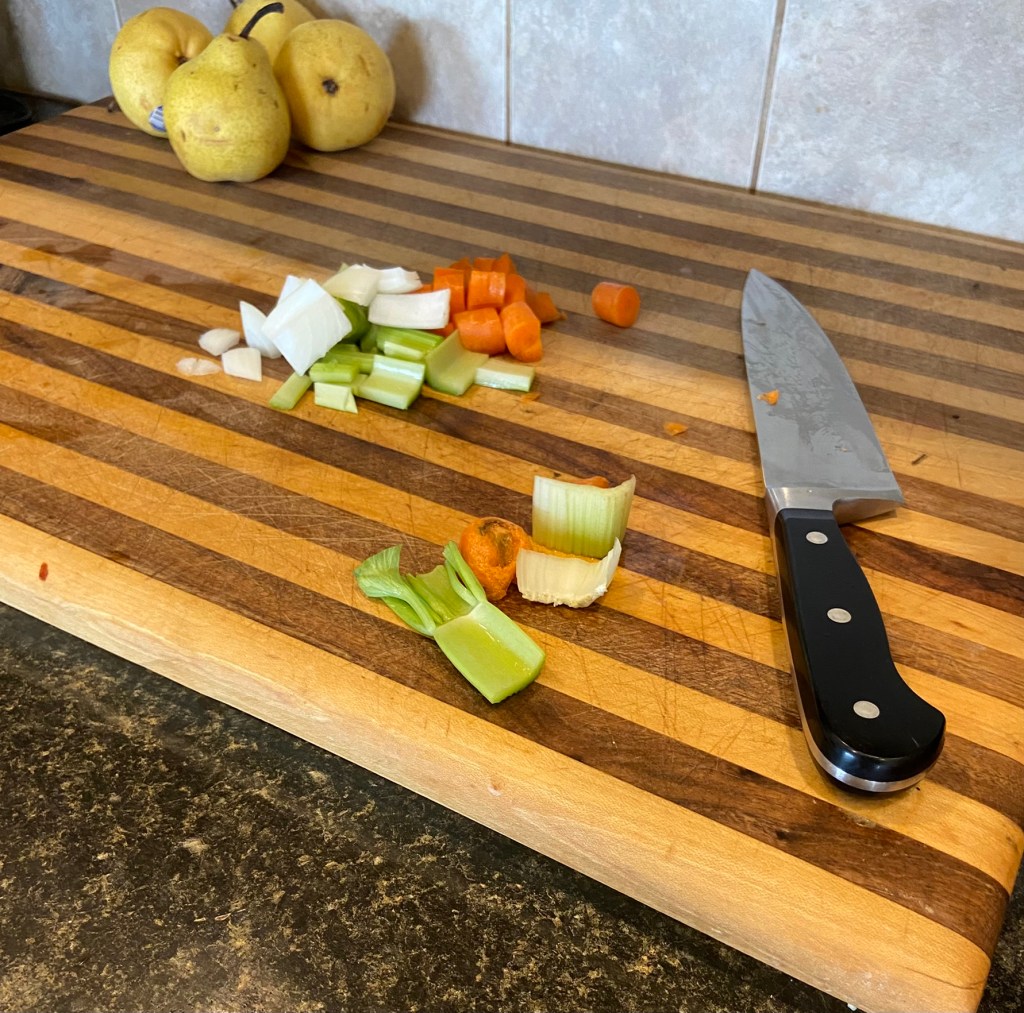
Vegetables ready to flavor Marcus’ Chicken Noodle Soup and pears to sweeten a smoothie.

There are times when it is the question, not the answer, that is hard to come by. Questions can be asked or avoided, but first there must be a question. What question, tucked deep in your heart beneath a thick layer of pride or something else, lays waiting for you to ask?

Reading the novel Apples Never Fall this weekend, I was reminded of a question I asked late in my marriage. It took a decade for me to unearth this simple question that grew in urgency as the years accumulated. I won’t spoil Moriarty’s book when I tell you one of the characters struggled to find the same simple question!

I shared the story in my book about being called as senior pastor and needing to let go of some of my daily work. Among the hardest stuff we do as people (especially as women?) is to let go of some of our daily work. It is ridiculously hard for me to let go of the need to tidy up the kitchen and stay on top of the laundry. Honestly, who cares! But I sacrifice valuable sitting, playing or reading time with this ridiculous need to tidy up. But I digress.

Before I began my new call, I had asked my husband a question that began with an admission: “I need more help from you.” Marcus and I talked through the question, “What might I let go?” He immediately agreed to do the weekend cooking, leaving enough leftovers to stretch through most of the weekdays. For the last seven years, his response to my question has loosened the tension of work at church and at home. Had I not asked it, my kids would not be eating as well (last night he made homemade French Fries!) and I would be grumpy about cooking.

The question we tend to keep tucked away where no one can see it is some variation of: “What do I need?” Most of us find neediness to be a character flaw, so we avoid needing anything from anyone as best we can. We have complexes about keeping scores even and so we try to stay ahead by needing less. This, my friends, is dumb.

Pacing through Holy Week one day at a time, we should become poignantly aware of our neediness. “What do I need?”, we might ask our needy selves? The question is surely avoidable, but if we summon up the courage to inquire, we will be freed by our admission that we need help, forgiveness, a hug, a kind text, a meal, carpooling partners, a grocery run, coffee with a friend, a walk, a Savior who exchanged his life for our forgiveness. Without our neediness, there is no need for grace, the perpetually uneven score. Avoid the question and avoid the rich response of mercy. Peel back the layers of your life to find that question, and trust that the answer just might surprise you.

The Best Summer Job

(Photo by Tegan Mierle on Unsplash)

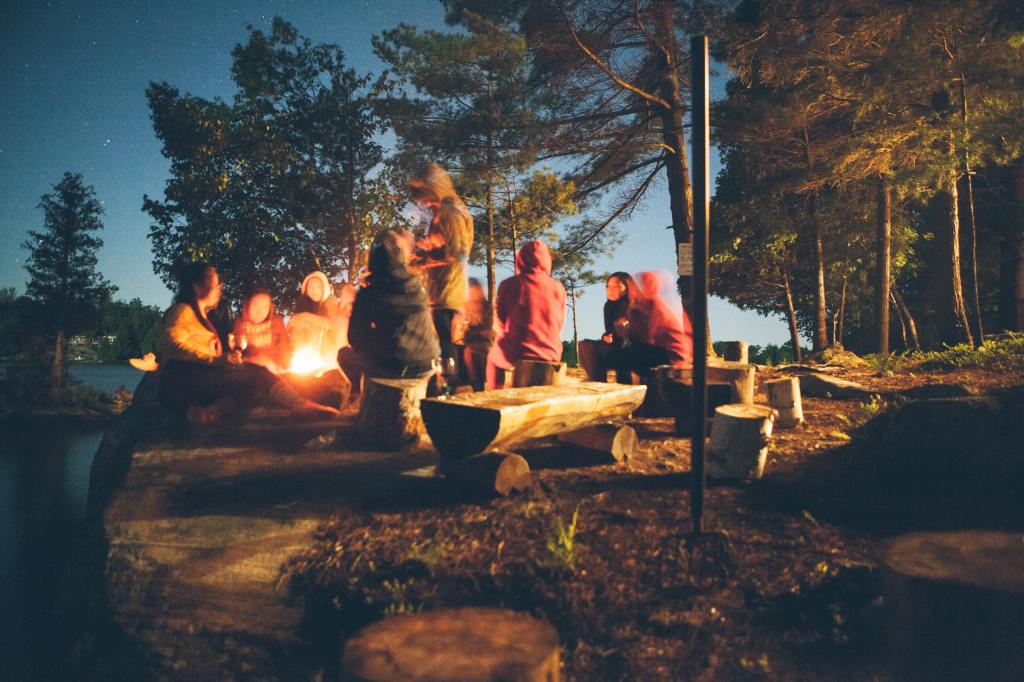
Seats around a campfire are sacred. Since the invention of fire, humans have encircled them to swap stories, learn from one another, and stay warm. I recently read Tish Harrison Warren describe their backyard firepit as the place her family has felt particularly connected since the beginning of the pandemic. Campfires illuminate the dark night with pops and crackles, often a soundtrack of belonging. Add an additional soundtrack of your favorite Bible Camp campfire tune and you have discovered the best summer job!

The denomination to which I belong, the ELCA, has a strong tradition of outdoor ministry. It is likely some of the most unique and creative pastors you know were once counselors at a Bible Camp. No job description for a camp counselor could capture all the job entails, but a simple phrase might suffice: “Be ready for anything, including exhaustion and elation in the very same minute!”

I had zero desire to be a Bible Camp counselor. My singular experience as a camper was the summer between 7th and 8th grade when I went to camp knowing almost no one and mistakenly hoping junior high girls would be kind and welcoming. You can imagine how that went!

But by the time I finished my second year of college, the sting had gone away. A beloved professor at my college was married to the Executive Director of Metigoshe Ministries. His need for additional counselors converged with my lack of summer employment, so off I went to camp, again knowing almost no one. This time, however, I would not leave camp sad, but changed.

Camp staff often explain their work by saying the days are long, and the weeks go quick. A day of camp is filled to the brim, making your daily life a constant pouring out of Jesus’ love. This work is not easy, but no work that truly matters ever is. Work you do that changes lives requires your whole life, not a few hours of it, not a little bit of your energy or time, but all of you. Your heart, your mind, the very self God has created is meant to be shared.

My own experience as a camper sharpened my vision for campers who felt left out. In fact, that very camp skill has followed me around, keeping an eye out for the forgotten ones. Much of the skills I acquired at camp, however, are not all directly transferable. I don’t get to give mud facials even though I wasn’t too bad at that. I don’t dress up in crazy outfits, chase children at night, shingle a roof, toss greasy watermelon, or help construct outhouses in my work as a pastor. Those remarkable skills have gone untapped.

So much of what I learned took place in the same type of circle in which people have been learning since the invention of fire:

  • One fire is enough for everyone, even better if you have to squeeze together.
  • Whether or not you can sing, music gets to you with the promise that you belong right where you are.
  • Life is not lived in your own seat but in a gathering of seats among people meant to be different from you.

The nightly campfire tradition of Bible Camps is perhaps what makes the transition from Bible Camp to whatever is next for camp staff profoundly difficult. Outside of camp, days rarely end around the sacred space of something equivalent to a campfire.

Right now, there is a young adult whom you know (or maybe are) who is waffling about summer plans. Tell that person there is a seat at a campfire just for them, as long as they desire to do work that matters. If money gets in the way of their decision, could you do what I know a camp staff dad often did, and subsidize that person’s income with a little of your own money? That’s an investment in the work of the Spirit, I assure you. Maybe you could get a mud facial in exchange! Maybe.

So Broken I Need Jesus

Really, Iowa? What the heck, Kentucky! I’m getting my butt absolutely kicked in the family March Madness competition. I didn’t really need that $20 anyway, right?

Oh well. The truth is, I am one of those annoying fans who jumps into men’s college basketball at the very end. Only after the players have sweated through an entire season do I even sort of begin to care. The losses that broke their hearts, the injuries they recovered from, the victories along the way. I know none of it. I do know my bracket is completely broken and I am currently in 18th place of the 18 people in our group!

Nonetheless, I have come to terms with my brokenness over the years. A broken bracket, like broken me, is not the end of things. I have come to terms with life as it waffles between easy and hard, joyful and sorrowful, hopeful and disheartening. Tomorrow will come and I will mess it up/get something right all over again. I am so broken, I need Jesus, and there he is.

Preachers of mainline congregations tend to wonder how much that particular truth resonates with people who gather with us for worship. Do they come to worship (online or in-person) for the familiar tunes or for the tunes that find the crack in our hearts and seep in? Do they come for words to comfort them or to comfort the poor and forgotten? Do they come for a deep drink of the Spirit of life or to become vessels for others to take their own deep drinks?

Maybe they come because they are in 18th place and lost their $20 and are processing the shock of their brokenness. How did it come to this? I thought Iowa would see me through, but none of us are immune to disappointment. And yet, the one who has come to put our broken selves together does not join us only in the end, like I do in this tournament. The one who cares most deeply for your brokenness is there through every broken heart, injury, and victory. Now. Later. Always.

In the Noise and in the Silence

It took me years upon years to learn why parenting littles was absolutely exhausting. Aside from the sleep deprivation and the fact that often our most demanding work years fall in the same season, kids require every iota of an introvert’s energy. Did my sons, whose birthdays fall within twenty months, care that I identify as an introvert?

Toddler Sons: “Mom, play cars, trucks, tag, push me on the swing, read me that book, watch me, watch me, watch me!”

Mom: “Actually, the introvert that is me requires blocks of quiet time and alone time, so I’m just going to sit by myself for a while as you risk your life being a toddler.”

Toddler Sons: “We completely understand. Go and feed your soul while we sharpen knives in the kitchen.”

There is no “tv timeout” that allows for an introvert to recover from so much people time. Even time with our own family in our own home as any introvert knows, can be over the top exhausting.

I’ve been recalling this as my kids are older and do actually allow introvert recovery time. They do their own thing, have their own friends and do not demand, “watch me, watch me, watch me” all the live long day. I can sit and read chapters of a book. I can take a walk. I can drink a cup of coffee while it’s steaming hot.

It is easy for me, too, to do my own thing. And yet, a fundamental need for all humans beings requires sitting together some of the time. Even if no words are exchanged, each one of us needs someone to regularly look us in the eye to assure that we have not mistakenly put on an invisibility cloak. I need your eyes to assure me I matter to you.

I recently sat with an elderly dude whose entire world is about to change. He told me his story a few times in the half hour or so we sat together. I didn’t need to say anything, but my eyes (and I suppose my ears) assured him he was heard. Words matter less when the person you sit with knows he matters to you. I did not know him well, but I did know we are both beloved children of God who need someone else’s eyes to remind us God sees us, too.

In the noise of life with young kiddos, we assure them they matter with our songs and silly conversations and with pushes on the swings that surface the giggles. As we grow older, it is often in the silence that we come to know and remember someone notices we are still here. Hanging out in this life, as unsure as anyone else what comes next.

Why Should I Have Coffee While They Flee?

(Photo by Engin Akyurt from Pexels)

While I was writing Spiritual Longing in a Woman’s World, the death of George Floyd set the spotlight on black voices begging to be heard. My eyes were opened by Austin Channing in particular. I began to wonder whether my book had a place at a time like that. Who am I, with my long history of supportive family and pastoral calls that came easily to me, to speak of longing? After more prayerful wondering, I understood there is never a perfect time for anything. If I waited to publish my book, there would certainly be another set of voices longing to be heard.

Today, ordinary women (like me) seek refuge in places far from home while their ordinary husbands (like mine) stay put to make possible their return. And here I am, a half-turn of the globe away, with my hot coffee and apple scone. Yesterday, our congregation prayed for peace from the safety of our building tucked into a quiet, ordinary neighborhood. How are we to live in the luxury of peace while there is no peace for so many ordinary humans?

I offer two responses to living in a world where one person is at peace at the same time another is a victim of war. One response is faithful and the other is not.

  • Be so thankful you are not them. I hear this from parents whose kids go on mission trips. “I just want them to learn how lucky they are.” Yes, that is what happens when we experience someone else’s struggle. We go home because we can, thankful we are not them. Today, we can tell our kids, “Eat your vegetables. At least you are not fleeing Ukraine with your mother.” This is a helpful way to deepen the divide between lucky us and unlucky them.
  • Recognize “them” are actually “us”. (Sorry, grammar people, that can’t be right. It’s the best I can do.) We are all people with families and homes who live in countries and are vulnerable to dangerous leaders. We = each and every one of us. There are no exceptions. The pain of the Ukrainian mother is my pain, too. I might feel thankful to enjoy peace, but more than that I feel deep sadness that someone else doesn’t get to enjoy it, too. Offering my kids this fuller picture points to Jesus in the gospels.

I am still drinking my hot coffee, however. And, I am fervently praying. Prayer shapes our hearts to see beyond ourselves. I am also giving money through Lutheran World Relief and the ELCA’s Lutheran Disaster Response. The latter nonprofit passes along 100% of your giving and retains zero dollars for administrative fees. I trust these two established organizations knowing they will not disappear when the crisis is over.

Teaching kids to recognize “them” are actually “us” takes turning the globe around and introducing them to our neighbors and wondering what “peace” looks like here and there. Most people in the world do not live with the luxury of food, shelter and clean water. We do, which means we have resources to share. Peace is not a luxury to be hoarded. It is what Jesus gave away, so that we might do the same.

Pancake Tuesday

Flip the calendar to a new month and you find a new liturgical season! Hello March and Hello Lent!

Today is the eve of Ash Wednesday, the first day of Lent. Lent, for normal people who do not live by the liturgical seasons, includes six weeks of waiting and preparing for the big, beautiful day of celebrating Christ’s resurrection. It takes six weeks to get ready for the monumental moment when Jesus’ tomb was found…wait for it…six weeks later…empty.

But today is pancake Tuesday. Historically on this day, Christians uses up much of their food in order to begin a fast on Ash Wednesday. Any lard lounging around was made into pancakes. At our house tonight, we are enjoying pancakes sans the fasting. Because what a great way to mark the beginning of a season but pancakes? A food my whole family loves morning, noon or night. Pancakes can be boring, or they can be sweetened up with chocolate chips or sugar. They can take on a healthy look with a handful of blueberries swimming in the batter. Even better, pancakes can transform into a blanket for sausage. Who wouldn’t want to be a blanket for sausage?

Pancakes are a love language, maybe, and today they are a way of eating our way into Lent. We are eating extravagantly into the season that leaves behind extravagance. I do love Lent. As a pastor, Lent is a time I try to minimize meetings to make room for heavy listening to Jesus, stripping away what is not important as much as I can.

It could be Lent is the picture of how I could live every day and every season all year long, but of course I don’t. Lent is a kind of permission to say no to the shiny things, no to the busy things, no to the steady stream of things. Lent is a time to say yes to the one who gives us life. And it all begins with pancakes around a table with the people who matter so much to me. Possibly, these next six weeks will help them glimpse what matters most in our lives and what does not. Pancakes matter. Sitting around a table matters. Worshipping together tomorrow matters, even if it is one of the few days my whole family will worship together.

We mark this day, Ash Wednesday Eve, with fluffy and extravagant pancakes. We mark tomorrow with grimy ashes. No extravagance. Just Jesus.

Parenting is Both Loving and Not Caring

Kid: “Mom, blah blah blah.”

Mom: “I don’t care. But I do love you!”

Doesn’t that feel good? Not caring can feel so dang good! I don’t care about a lot of things. I don’t care if if I catch the news every day or if I’m a few minutes late for some things. Okay, for several things! And it’s not just me. My husband doesn’t care about the laundry on the floor or if the bed never ever ever gets made again.

I don’t care if my kids earn perfect grades or become impressive athletes. I don’t care if they stop going to church or never leisurely read another book. I will never stop loving these three young humans, but I will never care about absolutely everything they do or do not do.

Like two sides of the same coin, love and not caring go together. You could also say love and letting go, if that sits better. Or, parenting is as much hands off as it is hands on. No matter the words, this work is not for the faint of heart! It may be easy to love our own kid (most of the time), but it is a great challenge to know when not to care.

Straight up, here is the importance of not caring: you will not rest if you 100% care for every single detail of your kid’s life every moment of every day. You cannot be you, a full self, a healthy human, if all you do is care about your kid. Sometimes, it is best not to care.

Let me be clear. There are parents who literally do not care an iota, which is often related to mental health or trauma or addiction. I’m not advocating for that. Do not stop caring for your kid’s basic needs. That is not cool. This is what I mean: I am learning to care less and at times not at all when the timing is right.

Let’s start at the beginning. When a doctor hands a parent a brand new baby, or you receive a child through adoption, you do not promise to protect this child from every possible problem. You do not promise to raise that child to perfection, or become the most remarkable caregiver. Before and after becoming a parent, you are as human as ever. The writer of Ecclesiastes, perhaps the world’s first life coach, assured us there is a time for every season under heaven. I agree. There is a time to care and a time to not care.

I am slowly learning this complex parenting wisdom, which grows more complex as my kids add years to their ages. I feel it in their schoolwork, which I hope they do well and work hard and I will support them as best I can. However, as much as I love for them to do their best, it is perfectly fine that I do not care so much for the end result. I can point out their grades, but not take their work personally. I can remind them and be clear with my concerns, and after that I need to know where my own parental responsibility starts and stops. Their future is completely out of my hands, unlike when they were little.

When they were little, I chose my kids’ day cares and babysitters and often even their friends. Now, none of that is true. They will choose their post-high school path, just as they will choose their own friends. They will choose their hobbies and whether they care that they wear dirty-looking work jeans to school every dang day, making it appear that our family shops for clothes out of the trash bin outside the thrift store. Again, out of my hands.

I love them so much, and I refuse to care for all the details that shape their lives. If parenting is raising small humans to grow into independent and helpful adult humans, then at some point, I have to hand over the burden of caring so much.

Perhaps this is God’s way of loving us, too. In Isaiah 43, God loves us and we belong to God. This chapter is the only moment in the entirely of the Bible when God explicitly states: “I love you.” But like the stoic parent who does not say the words out loud every single day, you know it’s true. The absence of the words do not make the parent’s love for you any less, only quieter. From the first page of Genesis to the last page of Revelation, God’s love for you sings from each chapter.

I will fiercely love my kids as long as I live, and sometimes my love will be elevator music they can hardly hear as they learn to do life on their own. It will be there, my love for them, at times by way of quiet background noise, yet still they will know it is there. Lingering and steady; that I both love and do not care because fierce love risks stifling both our lives. The poet Rainer Rilke puts it this way: “We need, in love, to practice only this: letting each other go, for holding on comes easily; we do not need to learn it.”

Change (John 4:46-54)

(Photo by Martin Lostak on Unsplash)

(John 4:46-54 NRSV) 46Then [Jesus] came again to Cana in Galilee where he had changed the water into wine. Now there was a royal official whose son lay ill in Capernaum. 47When he heard that Jesus had come from Judea to Galilee, he went and begged him to come down and heal his son, for he was at the point of death. 48Then Jesus said to him, “Unless you see signs and wonders you will not believe.” 49The official said to him, “Sir, come down before my little boy dies.” 50Jesus said to him, “Go; your son will live.” The man believed the word that Jesus spoke to him and started on his way. 51As he was going down, his slaves met him and told him that his child was alive. 52So he asked them the hour when he began to recover, and they said to him, “Yesterday at one in the afternoon the fever left him.” 53The father realized that this was the hour when Jesus had said to him, “Your son will live.” So he himself believed, along with his whole household. 54Now this was the second sign that Jesus did after coming from Judea to Galilee.

http://www.bibleoremus.org

Lately, I’ve taken to writing in the company of a lava lamp, a quirky re-gift that I scored a few years back in a white elephant gift exchange. The liquid is blue and the “lava” is a bright green, calling to mind the gurgling water in The Simpsons nearby radioactive lake with singular-eyed fish.

I love this lamp. In college, a similar lamp gently illuminated my dorm room, its mysterious liquid gracefully changing form again and again. One moment, four tiny balls of lava were bouncing around, the next, it had stretched into a piece of taffy, and then it became one enormous, satisfied glob.

Almost like a crystal ball, the lamp has given me assurance that change is an essential process to lead to the next thing. Change occurs only so that the another thing may mysteriously occur, so the lava can transform into something new.

This is true as Marcus and I talk through high school registration options for next year with our boys, reviewing forms labeled “sophomore” and “junior”. These new class labels preview changes that will occur so that our boys’ lives may continue to change, one year at a time. The changes are not as graceful as the mysterious liquid in my beloved lamp, (childhood is hard on everyone, if you recall) and yet they are mysterious changes that will transform our boys into something new.

Change is also Jesus’ thing. A few weeks ago, Jesus changed water into wine. Then, Jesus changed Nicodemus’ mind. Last week, he changed a woman from unacceptable to accepted. These changes are just as cool as the transforming lava substance in my lamp, and equally mysterious!

The story above is told when Jesus changed a sick and dying child into a healed and living child, which was sure nice of him. John’s gospel presents a mere three healing stories, far fewer than the other three gospels. In the other gospels, it is common to hear of Jesus changing sickness into health. John’s book is more frugal with these types of changes, and I find this to be refreshing. Sickness does not always change into health. Sickness can change into remission, can change into hospice, as is true this week for my dear friend, Terry. Change is a mysterious process, a sifting around of the lava so that a new transformation may occur.

For those raising kids, change is the air you breathe. Kids grow. They like you one day and dislike the next! They do the right thing and do the wrong thing and up and down and back and forth the changes go. I’m pinpointing the good news in this story not to the healing, but to the changing. Changing, as the lava lamp proclaims, is a steady promise. All things change and not always in the way we desire. But still they change.

For the father of the man in John’s gospel, his sorrow was changed into relief. For you and for me, all of our sorrows are finally changed into relief. Into hope. Into rejoicing. Jesus changes death into life, which is the change that holds us steady when the miracle we waited for does not come. When life unfolds unfairly and without much common sense.

What changes are you presented with in this season of your life? Are you walking your kids through big changes in their lives? Could you hold those changes alongside Jesus’ promise that change can look like four tiny balls changing into a piece of taffy changing into an enormous, satisfied glob because, in the end, change is Jesus’ mysterious, steady, and transforming good news.