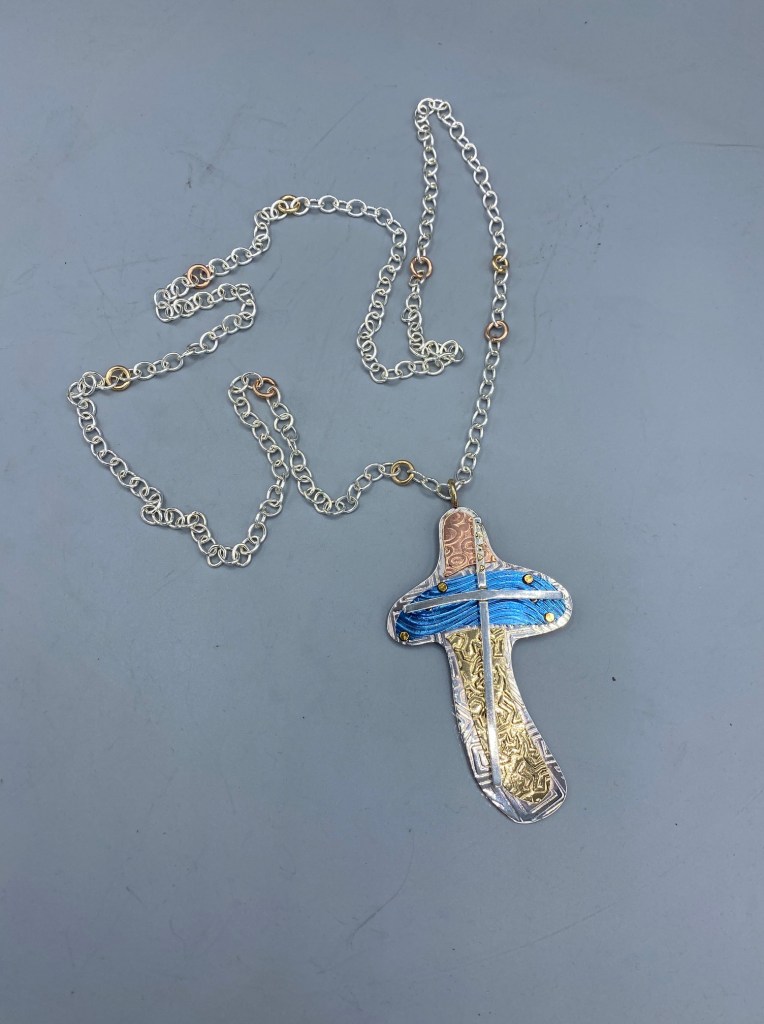
Disruption at the Communion Table

Like a speed bump not meant to be seen but only felt, the holy surprises you. The holy, or a moment the veil between heaven and earth is lifted, when an ordinary task is accompanied by a deeper and mysterious sense. It is an unexplainable feeling from within that there is more going on than can be seen.

When your day is disrupted by the holy, you know it. And sure, the holy is a beautiful disruption, but still, a disruption. Holiness can really get in the way. As you move through your day and follow your routines, holiness is like the prick of a tiny needle. You remember, if only for a moment, that the air around you is keeping you alive and don’t you forget it. You are alive because all kinds of mini-miracles have occurred in your life. You are alive, caught up in the beauty of life and the mysterious presence of the Spirit.

Last week, when the Communion meal was complete, I was putting the dishes back on the credence table for the thousandth time. I truly love the routine of putting these dishes away after a community has been fed with mercy for the neighbor. When I set down the last of the dishes, the holy, the speed bump, the prick of a needle woke me up. My heart sunk deep in my chest and tears poked at my eyes. It suddenly struck me how incredibly humbling it is to carry the old dishes that have been held by how many pastors before me. They held up the same old silver cup and told the same old, old story of a Savior who would do absolutely anything to fill you with God‘s love, to fill you with God‘s mercy, to fill you with his body and blood. And there I was, disrupted in my routine, pricked by the holy, and all I was attempting to do was stay within the sacred 60-minute bounds of Lutheran worship.

But holiness is a speed bump that cares not how fast you are moving through life, or how smoothly you are handling the everyday routine. The Spirit will remind you in speed bumps and pinpricks that your life is not your own. The air you breathe does not belong to you. The silver dishes I put away do not belong to me. You, mere mortal, beloved child, do not even belong to you.

“Slow down,” the holy nudges. “Take a peek. Here is life.”

Photo by JL Merilles on Unsplash

Annual Meetings and Why God Picked Moses

What is an annual meeting but a reunion of hopes and dreams? A re-gathering of your hopes and my dreams, my hopes and your dreams, grounded (we hope) in the stirrings of the Spirit. At these meetings, we review how resources have been shaped into hopes and approve how future resources are to be shaped into dreams.

A congregation’s hopes and dreams often get knotted up in the how muches and how manys. How many people are there? How much money do they give? How many years will the roof hold out?

Long ago, God called Moses into ministry. Not only was Moses called to be a leader for God, he was to be the voice of God. What terrified Moses was his very ordinary fear of public speaking. How much could God expect from a guy whose public speaking audience had been limited to sheep? How many people would be listening, Moses wondered. I’ll pass, he concluded.

After a few more exchanges, God gave in. He accepted Moses’ counteroffer to let his brother, Aaron, do the talking. Moses would lead and Aaron would speak.

It turns out, our human how muches and how manys do not get in the way when God wants to get something done. When God has an idea, it will happen. We can get on board or not, but no matter how arduously we point out a lack of how muches or how manys, God will make a way.

While annual meetings require human how muches and how manys, we can hardly believe that’s the point. The point of an annual meeting is to check in with the Holy Spirit. Are we listening to the Spirit’s hopes? Did we pay attention to the Spirit’s dreams?

It is a wonder the how muches and how manys tend to work out, as they did for Moses. We, like Moses, will certainly question God’s ideas. Often, they are absurd, at least at first. Why expect the sheep-whisperer to lead straying and wooly people…oh, perhaps that was a good idea, God. Sheep and people share much in common!

Even so, God will present to a congregation an array of mildly absurd ideas that require the time, talent, and treasure of its people. We might try to hold out, but it will work no better for us than it worked for Moses. If we listen, the reunion of hopes and dreams at an annual meeting will also happen to be the hopes and dreams of the God whom we follow.

Photo by Alberto Bigoni on Unsplash

Yep, It Is That Simple

Humanity has a way of complicating the simple. As if anything worth doing should be difficult. Christians are currently in the second millennium of overcomplicating two simple instructions: love God and love your neighbor.

Love God. Well, I’m busy. My kids are busy. My grandkids are busy. There is a new season of my favorite show.

Love your neighbor. Who, precisely, is my neighbor? How much do I really need to care? Will it cost me money? Can I draw a border? Do I have to? Can’t the neighbor meet me halfway? Isn’t it someone else’s job?

My life as a wife, mom and pastor may appear complicated and is when I overcomplicate it. But really, it is simple. I am to show up with Christ’s love. Nothing more, nothing less. I am to be present one person at a time, one moment at a time, not worrying too far ahead, and letting go of what has been done.

In Matthew 6, Jesus demonstrates how prayer is also simple, providing words to guide our way. We need not overcomplicate a conversation with God. Pray for justice on earth, basic needs to be met, forgiveness given and received, and protection. Pray to the one whose name is most holy, with assurance that your meager words are enfolded into God’s eternal love story with God’s people.

The Lord’s Prayer is a guide that not only offers you words, but offers you community. Billions of people have prayed this very prayer for over 2,023 years. These particular words have been spoken by believers and doubters, the living and the dying, at kitchen tables and hospital bedsides, by people under the thumb of dementia, by nearly ever flavor of the Christian experience, and by martyrs for whom these words were their last. The words of the Lord’s Prayer might be the most unifying words ever spoken.

These words, simply put, are your guide whenever you need them.

Photo by Hello I’m Nik on Unsplash

Treasuring

In perhaps the longest sermon Jesus ever preached, he gave a lesson on prayer. In Matthew 6, Jesus covered how to and how not to pray. He illustrated insincere prayer as attention-seeking and wordy. Sincere prayer, on the other hand, happens in the dark corners of the world and in our hearts.

Prayer from the heart and treasure, it seems, are related. What you pray unveils what you treasure. “For where your treasure is, there your heart will be also.” (Matthew 6:21)

Look around your heart. What are you treasuring these days? Truly treasuring? Do your prayers tell the secrets held in the dark corners of your heart? Do your prayers reach the dark corners of the world?

Take a moment now to pray, for your words are a treasure to the God who shines mercy into dark corners.

Photo credit: Omer Salom on Unsplash

Gratitude Can Be Dangerous

Gratitude can be dangerous.

When gratitude becomes one way to recognize one person or family as more blessed than another, it is dangerous.

Gratitude is not meant to open our eyes to how good we have it and how bad others have it. “At least we aren’t him,” Job’s friends said in the pitying look they exchanged. Gratitude is not eye-opening, but heart-opening. It is the moment our hearts open up to the hard truth that life, at times, can be too much for any of us. Gratitude recognizes that even a moment of peace is a gift from God.

Gratitude is meant to turn our attention away from ourselves to the hand of the giver, who gives not unjustly, but in hopes that all we have would involve a borderless we – a we that stretches and expands like the pantyhose that left all women itchy and irritated.

Gratitude is never dangerous as long as covers the bold and the meek, the haves and the have nots with the same sheer delight that somehow, somehow, a planet full of broken human beings keeps spinning.

Photo by Greg Rosenke on Unsplash

The Best Parenting Analogy

The best parenting analogy I know came from a 7-8th grade school counselor several years ago. She described walking through a tall corn field as a kid and trying to find her way to her mom. When she couldn’t find her mom because the stalks were so tall, it was scary. As she grew older and taller, it became easier to find her way. She could see more of the field until finally she could see as far as the grown-ups.

Parents and guardians need to recognize the limited view of a kid. We cannot expect kids to see as far as the adults. Their limited view can sometimes be scary. Because they cannot see as broadly as the adults, we need to meet them where they are at any particular time in their lives.

I was remembering this analogy this morning when I wondered, in befuddlement, whether the prefrontal cortex of my teenagers will ever, ever, form into one developed brain. Their sleep patterns, morning routine, study habits, priorities and diets are an utter mystery to me. I had an entire conversation that luckily stayed in my head. “Why don’t you…?” “My Lord, it would be so much easier if you…” “Honestly, what the what…?” Time for more coffee.

I remembered then that they can only see so much of the corn field. For now, I will meet them where they are, which is just where they should be. I will keep the conversation in my head and love them with their glacial formation prefrontal cortexes because they are exactly who God needs them to be at this particular time in their lives.

Parenting is one long practice in self-restraint. My work isn’t to change my kids as much as it is to be aware of conversations that mostly need to remain in my head. It is getting more crowded up there, for sure, but I’ll keep making room.

Is There Ever Enough Coffee?

What is coffee but a dip in the eternal river with the communion of saints? Since its invention, most gatherings in churches have involved a percolator. My cup of coffee connects me to the generations before me who also often relied on coffee to fuel their dreams.

Dreaming is what churches are meant to do. At least, I hope that is still true. If you have been a devoted member of a congregation in the last three years, you might wonder. Along with other public gathering spaces, we stopped serving coffee for a couple of years. When the coffee stopped percolating, I wonder if it halted the percolating of dreams along with it.

Deacons and pastors of your churches can tell you that since Covid, our work now includes an intense and important ministry called digital ministry. If our budgets look the same as they did at the start of 2020, between the lines there are new expenses related to the time spent troubleshooting stream keys and researching digital hospitality. Because of digital ministry, people who are homebound or immunocompromised or too ashamed to walk into a church building or unable to get to the building are an active part of the worshipping body. Digital ministry is an incredible gift from God and I am grateful churches quickly learned to make it happen.

Beginning a new year, however, I now wonder if the intensity of this new ministry, along with other post-pandemic demands has made it difficult to be a church that keeps dreaming. Looking back, these have been busy years simply learning to move from one month to the next. Dreaming is the very best medicine for a church plagued by busyness and troubleshooting.

Is there ever enough coffee to keep fueling all the dreams? Of course. I can’t say what kind of triple espresso John the Baptizer consumed, but he was full of dreams. He proclaimed the news that the greatest dreamer of all was around the corner. And then he baptized the dreamer with water, as the Holy Spirit bestowed on him a renewed power to dream. With the Spirit as Jesus’ guide, he dreamed out loud that the addicted might find a home in the church. He dreamed that power would not be concentrated among people, but would concentrate on the redeeming love of God. He dreamed that children would be cared for, women would have a voice, and the abused would be healed.

That’s a lot of dreaming.

While we drink our coffee at churches, may we be fueled by the Spirit and filled with caffeinated dreams. May our dreams reach people on the other side of the screen, and those who have not yet heard about the dreamer who has come among us. The dreamer not only dreams of mercy for the broken, but became mercy for the broken. Lord, keep your church from becoming too busy to dream. Amen.

Photo Credit: Merve Sehirli Nasir on Unsplash

Watering Can

Today, I imagine God carrying around a watering can.

Do you have indoor plants? For Mother’s Day last year, Marcus gave me a cute, mint green watering can with a big spout that creates a gentle rain shower. Along with the watering can, he gave me a container of pretty succulents which I somehow managed to murder. But the watering can remains cute.

Most preachers have water on the brain this week as we prepare for Baptism of Our Lord Sunday and the story of Jesus being watered by John. Jesus came up out of the water and a voice from heaven proclaimed, “You are my Son, the beloved, with you I am well pleased.”

We water what we care for: plants, people, animals, our own human body. Water sustains creation.

And there is something in that water.

I imagine God carrying a watering can filled not with water but with mercy. A splash of mercy here, a deluge of it there. Water for the person who will struggle today with addiction. Water for the family contemplating end of life decisions. Water for state legislators who face unlimited demands and limited resources. Water for tired teachers. Water for hectic emergency rooms. Water for the young mom who needs more sleep.

God’s watering can, of course, is not a cute mint green can, but human beings like you. Mercy comes from among us, pouring through our words. Our watering cans get clogged with judgement and scarcity and resentment. And mercy trickles out too slowly.

If you are the one in need of mercy today, even a trickle from the watering can might do. If you have mercy to spare, may it pour out of you in abundance.

Photo Credit: Photo by Hitomi Bremmer on Unsplash

The Great Eight

As we close the book on 2022, here are my top eight favorite reads.

FICTION

  • “The Lincoln Highway”, by Amor Towles. When a friend recommended this book, the sheer volume of this volume left me feeling afraid! However, a few chapters in and I could hardly put it down. It is written from the perspective of several characters. With its light sprinkling of historical nonfiction, this was a fun read.

NONFICTION – HISTORY

NONFICTION – HEALTH/MEDICINE

NONFICTION – MEMOIR/ESSAYS

NONFICTION – PARENTING/SELF-HELP

NONFICTION – FAMILY SYSTEMS/SELF-HELP

In order to boil the list down to these eight, I had to leave out two series. Karis’ 4th grade teacher introduced her to Kate DiCamillo and Patchett dedicated an entire essay to DiCamillo in “These Precious Days: Essays.” Louisiana, Beverly and Ramie became endeared characters in our lives, along with Inspector Gamache. Gamache, the impressive creation of Louise Penny, has filled my ears (via air pods) these last few months. I am currently enjoying #8.

Photo Credit: Tom Hermans on Unsplash

Have I Learned Anything This Year?

In the last week in December, we tend to set our eyes on the year ahead. What can I get better at? How can I improve at being human? What torturous, calorie-depriving task shall I undertake in January?

I have answers to all 3. I’d like to get better at setting aside time to write on my day off. I’d like to improve at being focused in the office when I’m there and at home when I’m there. And I’d like I feel compelled to take a break from sugar in January.

These are phenomenal plans and planning is my happy place. Making your own individual goals does actually tend to make you a better human. Focusing on your own goals keeps you from making goals for other people, such as your spouse or child. They can make their own goals and would prefer it that way.

Could you also take a moment this week to set your eyes on the year now behind you. Not only will we celebrate the inbreaking of a new year this weekend, we can celebrate the send-off of 2022. The end of something deserves as much attention as the beginning of a new thing. This is a Christian practice. We are both ending and beginning people, believing there can be no beginning without a solid ending.

A new job follows the end of a previous job. A new relationship follows the end of another relationship. A new plan follows the end of an old plan. Resurrection follows a death. And a new year follows the end of an old year. And ending, therefore, is a sign of hope. It is only in the ending that God stirs up a new beginning.

Take a moment today to look back and have a talk with God.

  • What did you learn in 2022?
  • What surprised you?
  • What happened to your faith?
  • What was one of the most difficult experiences?
  • When did God renew your strength?
  • What do you need to let go? (A hurt, a dream, a stack of clothing you never wore)
  • When did joy bubble up inside you?
  • What did you learn you can do that you did not know you could do?
  • How did the year behind you prepare you for the year ahead?

Before you ring in a new year, wring out the old year. Say goodbye before you say hello. Embrace the ending and then embrace the new beginning.

Photo Credit: zero take on Unsplash