Mom, wife and pastor relying on the gentle love of Jesus. Writing about being in relationships, not losing yourself in them, and Bowen theory. Author of Spiritual Longing in a Woman’s World and Wait: An Advent of the Familiar.
On Sunday evening I began to open thank you cards. Each day, a few at time until my eyes become too teary to read the blurred words. Today I managed a bigger stack, although I have no desire to rush through them. Like my savoring of Louise Penny’s Inspector Gamache series, there is far more reason to slow down than hurry up!
In January, I picked up a weekly habit I’d set aside for a year, writing 4-5 thank you notes on Tuesday mornings. Calling/texting or emailing each member of St. John on their birthdays replaced this practice in 2022. This year, it’s back to the routine I learned from Chick Lane. Tuesday thank you’s recognize how members of St. John live out our mission of Living in Service to Christ. The child who smiles at someone new at worship, the person who shares an offering of music or advocates for justice in a public way set the mission in motion. Deacons and pastors often witness faith-filled moments and I find it so fun to point them out.
Thank you are words that offer a warm embrace, a friendly bear hug. Perhaps the Spirit draws us closer together when we recognize human generosity. Amid the busy landscape of people’s lives, these two words given or received slow us down enough to notice how much we all need each other.
I’m not sure how other industries recognize 15 years of service. But these cards are by far the greatest gift of all! Thank you.
We all know them: Christians who bubble over with judgement, who hold people to impossible standards, whose words of criticism set a bushel basket over the gleam of Christ’s mercy. Not only do we know them, we are them.
“You hypocrite, first take the log out of your own eye, and then you will see clearly to take the speck out of your neighbor’s eye.”
Matthew 7:5
Ugh! It might be the disturbing image of a log lodged in a person’s eye that makes this verse unforgettable. How careless must a person be to end up with log in the eye? The logistics baffle me.
Sure, Jesus is being hyperbolic. Stretching the illustration to ridiculous proportions, he wants you to realize that at the very moment you are judging someone, you are ignoring the many reasons you could be judged.
I know, I don’t like it either!
Today I learned a new term: “blame validation”. It means that first we find someone to blame and then we create reasons to justify it. We live out our toddler years again and again when we point blame and judgement far away from our own selves.
The country’s deficit dilemma? It’s those politicians on the other side.
The murder of Tyre Nichols? It was ___ fault. Not my problem.
My own home state is facing extreme legislation related to gun laws and abortion. Blame validation fills the space between each line of the bills.
The toaster waffles are gone? It’s my brother’s fault.
While it may appear to make our lives easier to point blame and judgement, it actually makes our lives more complicated. Judgement is corrosive to our hearts. Where compassion is needed, we paste over the corrosion with self-righteousness. Practicing blame validation, we continue to come up with reasons to justify the blame. This is particularly dangerous if we hang around people who agree with us.
This is always a good question for self-reflection. Who do I visit who does not agree with me politically? Visiting with people who are willingly to challenge you in a respectful way will always make you wiser. They will help you see the log you somehow got stuck in your eye. If you are courageous enough to keep the conversation going, you will then help them see the speck in their own eye. The following week, the roles will be reversed: you with the speck and your conversation companion with the log.
In Matthew, chapter seven, it helps to keep reading. Jesus follows up the log and speck illustration with instructions for prayer.
“Ask, and it will be given you; search, and you will find; knock; and the door will be opened for you.”
Matthew 7:7
And a few verses later, the “golden rule”.
“In everything do to others as you would have them do to you; for this is the law and the prophets.”
Matthew 7:12
Jesus moved from warning against judgement, to instructions to pray persistently, to the ancient law to love your neighbor as yourself. We may want to rephrase that verse to say, “judge your neighbor as yourself,” but that would put us out of bounds. As much as we feel drawn to the judge’s seat, we do not belong there. Ever.
Notice yourself today when you slip into blame validation. Then check your eye for a log.
What is an anniversary but a way to keep the days and years from running together? Like a landmark along the unremarkable stretch of I94, an anniversary catches our attention, disrupts the routine, and makes the journey more interesting.
Last Sunday, the congregation I serve completely surprised me by recognizing the 15th anniversary of my installation! I am still in awe of their sneakiness! And grateful for their love in Christ. Together, we pulled off the interstate and noticed the landmark.
Today marks a different kind of anniversary, another sacred landmark on the journey. One year ago, my dear friend Terry who had been my boss at the Luther Seminary Bookstore long ago, died of lung cancer. I am telling you this story because he was my cheerleader, the very first person to subscribe to this blog. I am telling you this story because people who shape your life become landmarks on the road.
I could tell you all about my friend who was the perfect image of health. My friend, who introduced me to bosc pears, one of his favorite snacks. He emailed me every single week to encourage his pastor friend and ended each email with a benediction he’d heard at worship that week at his beloved congregation.
Terry grew up and lived in Eau Claire until he took the bus to Connecticut and then walked to Yale University caring a single suitcase. He would never let you in on the secret that he was brilliant. During his internship as he studied to become an ordained pastor, he heard a new calling. He was called not to be a minister of Word and Sacrament, but to be a minister of the Word. He sold books, but that’s not quite right. He put words into the hands of people hungry for the Word.
I could tell you all about my friend, but instead I will tell you that anniversaries are an invitation to give thanks for the people who enrich the journey. Today, I am so grateful for my friend, as I live now in the presence of his absence. And I am awakened again to the fragility and wonder of this life, and the surprises along the way.
To mark this anniversary, I will snack on a bosc pear while you are encouraged to download a free e-book edition of my book, Spiritual Longing in a Woman’s World. If you already downloaded it, you may not be able to download it again, so tell a friend! It is free all day long today only. If you have read it, please share an honest review on Amazon or Goodreads.
When your friend hands you a tissue, you may want to wonder why.
When you take the tissue, even though your nose is not running, you follow your friend to meet the surprise that is your parents who have flown from sunny Arizona to frigid North Dakota.
When you hug your parents and take your tissue and your seat, you are even more surprised when your community has conspired to recognize a 15-year milestone as their pastor.
When you have been people’s pastor for 15 years, you have not stopped to look all the way back at the privilege of these relationships.
When you do look back, you are thankful your friend gave you a tissue.
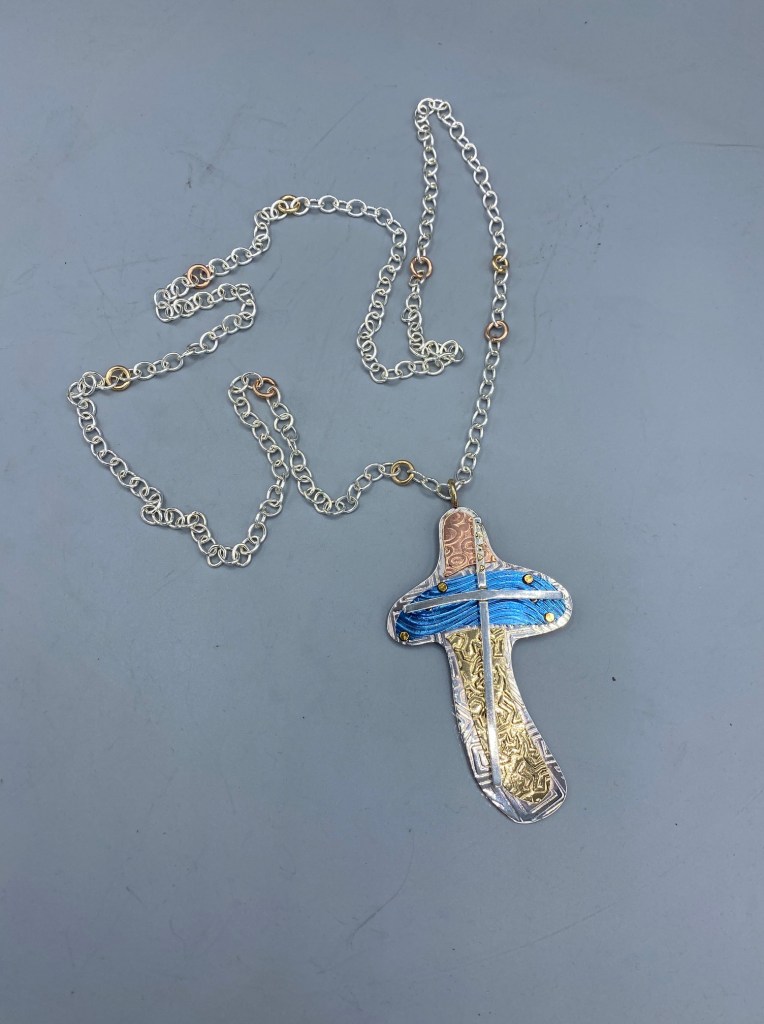
Thank you, Audrey, for contacting my parents, for working with an artist to design a stunning pectoral cross, and for the tissue.
Thank you, Council Member and especially Jean.
Thank you, sneaky staff members for creating an underground card receptacle. I had no idea you were so sneaky! I am very afraid.
Thank you, parents, for trading your lighter jackets for your winter jackets for a few days.
Thank you, St. John community. I am so humbled as I read your gracious cards. I open only a few at a time, until my eyes are too blurry to read the words.
Like a speed bump not meant to be seen but only felt, the holy surprises you. The holy, or a moment the veil between heaven and earth is lifted, when an ordinary task is accompanied by a deeper and mysterious sense. It is an unexplainable feeling from within that there is more going on than can be seen.
When your day is disrupted by the holy, you know it. And sure, the holy is a beautiful disruption, but still, a disruption. Holiness can really get in the way. As you move through your day and follow your routines, holiness is like the prick of a tiny needle. You remember, if only for a moment, that the air around you is keeping you alive and don’t you forget it. You are alive because all kinds of mini-miracles have occurred in your life. You are alive, caught up in the beauty of life and the mysterious presence of the Spirit.
Last week, when the Communion meal was complete, I was putting the dishes back on the credence table for the thousandth time. I truly love the routine of putting these dishes away after a community has been fed with mercy for the neighbor. When I set down the last of the dishes, the holy, the speed bump, the prick of a needle woke me up. My heart sunk deep in my chest and tears poked at my eyes. It suddenly struck me how incredibly humbling it is to carry the old dishes that have been held by how many pastors before me. They held up the same old silver cup and told the same old, old story of a Savior who would do absolutely anything to fill you with God‘s love, to fill you with God‘s mercy, to fill you with his body and blood. And there I was, disrupted in my routine, pricked by the holy, and all I was attempting to do was stay within the sacred 60-minute bounds of Lutheran worship.
But holiness is a speed bump that cares not how fast you are moving through life, or how smoothly you are handling the everyday routine. The Spirit will remind you in speed bumps and pinpricks that your life is not your own. The air you breathe does not belong to you. The silver dishes I put away do not belong to me. You, mere mortal, beloved child, do not even belong to you.
“Slow down,” the holy nudges. “Take a peek. Here is life.”
What is an annual meeting but a reunion of hopes and dreams? A re-gathering of your hopes and my dreams, my hopes and your dreams, grounded (we hope) in the stirrings of the Spirit. At these meetings, we review how resources have been shaped into hopes and approve how future resources are to be shaped into dreams.
A congregation’s hopes and dreams often get knotted up in the how muches and how manys. How many people are there? How much money do they give? How many years will the roof hold out?
Long ago, God called Moses into ministry. Not only was Moses called to be a leader for God, he was to be the voice of God. What terrified Moses was his very ordinary fear of public speaking. How much could God expect from a guy whose public speaking audience had been limited to sheep? How many people would be listening, Moses wondered. I’ll pass, he concluded.
After a few more exchanges, God gave in. He accepted Moses’ counteroffer to let his brother, Aaron, do the talking. Moses would lead and Aaron would speak.
It turns out, our human how muches and how manys do not get in the way when God wants to get something done. When God has an idea, it will happen. We can get on board or not, but no matter how arduously we point out a lack of how muches or how manys, God will make a way.
While annual meetings require human how muches and how manys, we can hardly believe that’s the point. The point of an annual meeting is to check in with the Holy Spirit. Are we listening to the Spirit’s hopes? Did we pay attention to the Spirit’s dreams?
It is a wonder the how muches and how manys tend to work out, as they did for Moses. We, like Moses, will certainly question God’s ideas. Often, they are absurd, at least at first. Why expect the sheep-whisperer to lead straying and wooly people…oh, perhaps that was a good idea, God. Sheep and people share much in common!
Even so, God will present to a congregation an array of mildly absurd ideas that require the time, talent, and treasure of its people. We might try to hold out, but it will work no better for us than it worked for Moses. If we listen, the reunion of hopes and dreams at an annual meeting will also happen to be the hopes and dreams of the God whom we follow.
Humanity has a way of complicating the simple. As if anything worth doing should be difficult. Christians are currently in the second millennium of overcomplicating two simple instructions: love God and love your neighbor.
Love God. Well, I’m busy. My kids are busy. My grandkids are busy. There is a new season of my favorite show.
Love your neighbor. Who, precisely, is my neighbor? How much do I really need to care? Will it cost me money? Can I draw a border? Do I have to? Can’t the neighbor meet me halfway? Isn’t it someone else’s job?
My life as a wife, mom and pastor may appear complicated and is when I overcomplicate it. But really, it is simple. I am to show up with Christ’s love. Nothing more, nothing less. I am to be present one person at a time, one moment at a time, not worrying too far ahead, and letting go of what has been done.
In Matthew 6, Jesus demonstrates how prayer is also simple, providing words to guide our way. We need not overcomplicate a conversation with God. Pray for justice on earth, basic needs to be met, forgiveness given and received, and protection. Pray to the one whose name is most holy, with assurance that your meager words are enfolded into God’s eternal love story with God’s people.
The Lord’s Prayer is a guide that not only offers you words, but offers you community. Billions of people have prayed this very prayer for over 2,023 years. These particular words have been spoken by believers and doubters, the living and the dying, at kitchen tables and hospital bedsides, by people under the thumb of dementia, by nearly ever flavor of the Christian experience, and by martyrs for whom these words were their last. The words of the Lord’s Prayer might be the most unifying words ever spoken.
These words, simply put, are your guide whenever you need them.
In perhaps the longest sermon Jesus ever preached, he gave a lesson on prayer. In Matthew 6, Jesus covered how to and how not to pray. He illustrated insincere prayer as attention-seeking and wordy. Sincere prayer, on the other hand, happens in the dark corners of the world and in our hearts.
Prayer from the heart and treasure, it seems, are related. What you pray unveils what you treasure. “For where your treasure is, there your heart will be also.” (Matthew 6:21)
Look around your heart. What are you treasuring these days? Truly treasuring? Do your prayers tell the secrets held in the dark corners of your heart? Do your prayers reach the dark corners of the world?
Take a moment now to pray, for your words are a treasure to the God who shines mercy into dark corners.
When gratitude becomes one way to recognize one person or family as more blessed than another, it is dangerous.
Gratitude is not meant to open our eyes to how good we have it and how bad others have it. “At least we aren’t him,” Job’s friends said in the pitying look they exchanged. Gratitude is not eye-opening, but heart-opening. It is the moment our hearts open up to the hard truth that life, at times, can be too much for any of us. Gratitude recognizes that even a moment of peace is a gift from God.
Gratitude is meant to turn our attention away from ourselves to the hand of the giver, who gives not unjustly, but in hopes that all wehave would involve a borderless we – a we that stretches and expands like the pantyhose that left all women itchy and irritated.
Gratitude is never dangerous as long as covers the bold and the meek, the haves and the have nots with the same sheer delight that somehow, somehow, a planet full of broken human beings keeps spinning.
The best parenting analogy I know came from a 7-8th grade school counselor several years ago. She described walking through a tall corn field as a kid and trying to find her way to her mom. When she couldn’t find her mom because the stalks were so tall, it was scary. As she grew older and taller, it became easier to find her way. She could see more of the field until finally she could see as far as the grown-ups.
Parents and guardians need to recognize the limited view of a kid. We cannot expect kids to see as far as the adults. Their limited view can sometimes be scary. Because they cannot see as broadly as the adults, we need to meet them where they are at any particular time in their lives.
I was remembering this analogy this morning when I wondered, in befuddlement, whether the prefrontal cortex of my teenagers will ever, ever, form into one developed brain. Their sleep patterns, morning routine, study habits, priorities and diets are an utter mystery to me. I had an entire conversation that luckily stayed in my head. “Why don’t you…?” “My Lord, it would be so much easier if you…” “Honestly, what the what…?” Time for more coffee.
I remembered then that they can only see so much of the corn field. For now, I will meet them where they are, which is just where they should be. I will keep the conversation in my head and love them with their glacial formation prefrontal cortexes because they are exactly who God needs them to be at this particular time in their lives.
Parenting is one long practice in self-restraint. My work isn’t to change my kids as much as it is to be aware of conversations that mostly need to remain in my head. It is getting more crowded up there, for sure, but I’ll keep making room.