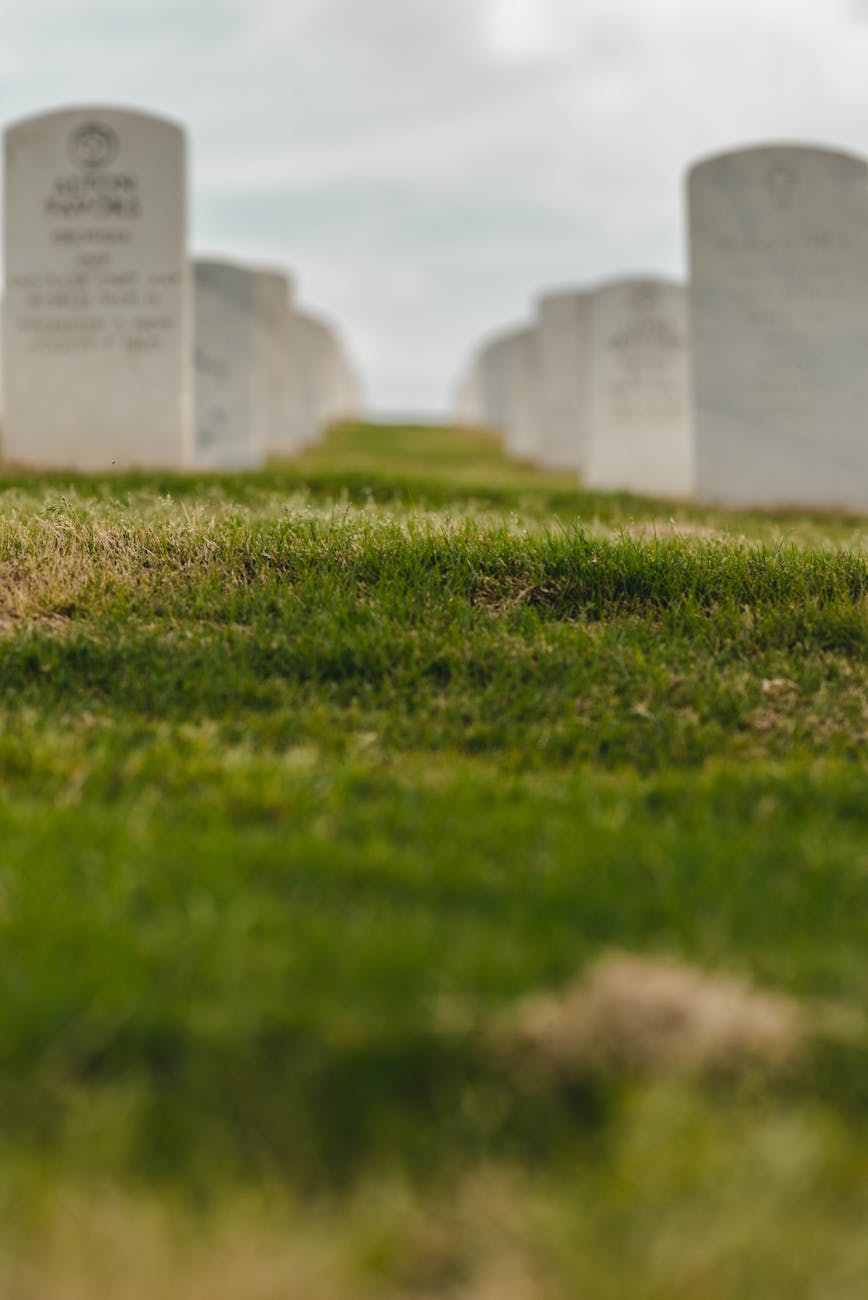
While waiting to preside at a burial at the Veteran’s Cemetery in Mandan yesterday, I had this touching encounter with a stranger.
I parked my car and noticed her, a quite elderly woman fighting wind gusts to plant a bouquet of artificial flowers beside a tombstone. This woman was determined! I could see her scoot around with her cane, set down the cane to pick up some kind of tool, then do it all over again.
I hopped out of my car to ask if I could help. She let out a small laugh of relief. “Yes,” she said, “the ground is much harder than I thought it would be,” as she showed me her assortment of “tools.”
She expected to stick the stem into the ground as she had the last 22 years at that very grave, but when her efforts proved unsuccessful, she went back to her car to retrieve whatever she could find, it seems, including a brush to sweep snow off a car, a hammer, and a screwdriver.
I attempted to convince the stem of the fake flowers into the hole she had started, then resorted to what seemed the most promising tool – the screwdriver. As I dug around, I pointed to the name on the headstone and asked if this was her husband, not paying attention to the dates.
“No,” she gently replied, “it’s my son.” Then I noticed he was my age. “I miss him every day.”
I was able to make progress with the screwdriver as the woman went on to share a story. About a year ago, a fellow soldier from her son’s unit contacted her as well as the family member of another soldier who had died. He had served in the same unit with them and now lived several states away. They eventually got together, this company of the grieving, to hear stories from the one who had survived.
He told them that he had been driving the second car, the car behind these two boys, when they drove over an IED in Iraq. He was witness to this terrible moment that changed their lives forever. Sitting with them, he was able to offer a touch of healing to their grief, a sign of hope.
By now, I was able to cram the stem of the artificial flowers into the ground. She took her hammer and pushed in the dirt around it. Clearly, she had done this before.
I pointed again at the tombstone where it listed her son’s service in the National Guard. “My son is also in the National Guard,” I told her.
“Which unit?”
“Um…I forget the number, but he is a bridgebuilder.”
“So was my son, Unit 957.”
I asked if I could walk her to her car, but she insisted she would be staying a while. We said our goodbyes and she wished my son the best.
Only later, on the drive home did the meaning of this moment hit me. She was me, many years ago. The mom of a boy who joined the military. Unlike me, her boy fought in a war and did not come home. But later, someone who did come home, a stranger, had given her a gift. He was the eye witness who could tell her more of the story of her boy, perhaps a missing piece to her grief – the tool she may have needed to process her sorrow.
I do wonder if the secret sauce to a safe and better world is hidden in these kinds of conversations with strangers. It was most likely we never would have chatted, but for a brutal wind and ground that was harder than she anticipated.
A sign of hope from a stranger can be easy to miss. I am grateful that this time I didn’t.
Photo by Chad Madden on Pexels.com

 Lisa Lewton