A Cookie Contradiction

My daughter baked these lovely sprinkle cookies. She is a near-master of the Crumbl knock-off recipes, which was the answer to my husband’s question a few months ago: “Why in the world do we have so much flour?”

The cookies are as good as they look…most of the time.

Always the willing taste-tester, she handed me one after it had cooled. At first, I could not describe what I was tasting. It looked sweet, yet the taste did not match. A weird contradiction clung to the roof of my mouth.

“You should try these,” I told her, or warned her, before she took them over to her grandpa for his birthday.

“What do you mean?”

“Just…try one.”

When she did, her face matched my perplexed tastebuds. What was this odd, perhaps even savory flavor competing with the rainbow specks of sweetness?

After some deliberation, we realized the culprit was the cutting board. She had asked if I thought it was okay to set the cookies to cool on the cutting board instead of dragging out the cooling racks, an act of injustice we will never again commit.

I did not consider the onions and garlic that had been chopped up for something, probably soup, just a few days before. Those savory flavors rose up in delight, invading the warm sweetness of the cookies like a sneak-attack, flavor-massacre.

Luckily, setting them back on the baking sheet for an hour or so seemed to undo the disaster. I did appreciate the lesson.

Human beings, like those cookies, are absorbent. Without realizing it, we soak up the sweet or spicy flavor of the spaces in which we gather. We can easily absorb both loving and unloving attitudes toward the world and our neighbor from those with whom we spend our time in-person and online.

“You are what you eat,” is perhaps a simpler way to say all of this. Hang out with angry people and we absorb that anger. Hang out with joyful people and we absorb that joy. Hang out with people who are curious, or kind, or bitter, or hateful and we will find ourselves like that cookie: one thing on the outside and another on the inside.

The slipperiest part of being human is that you think you can change another person, but you cannot. You can try to make the angry person less angry, or the bitter person less bitter, however, without even noticing, those exact flavors have a way of sneaking in from the cutting board and shaping who you are and how you see the world and your neighbor.

What flavors would you like to absorb as you live your life with people?

For years, I have prayed with this New Zealand Prayer Book, a prayer book my internship supervisor first introduced. The ELCA lacks in prayer books, unlike our friends in Christ who are Roman Catholic or Episcopalian, which is the source of this prayer book. A few months ago, I tried to be more disciplined in reading the morning and evening prayers daily. As these things go for me, most days I remembered and other days I did not. I am no champion of perfection.

I can tell you that on the days I start and end with these prayers, it feels as though the day fully begins and ends with the Lord. Dare I say it is absorbing! The morning and evening prayers of each day are tied together and somehow, each prayer has spoken directly to my life, as the Holy Spirit has a habit of doing.

Here are two wonderings for you to absorb:

  • Consider the people with whom you spend your time at home, work, and wherever you go for fun. What might you be absorbing? What is the same or different in each setting?
  • What are you absorbing in the time you spend online? Does it make life sweeter when you spend time wherever you do online? Or would you like to reconsider what you prefer to absorb when you travel around the internet?

2007

High school graduation is just around the corner, with this year’s “Pomp and Circumstance” procession including yet another Lewton. Those preparing to graduate share in common one unusual attribute. Someday, their kids and grandkids will scoff at their antiquity, finding it difficult to believe that these old people entered the world with the iPhone.

That’s right! This year’s graduates have only known a world in which apps refer to applications and not appetizers, a society that devotes an entire device to one particular person. (Remember sharing a generic home computer with everyone in your family?)

The invention of this personalized device unleashed a storm of issues no one saw coming, or bothered to mention in 2007: data breaches, bullying, mental health worries (crises?), pornography, never-ending workdays, brand new gambling addictions, and a handful other unfortunate byproducts of the iPhone.

Although these issues are real, the blame for the storm cannot land entirely on any one device. These issues are in fact the byproduct of our sinful condition as broken humans. Human beings steal things, bully, and make poor choices. We set our own desires above the well-being of our neighbors. The device born in 2007 brought nothing new, only new variations on very old problems. There is, after all, nothing new under the sun.1

I have spent the past 17 years wrestling with the meaning of the invention of the iPhone for my kids. It has changed the landscape of their childhood, like any influential invention throughout time: the wheel, antibiotics, the printing press, Elvis Presley’s hip moves.

The wrestling match with a new invention is meant first for the grown-ups, not the kids.

Like any issue we encounter as parents and guardians, this is a faith issue. The match has less to do with a device and everything to do with how we choose to “fear, love and trust God above all things.”2

Instead of blaming a device, I might ask myself these questions:

  • How am I maneuvering life with the iPhone?
  • Do I rely on this gadget for the assurance, comfort and joy only God can deliver and offers me each moment?
  • What impact has this new-ish device had on my own ability to love my neighbor, tend to my well-being, and nurture relationships with those closest to me?

Kids do not learn from listening, they learn from looking. They learn from looking at the wrestling matches of the adults around them as these adults contend with new inventions, relationship disasters, social media, and work stress. What learning has the class of 2025 soaked up from the adults around them?

Just for fun, let’s go back to Elvis’ hips.

In 1956, Elvis was invited onto NBC’s “The Steve Allen Show” under strict instructions to keep his hips under control. One columnist at the time wrote: “Will Elvis rock and wriggle on Steve Allen’s Show tonight??? While thirty million teenage fans applaud in wild delight??? And will he shake his torso like a trotter with the heaves??? Will Presley’s fans all rally at the nearest TV set??? While mom and pop retire just as far as they can get??? Will maidens swoon and lads grow faint when Elvis starts to squeal???3

Elvis’ hips behaved, they did not rock nor wriggle. There was no need for mom and pop to retire as far as they could get. It appeared they had succeeded at teaching kids that hips are not for dance moves.

But what if the adults had offered a different kind of response, less appalled and more amazed at what hips can do? I’m not saying Elvis’ hips and iPhones are worth comparing, but I do wonder how the response of adults can help or hinder progress.

The maidens and lads refenced in the article would go on to hear their own grandkids and great-grandkids scoff at their antiquity, that their generation weathered the stormy moves of a rock star’s hips…until the next invention captured everyone’s attention and produced a new set of fears.

Although the world changes, Beloved Graduates, it also stays the same, as does our lifelong instruction: Love the Lord your God with all your heart, soul and mind, and love your neighbor as yourself.

  1. Ecclesiastes 1:9 ↩︎
  2. Luther’s response to the First Commandment. ↩︎
  3. http://www.elvis-history-blog.com/steve-allen-show.html ↩︎

Photo by Suad Kamardeen on Unsplash

Sermons and Reels

Hanging out in front of the tv with my daughter last night, I watched what she likes to watch. Often it’s Mr. Beast on the screen, essentially a slightly awkward game show host who gives away exorbitant amounts of money. Or Hopescope, who tries out products she sees on social media.

Last night, she was watching video clips on Youtube called Youtube Shorts. This version of social media reels are, as the name implies, short, lasting 15-60 seconds. They feature ordinary people providing quick entertainment. One person impressively sang and played the piano. Another explained a video that had gone viral, posing as a news reporter. Someone else painted herself green and pretended to marry Duolingo.

The videos went by quickly, one after another after another. And I noticed this was not relaxing for me! There was no time to enjoy one video before the next one started up; no room to get to know the entertainer or appreciate the person’s talent. Perhaps my attention span is too long for Youtube Shorts? Who knows.

I’ve been pondering attention span since listening to an episode of The Ezra Klein show called “Tired, Distracted, Burned Out? Listen to This.” Parents in my generation were among the first to hand their kids a smartphone and then wonder what the heck just happened! It is now normal for a kid to carry around a smartphone by 6th grade. Like many parents, I quickly learned the content and restrictions, adding screen time and downtime limits. My kids signed a covenant before they could enter their first passcodes. I did my best with what I knew at the time.

And now I know I cannot sit through Youtube Shorts! But my kids sure can. The speed of the clips does not bother them like it bothers me. They adapt more quickly and maybe even process what they are seeing more quickly.

It’s important for parents to note that just because something is different and makes me feel slightly uncomfortable does not necessarily mean it is wrong. It’s not wrong that my kids adapt more quickly. This difference in processing does not mean my kids are doing something wrong because I grew up without the same technology.

It does mean that preachers like me need to wonder what will happen with sermons. Unlike 15-60 second clips, sermons are (among Lutherans) 12-15 minutes long, that’s 720-900 seconds.

My sermons are not entertaining like Youtube Shorts, nor are they meant to be. And the Lutheran church is not known for its entertaining light shows. Never has someone left a Lutheran worship service to say, “That was so entertaining.”

Worship, including preaching, is not intended to be entertainment for the consumer. Instead, it is meant to draw a person into a deeper trust in the God who calls us to share Christ’s love by serving our neighbor. To do that, sermons rely on words. Will words, even profound ones, be enough to engage a generation that processes technology incredibly fast?

It may be the first preacher to ask this question was reacting to the invention of the radio! This is not a new question for the church. For now, Youtube Shorts are not my favorite even though my kids enjoy them. I will keep discerning how to faithfully proclaim the ancient promise of God’s saving love in Christ to a people whose brains may be changing, but whose need of this good news is not.

Photo by S O C I A L . C U T on Unsplash

In the Weeds of the Facebook Ranting Groups

It wasn’t long ago that everyone read the daily newspaper. The inky pages were dropped at your door in the morning so when you arrived at work you and your coworkers knew the same information. The Minot Daily News informed my small town day after day.

Early in America’s lifetime, there were several newspapers. Based on your political preference, you could choose to read the conservative, moderate or liberal bend of the news. These days, we do much the same thing on social media.

What’s new, however, is the way social media has made people into sources of news. This wasn’t the intent of the internet, but it happened anyway. YouTube, for example, was first motivated to share media, but it was surprised when so many people became novice creators of content. Suddenly, any ordinary person can become an expert on make-up, home repairs, relationships, or politics.

I mentioned yesterday that I’ve wandered carefully into the weeds of social media Rantville, trying to better understand my own community and its values. My heart beats extra fast at the heartless comments in one of our community’s ranting Facebook groups.

Last night I visited with one of the people who speaks truth into the untruths of this particular site. He reminded me that Facebook does have standards that enable the rest of us to report comments that are slanderous. It is imperative that we report comments that harass leaders or claim all elections are rigged. (Or “rigid” if you get that joke.)

I would prefer never to enter the muddy mess of immaturity that is Rantville. However, I also know the 8th commandment holds me accountable to “fear and love God so that we do not betray, slander or lie about our neighbor, but defend him, speak well of him, and explain his actions in the kindest way.” (Luther’s Small Catechism)

What would happen if we took turns braving the heartless social media groups to uphold the 8th commandment? I say take turns because this is tiresome work. But what if we showed up with integrity and mercy to carry out our baptismal promise: “to care for others and the world God made, and work for justice and peace”.

I absolutely loved the interview on Kate Bowler’s podcast with David Brooks, who is one of my favorite authors. He pointed out how each and every person simply needs to be known. I have a hunch the Facebook haters feel overlooked, as though their concerns have gone unheard. I do not appreciate slander, but I would like to look into their eyes and tell them they matter. Out of faithfulness to the 8th commandment, I might even assume their expression is a concern for our community. Maybe.

Community, Peter Block explains, is not a problem to be solved but a way in which we are citizens together. Much like we can’t pick our family members, we cannot pick the people who are citizens with us. However, we can share our faith by showing up, even in the weeds, to invite others to be citizens instead of ranters with us.

Credit: Photo by Jonny Caspari on Unsplash

The Land of Distraction

Of all the conveniences my phone offers, chief among them is distraction. Distraction conveniently distracts me. As long as my phone is within reach, I have a free ticket to Distraction, land of the unnecessary.

I can check the weather on my phone instead of stepping outside to feel the breeze and smell the fresh with a touch of Canadian haze North Dakota air.

I can scroll through my friend’s Facebook page instead of meeting up for coffee to fully show up in that person’s life.

I can clean off the counter that will most certainly re-clutter within the hour instead of looking into the faces of the beloved people responsible for the re-clutter.

There are a hundred distractions in a moment. Each distraction whisks you into the land of the unnecessary. You can scroll your way through an entire day only to miss the handful of delights. There are a handful of delights in a day, yours for the taking.

In the conversation or prayer, a view of the sky, the smell of a ripe peach, or the feel of someone’s hand in yours, the delights are uncomplicated. And there are enough of them to savor, to proclaim, and to wait attentively for the next one.

Photo by Pixabay: https://www.pexels.com/photo/facebook-application-icon-147413/

Resting or Distracting: You Need to Know the Difference

Checking out is not the same as resting. Scrolling or gaming on a phone is not resting. Watching a sports game (unless it is golf or baseball) is not resting. Baking is not resting even though your dough is resting. Scrolling, watching sports, and baking are means to distract ourselves. These activities do not count as rest.

Ever since I listened to a podcast episode called “Work Harder at Resting”, I have wondered the difference between rest and distraction.

  • Rest loosens your muscles and your tight grip on life. Distraction is avoidance.
  • Rest is a commitment to accomplish nothing for a period of time. Distraction is cheap entertainment.
  • Rest leaves you feeling content; you are glad you took time to do that. Distraction leaves you feeling hustled; the time you had to rest is now gone.

With phones constantly in reach, distraction is our default. Rest, on the other hand, is a protest against the flimsy offerings of distraction. Rest is a bold statement of trust in the God who offers the gift of rest.

“…we are situated on the receiving end of the gifts of God. To be so situated is a staggering option, because we are accustomed to being on the initiated end of all things. We expect nor even want a gift to be given, so inured are we to accomplishing and achieving and possessing. Thus I have come to think that the fourth commandment on sabbath is the most difficult and most urgent of the commandments in our society…”

“sabbath as resistance: Saying NO to the CULTURE OF NOW” by Walter Brueggemann, p. xiv

Rest requires a particular posture: open hands and open heart. How can God fill you with rest if you fill your minutes with distractions? How can God open your eyes to the landscape of God’s love if your eyes are on a screen? How can God open your heart if your heart is occupied with love for your distractions?

Today, how will you rest? Set a timer for 5 minutes and sit still by yourself, listening for God’s whispers. Read a psalm not to learn but simply to absorb the words. Download my favorite devotional app, Pray as you Go, and take a walk. When you reach for your phone, fold your hands and take three deep breaths.

“O God, you are my God, I seek you, my soul thirsts for you; my flesh faints for you, as in a dry and weary land where there is no water.” Psalm 63:1

Photo Credit: Artem Beliaikin on Unsplash

Lent Week 2: The Math of Lent

(Photo by Crissy Jarvis on Unsplash)

During Lent, we often practice subtraction. We subtract (give up) chocolate, social media, or alcohol. One person told me she subtracts one meal each week to recognize how many people go hungry. At our church, we subtract busy programs and as many meetings as we can during Lent to focus on worship.
Subtracting what pushes into the margins is a healthy practice to delineate where life is to start and stop. Life has a way of spilling into the margins. We eat too much chocolate, consume too much social media, and drink our worries away. Wait, where is the margin? We expend too much time overparenting, pour more energy into work relationships than our marriage, and make rest a distant priority. Margin? What margin?

Perhaps it is time to wonder if Lent can be a time of addition. Can you add a screen time limit to your own phone? Add an automated gift to your favorite charity that feeds the hungry? Add to your calendar a date night with your spouse, or a self-care day for yourself? A couple of years ago, my family added hosting a weekly dinner with friends during Lent. Each Friday, we invited friends or family to our home for a nice meal, conversation, and games. We didn’t do it perfectly. There were a couple of weeks it didn’t work out, and isn’t that how it goes when you are trying to maintain margins? Each week, we simply start over.

When we add what matters, the margin seems to work itself out, no subtraction required.

A question for littles

What is something you love to do together you wish we would do more?

A question for former littles

Think of some of the most meaningful ways you spend your time. What do you do that gets in the way of spending time meaningfully? Do you want to spent more time alone/with friends/with family doing what is meaningful to you?

A spiritual practice

Try adding one meaningful thing to your life for the next four weeks of Lent. It could be a daily or weekly practice. Like most important things you don’t want to forget, add it to your calendar. Make that time sacred and nonnegotiable.

The Jesus I Follow and Hashtags to Avoid

(Photo by Jon Tyson on Unsplash)

When writing Instagram posts, I have learned to be skeptical of hashtags with Jesus’ name. This is how it goes.

My Instagram post is about Jesus’ mercy. But #JesusMercy is overwhelmed by creepy Jesus images.

#Jesus isn’t so bad…as long as you are convinced men have the most authority in the pulpit. (Example: a bazillion pictures of a man preaching. #Jesus)

#JesusLovesYou is a library of Christian platitudes. (“God has a plan.” #JesusLovesYou)

#JesusAndCoffee is the perfect blend if you are looking for posts from Jesus’ cheer team. (“It’s Friday, don’t forget to be fabulous!” #JesusAndCoffee)

This is not the Jesus I follow. He cares not that I am fabulous nor that I know the most platitudes. (Someone please initiate #JesusPlatitudes.) I chose the hashtag #SpiritualLonging for at least two reasons to tell you about the Jesus I follow:

  1. Jesus hashtags often present a shallow Jesus. Any hashtag that inspires you to be your best, fabulous self is leaving out your primary call to serve your neighbor. We do not serve our neighbor out of our best selves, but out of our broken selves. Only because Jesus became broken, and I am as broken and my life is as messy as yours can we together follow the Savior who makes us whole. He does not tell us to get fabulous and take away the mess of our lives. He entered the mess, died for you, and lived to tell about it.
  2. An important distinction in any proclamation of Jesus is this: Don’t tell me what Jesus does, instead let me see it, feel it, taste it, yearn for it. The only difference between a good sermon and a bad sermon is whether those words tell you about Jesus, or give you Jesus. Do the words point to Jesus, or do the words put Jesus in your heart, your mouth, and your bones? That is the Jesus for whom I long and the Jesus whom I follow. You cannot receive that proclamation via Instagram posts. You need a preacher, so a church community becomes helpful. (“How, then, can they call on the one they have not believed in? And how can they believe in the one of whom they have not heard? And how can they hear without someone preaching to them?” Romans 10:14.

There is no room in #SpiritualLonging for only one gender and sexual orientation of preachers, or Christian platitudes, or a fabulous you. Instead, we are filled with longing in a world that is not yet as it should be for our neighbor. And in our brokenness, we are washed in the promise that we are all on the way, and you are beloved, just as you are. #BeYourBestForJesus

The Mom Drama of Kids and Video Games

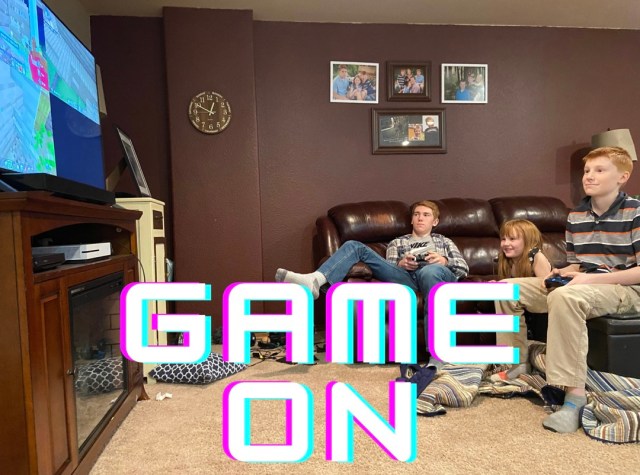
(A rare moment of all three Lewtons playing a game together.)

It might be best if we kept this under wraps, but one of my favorite Sega Genesis games (circa 1995) was Mortal Kombat. Girls are stereotypically often more dexterous than boys, which is the only logical reason I can come up with that I would “Finish Him!” more often than the boys who gamed much more than I ever did.

Sonic the Hedgehog was more enjoyable (and less gory), along with Ren and Stimpy (happy, happy, joy, joy). While I did not spend most of my time with any of these characters within the orange shag-carpeted walls of our basement growing up, I did spend some.

Video games have become a million times cooler with realistic sound and visual effects and the ability to play with friends from their own homes (a great perk during a pandemic). Even so, for years I didn’t want my kids to be gamers. Why was that? Is it a Midwestern mindset that sitting down and looking at a screen to play a game is somehow bad? Where did that come from? How many wonderful people play Candy Crush? I played Mortal Kombat and I didn’t want my kids to play Mario Carts? Being a parent is a constant exercise in self-reflection.

Ours was the house without a gaming console until I changed my mind. Sometimes my kids play video games. We have regular conversations to determine how much is appropriate and how to self-regulate. Both are important life skills. How do we understand moderation and practice it? Again, questions applicable throughout our entire lives.

Most importantly, the video game self-reflection and conversations have taught me never to identify my kid (or someone else’s) based on what they do or do not do. Kids are not “gamers”, they are kids who play video games. If we see a kid as a “gamer”, we see only a part of his or her whole self. Parents carry the power to shroud a kid in shame by narrowing their kid down to what they do or do not do. And, parents carry the responsibility to tell kids the story of who they truly are: beloved by God, made in God’s image, already forgiven, bearers of Christ’s light.

My kids are just like their mother: flawed, fully freed and forgiven by Jesus, and forever learning. (Unlike me, they are not triumphant Mortal Kombat players, but that’s only between you and me.)

Advent Wondering: Can I Live Without Amazon for a Year?

If I set aside the downsides of every one of my Amazon purchases (extra packaging materials, more fuel burned by trucks, working conditions for underpaid and harried Amazon employees) what’s not to love about Amazon?!?

For the love of this busy culture, in two days my item arrives at my door! Socks for a kiddo, lotion for me, that cute pillow case for a living room throw pillow. Or, in two days an item arrives at the door of any address I enter into the shipping information. Need to send a gift? Amazon will do it! Need a toothbrush every six months to arrive without actually ordering it? Amazon can do that, too.

Amazon is like Tabitha from “Bewitched”, Santa Claus, the world’s best mom, and a little bit of Jesus all wrapped in one.

Which makes me wonder…when buying becomes so easy and automatic (“I’ll just order it on Amazon.com!”), what am I forgetting? The more automatic it is to order on Amazon, the less I actually consider what I’m buying. If what I “need” is but a click away, that’s just too fast for me to make a mindful purchase. I’m not looking at something at the store and comparing it with the items around it, which takes long enough for me to also wonder if I truly need to purchase it. A “click away” takes the think away. (I’m sorry.)

My Amazon Prime membership is up at the end of December and I wonder if Amazon and I need to take a short break. Will I miss out if I don’t click for 365 days? Will my kids go without socks and my couch look dreary? Both are entirely possible. I’ll also need to buy toothbrushes all on my own in six months.

Will I also be a little slower in my clicks? Will I end up with fewer things at the end of 2021?

The weeks of Advent lead me to wonder such things. How can I slow life down? How can I be intentional with choices that impact my neighbor and this earth? How much do I really need and have I noticed how many drop-offs I make at the thrift store? Am I being mindful with money or just clicking away?

Life tends to accelerate without our even noticing. Even in a global pandemic it moves quickly.

“Blessed are those who click wisely.”