Berry Season Forever Prayer

Dear Lord,

Please could it be berry season forever? Could all lands be lands of perpetual strawberry and blueberry harvest? I wouldn’t mind. I’d trade it for root vegetable season any day of the week! Potatoes and parsnips are no fun in yogurt parfaits.

This world is not as it should be. Berry season is temporary, much to my dismay.

On the list of complaints you will hear today, this is on the low end. Better that you tend to war refugees, among them thousands of Ukrainian children snatched up by the Russian army, an injustice that should get all our hearts racing. Could you, Lord, deal with corrupt governments, the production of opioids, and the disproportionate number of foster kids to foster parents? Your to-do list is long, I get it. My list is mostly laundry.

One human response to your long to-do list is fear, as though the world only recently became broken and the way through is to be afraid for the future, afraid of our neighbor, afraid of losing assets, afraid you’ve jumped ship and found another universe you like better.

Another response requires the long view, a look at your creation that takes the viewer back to the beginning. This response is more work, thus less desirable. We’re human, you made us, you get it. The long view reveals a season and a time for all things: a time for sweet berry harvests and another for hearty root vegetables; a season for peace but not for everyone, everywhere at the same time; a season for long days, another for long nights.

Like us, you long for the world to be as it should, to match your original dream. Out of love, you create scientists to contend with disease. You raise up an agency to fight for the safety of children and another to set up refugee camps. You call prophets and poets to speak truth. Again, your to-do list is lengthy and I see only in part, as Paul writes.

For today, I will enjoy the berry season. I will miss it when the days grow shorter. Then, the sun will set earlier and I will go to bed at a decent time and so will the rest of us, except for the teenagers. Lord, why did you make them so weird?

Thank you for berries, Lord, and all the ways you add sweetness to this life. Amen.

Photo by Will on Unsplash

Not-So-New

It is the season of the new, yet no-so-new.

A new school year begins, surrounded by millions of school years that have come before and the millions that will come after.

New pencils and notebooks find new homes in desks previously occupied by other students, and someday occupied by other students.

The lockers frustrating this new class have seen those frustrated faces before, and not for the last time!

While a new school year may produce anxiety in kids, there are helpful reminders that what is new is also not-so-new. The new school year begins with the not-so-new presence of Christ. The new schedule unfolds with the not-so-new promise that Jesus hangs out in classrooms and hallways, on playgrounds and monkey bars, at lunch tables and lockers.

Jesus keeps us company with his not-so-new peace, not-so-new mercy, not-so-new tender love. With his not-so-newness, we begin a new school year, just as we did before, just as we will again. And we will see, not for the first or last time, that Jesus is already there.

Photo by moren hsu on Unsplash

The Real Invitation

During their afternoon naps, Cornelius and Peter had unsettling dreams.

In Acts 10, Cornelius, who was not a Jew, envisioned an order from the Lord to seek out Peter, a Jew who was part of the new Christian movement. It was unsettling for Cornelius to imagine seeking out Peter.

In his dream, Peter envisioned an invitation to eat what his Jewish dietary laws forbade, which was extremely unsettling.

Cornelius sent for Peter to come to his home, both of them unsettled.

Together in the same room, Cornelius asked Peter to tell him the Jesus story. Peter did, preaching what he called “peace by Jesus Christ.” (10:36) The problem posed in this story is this: peace by Jesus Christ can be unsettling.

Peace by Jesus Christ invites very different people together. Let’s imagine.

Imagine you are part of the gathering of very different people. Imagine the gathering as the meal of Holy Communion. Imagine at your right is the person with political views the extreme opposite of yours. This is that outspoken, obnoxious, Facebook commenting person. The person you would rather never see, let alone commune beside. And that’s not all!

On your left is the family member you avoid all year long except that one holiday where you are forced to see that person in order to please your mother. The old hurt that exists between you and this family grows like mold. The scene you are imaging gets worse.

Across the table from you are the kinds of people you demean with your friends. They are wrong in every way, an insult to an otherwise orderly society. You curse these kinds of people because your favorite news source has conditioned you to see them as a threat. And now here they are, unsettling you at the table.

Who the heck created the invitations to this meal, you wonder, unsettled? How could this group of people be expected to sit together, eat together, pray together? Ridiculous, you mumble under your breath, along with other words.

And then you remember the invitation, which didn’t seem unsettling until the moment you found your place with these people, who have also found their place at the table, at the invitation of the dark skinned and shaggy haired host.

The invitation is not to people who look or live like you. The invitation is to people who are broken like you. Mercy is the equalizer at this table, Peter discovered when his unsettling encounter with Cornelius became peace by Jesus Christ.

Photo by erica steeves on Unsplash

Gratitude Can Be Dangerous

Gratitude can be dangerous.

When gratitude becomes one way to recognize one person or family as more blessed than another, it is dangerous.

Gratitude is not meant to open our eyes to how good we have it and how bad others have it. “At least we aren’t him,” Job’s friends said in the pitying look they exchanged. Gratitude is not eye-opening, but heart-opening. It is the moment our hearts open up to the hard truth that life, at times, can be too much for any of us. Gratitude recognizes that even a moment of peace is a gift from God.

Gratitude is meant to turn our attention away from ourselves to the hand of the giver, who gives not unjustly, but in hopes that all we have would involve a borderless we – a we that stretches and expands like the pantyhose that left all women itchy and irritated.

Gratitude is never dangerous as long as covers the bold and the meek, the haves and the have nots with the same sheer delight that somehow, somehow, a planet full of broken human beings keeps spinning.

Photo by Greg Rosenke on Unsplash

An American Advent: The Story That Leaves Us Hanging

You are a gingersnap away from An American Advent turning into Christmas. We have now sledded through Habakkuk, Esther and Isaiah.

  • First, we reflected on a word in which I encourage deeper reflection before you sit among differing opinions at the Christmas dinner table: justice. Justice happens when people work toward the same equitable goal. Justice is a touchy topic in America today, often confused with political positions.
  • We spent time with Esther, who bravely believed she need not wait for someone more important to make things better. On the news, America’s messes are the fault of politicians, which lets the rest of us off the hook. We complain as we wait for the important people to make it better. But Esther would not wait.
  • Last week we named how hard it is to begin a new tradition when we prefer old, familiar patterns. For example, how are the patterns of your family of origin troublesome when you gather for the holidays? When God’s people were caught in an old pattern of rebellion, Isaiah proclaimed the coming of a new pattern – one of love that would begin in a manger.

Finally, the Narrative Lectionary reading for the last Sunday in Advent is reserved for Joseph. We know so little of Joseph, it seems a strange way to conclude Advent. Only a dozen or so verses are dedicated to him in all the Gospels. The Bible calls Joseph “righteous.” We gather that he both knew the rules of his religion and followed them, as was expected. If we imagine Joseph’s religion to be a path, Joseph knew the way because he knew the rules.

What happened in Joseph’s dream in Matthew 1:18-25 might seem a likely prelude to Jesus’ birth in Bethlehem. An angel appeared to Joseph to explain Mary’s pregnancy. (Either Joseph caught on quick, or the angel’s words here are abbreviated. Explaining a virgin conception in a single verse?!) In his dream, Joseph needed to understand why his fiancé was suddenly pregnant, however, this dream is not only about Mary expecting! This dream is the beginning of Jesus upsetting the righteous.

Throughout his life, Jesus upset righteous people like Joseph. He stepped onto people’s religious paths and begged them to see God as more than a religion for the righteous. God loved God’s people dearly, more than God loved rules. God loved the people more than God could put into words. So, God squeezed God’s tender love into one Word: his own Son, who would later be executed by the righteous for not following all the rules.

But this is an Advent devotion! Let’s not speed ahead to Good Friday.

This is An American Advent devotion. You are reading this in a time when many Americans have mixed up our politics with our religions, neither of which proclaim the birth of God’s embodied love. Both your political party and your own religion at times will disappoint because both are human inventions. The Word made flesh is our only hope.

  • The leaders of your political parties are not your saviors and they will not set you free. Only the Word made flesh sets you free.
  • People who follow the political party that opposes yours are the very people you need to work together for justice. If you draw a line in the sand between you and those with whom you disagree, the Word will annoyingly erase it.
  • Sitting back and blaming the leaders tricks you into believing you have nothing to offer to make this nation better. The Word proclaims hope through ordinary people like you.
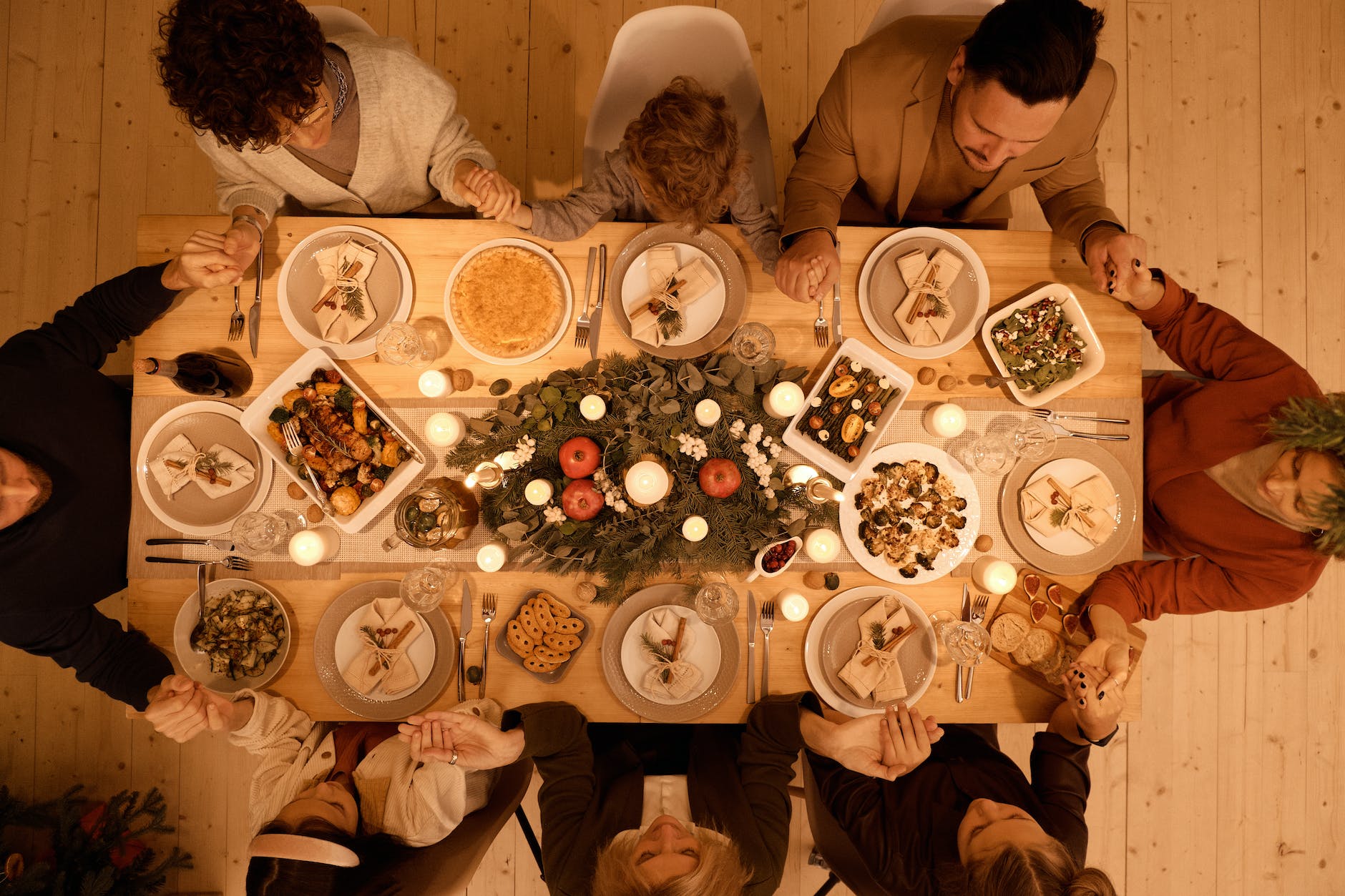
  • Old patterns, even deep divisions between people on the left and right, can change. For you, it might begin at the Christmas dinner table. The Word is present when we pass the peace along with the mashed potatoes and gravy.
  • Religion is more than rules. At its best, religion pushes the faithful to recognize God’s love for all people and all nations. This Word has no margins.

Your wait through Advent is but a few more days. Despite our political disagreements and the old relationship wounds acquired during the pandemic, a few songs will unite us in the week ahead. Together we will sing of the angels, the shepherds, and the little Lord Jesus, no crying he makes. Our own cries of blame and bitterness will quiet into a silent night while candles real and battery-operated outshine our divisions, if only for a moment.

Christmas is the story that leaves us hanging. The Word made flesh does not fix our America. The Word made flesh instead insists on hope: hope that justice calls us to work together; hope that ordinary people can heal extraordinary division; hope that peace can indeed be passed with the mashed potatoes and gravy.

Blessings on your Christmas, that the Word made flesh might make an appearance at your Christmas dinner table dressed like you. Amen.

Photo Credit: Nicole Michalou on Pexels.com

It Was There the Whole Time

our backyard

There is a peaceful place you yearn to be when life feels hectic. When the pace picks up, where do you long to go, knowing that in your particular, peaceful place, the pace slows?

Humans require a peaceful place with a slower pace every now and then, as noted in the commandment to remember the Sabbath day and keep it holy. The command is not for God but for us. Good comes when we hit the pause button for an hour, a day, or longer, even when it means stranding a bottomless to-do list.

The peaceful place I often imagine is near water: a stream, river, lake. A watery site where birds hover and come to visit. Is this why my favorite color is blue, I just now realize? I know I’m not alone in finding peace by water. It’s where Jesus tended to hang out when he hit the pause button. It is why lake cabins are forever in demand. I love to watch the water in motion, quietly offering life to mysterious creatures below and to happy onlookers like me. Does it have something to do with our very first swim in the amniotic waters? Who knows.

I do know there is little natural water to be found where I live. We are all shocked when the grass is still green in July! Lakes are few and far between in southwest North Dakota. There is a lovely river not far from me, but not so easy to visit.

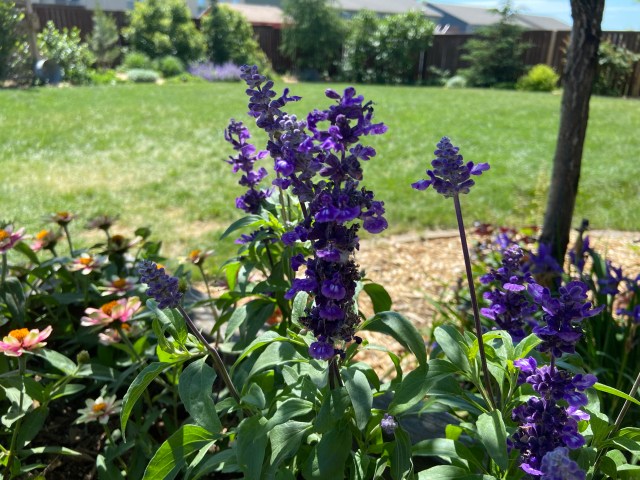
And all this time I long to be spectating waters, it occurs to me, peace may not be so far away after all. The disruption of peace is not limited to the particular places where the pace slows. In the wonky rhythm of summer, there is peace in a deep and renewing breath, in the shifting colors of a yard populated by perennials (thanks, Marcus), and in the broad view of badlands or a field of seeds quietly growing food in the darkness of the soil.

Peace is not only there, it is also here.

Dear Lord, keep me from overlooking peace because I expect it to look like something else. Amen.

Why Should I Have Coffee While They Flee?

(Photo by Engin Akyurt from Pexels)

While I was writing Spiritual Longing in a Woman’s World, the death of George Floyd set the spotlight on black voices begging to be heard. My eyes were opened by Austin Channing in particular. I began to wonder whether my book had a place at a time like that. Who am I, with my long history of supportive family and pastoral calls that came easily to me, to speak of longing? After more prayerful wondering, I understood there is never a perfect time for anything. If I waited to publish my book, there would certainly be another set of voices longing to be heard.

Today, ordinary women (like me) seek refuge in places far from home while their ordinary husbands (like mine) stay put to make possible their return. And here I am, a half-turn of the globe away, with my hot coffee and apple scone. Yesterday, our congregation prayed for peace from the safety of our building tucked into a quiet, ordinary neighborhood. How are we to live in the luxury of peace while there is no peace for so many ordinary humans?

I offer two responses to living in a world where one person is at peace at the same time another is a victim of war. One response is faithful and the other is not.

  • Be so thankful you are not them. I hear this from parents whose kids go on mission trips. “I just want them to learn how lucky they are.” Yes, that is what happens when we experience someone else’s struggle. We go home because we can, thankful we are not them. Today, we can tell our kids, “Eat your vegetables. At least you are not fleeing Ukraine with your mother.” This is a helpful way to deepen the divide between lucky us and unlucky them.
  • Recognize “them” are actually “us”. (Sorry, grammar people, that can’t be right. It’s the best I can do.) We are all people with families and homes who live in countries and are vulnerable to dangerous leaders. We = each and every one of us. There are no exceptions. The pain of the Ukrainian mother is my pain, too. I might feel thankful to enjoy peace, but more than that I feel deep sadness that someone else doesn’t get to enjoy it, too. Offering my kids this fuller picture points to Jesus in the gospels.

I am still drinking my hot coffee, however. And, I am fervently praying. Prayer shapes our hearts to see beyond ourselves. I am also giving money through Lutheran World Relief and the ELCA’s Lutheran Disaster Response. The latter nonprofit passes along 100% of your giving and retains zero dollars for administrative fees. I trust these two established organizations knowing they will not disappear when the crisis is over.

Teaching kids to recognize “them” are actually “us” takes turning the globe around and introducing them to our neighbors and wondering what “peace” looks like here and there. Most people in the world do not live with the luxury of food, shelter and clean water. We do, which means we have resources to share. Peace is not a luxury to be hoarded. It is what Jesus gave away, so that we might do the same.

Kelly Corrigan’s Lovely Oh Wells

(Photo by Helen Cheng on Unsplash)

You know those moments when the words find you. When you read a passage in a book that names exactly how you feel. Or a phrase from a song touches you. It happens to preachers, when someone listening thanks you for words they needed that you may or may not have said.

This 6-minute episode of a podcast found me at the right moment. I’m a fan of Kelly Corrigan, author, podcaster, and person who wonders out loud. She also wrote a lovely children’s book called “Hello World!”, calling young humans into the wonder of the world and its inhabitants.

Back to her podcast episode, where she gracefully names some of the disappointments we experience and concludes with the refrain: “Oh well.” These two words are like Teflon for the moments we simply must let go. They resemble the life-giving reminder to be gentle on yourself. And they sound like Jesus’ promise of peace, unlike anything the world gives (John 14).

There are some reminders that never completely sink in, or maybe they do, and they’ve sunk so deep we hardly notice them. As your life changes, however that may be, and the story isn’t the one you had in mind, “Oh well.” The earth spins and we start over. We can cling to regrets and grudges, or we can let them go. “Oh well.”

No circumstance changes who you already are, beloved human of God. “Oh well” keeps us from shooting for perfection. You are you with your flaws and your everything. “Oh well.” You are loved just as you are, and that is well enough.

Messy Make You Awesome

Oh, how I would love to open my kitchen cabinet doors to discover a gleaming oasis of organization. Instead of moving mixing bowls to get to a serving bowl, all bowls would be equally accessible. Some people’s dreams are inspired by dramatic home renovations on HGTV. I simply long for less crashing when I reach for a bowl.

Until the day arrives when only my husband and I open the kitchen cabinets, the crashing will persist. There is no possibility of an oasis for now. Like the lives we live, the cabinets will be messy, imperfect, oasis-less.

I have rounded the corner to the last third of my congregation’s gift of a sabbatical. The abundance of time I have to hang out with Jesus in prayer, to say yes to late night conversations with kiddos and my husband, and to Uber my kids here there and everywhere will shift in a month.

In my morning devotions, a question posed was whether I carry around heavy burdens from my past. Whether old sins linger and weigh on my shoulders. For me, it is the little things that snowball into a heavy burden. It is the everyday obnoxious, pestering questions:

Did I do enough for my family? For the church?

Whom did I disappoint?

Why did I say that?

Why didn’t I say that?

Could I have done that better?

Those are the pesky questions that keep me up at night and scratch at my soul, more than heavy burdens from my past.

And so, when I opened the kitchen cabinet and moved three things to get to a bowl this morning, I wondered if God was reminding me there is no oasis here. No organization or perfection to simplify life. As long as your heart is involved and your daily work (at home or anywhere) involves leading with your heart, you are in for messy cabinets, messy calendars, messy moments, messy sleep schedules. As long as you deeply care for people, do not expect perfection in your pantry.

This is why I wrote myself a note today. While the previous paragraph makes complete sense to me right now, in a couple of months when the messy cabinets are messier and I long for more time just to sit with Jesus, I will need a reminder. I will need a reminder that life with people involved is like needing the bowl that happens to be tucked into the corner, behind three other things. Always there is reaching and crashing. Remember, the note will nudge me, messy cabinets accompany life. The reaching, perhaps, could sound like Jesus’ reaching for me when I get stuck in the pestering questions. The crashing, perhaps, could sound like the slippery waters of baptism protecting me from the sticky burden of worrying whether I have done enough, or whether I am enough.

The moral of the story: If your cabinets are messy, you are awesome. Or more importantly, you are enough. And that is awesome.

A Mom on Sabbatical

Photo by Pixabay on Pexels.com

What have I learned in nearly two weeks of sabbatical time? I can sum it up in two words: slow down.

A year or two ago, I stopped at the post office to mail a package. It was a quick stop between Walmart and a haircut and I was hustling. Hustling is a drug that keeps you moving. It makes you feel amazing and unstoppable and completely unaware of how addicted you’ve become. I was pushing my pin number into the machine on the post office counter, but the machine kept rejecting my card.

“It worked when I was at Walmart a few minutes ago,” I assured the nice man at the counter, saying between the lines that there is actually money in my checking account! “You can slow down,” he gently prodded, seeing how flustered I had gotten. After a few more useless tries, I abandoned the debit card and handed over my credit card.

Later, I would realize I mistyped the four numbers of my pin. In my mindless hustle, I had thrown it off by a number enough times to lock up my card.

Now, nearly two weeks into this slower season of sabbatical, I am noticing more. I notice when I am tired and need more sleep, and then I go to bed earlier and sleep. I notice I tend to eat more when I’m in a hurry. I notice how easy it is for any one person in my family to default to a screen for distraction. I notice the majority of my breaths are shallow.

I notice how fun it is to prepare food when I don’t have to rush. I notice how much more meaningful conversations become when I’m not watching a clock to get back to work. I notice I take more time for contemplative prayer and daily devotions. I notice my families faces (even though not all teenagers appreciate such noticing).

“You can slow down”, came the wisdom behind, of all places, the post office counter! I’m listening. I’m slowing down.

What might that look like for you today? Notice when you are walking fast without needing to. Notice when you read, eat, or talk too fast. Notice your breaths and whether they are deep or always shallow.

In the noticing, often called mindfulness, Jesus’ presence becomes obvious. If there is one thing we do not attribute to Jesus, it is hustle! He was in no hurry moving from village to village, miracle to miracle, conversation to conversation, prayer to prayer.

How might the practice of slowing down help you notice the peace of Jesus’ presence today?