What is Good?

Today we recall the crucifixion of Jesus and call it Good Friday. What is good in this gruesome story? What is good about a death?

The good is this: There is no simple explanation for the death of God on the cross, but Love.

Here is what I mean. There is no uncomplicating the tangled up, prickly yet tender love of God. The unavoidable fact of Good Friday is that God had a rebellion on God’s hands, a rebellion against grace. God died for the rebels, died so that grace would be the last one standing in the rebellion.

There are many goofy theories around Good Friday which can all be confirmed on the internet. I just re-read the novel “Gilead.” Set in the 1950’s, the pastor noted how 40 years of ministry with a congregation can quickly be undone by one television preacher. And then, there is the internet!

  1. Atonement – This is the notion that Jesus had to die to satisfy God’s anger over our sins. Humanity was so terrible, according to this theory, and God was so mad about it, that the only way to avoid God’s wrath was to put Jesus to death, as though there was a deal between the Father and the Son. This is a trinitarian disaster.
  2. Substitution – This theory suggests Jesus stood in for us on the cross; although we are the sinners, Jesus took the nails for us. This wrathful view of God does not line up with the Gospels for sure, or with the God we meet in most of the Hebrew Scriptures. The God we meet there kept rescuing God’s people.

I suspect television/internet preachers are attracted to these kinds of simple answers to Jesus’ death. It is good, they might suggest, to make sense of the cross.

If only love were so simple.

Bring to mind a person or place or something you deeply love. Or recall a moment when you felt an overwhelming sense of love.

Was it witnessing a gorgeous act of creation – an unforgettable sunset, the Northern Lights, a stunning view of the ocean. Or the birth of a child, the wedding of a granddaughter, the last goodbye to your loved one who was dying. How do you squeeze any of those moments into words? You cannot. The grandeur of love, deep and sweeping love, defies description.

What is good on this Good Friday? The good is the inexplicable love of God for you. The good is Christ, delivering you on the cross from death as the end, who had more mercy for sinners than the world (our world) could handle. The good is God, who met our resistance to grace by embodying it. The good is God, whose love is good and whose grace is good.

Photo by Alicia Quan on Unsplash

The Word They Didn’t Really Mean

Sunday begins the holiest week of the year for Christians. It begins with Jesus’ arrival into Jerusalem and ends with his departure on the cross. What unfolds in the middle is our response to a God who offers to change our lives for good.

Because really, we would rather not be changed. To be changed requires so much of us, maybe even sitting in a different row in church! No thank you, ma’am!

But first, Palm Sunday. Jesus paraded into Jerusalem, parting the crowds of jubilant people crowded together for the Jewish Passover. Jesus’ reputation as one who had challenged the authorities, healed the sick and even raised the dead had preceded him. This was “the guy” they had been waiting for to finally stick it to the Emperor. Jesus’ parade into Jerusalem blatantly mocked the power of the Roman army. He was getting himself into trouble here.

And the crowds were eating it up.

“Hosanna!” the crowds shouted, literally begging Jesus to “save us.”(Remember, salvation not only pertains to the afterlife but to the way we live our lives on earth.) “Save us!” But they didn’t really mean it. They were caught up in the shouts of the crowd. When they realized that for Jesus to save them, they would all need to change, they changed their minds instead, which is why the week ends with Good Friday.

“Save us!” they shouted to Jesus. But what they meant was, “Save us…only if we can continue to live the way we want to live. Save us as long as we can fit in with the crowd. Save us as long as we can protect our own money and resources. Save us as long as we don’t have to entrust our whole lives to you. Save us as long as we don’t need to change.”

This is not the salvation Jesus offers. Salvation according to Jesus is a drastic change. Your life is not your own, if Jesus has anything to say about it. Your life never follows a crowd. Your life is not a continuous climb up a corporate ladder, nor is it busy streak. Your life is meant to be so tangled up with your neighbor’s that you sometimes forget what belongs to whom. That is the salvation Jesus offers.

And this is the salvation the crowd declined. “Yeah…no.” They said, turning around when they realized to be saved is also to be changed. How often do I do the same, turning away from Jesus’ daily offering of salvation, abundant life and mercy because I am so set in my routine and rhythm? So set in saving my money, curating my time, taking care of my own family, sticking to my own goals. Do I really want Jesus to change me? Is my “Hosanna” genuine?

“Hosanna!” Yes, please. “Hosanna.”

Photo by Nicholas Green on Unsplash

You Made Plans? That’s sNOw Interesting!

You don’t understand. My plans were solid! Holy Week is meant to look a certain way. I should know, I’ve been through a few. Holy Weeks include sermon writing and mostly visitation of homebound members. Me and my trusty Communion Kit make the rounds and church is brought to the people who may not get to church for Easter Sunday. I know this was the plan because I wrote it all down!

But then snow…more snow…and a little more snow to top it off.

Suddenly, all the plans are in jeopardy, even the ones I wrote down! And I am feeling a sort of deja vous feeling. I remember not long ago writing down plans and none of them happening. I remember an orderly calendar layered with eraser bits. I remember not liking it!

The thing about revising plans is that it often takes a few revisions before we land on the plans that actually happen. Take, for example, Maundy Thursday. With eraser in hand on Thursday morning, was our next plan to worship in the building or only online? Could I even make it to the church building? Would I get there in a pick-up or would my neighbor take me on his snowmobile? Would a musician be able to get there to lead worship with me? Or would it be a solo job? Was there too much wind and snow to even get to the building on snowmobile, leaving a service at home to be the only option? And then would I be crossing my fingers that the kids don’t choose the contemplative moment of neighborly handwashing to argue over the last donut?

But today is Saturday, so clearly it all worked out, as it always does. Peering over my shoulder at the past few days, I once again learn the lesson that no matter how solid and admirable and efficient my plans may be, they will not hold up against a blizzard, a pandemic, or whatever might befall the human race next time. There is no formula that states the more thorough the plan, the more likely it is to play out.

If I’ve been through a few Holy Weeks, then I know life is lived in the letting go. We fully live when we hold onto plans with a loose grip, never so tightly that we cannot let them go. Our life is not lived in plans, but in the many ways God’s grace can be seen in the eraser bits. In the way that neighbor of mine would have taken me to church on his snowmobile. In the way my son could come with me to church to record the service. In the way that the only reason for a Maundy Thursday service at all is because God, in the inerasable love of Jesus Christ, has come to open our hands and fill them with mercy.

Got plans? That’s sNOw interesting. They may not hold up; you may need your eraser at the ready. And what you will find is a mess of mercy.

The Avoidable Question

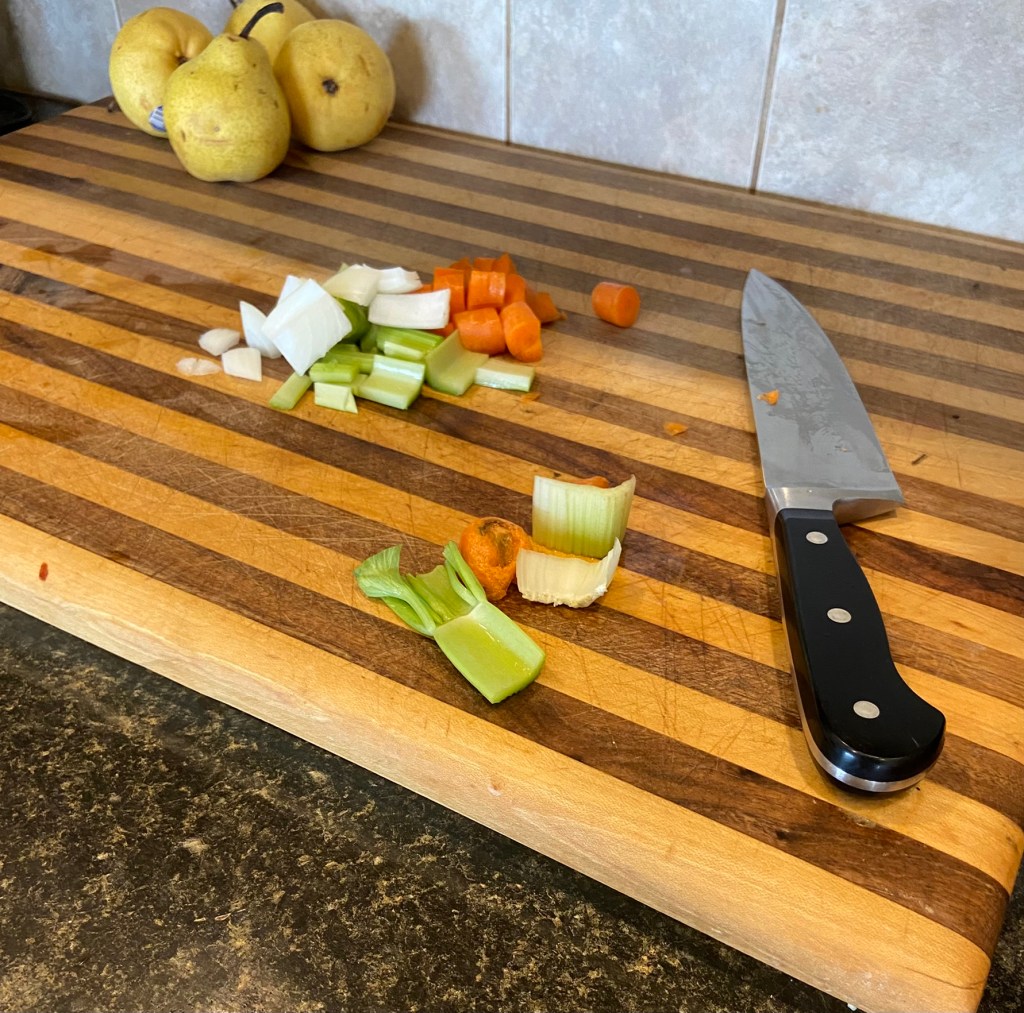
Vegetables ready to flavor Marcus’ Chicken Noodle Soup and pears to sweeten a smoothie.

There are times when it is the question, not the answer, that is hard to come by. Questions can be asked or avoided, but first there must be a question. What question, tucked deep in your heart beneath a thick layer of pride or something else, lays waiting for you to ask?

Reading the novel Apples Never Fall this weekend, I was reminded of a question I asked late in my marriage. It took a decade for me to unearth this simple question that grew in urgency as the years accumulated. I won’t spoil Moriarty’s book when I tell you one of the characters struggled to find the same simple question!

I shared the story in my book about being called as senior pastor and needing to let go of some of my daily work. Among the hardest stuff we do as people (especially as women?) is to let go of some of our daily work. It is ridiculously hard for me to let go of the need to tidy up the kitchen and stay on top of the laundry. Honestly, who cares! But I sacrifice valuable sitting, playing or reading time with this ridiculous need to tidy up. But I digress.

Before I began my new call, I had asked my husband a question that began with an admission: “I need more help from you.” Marcus and I talked through the question, “What might I let go?” He immediately agreed to do the weekend cooking, leaving enough leftovers to stretch through most of the weekdays. For the last seven years, his response to my question has loosened the tension of work at church and at home. Had I not asked it, my kids would not be eating as well (last night he made homemade French Fries!) and I would be grumpy about cooking.

The question we tend to keep tucked away where no one can see it is some variation of: “What do I need?” Most of us find neediness to be a character flaw, so we avoid needing anything from anyone as best we can. We have complexes about keeping scores even and so we try to stay ahead by needing less. This, my friends, is dumb.

Pacing through Holy Week one day at a time, we should become poignantly aware of our neediness. “What do I need?”, we might ask our needy selves? The question is surely avoidable, but if we summon up the courage to inquire, we will be freed by our admission that we need help, forgiveness, a hug, a kind text, a meal, carpooling partners, a grocery run, coffee with a friend, a walk, a Savior who exchanged his life for our forgiveness. Without our neediness, there is no need for grace, the perpetually uneven score. Avoid the question and avoid the rich response of mercy. Peel back the layers of your life to find that question, and trust that the answer just might surprise you.

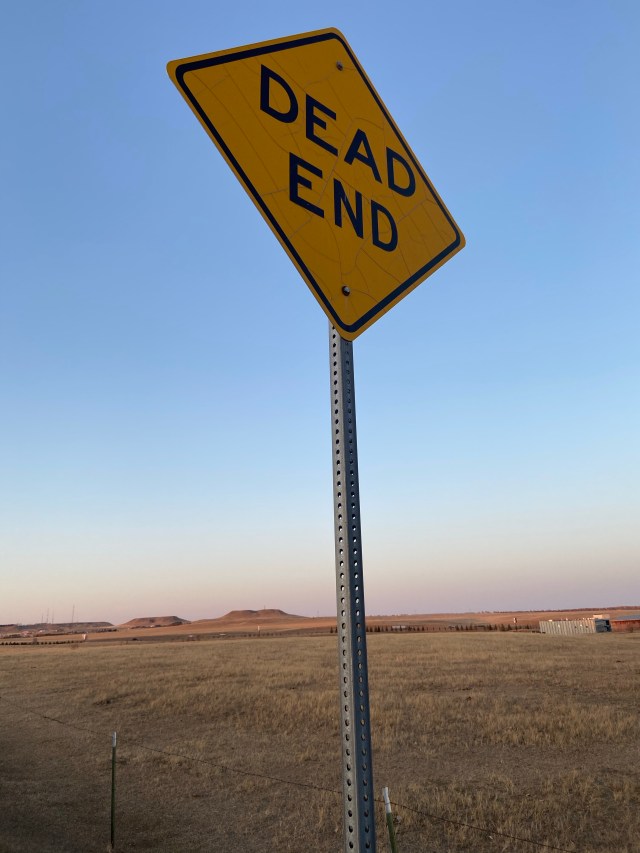
Holy Week: The unDead End

The human experience is often habitual. From our morning routine, to the route we take through the grocery store, to the way we choose to relax. If you were to zoom out on your life, you would notice other examples of habit. How you set goals (or don’t) and whether you expect to achieve them. How you respond to your self-criticism. How you dream (or don’t dream) about your future.

When we move comfortably in rhythm with our habits, we might wonder whether this is all there is. Is this the only way? Does your familiar habitual experience lead irreversibly in one direction? Do all roads close in on the one dead end at the very end?

I am wondering because some habits are not particularly life-giving. Whenever you feel stuck in a job or a relationship, it feels very much like moving toward a dead end; as if this truly is all there is and there is absolutely no other way.

If you want a ridiculous example, I can supply many from my own life. To offer you just one. I have been wearing disagreeable sunglasses for almost a year. They never quite fit properly and they have left a small scratch on the bridge of my nose that will not go away for the obvious reason that I keep wearing them. In the very center of one lens, there is a damning scratch that occurred when my kids were fighting like zoo animals in the car one day and I threw my glasses because…because…well, that was just a dumb thing I did.

For the past year, I have answered “yes” to the question, “Is this the only way I might protect my eyes from the sun? Is this scratched and scratching set of sunglasses my only option?”

Here is another example, this one from the Bible and not so petty. I give you, the story we call Palm Sunday.

When Jesus sat on a donkey and strode into Jerusalem, he was mimicking a Roman victory parade. If we were first century residents of Jerusalem, we would have known that after your country (always Rome in the first century) wins a war, a prominent military figure would sit on a fancy-pants horse and enter a city through a parade of worshippers. It was “the only way” to assure a city the victors would forever be the victors. There was no reason to doubt the men in charge because, can’t you see, military men like this one will forever rule the world and therefore be worthy of your praise.

But…Jesus was on a donkey, not a horse. His victory would be by death, not by inflicting death on others. Which means this “ruler” of ours would not promise to live, but be killed. Eek.

Jesus’ life-long sermon was, “Nope, this is not all there is.” Victors who rule by might alone? Not all there is. People who are weak, poor, lost, addicted, not religious, lonely, left in the gutters? Not all there is. Women whose proper place is wherever the men decide? Not all there is. Kids who are subjected to sexual abuse because their voices don’t matter? Not all there is. The rich buying their way through life? Nope.

On Palm Sunday, Jesus preached this sermon without words. His parade into the city was a colossal joke, a prank meant to light a fire under the church and city rulers. It worked.

On Easter Sunday (and every single day) God preaches that sermon again and again. “This is not all there is.” Christians are brazen enough to look for the living among the dead because all roads, no matter how deep the ruts of our habits, do not lead to a singular dead end. The tomb was a most profound hoax of a dead end, revealing itself three days later to be an un-dead end.

I did order new sunglasses yesterday. Just in time for Easter.

A question for littles

Sometime when you are driving home and everyone is in a delightful mood and you are not in a hurry, take a different route. You could ask you kiddo to tell you where and when to turn. Ask them what they notice? What’s it like to take a different route?

A question for former littles

Do you feel stuck in any particular habit? (First, the grown-up must share an answer from her or his own life.)

A spiritual practice

When you have 5 extra minutes (or maybe during your shower) think of words you use to describe yourself. Be honest and let the words come to you. Notice whether the words are positive or negative. Are some of the words untrue? Do they lead you to dead ends in your life? How might the un-dead end of the empty tomb renew your sense of yourself?