The Phone Call You Need to Make Today

Someone you know is having a rough day. You may not know it, because your someone wouldn’t want you to worry.

As your someone waits for a diagnosis, pushes through chronic pain, wrestles with gender or sexual identity, grieves a death, or struggles through another sleepless night with a new baby, you have no idea how alone your someone feels.

Loneliness is something of a pandemic these days. How ironic it is that most Americans feel a deep sense of loneliness and mistakenly believe we’re all alone in our loneliness. We are a community of lonely people, including the someone you know who is having a rough day who might be praying a version of this prayer from “Sheltering Mercy: Prayers Inspired by the Psalms,” Psalm 70:

Grant me strength, O Lord.
Can You not scatter these dark spirits
with the sound of a thundering army,
or twist their devil tongues to confusion?

On this day, you might be the one to scatter the dark spirits, to re-member (bring back together) someone with your community. You might be the one to embody the promise and join in the prayer of the next paragraph of Psalm 70:

For You,
Lord of light and beauty,
are Lord over death and darkness as well - 
all evil prostrates in Your presence.
Send those taunting voices back to the depths of the earth
where they belong.

There is a phone call you need to make today to scatter the dark spirits and reshape the community of the lonely into the community of the re-membered.

Photo by Pawel Czerwinski on Unsplash

The Anti-Chore List

I spent the better part of a couple of days this week in bed not feeling so great. Feeling unwell, although annoying and inconvenient, is simply a reminder of our humanness. Our mortality speaks up when our bodies do not do what we want them to do because of illness or aging.

Feeling crumby offers a gentle or abrupt invitation to be cared for, to admit we have needs, and to write an anti-chore list. This morning, I wrote an anti-chore list I’ll share with my family this week. In my many hours of rest, it slowly dawned on me that I’ve done what I sometimes (often) do at home: other people’s chores.

Writing an anti-chore list was very fun, and I suspect it will be helpful for the people with whom I live. Is it helpful or annoying that I sometimes (often) do their chores? Perhaps both.

It might be great when I do other people’s chores because, obviously, then they don’t have to do them! More leisure time for them! But it is also annoying. How does a person know what to expect when an overly helpful mom steps in? It would be like your co-worker sometimes (often) doing a task that belongs to you and not knowing whether it is even your responsibility anymore.

No longer will I feed the dogs, empty the dishwasher, and a few other tasks that belong to my kids. No longer will I step in when I can instead step aside. No longer will I ignore my own limits, no longer will a clean kitchen be more important than rest. No longer…until the next time! This lesson is not one-and-done with me, but rinse and repeat. And repeat.

Our days are a steady reminder that we are created both to love and be loved, to give and to receive.

Photo by Paico Oficial on Unsplash

The Length of Lent

If you were to Google the family tree for the word “Lent”, you would discover that a distant relative of “Lent” is “long”. Lent is the 40-day long stretch between Ash Wednesday and Maundy Thursday, excluding Sundays because each Sunday is a mini-Easter Sunday.

The days can be long during Lent for anyone fasting from something you love. The days can be long yet the weeks can still go fast. You have heard that saying elsewhere; I first heard it as a Bible Camp counselor. The days were long because they were so full. And the weeks went fast.

Your day might be long for any number of reasons. It might be a long day because it is so full or so empty. The day could be long because you are waiting for someone to contact you or waiting for your body to heal.

Long days are not to be wished away. A day is a unique gift – a limited resource. There are only so many and no two are the same. Lent instructs you to lengthen the day to truly see it. Lent is the caution sign on the side of the road to slow you down so that you pay attention.

Try one of these Lenten practices to make your day long enough for you to pay attention.

  • When you talk to someone, notice the color of the person’s eyes. Remember that person, like you, has seen the world through a particular lens shaped by their own experiences. That person, like you, is a beloved child of God.
  • During a meal, notice the individual flavors in whatever you are eating. Can you taste a specific herb? Can you describe to yourself the texture? How many people did it take from start to finish for this food to be on your plate?
  • Take three slow, deep breaths.
  • If you are reading a book, slow down. Savor the words on the page. What a miracle it is to have the ability to read.
  • Set a timer for one minute and sit still. Let your muscles relax, your face included. Notice Jesus sitting beside you.

We are at the start of the 40-day long stretch of Lent. The days are long and yet the weeks go fast. Let Lent teach you something new, that has been there all along.

Photo by Matthew Alexander on Unsplash

What Can and Cannot Be Replaced

At the turn of the century, Marcus and I chose dishes for our wedding registry. Fact Check: I chose dishes for our wedding registry! I had spent roughly 9 months working in the home department at Herberger’s in Moorhead a couple of years before when I was a junior at Moorhead State University. The same year I began learning Greek, I learned Pfaltzgraff patterns. Both were magical in their own way.

Pfaltzgraff patterns are mesmerizing – maybe even hypnotic! You focus on the pattern and begin to picture your life with these dishes. You imagine who will sit at a table with you and these dishes. You picture the beautiful food you will eat and imagine the rich stories you might share. In your hypnotic state, you dream of how much love be passed around the table among the perfect family you have just made up in your head.

The Rio pattern caught my attention back in 1998. It is pottery dinnerware, which seemed casual and also grown-up. Two shades of blue and cream color these heavier dishes. I didn’t realize they are heavier dishes.

The truth is Rio was not the best choice. The dinner dishes have not fit well in some of our dishwashers and a heavy plate is not ideal for little kids. They have been sturdy, however, which is ideal for little kids. Even so, Rio is being replaced.

With a gift St. John gave me for my 15-year anniversary, I bought new dishes. Again, I chose the dishes! Marcus will place delicious food on them. Our roles have become clearer in 21 years! But the hypnosis wore off long ago. The Rio dishes were not set before a perfect family. I can only guess that never once have we enjoyed a perfect meal without any spilling of milk or careless words. The family I dreamed up has never once shown up for dinner!

Instead, the table is where we gather as human beings who have often had a long day, a tough conversation or two, friendships that were strained, and problems that were hard.

As the Rio pattern is replaced, I now have a better, non-hypnotic picture of the family that will use the new dishes. It is not the same family I had imagined! The same is true for you. The people who show up in our lives are not the ones we imagined. We can pick (and replace) the dinnerware pattern but not the people. We can set the table but not the cast of characters.

Which means you, unlike your dishes, are simply not replaceable.

Photo by Brooke Lark on Unsplash

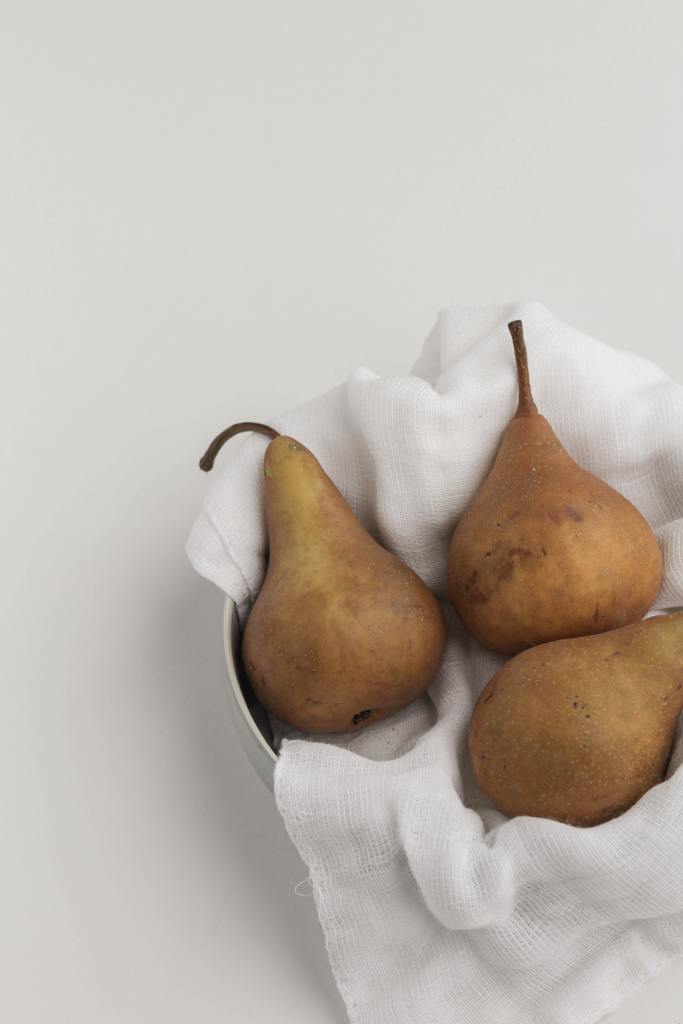
An Anniversary and Bosc Pears

What is an anniversary but a way to keep the days and years from running together? Like a landmark along the unremarkable stretch of I94, an anniversary catches our attention, disrupts the routine, and makes the journey more interesting.

Last Sunday, the congregation I serve completely surprised me by recognizing the 15th anniversary of my installation! I am still in awe of their sneakiness! And grateful for their love in Christ. Together, we pulled off the interstate and noticed the landmark.

Today marks a different kind of anniversary, another sacred landmark on the journey. One year ago, my dear friend Terry who had been my boss at the Luther Seminary Bookstore long ago, died of lung cancer. I am telling you this story because he was my cheerleader, the very first person to subscribe to this blog. I am telling you this story because people who shape your life become landmarks on the road.

I could tell you all about my friend who was the perfect image of health. My friend, who introduced me to bosc pears, one of his favorite snacks. He emailed me every single week to encourage his pastor friend and ended each email with a benediction he’d heard at worship that week at his beloved congregation.

Terry grew up and lived in Eau Claire until he took the bus to Connecticut and then walked to Yale University caring a single suitcase. He would never let you in on the secret that he was brilliant. During his internship as he studied to become an ordained pastor, he heard a new calling. He was called not to be a minister of Word and Sacrament, but to be a minister of the Word. He sold books, but that’s not quite right. He put words into the hands of people hungry for the Word.

I could tell you all about my friend, but instead I will tell you that anniversaries are an invitation to give thanks for the people who enrich the journey. Today, I am so grateful for my friend, as I live now in the presence of his absence. And I am awakened again to the fragility and wonder of this life, and the surprises along the way.

To mark this anniversary, I will snack on a bosc pear while you are encouraged to download a free e-book edition of my book, Spiritual Longing in a Woman’s World. If you already downloaded it, you may not be able to download it again, so tell a friend! It is free all day long today only. If you have read it, please share an honest review on Amazon or Goodreads.

Photo by Fernanda Martinez on Unsplash

Yep, It Is That Simple

Humanity has a way of complicating the simple. As if anything worth doing should be difficult. Christians are currently in the second millennium of overcomplicating two simple instructions: love God and love your neighbor.

Love God. Well, I’m busy. My kids are busy. My grandkids are busy. There is a new season of my favorite show.

Love your neighbor. Who, precisely, is my neighbor? How much do I really need to care? Will it cost me money? Can I draw a border? Do I have to? Can’t the neighbor meet me halfway? Isn’t it someone else’s job?

My life as a wife, mom and pastor may appear complicated and is when I overcomplicate it. But really, it is simple. I am to show up with Christ’s love. Nothing more, nothing less. I am to be present one person at a time, one moment at a time, not worrying too far ahead, and letting go of what has been done.

In Matthew 6, Jesus demonstrates how prayer is also simple, providing words to guide our way. We need not overcomplicate a conversation with God. Pray for justice on earth, basic needs to be met, forgiveness given and received, and protection. Pray to the one whose name is most holy, with assurance that your meager words are enfolded into God’s eternal love story with God’s people.

The Lord’s Prayer is a guide that not only offers you words, but offers you community. Billions of people have prayed this very prayer for over 2,023 years. These particular words have been spoken by believers and doubters, the living and the dying, at kitchen tables and hospital bedsides, by people under the thumb of dementia, by nearly ever flavor of the Christian experience, and by martyrs for whom these words were their last. The words of the Lord’s Prayer might be the most unifying words ever spoken.

These words, simply put, are your guide whenever you need them.

Photo by Hello I’m Nik on Unsplash

Gratitude Can Be Dangerous

Gratitude can be dangerous.

When gratitude becomes one way to recognize one person or family as more blessed than another, it is dangerous.

Gratitude is not meant to open our eyes to how good we have it and how bad others have it. “At least we aren’t him,” Job’s friends said in the pitying look they exchanged. Gratitude is not eye-opening, but heart-opening. It is the moment our hearts open up to the hard truth that life, at times, can be too much for any of us. Gratitude recognizes that even a moment of peace is a gift from God.

Gratitude is meant to turn our attention away from ourselves to the hand of the giver, who gives not unjustly, but in hopes that all we have would involve a borderless we – a we that stretches and expands like the pantyhose that left all women itchy and irritated.

Gratitude is never dangerous as long as covers the bold and the meek, the haves and the have nots with the same sheer delight that somehow, somehow, a planet full of broken human beings keeps spinning.

Photo by Greg Rosenke on Unsplash

An American Advent: Esther

You will find them in the reeds when Moses floats down the river. She is the unseen young girl whose parents were taken during the war. Before anyone else finds out, the angel first proclaimed the good news for all the world to her.

The Bible is nothing if not shocking. When something big is about to happen, it does not first happen among the mighty and powerful. Elected leaders do not shape the story of Scripture. Those with political importance are only center stage when they have messed it up.

The infant Moses was saved when two young girls took charge. It is teenage Mary who first received the good news of Jesus’ coming. And no one suspected Esther.

Esther’s story is told in ten chapters that famously make no mention of God. She was a Jew raised by her Jewish cousin, Mordecai, after her parents were taken in the Babylonian Exile. When the non-Jewish king went on the hunt for a new pretty face, Esther won his favor. Later, Mordecai overheard a plot to exterminate the Jews and urged Esther to use her place in the king’s favor to stop it. He said, “Who knows? Perhaps you have come to royal dignity for just such a time as this.”

This Advent series challenges you to notice an Advent hope for our own nation. In America, the land of the divided and the home of finger-pointers, we tend to look for hope in all the wrong places. We look for hope among the wealthy, the mighty, and within our own political party. We blame and bicker, boo and belittle.

And no one suspects Esther.

Upon Mordecai’s urging, Esther went to work. When no one suspects you of changing the world, you have plenty of permission to do so. And she did.

As America waits for a better economy, a better selection of political candidates, a better nation, Esther is a story of what to do while you wait. She wasted no time blaming or bickering. She, a young woman in a man’s world, the unseen girl with tragedy as her backstory, hatched a Shakesperean plan that concluded: “…and if I perish, I perish.”

While we spend these Advent weeks waiting for the birth of a Savior and waiting for Jesus to come again and waiting for a better America, how are you waiting? Are you blaming the leaders you elected because America does not look how you want? Are you bickering with those who see the nation differently when all this time you could be the unsuspecting whisperer of hope?

Let’s move the spotlight from the nation to the Christmas dinner table that awaits you. You know, the table you may be dreading because the very people who bother you most will be seated beside you. People who see the nation differently, or your family history differently. People you successfully avoid most of the year. I recently listened to a podcast in which a listener asked if it is possible to just end it with her family because she’d had enough of them. If you are dreading the Christmas dinner table, it appears you are not alone.

Esther saved a nation, and perhaps you could save Christmas dinner. How did she do it? She believed that what made her unique was exactly what was needed. Out of love for her people, she was brave and honest. She did not wait for someone more important to make a difference, she understood the one who could make a change was her.

Photo Credit: Akira Deng on Unsplash

If I’m Washing Dishes, Look Out

(Photo by Gary Barnes on Pexels.com)

If my life were a movie, there would be a hundred scenes of a crabby me washing the dishes. It isn’t that I do not enjoy washing the dishes. It’s not the worst chore. What ticks me off is that washing the dishes is someone else’s chore. And that person seems to “forget” the assignment and get lost in a screen. Instead of maturely asking the person to wash the dishes, to quote any toddler you know: “I do it myself!” And the wrath of Lisa is felt at every corner of my home.
“Mom,” the person will later say, “I would have done the dishes…eventually.”
And it’s true! Eventually, had I been more patient and mature, that person would have washed the dishes without my transforming into such a crab. I could have ignored the dirty dishes and read a book, but instead, I jumped in and overfunctioned.
This is one of my biggest human struggles. And as you will notice in yourself, struggles within your family relationships often match your struggles in your work relationships. At home and at work, I tend to agree to do something before I think it through.

At home, when we overfunction for a spouse or child, typically that person learns to underfunction. We teach people how to treat us. To balance out a relationship, one person’s overfunctioning perpetuates the other person’s underfunctioning. In a marriage, we might adopt this relationship based on marriage as we saw it growing up. For instance, in the marriage we saw growing up, one partner did all the cooking while the other watched tv, so that seemed normal. Or maybe one partner constantly worked on the marriage while the other jokingly (but not jokingly) complained about it. In both of these examples, one partner is overfunctioning.

Roberta Gilbert described overfunctioners in this way:
“Advice-giving,
Doing things for others they could do for themselves,
Worrying about other people,
Feeling more responbility for others than is actually needed,
Knowing what is best for others,
Talking more than listening,
Having goals for others that they don’t have for themselves,
Experiencing periodic, sudden ‘burnout’ or severe illness in other forms,
Taking charge of others’ lives,
Doing well in life, but someone close to them is not.”

Underfunctioners, on the other hand:
“Ask for advice when what is needed is to think things out independently,
Get others to help when help is not needed,
Act irresponsibly,
Listen more than talk,
Float along without goals,
Set goals, but don’t follow through,
Become mentally or physically ill frequently,
May have substance addiction problems,
Put others in charge of their lives.”

The goal in a relationship is for each partner to be equally emotionally responsible. For the overfunctioner, Gilbert points out, this sounds preposterous! The overfunctioner assumes he or she is the most responsible, but in truth, overfunctioning simply perpetuates the problem. She points out the best way out of an over/underfunctioning relationship is for one person to ask, “What is my contribution to this relationship pattern?” That’s a bugger of a question. It means I cannot blame my kid for neglecting the dishes again!

In any relationship, each of us plays a part. If you step back and look at your life like you would watch a movie, you will notice the part you play. From there, you can thoughtfully work to change patterns that need changing.

A New Way to See Your Life, Part Two

(Photo by 蔡 世宏 on Unsplash)

You come home from work replaying in your mind a heated argument with a co-worker and you snap at your child when he asks what’s for supper. After watching your daily dose of breaking news, you join your friends for coffee to discuss how terrible the world has become. For the thousandth time, your spouse left bits of toothpaste in the sink tonight, even though your spouse knows it grosses you out. You are so angry you won’t even say goodnight.

We live our lives with people, including and not limited to strangers, friends, co-workers, news reporters, and family members. In systems thinking, connection with another human being creates what is called an emotional system. An emotional system can shape your behavior. Your frustration from work goes home with you and you snap at your child as you snap the dry spaghetti noodles, even though your child had nothing to do with that encounter at work. Watching the news makes you anxious, so you share that anxiety with friends, making yourself and others more anxious. You are grossed out by the toothpaste in the sink, but know you will resurrect an old argument if you bring it up.

Any relationship you have with another person (spouse, parent, child, co-worker, boss) can create intense emotions, even if the subject is toothpaste. When emotions flare up, we tend to bring a third person into the mix. Picture this. You have a tough conversation with a co-worker and at the end of the day, you can’t stop thinking about it. So when your child asks, “What’s for supper,” instead of responding “Spaghetti”, you pass along some of your anger by shouting, “SPAGHETTI!” It’s not your kid’s fault your day was stinky, but it was an easy way for you to pass along some of your anxiey.

Or, you keep watching that “breaking news” show all day (seriously all day?) until it’s time for afternoon decaf with your friends. “Can you believe that president/senator/CEO/principal/football team/liberal/conservative #&*&^(&(@! What is this world coming to?” Anxious news-watching generates more anxiety when we sit with other anxious news-watching people, but it makes us feel better (for a little while). At least we’re not the only anxious ones.

Or you call your mother to complain that your spouse is basically still nine years old and unable to handle toothpaste, instead of peacefully suggesting toothpaste tablets directly to your spouse when you aren’t both too tired.

This is called triangling. Instead of dealing directly with the person with whom we have conflict, we take our anxiety outside of the relationship to calm ourselves down. Not all triangles are negative, yet some can become destructive. Roberta M. Gilbert suggests these are common ways we find ourselves in a triangle:

  • Talking against the boss, the minister, or the teacher to people other than the boss, the minister, or the teacher;
  • Gossiping;
  • Having an affair;
  • Taking a morbid interest in other people’s problems, and
  • Thinking more about a child or anyone else than one’s own marriage or life. (Extraordinary Relationships A New Way of Thinking About Human Interactions, p. 53)

At our more mature moments (when we are rested and fed), we recognize our dangerous position in a triangle. We feel yucky when a friend gossips and we join in. We try over and over again to stop the affair. These unhealthy practices distract us from the real work that needs to be done on our own selves. Yes, you are a work in progress and therefore it takes work to be you. It takes hard work to notice your feelings without letting them take over. It takes hard work to admit when you acted immaturely. It takes hard work to be a responsible, non-blaming human in the 21st century…and in the 1st.

A story in Luke’s gospel illustrates. Jesus has come to visit the sisters, Martha and Mary. Martha is preparing food in the kitchen while Mary sits and visits with Jesus. Martha is ticked and Mary is enjoying herself. Instead of asking Mary to help in the kitchen, Martha passively agressively creates a triangle with Jesus. “Jesus, tell my sister to grow up.” (paraphrase mine). Jesus says nothing to Mary, instead addressing Martha. “Mary is doing what’s best,” he explained to the sassy sister, avoiding being triangled in the drama that is sisterhood.

It takes guts to avoid an unhealthy triangle. (Leave it to Jesus to nail it.) Can you spot a triangle in your life you don’t like? How might you directly address the person with whom you have a conflict?

Glossary

Emotional System: “In difficult relationships, emotions reverberate from person to person, very much like the excitement caught by a herd, beginning with one anxious individual who perceives danger.” (Extraordinary Relationships A New Way of Thinking About Human Interactions, p. 9)
Triangle: To calm a relationship between two people, a conflict often spills out into a third person. Or, when news makes us anxious, instead of processing and dealing with the news maturely, we raise the level of anxiety by inviting other people into it.
Conflict: Relationships move from close to distant and back again, from up to down and back again. In between close and distant, up and down are periods of conflict. Conflict is not negative, but instead offers an invitation for people to grow closer if handled honestly and maturely.