What Your Laundry is Telling You

Your laundry has something to tell you. And no, it has nothing to do with your favorite brand of detergent.

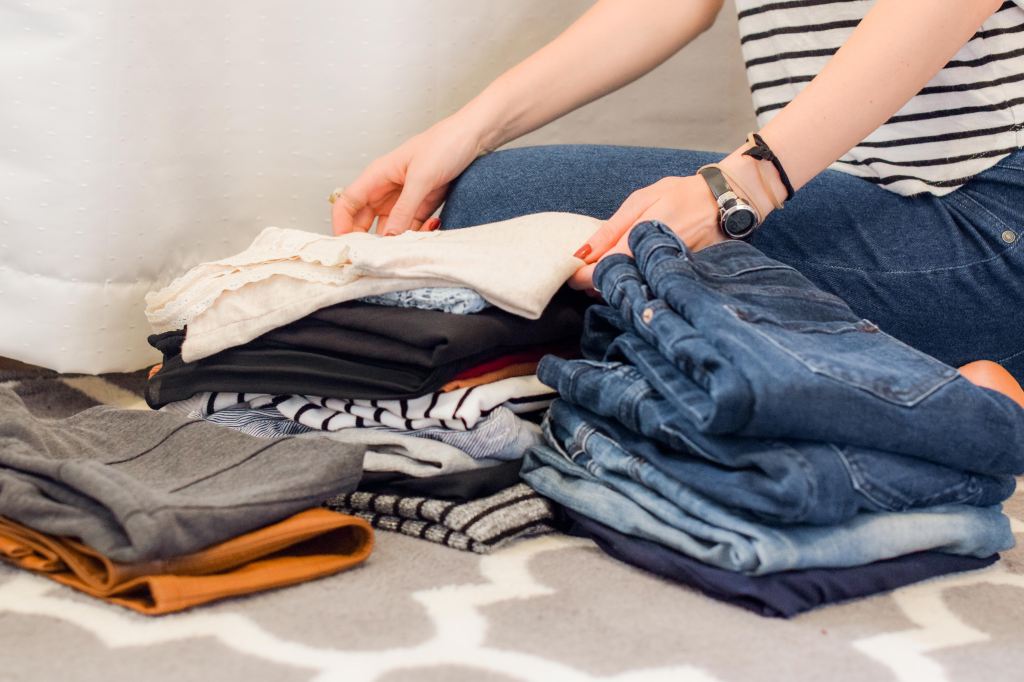
In 2014, Marie Kondo wrote “The Life-Changing Magic of Tidying Up.” That’s when I learned to fold clothes. Her method is truly magical and involves setting each article of clothing from socks to sweatshirts upright in drawers. Instead of laying clothing flat, allowing only the item on top to be seen, Kondo’s method enables all the clothing equal opportunity.

Her method is partly informed by her Japanese religion, Shintoism. In the Shinto religion, every physical item contains the sacred. As Kondo folds pajamas in the morning, for example, she thanks the pajamas for a good night’s rest, acknowledging the sacred woven into the fabric.

In the Christian faith, pajamas are pajamas, although a good night’s sleep is certainly sacred! And yet, Kondo’s practice might inspire us. Your laundry can tell you how to pray for your neighbor.

  • When I fold my pajamas (the Kondo way of course!), I thank God for warmth and rest, for a safe place to lay my head, for the luxury of shelter. I pray for my neighbors who slept outside without the protection of a roof and the extravagance of a pillow and clean sheets.
  • Folding towels reminds me to pray for my neighbor far away who will never experience a hot, soapy shower; women who would do anything to bathe their babies if only clean water was readily available.

You get the idea. All around you the Spirit is stirring up prayer cues. Listen to your laundry. You will get to know your neighbor, the one whom Jesus loves so much.

Photo by Sarah Brown on Unsplash

The Story of the Christmas Cards

What do you do with Christmas cards after you pull them out of their cozy envelopes? Do you lay them in a basket on your table? Hang them up?

Early in our marriage, opening Christmas cards addressed to Mr. and Mrs. felt so very grown-up! The first couple of years, I kept each card in a photo album. Then I stopped. What would I do with all those albums?! Instead, I set the cards in a basket and then stored them away after Christmas, like time capsules.

These days, we hang the cards on a kitchen wall to savor. Later, they will enter the world of the recycling bin, but for now our friends and family hang out with us through Advent from the wall, their photos a collection of real-life stories intertwined with our own.

Christmas cards tell a story. The real story of life. The photos insist that amid the despair of real life, it is possible to lock eyes with a camera. It is possible, despite the real hardships of our lives, to appear in a photo as evidence of how life can go on. Through miscarriage and divorce, cancer and job loss, deep grief and fierce betrayal, one day stubbornly leads into the next. There is one more day, and then another.

The story of the Christmas cards is one of hope. We can put on our best clothes and smile at the camera, but the real hope comes in the mess of a manger birth. The real hope is the child who would not avoid the real hardships of life, but live them, one day stubbornly leading to the next.

Christmas cards can lure a person into believing that life can look perfect; we can all have our tidy lives. But there are no tidy lives. Every relationship is hard at times. Your relationship with your own self can be trying! Each and every person is touched by the messiness of life.

The story of Christmas is this: Immanuel (God-with-us) in the mess, in the hardship, in the despair – hope evident in the Christmas cards on your wall, in a basket, but I hope not in an album unless you have tons of space!

Photo by Annie Spratt on Unsplash

Slow-Growing Advent Hope

Here is a fable to illustrate hope.

Imagine a forest populated with ferns and bamboo.

Long before, a farmer had planted seeds to grow the lush ferns and abundant bamboo. The ferns grew quickly, covering the ground like the green shag carpet in the living room of my youth.

However, even after an entire year nothing came of the bamboo.

The following year, the fern continued to grow more vibrant and abundant, but nothing grew from the bamboo seed. This continued for five years, until a tiny bamboo shoot emerged from the earth. It could hardly be seen among the now plentiful fern.

In the sixth year, however, the bamboo sprung up an astounding 60 feet! It had spent five years growing the roots to sustain it.

Hope can be impossible to see. It may be hard to imagine that whatever you are hoping for might work out.

Advent is the time of hoping. In Advent we dare to hope beyond what we might see or even imagine. For instance, God squeezing into the body of a newborn in order to keep us company on earth? We could not begin to hope for God to come this close!

It took many centuries, many millennia, many failed kings, many broken dreams and many misplaced hopes for the slow-growing hope of God to break into the world in Jesus. The astounding mercy of God required an intense root system. Now it is established for eternity.

Do not lose hope, whatever your hopes may be. Roots are slow-growing and hidden. God’s work in your life is at times impossible to see and more impossible to comprehend. There is too much dirt in the way.

At this moment, God is rooting around to position the people you will need into the needed moments in your life. Connections are being made; growth is a quiet set of miracles. Once the roots are ready, you will see. Your hopes are of utmost importance to the God born into the world in the body of hope.

Photo by おにぎり on Unsplash

Sometimes

Margaret Wheatley wrote a book called “turning to one another.” In it, she asks a question that has me pondering: “Am I becoming someone I respect?”

What do you think as you rattle this question around in your heart and mind? I hope it clings to you like it has to me.

Am I becoming someone I respect, now perhaps halfway through this life? Am I?

I answer with a resounding: sometimes. Sometimes I speak up for my neighbor when I would rather not. Sometimes I slow down enough to recognize my life is not mine, it is God’s. Sometimes I pay close attention to the people God has put in my life to love. Sometimes I know what matters to me and order my life around these values. Sometimes.

And sometimes, I mostly hope people like me. I rush through the days and miss the moments that matter. I make hasty decisions that don’t reflect my values. Sometimes.

Last night in Confirmation, we discussed Jesus’ humanity and divinity. “Was Jesus human or divine,” I wondered with them. I began to answer with the theological response that frankly makes the Christian faith hard. But before I could give the answer, which is “yes,” a student responded, “Both, I bet it’s both.” Yeppers.

It’s both. This is, perhaps, the hurdle of the Christian faith. Choosing one answer over the other is cleaner and more comforting. If you feel like nerding out, the 4th century argument over whether Jesus was human or divine exacerbated by a heretic named Arius led finally to the formation of the Nicene Creed. In it, we confess Jesus was born of the Holy Spirit and the virgin Mary and became truly human. Jesus was human and divine, both at the same time.

If Jesus can be both, then there may be space for the sometimes answer. I can be both broken and made whole. I can be hopeful and despairing. I can be forgiven and yet forgetful, saint and sinner. My days can be both ups and downs, tragic and joyful.

Am I becoming someone I respect? Sometimes. And yet, the mercy of the Savior both human and divine is not sometimes, but at-all-times.

Photo Credit: Vaishakh pillai on Unsplash

Who Are Your People?

Prior to becoming a parent, I pictured our home as a welcoming space for our kids and their friends. I hoped ours would be the home where tweens and teens would hang out, eat snacks, and watch movies. I imagined I would stock the pantry with their favorite foods and every friend could grab their favorite soda and chips and feel at home in our home. The bottomless cookie jar would be a way for me to connect with my kids’ people – the peers who would surely influence my kids in many ways. 

Across the generations, every person needs people. Ideally, your people are a support while at the same time they challenge you to grow. Your people have a deeper understanding of you than others. They know you are a normal human being who falls apart, yet they do not judge you for it. Your people encourage you to think beyond yourself and they forgive you when you fail. 

I imagined encouraging my kids to gather with their people in our home because I know the importance of hanging out with your people. Your people shape who you become. 

One of my favorite definitions of church comes from a guy my age. He felt most at home one Sunday at worship when he looked around at the guys in his Bible Study group, also at worship with their families. These are my people, and this is my church, he explained. 

You, fragile human being, need people to call your own. People to reflect Christ’s mercy and remind you not to hustle through life or push through alone. Having people to call your own takes time. 

You, busy human being, need people to bring out your best. People with whom you can be comfortable in your own skin – the most honest and hopeful version of yourself. 

With a new season of fall and an academic year around the corner, how would you like to hang out with your people? How about… 

  • Create a standing, weekly appointment for morning or evening drinks. 
  • Take turns hosting in your homes each month. The host provides the space and the guests provide all the food. 
  • Go to church together and then donuts. No planning needed. 

It turns out, my kids do not gather often with their people at our house. I hope not, but there is a slim possibility that kids might be scared off by the superintendent and pastor in residence! Which is ironic. Our particular jobs can be lonely at times and my husband and I understand the importance of gathering with our people. We are most grateful for the people whom we call our people.  

I hope that we are modeling for my three favorite kids the importance of hanging out with trusted friends. Your people shape your life and you must be choosey and encourage your kids to do the same. Although my kids’ people are not often at our house, the cookie jar is almost always full, just in case. 

Photo by Gaelle Marcel on Unsplash 

Is Like, Is Like, Is Like

Jesus spends most of Matthew chapter 13 speaking in parables. A parable is a teaching tool in which a quick story is told with exaggeration and familiar illustrations. Jesus uses parables to help others imagine “the kingdom of heaven.”

The kingdom of heaven is not an address in the land of Eternity. Instead, it is the in-breaking of Christ in our lives. The kingdom of heaven is God’s dream for people and creation; it is like everyday life with some heaven-dust sprinkled on top.

Several times, Jesus uses these two words: “is like.” The kingdom of heaven “is like” a mustard seed, “is like” yeast hidden in flour, “is like” a farmer who sowed good seed. In each of these parables, the kingdom of heaven starts small and ends big.

Here is another one Jesus may have forgotten. The kingdom of heaven is like friendship. Perhaps this parable was missed when the gospel accounts were finally written down. Around a campfire with his own friends, I imagine Jesus saying the kingdom of heaven is like friendship. One small act of compassion grows into immense joy. The generous work of listening becomes the wide embrace of being known. The hidden hopes tucked away like yeast in the flour move out of hiding and it is God’s wide embrace known among our neighbors.

The kingdom of heaven is like friendship – the few and far between kind. The kind in which one friend speaks truth, occasionally a hard-to-swallow truth, the sort of truth that helps the other friend mature. The kingdom of heaven is like friendship, offering the caring questions that clarify the other friend’s thinking while being gentle with the conveyor belt of feelings.

The kingdom of heaven is like friendship, as one person caring for another sprinkles heaven-dust upon an ordinary world and there is joy. Two people evolve into two more well-defined, true selves, who respond to Christ’s joy by whole-heartedly caring for their neighbors with joy.

Photo Credit: Tim Mossholder on Unsplash

Nature, Nurture, and Option #3

Perhaps it is because my son turned 16. Or because I am on vacation and have room for wonder. Or maybe it’s because my mom saw me write my age on a document and kindly reminded me, “45? You’re getting old!”

Whatever the reason, I am struck by the wonder of watching a kid transform into an adult. It reminds me of something I often heard when I was pregnant. Women would say some version of, “There is just no way to be ready for how amazing it really is.” That’s how this phase of life feels, too. More amazing than I could be ready for.

Don’t get me wrong. Right now I’m on vacation, which means I can see a wider view of our lives. We aren’t rushing out the door in the morning; I’m not pleading with anyone to do their chores. Offering you extra time and energy, vacation can help adjust your vision to see your actual life: the joys, challenges, hopes and dreams. In the thick of everyday life, we cannot see the wonder, only the chores left undone.

But right now I’m seeing it. The way the people who belong to God and are entrusted to my husband and I are growing up. I can see the nature of my husband and I in them. I can see our nurturing, far from perfect, but our best efforts. I can also see option #3, the Spirit, accompanying and caring for them now and always.

A person need not be a parent to be part of the holy work of shaping young humans. It is also the work of attentive neighbors, loving aunts and all the encouraging people the Spirit sets in their lives. I heard it once from who knows where, that a good goal is for a kid to have seven caring adults in his or her life. Seven adults who are there when needed, who remember the birthdays and other big days, who do not judge, only affirm, who are part of the Spirit’s nurturing work of growing beloved grown-ups.

Who are the teenagers you know? Are you one of the seven for some lucky teenager? Today, how might you be a part of the Spirit’s work of accompanying growing grown-ups as they move from kid to adult? How might you remind that as so much changes in their lives, the steady love of Jesus does not.

Photo Credit: https://unsplash.com/photos/TyQ-0lPp6e4

Please Don’t Make Me Polka

Summer is a delight. Where I live, one delightful summer day comes at the cost of a month of cold and terrible winter days. One month of winter opens the door to the taste of blueberries and the smell of fresh-cut grass. All the snow-shoveling makes a path toward cookie dough ice cream on a steamy day and the sounds of the crowd as you spectate your favorite summer sport. Summer is a delight.

Although, I find summer to be something of a bad dancing partner. It lacks rhythm. It is a fun time, for sure. But there is no “settling into summer.” The days are unpredictable when we spend so much time outside. Summer activities pepper the days but also change places on the calendar when weather does not permit. You planned for an outdoor gathering with friends? Or a day on the lake? Or a trip to the zoo? Or the last day of seeding a crop? Now you must listen to fall back into the rhythm because your dancing partner has none.

It took nearly 10 years for me to realize why dancing with my husband is slightly frustrating. He loves loves loves to dance so much more than I do. He especially loves to polka, which is popular in southwest N.D. I hold on tight as he bounces up and down. If you watch him on the dance floor you just hope he doesn’t swing an elbow into someone’s eye.

I could never seem to find the same beat to the music. He would move and I would be constantly catching up. But then I realized he was just moving, but not necessarily to the rhythm of the music! I won’t say he has no rhythm…so let’s move on!

The daily rhythm of summer can be slightly frustrating. We shape our days by the weather in this season more than any other.

  • How do you let go of what you thought would happen today, and how do you fall into a new rhythm?
  • Or even bigger, how do you let go of what you thought might happen in this season of your life and fall into a new rhythm?

Like dancing with my husband, life may not move to your rhythm. You fall behind until the rhythm catches you. Can you notice in your life where you might be waiting for the rhythm to catch you? Where in your life do you feel some discomfort, or even frustration? Can the Spirit be your dancing partner for now?

When you feel behind the rhythm, are you trying to take the lead that isn’t yours to take? Perhaps the Spirit has you in an elbow-swinging polka and all you can do is hold on tight! And the seasons come and go, temperatures rise and fall, snow-shoveling makes away for summer sports, and the rhythm catches you. And that is when you realize you weren’t the one holding on tight. You were the one being held.

Photo by Ardian Lumi on Unsplash

Living Is Learning

Today marks the beginning of a new year of living and learning. Today I am grateful to say hello to 45! Even though last night my dad switched the numbers on my birthday cake and we were all confused, today is indeed the dawn of a new year which is not Year 54.

Isn’t it amazing that even after all the years you have lived in your own body, there is still more to learn about you? I find that to be wild. If anyone should know you, it is you. And yet, you are constantly living and learning what you need, how to articulate those unique needs, and how to move along when life falls apart, even for a few minutes.

Can you look back and notice what you have learned as you have lived these past few months or past year?

  • What have you learned about yourself? Does that surprise you?
  • Can you look further back in your family to see when you learned that? From whom?
  • What needs have you been able to articulate in order to live more openly and honestly?
  • What might you let go to free up your hands to let Jesus hold them?

Living has helped me learn how much I need one hour to myself nearly every day. This is a luxury not afforded to everyone. In seasons of caregiving for kids or adults, time to yourself is truly a luxury. And yet, for me time to myself is daily bread. I do need to be given this day and most days the daily bread of time wasted with Jesus. Time to write or read or soak up the stillness in prayer.

It surprises me that I didn’t realize this years ago, and that it has taken years to figure out how to meet this need. But once I could articulate that an hour to myself is necessary for my own well-being, everyone around me understood. The staff with whom I work know that from 8-9:00 am I am alone in my office. At home, when I am in a particular space with my journal or a book, people tend to let me be.

I come from a family of introverts, which means growing up I learned the importance of time alone. We do not need to be visiting or playing games to be together as family. We can simply share space, which I can see in my own kids now.

Living is learning. And paying attention, we also help the next generation in our families learn to live.

Photo by Rakesh Sitnoor on Unsplash

Last Minute Ketchup (and a book recommendation)

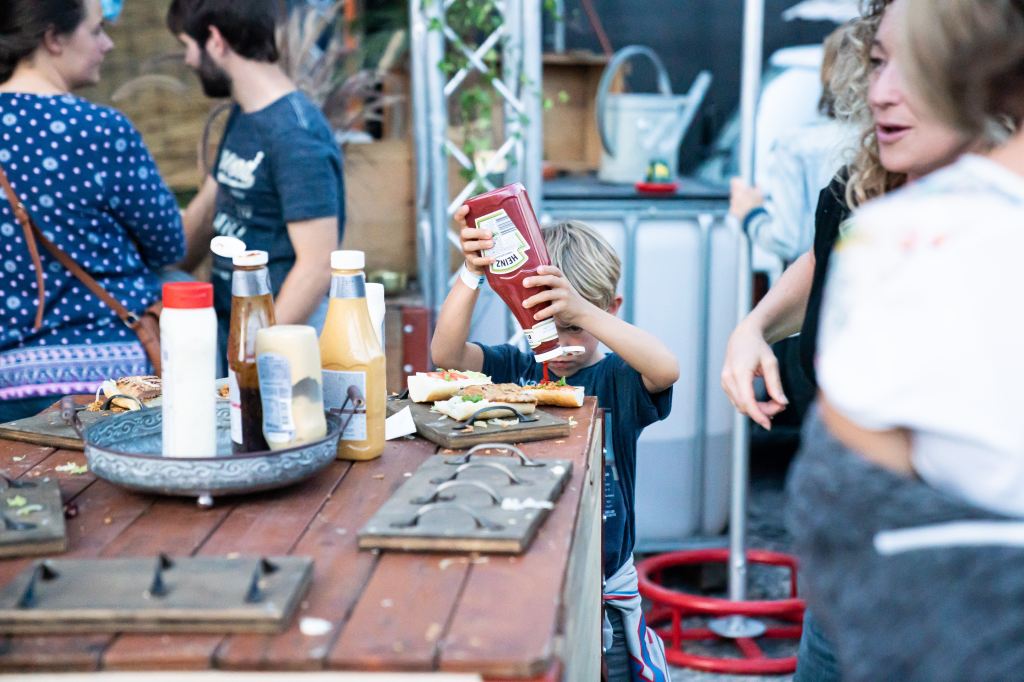
We were moments away from a dinnertime-disaster. Special guests who had accepted a last-minute invitation were soon to arrive. The hot dogs and brats were finishing their sweat session on the grill. And we…had no ketchup! A key ingredient was missing.

After double and triple-checking for a sneaky bottle hiding in the pantry, I texted my lovely neighbor who replied, “I don’t have an unopened bottle but you can have the open bottle in the fridge.” Deal. Neighbor to the rescue.

Neighbors can be the way to avoid disaster, at least the dinner-variety disaster. Neighbors can offer ketchup, a friendly wave, a kind word, and understanding when your teenager plays his music at an un-neighborly volume. Like ketchup makes a hot dog, neighbors make a neighborhood, or something like that.

I’m nearing the end of the book: “Start with Hello (and Other Simple Ways to Live as Neighbors)”, by Shannon Martin. I have really liked the audiobook, even more because her voice sounds exactly like Angela Martin from “The Office.” This would be a fun book to read in a group and form neighborhood experiments from her stories.

Martin (not Angela, but Shannon), provides an honest picture of what happens when we get to know our neighbors. She names the awkward parts, the fear of rejection, the reasons we talk ourselves out of it.

I appreciate how she explains the “toxic independence” of our culture, which would first encourage a quick trip to the store before texting a neighbor for ketchup. In truth, I am dependent upon my neighbors for more than ketchup.

  • I need my neighbors if my kid is home alone and suddenly requires help from an adult.
  • I need my neighbors to let me know if something fishy is going on.
  • I needed my neighbor this endless winter to scrape the mountain of snow off our driveway with his blessed tractor.

Living independently is not neighborly and also not good for hot dogs. Or for the guests who will be eating them. A neighborhood of neighbors needing and caring for one another looks a whole lot like God’s dream for the world.

Photo Credit: dimitri-photography-jMgoWJKnBcw-unsplash