Advent Week 3: Waiting and Waddling

(Photo by Phil Hearing on Unsplash)

A woman instinctively knows how to waddle. At a particular point in pregnancy after she can no longer see her toes, she finds herself sliding one heel forward and then the other while jutting out her hips. How does the waddler come to know such moves? It simply happens.

Suddenly, Mary the mother of Jesus began to waddle. We know so little of Mary from her brief appearances in the Gospels, but we can be sure she spent nine whole months waiting and some of those months waddling. She was human and therefore she carried her child in the most human of ways. For nine months, she experienced all the mysterious moments pregnant bodies experience: waddling, indigestion, and tiny elbows to the ribs, while waiting for her child to be born.

What is unique to Mary is how she only sort of knew what she was waiting for. She had no idea what a Messiah would look like or sound like. She had never been pregnant before, and no woman had ever been pregnant with the Son of God before. Would he have skin and bones or some divine substitute? Dark hair or blond and curly angelic locks? Would he cry? Would he nurse? Would his diapers be any less disgusting? Shortly before Mary pondered and treasured the words of the shepherds, she had practiced pondering and treasuring while she waited for the birth of the mystery inside her body.

Although Luke’s Gospel moves quickly from Gabriel’s announcement to Jesus’ birth, Mary endured nine whole months of waiting in between. Throughout the nine months, she knew almost nothing of what was to come. And there was no Google to help her out.

If you are like me, I am astonished at how often I turn to a search engine. Google is a quick fix for the discomfort of not knowing something. In my week at a hermitage, it took a couple of days to let go of my knee-jerk reaction to hastily Google any question that popped in my head. When will the sun go down tonight? What is that mean bird with the red feathers and are they all bullies or just this one? I wonder all the books this particular author has written and does she have an Instagram account? What supplies do I need to take up kayaking? How much sugar is in a naval orange? Why do I care how much sugar is in a naval orange? Why do I think I need to kayak when I mostly like to gaze at water from a distance?

In that one week, I Googled nothing. The multitude of questions I couldn’t answer myself went unanswered and I was just fine. I could wait until I was home to learn what I needed to Google, although I forgot most of my questions anyway.

Could it be that there are times when waiting helps us let go of the irrelevant questions? When we must wait: for a diagnosis, a family member to come home, a job interview, a pandemic to go away, do we become more focused on the questions that truly matter?

It seems significant that Mary pondered while she waited. She did not demand to know what was coming next. Pondering requires waiting and trusting that the answers will come when they will and no sooner. You do not ponder on Google, you ponder when Google is not an option. You ponder when you must endure the wait as you live in the genre of mystery.

We are constantly waiting for one thing or another. We wait to know or understand something, or we wait for the birth of something new. For nine months, God waited for the world to catch a glimpse of God’s intense love for the people who perpetually turned their backs on that love. God had pondered what love might look like dressed up as a baby. And then Mary waited and then she waddled. And finally, when the wait was over she held God’s love and then began a new wait, pondering the simple question of what would happen next.

PRAYER PRACTICE

Light a candle and picture the places and times you often wait. The next time you are waiting in a checkout line, or waiting to pick up a child from school, or waiting for your partner to be ready to go, or waiting for your appointment to begin, before you pick up your phone, repeat your phrase and say a prayer. What might you ponder for that one moment while you wait?

Advent Week 2 – Expectations

(Photo by Kelly Sikkema on Unsplash)

(This week’s devotion is a letter written to the not-my-favorite-person who first added candy to Advent calendars.)

Dear Sir or Ma’am:

Why? Why did you take a perfectly lovely German Lutheran tradition and transform it into a mild nightmare for moms? Whoever you are, I suspect you are not a parent. You might be one of those beloved and sneaky aunts who spoils the kids and runs away before bedtime.

Excuse my annoyance. This is not entirely your fault. It’s just that each year I hope to invite my kids into the mystery of this season, only to find myself yelling over the yelling when one of my three kids might get one more piece of candy than another. Really, you should have seen this coming! What did you expect? You have messed with the expectations. Now my kids expect the wait for Jesus’ arrival to be a road paved with chocolate. You changed the Advent Calendar to a sweet milk chocolate countdown and I have to tell you I’m 95% cacao bitter about it.

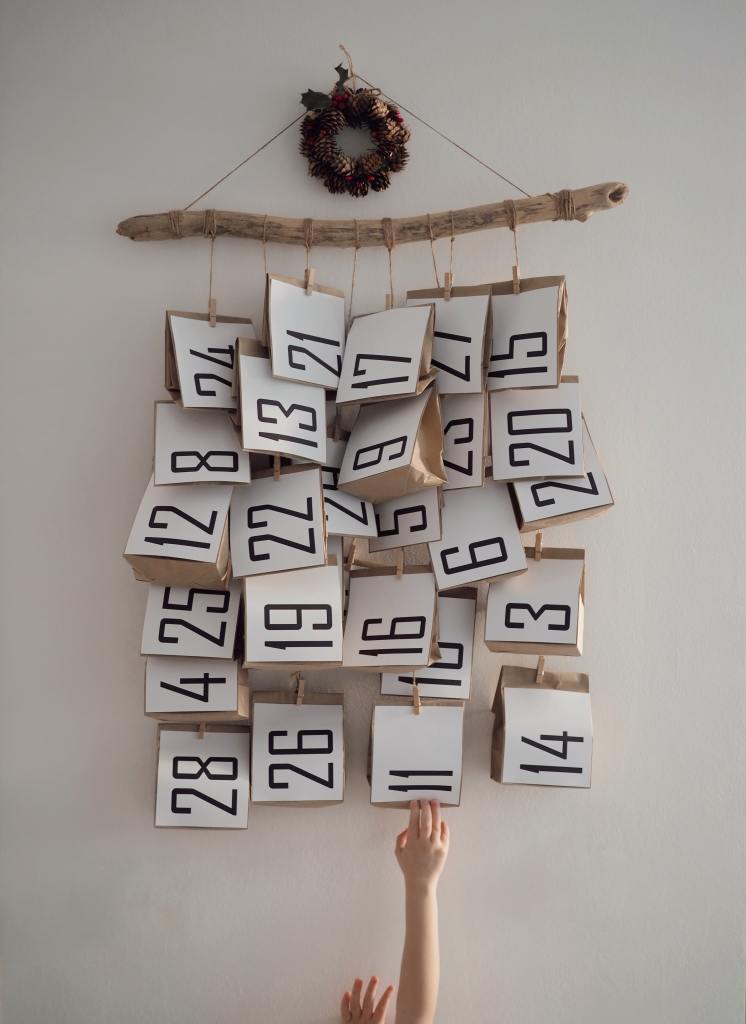
I’ve tried workarounds. Last year, I constructed a homemade Advent Calendar with a variety of surprises in individual paper bags. Each day, the kids opened a bag to discover a Bible verse they had to look up, with a small piece of candy (not always chocolate!) or instructions to do something kind for a sibling or a pair of socks or something silly. It was Pinterest-worthy and too much work to do a second time. It will live in my memory as that time I accomplished something Pinterest-worthy.

This year, I hunted for an Advent Calendar on Etsy…until I wondered what it meant that I might spent $50+ to help my kids get ready for the arrival of the Prince of Peace, when actually the calendar becomes a battleground?

Excuse me if I might be channeling too much Cindy Lou Who here, but oh my goodness it is a challenge to slow down the countdown to Christmas Eve! The sweet surprises in the Advent Calendar risk putting us in the fast lane when Advent is a slow lane kind of season. The slowness is necessary to absorb or breathe in the mystery of divine love packaged in a slippery infant body and delivered in an unseen corner of the world by an exceptionally young woman. The addition of chocolate, you see, sweetens the rugged and ragged mystery.

I expect chocolate makes everything better, including the Christmas story. But is it possible the daily dose of chocolate might forget this story is sweet enough without the candy? How sweet it is that God, so far away in the heavens, could not stand to be so far away from you. How sweet it is when God finally threw God’s arms up in the air when humanity kept messing it all up, and finally did what we could not: save ourselves. How sweet that we can expect radical hope every single day, beyond the rugged and ragged scene laid out before us in our everyday lives.

Sheepishly, I will admit to you, chocolate pusher, that in the end I stuffed some candy into 24 little bags and shoved them into a big Christmas cookie tin because it did not feel right to be missing an Advent Calendar! See what you’ve done? You have planted in my brain the expectation that candy must accompany all 24 days of Advent. <sigh>

I will choose to believe your intentions were good. You called attention to Advent using something ordinary and yummy. I will choose to believe you did not expect your idea would become so profitable. It can be tricky to know what to expect when something new is unleashed into the world. In the first century, no one expected a crying newborn to be God’s love unleashed into the world, but God does not adjust to any of our Advent expectations. God’s love for all the rugged and ragged among us does not fit in any of those tiny boxes or bags where sweet treats can be found for 24 days. Its sweetness outdoes all the chocolate in the world.

Signing off, slightly less bitter in North Dakota,

Lisa

PRAYER PRACTICE

  • Light a candle and make a list of expectations God might have for you this Advent season. God does not expect you to supply your children with daily surprises, or for you to locate the perfect present, or to make everyone else’s holiday a smooth ride. What God expects from you might invite you to be more gentle on yourself and stay in the slow lane.

Advent Week 1 – Promises

My daughter finds it funny to remind me of the time her principal called our home during the day to tell me she had fallen from the monkey bars and, we would later learn, fractured a bone in her arm. For whatever reason, Caller ID described the school’s number as “Private Caller,” ostensibly “Annoying Solicitation.” My choice to let the phone ring will be an everlasting tale for her to hold over my head. Forever and ever. “Whatever you do,” she instructs her brothers, “don’t call mom if you break your arm!”

In some way, I had broken an unspoken promise that whenever my six-year-old called or needed me, I would immediately answer the phone. Of course, it did turn out fine after the school called my husband who called me. She did not wait long for her mom to rush to her side! But it did seem the world shifted ever so slightly. She gained some awareness that our lives are not one life but two separate lives.

Parents make many promises to a child, perhaps each of them unspoken. There are basic promises to feed, clothe and show love. And there are social promises to equip a child to make friends and swim in the larger world of peers. There is a promise to be present for the conversation that needs to happen, to listen to a worry, to talk through a dilemma, to help navigate the tough spots, to keep the cookie jar from an empty state.

It could be that parents construct an entire foundation under kids with our promises. No parents keeps them all perfectly, so as we build the foundation with promises, we also build it with empathy and forgiveness. Promise-keeping happens to be the language of Holy Baptism. God promises to hold onto the baptized from this life into the next, and to love us even when we let God down. In turn, hearing God’s unconditional promise of love for us, we make promises, too. Our promises are designed for the well-being of our neighbor.

At weddings and baptisms, I take delight in disclosing to the people making promises (couples and parents/guardians) they are making promises that are impossible to keep. I assure them they will not keep every promise made in the rites of marriage or baptism. They giggle nervously, but I hope my disclosure relieves some pressure.

If we were meant to keep promises perfectly, God would have improved the prototype for humanity. But we are broken people who break the promises we make to one another, even though we know we should not. We act selfishly and out of resentment. We struggle with addiction or get tangled up in an abusive relationship. We get too busy and out of the routine to take our kids to church. Being human requires forgiveness and new starts, or to quote Ann Lamott, earth is forgiveness school. Which is why God’s promise of unconditional love will hang over your head like my daughter’s everlasting tale of the time I chose not answer the phone! This umbrella promise covers you and any mistake you make, including the small mistakes like neglecting to answer the phone, along with the bigger and heavier ones.

In this first week of Advent, we inch closer to a promise God had made long before Jesus was born. Throughout the Hebrew Scriptures, the promise of Jesus’ coming is whispered on each page. The patriarchs of the first book of the Bible tried to follow God and failed, just like the Israelites who entered the story later on, and the promise remained. Through creation and judges and prophets, through insignificant and unnamed people and rich and famous ones, the promise of a Savior is carried from page to page until finally, the promise is a child. On the page we discover an impoverished couple on an obligatory journey into Bethlehem because a king had promised to harm them if they didn’t.

God’s unending promise to love you can be, at times, difficult to hear. The whisper is too low, like a handful of lovely people in their seasoned years who have admitted to me after worship: “I can hear the man’s voice but not yours.” The Bible is like that, too. We can hear God’s promise loud and clear on some pages but not others. We hear it in Isaiah, but turn the pages back and the pitch is too low in the book of Judges (not bedtime reading, that book.) And yet the promise is on that dreadful page, too!

God’s promise cannot be erased or compromised, and I wonder if the is so gracious as to become hard to believe. Can you believe you cannot undo God’s promise of mercy? It is a wild and unwieldy promise, and it is yours to keep.

PRAYER PRACTICE

  • Light a candle and write a list of promises you are trying to keep. One by one, name them and remind yourself, beloved child of God, how God’s promise to love you is an unconditional promise of mercy. Let God’s forgiveness bring you to forgive yourself, too. With a marker, write “I Love You, I Promise. Love, God” over all of your words.

Advent Week Four: Love’s Story

(Photo by Kaboompics .com from Pexels)

Advent candles flickering toward hope, peace, joy and finally love have been lit. We are two millennia past and two days away from love’s story.

Now, a story about stories.

It used to be we were limited to understanding the world and its people by where we lived and who we knew. B.I. (before internet) we were limited in knowledge to the dictionaries and encyclopedias we could access. We knew only the stories told on famous radio programs, a handful of television shows, and a limited number of books depending upon the ingenuity of the local librarian.

Long ago, Abraham Lincoln made time each morning to hear people’s stories. Franklin Delano Roosevelt did not read headlines of the newspapers he collected from across the country each day. He read editorials in order to understand people’s stories.

Now, you and I live in a land of innumerable stories. They fall into your lap each day. We are not limited to understanding the world and its people by a limited number of sources. But this is what we do when we depend on the news or your Facebook feed to tell stories. Stories need to be told by the bearers of the stories.

I’ve learned about the world and its people through stories, not the news. Ta Nehisi-Coates and Ibram X. Kendi taught me my micro-contributions to racism. Glennon Doyle helped me understand bulimia and addiction. Kristin Howerton gave me language for adoption and families with kids of different colors. Joel Stein visited folks in Roberts County, Texas and folks at elite conferences at ski resorts to teach me how America reached the unlikely conclusion to elect Donald Trump in 2016. Malcolm Gladwell, a storytelling wizard, blew my mind with his collection of stories that make sense of why violence befalls our black and brown siblings in Christ in shameful proportion to whites. Ada Calhoun listened to the stories of so many women in my generation and then broke the news to us that feminism did not free us to do everything all at once.

Stories are how we understand each other. They open a door to mingle in each others truths so that we might become a bit truer ourselves. Stories, when told so bravely, crack open love for one another.

Two millennia ago and two days from now, love became a story. It’s the story we tell about a starry night and a desperate couple. We tell the story freely and often, but we miss the love unleashed in it. Perhaps this year you might hear it differently. The story is not a love story, but love’s story, calling us to see love in all our stories.

Advent Joy: Ode to My First Playground

(Photo by Kelly Evans on Unsplash)

Remember the elementary school playground, if that is part of your story? The playground I grew up on was the most amazing place. It was far too massive for playground protocol today. 

The playground at Sherwood School (where K-12 fit snuggly in a single building), showcased slightly ancient yet timeless equipment such as the wood and metal merry-go-round, where I overindulged in spinning on the first day of third grade and went home after losing my stuff in the doorway into the bathroom. (Blessed be the janitors.) Metal slides towered into the clouds like skyscrapers, and the swings were for swinging but mostly for girls to chatter about boys.  

Behind the equipment was a mowed area nearly the size of a football field where baseball, soccer and football took place, long before we understood the long-lasting effects of concussions. You are welcome, next generations, for all the inadvertent experimenting we did with head injuries in order for you to know, today, that getting hit in the head is not a good thing.  

To the east of the land of head injuries was, you might not believe me, a forest. A Sherwood Forest, yes, clever you. The forest became off limits late in my elementary days for obvious reasons, but before that, we built forts and did business. We coldly ripped bark from trees and made it our currency to purchase pretend food and pretend supplies. We told secrets in those woods and I’m sure drove the teachers on recess duty into utter exhaustion. We ran from bullies, made weapons with sticks, and how did none of us die in there during recess? 

Today marks the last day in the week of Advent set aside for joy. We await the joy Christ will usher in when he comes again to gather us as one. In the meantime, would you share a story today about your first playground?

Advent Wondering: Peace in My Neighbor’s Neighborhood

In 2020, our world became both smaller and bigger.

The world was smaller in the sense that we scarcely moved around in it. I spent much of my time at home with the four people in my immediate family. In shared spaces, we all did our work. We cooked and ate and washed dishes together. I took lots of walks. We watched movies and played games and drove each other bonkers and then we got over it. There is a sense of peace in being connected with the people in your home.

The world also grew bigger. From my living room in June, I watched the burning streets of South Minneapolis on Facebook. Peace may have been something I was enjoying in my small world, but not in my bigger one. More than ever before, 2020 made me aware of the absence of peace for so many of my neighbors whose neighborhoods are not quiet like mine. Not all my neighbors trust the police like I do. Not all my neighbors feel safe going on long walks or stopping at a convenience store like I do.

Injustice against black and brown bodies was not new news to the big world, but it became more tangible news as our siblings in Christ persisted in speaking up about an absence of peace. Perhaps for the first time, I felt invited into the lament of a wide world with a narrow sense of what is normal (white food, song, experience) and what is not (black food, song, experience).

Peace is not reserved for our small world. Peace is not mine, it is God’s dream for the world. Peace requires peering out far enough for the world to become bigger, and neighborhoods to look more like one big world and less like separate worlds.

God arrived in a manger in only one world, after all, in another time when peace was only enjoyed in small worlds. This Advent, as I dream of peace in my small world, I’ll also dream of peace in the world that is unfolding more and more each day.

Advent Wondering: Can I Live Without Amazon for a Year?

If I set aside the downsides of every one of my Amazon purchases (extra packaging materials, more fuel burned by trucks, working conditions for underpaid and harried Amazon employees) what’s not to love about Amazon?!?

For the love of this busy culture, in two days my item arrives at my door! Socks for a kiddo, lotion for me, that cute pillow case for a living room throw pillow. Or, in two days an item arrives at the door of any address I enter into the shipping information. Need to send a gift? Amazon will do it! Need a toothbrush every six months to arrive without actually ordering it? Amazon can do that, too.

Amazon is like Tabitha from “Bewitched”, Santa Claus, the world’s best mom, and a little bit of Jesus all wrapped in one.

Which makes me wonder…when buying becomes so easy and automatic (“I’ll just order it on Amazon.com!”), what am I forgetting? The more automatic it is to order on Amazon, the less I actually consider what I’m buying. If what I “need” is but a click away, that’s just too fast for me to make a mindful purchase. I’m not looking at something at the store and comparing it with the items around it, which takes long enough for me to also wonder if I truly need to purchase it. A “click away” takes the think away. (I’m sorry.)

My Amazon Prime membership is up at the end of December and I wonder if Amazon and I need to take a short break. Will I miss out if I don’t click for 365 days? Will my kids go without socks and my couch look dreary? Both are entirely possible. I’ll also need to buy toothbrushes all on my own in six months.

Will I also be a little slower in my clicks? Will I end up with fewer things at the end of 2021?

The weeks of Advent lead me to wonder such things. How can I slow life down? How can I be intentional with choices that impact my neighbor and this earth? How much do I really need and have I noticed how many drop-offs I make at the thrift store? Am I being mindful with money or just clicking away?

Life tends to accelerate without our even noticing. Even in a global pandemic it moves quickly.

“Blessed are those who click wisely.”

Advent Week One

You have only four weeks to get ready for the arrival (advent) of love in a manger.

Not four weeks to choose the most amazing presents and bake the most delectable cookies. Not four weeks to wear yourself down to design the perfect Christmas.

Christmas is most perfect when we don’t fuss with it too much. God did a fine job being born in a manger, filling a human body with the loving presence of the Almighty.

It won’t get better if you do too much. If you beat yourself up for eating too many cookies or get crabby with your family because they don’t appreciate all your hard work.

Work less hard toward the perfect Christmas. Light a candle and reflect manger love in conversation, stillness and gentleness with the friends and family whom God entrusted to you.

And grace lightens the darkness through you for four whole weeks.

Advent All Along

(Photo by Valeria Boltneva on Pexels.com)

We are a mere three Sundays from the first Sunday in Advent. Advent is a season, or time in the year when we turn down the volume. We dim the lights and slow the pace. Counter to our culture, we recklessly insist on hope and pray exclusively for peace. Week after week as the nights stretch out, we light more candles to push against the dark.

Advent and Lent are both seasons that lead to the two biggest celebrations of the church year, and both seasons call for quiet. They demand a thoughtful kind of waiting. For four weeks of Advent (literally “to arrive”) we are waiting for the arrival of the embodiment of God’s love in a way God had never shown up before.

Last year, our congregation journeyed through Advent with Amy-Jill Levine and her “Light of the World” book. She opens up the old stories with her even older Hebrew stories. And…she is delightful. This year, I may wait through Advent with “Present over Perfect”, by Shauna Niequist or “Waiting, Accepting, Journeying, Birthing”, by Sarah Bessey. I can’t decide. Both wise women push against the kind of dark that calls women to do more, be more, and have more.

Perhaps there has never been a more intense Advent for so many women in America. I heard Kristen Howerton tell Kate Bowler in a recent podcast the gift of feminism is that women can do anything. We just don’t have to do it all at once. And yet, women are keeping up with the majority of household work, bending our schedules to align with the hybrid schedule, usually leading the way in our marriages, scheduling kids’ appointments and activities, and working extra hard in our paid work. Oh, and the groceries! And now it is the eve of Christmas Eve and we do the shopping, send the cards, bake the goods, wrap the presents, and hide the freaking elf.

All this time before we even reach Advent, we are waiting. Waiting for “normal”, for less intensity, for a vaccine, for the busy lives we knew before and didn’t really like to come back. Every day we wait for the intense fog of our daily lives to lift. And it will, but not yet.

Not yet. Those are Advent words.

Life is not as it should be, not yet. Every day is Advent, not yet as it should be yet demanding reckless hope from you and prayers exclusively for peace for you. All this pandemic time, we have been waiting. So dim the lights and turn down the volume. Light a candle and insist the love of God that took shape in Jesus Christ is worth the wait.

While you wait, do not do more. Stop that. It’s ridiculous. There is no award for cutest tree, most precisely-wrapped gift, or most exhausted mama. There is only the love of God for which you need not wait.