I Wrote a Book When Few People Read Books

A year ago I wrote a book even though reading books is a rarity. If you are reading this, perhaps you also read books. Or, maybe not. It is possible you used to read many books and now you pick up a book only once in a while.

I recently read (in an actual book!) that reading fiction broadens our perspectives of other people. A book is like someone else’s shoes we get to slip in and out of. A story parks us briefly in another person’s mind.

Because of books, I have at least a slightly more honest understanding of people who grew up on a Native American reservation, or raised a child within inner-city poverty, or battled addiction or contended with a family member’s addiction. None of these scenarios are my own. Without fiction, I would remain ignorant and probably judgmental – certainly less understanding of people whose lives differ from mine.

The book I wrote is an Advent daily devotional called Wait, An Advent of the
Familiar
. Although few people read books, we all live among people whose stories differ from our own. There is a variety of footwear for us to try on. I wrote the book in hopes of making life with so many other people slightly more honest and understanding.

In the book, I often invite you to imagine you are a character in a play. Family members join you on stage, for example at the holiday dinner table. What part do you play? What family member is the antagonist? Is there a hero on stage? Who is helpful – annoyingly helpful? Which character goes mostly unnoticed?

If these questions are uninteresting, this might get you to turn the page.

The way you play your part “on stage” will influence the next generation of your family, the next cast of characters whom you may never meet.

Think about it, how did the decisions your parents and grandparents make shape which family you are now closest with, or distant from? The book is a tool to walk in other family members’ stories, and to take a more neutral look at your own.

The 24 devotions in the Advent devotional book lead to the story you know very well, regardless of your relationship with books. You need not be an avid reader to get swept up in the story of the God who put on sandals to understand your life.

Happy (almost) Advent! May this season offer clarity and healing to your relationships, lighten your heart and broaden your footwear.

Photo by Kimberly Farmer on Unsplash

Around the Corner in 41 Days

You may already know. Advent begins in 41 days. Of course you know ! Who doesn’t have an Advent countdown? (Everyone. Everyone does not have an Advent countdown!)

You have to look past Halloween, All Saints Day, the end of Daylight Savings (a day savored by church leaders), and finally Thanksgiving to land in the liturgical season hovering just around the corner: Advent.

A year ago, I shared the news that with the help of Amazon I published my second book, Wait: an Advent of the Familiar. I was overjoyed to get the book out into the world! So overjoyed, in fact, that I overlooked mistakes I had managed to slip in after the proofreader did her good work. Oy vey.

Since then, I rewrote and reworked parts of the book, smoothed the rough edges and sent it right back out into the world, all spiffed up. You can purchase a paperback on Amazon or at our local bookshop, Faith Expressions. If you like e-books like I do, I will warn you the formatting here and there had a mind of its own. A few times I had to throw my hands in the air and admit defeat. If you like e-books, it is still a great option.

I wrote this book in an effort to help us all (me first) manage our own selves in relationships. By which I mean, move toward the Christmas holiday feeling a bit lighter. Perhaps an old hurt has made a relationship difficult, or political differences, or an episode of a soap opera actually took place in your own family generations ago. Maybe all three of these scenarios apply to you. (If so, this makes you normal.)

When a relationship gets tricky, we tend to react in one of three ways:

  1. Put your head down and ignore the problem. (distance)
  2. Fight, fight, fight. (conflict)
  3. Find an ally who agrees exclusively with you and avoid actually dealing with the issue. (triangling)

These tactics only get you so far down the road before you find yourself stuck in a roundabout, going round and round, repeating the same old relationship pattern, as though you are on stage with a familiar cast of characters performing a play you know all too well. Here you are, an advent of the familiar.

The holiday dinner table is often the set for this familiar play. This book is for you if you would like to find a way out of the roundabout toward a more pleasant Christmas Eve with family and friends.

These 24 short daily devotions will not quickly fix your relationships, but they may offer a new perspective. You may notice that what ticks you off about that family member or friend may not actually be the problem. Perhaps there is more to your feelings than first meets the eye.

The book begins with “wait,” a word that weaves its way through the pages. Because relationships are precious, they deserve a thoughtful pause, which is the meaning behind the liturgical season of Advent.

Slow down your breathing, your rushed words, and your hurried thoughts. Wait here. How might you see that one relationship with a touch of tender mercy, as you wait for the arrival of tender mercy in the manger?

The God Who Trades

...to comfort all who mourn...to give them a garland instead of ashes, the oil of gladness instead of mourning... (from Isaiah 61:2-3)

God is no good at trading. In this last section of Isaiah, God trades the hardship of the Israelites for renewed hope. “Let me carry your mourning,” God offers, “while you hold the gladness.”

What an uneven trade, Lord! Everyone knows mourning is heavier than gladness. And sins weigh more than forgiveness, another one of God’s uneven trades.

God is unfathomably generous. God’s ways do not align with our human, even-trading, fairness-focused, transactional look at life. We do not give this in order for God to do that. This is not a balanced relationship.

Which is nice.

When the dark winter days come with heavy human sadness, it is good to know that Christ will carry his share of the pain and yours. “Sit down, take a load off,” you hear Jesus whisper. “I will take care of things and when you are ready, you can follow me through the darkness. You are looking a bit broken today. I will gather the pieces and trade you for the peace only I can give you.”

Thank you, Lord, for uneven trades, a mark of your light-bearing grace.

Photo by Joshua Rodriguez on Unsplash

Introducing…

Meet my newest book!

Unlike normal people, I have spent most of the year in Advent. My days off have been filled with Advent wonder and writing. I am grateful to finally share this with you!

Let me introduce you to the book.

Soon it will be Advent, a word that means arrive. Advent will lead to Christmas, when you may gather with familiar people for the holiday. I wrote this book of daily Advent reflections because family gatherings tend to be tricky. Some of you even dread holidays with family. This does not make you a terrible person, it simply makes you human.

Christmas is an advent of the familiar, that is, an arrival right back with the familiar people with whom you started. Christ will come soon, and your family might be coming to your house soon! Wait, don’t panic.

I hear a chorus of the same holiday angst. angst. You are not alone if thinking ahead to Christmas dinner and the familiar faces raises your heart rate.

A main idea in this book is the hard truth that you cannot change the familiar people with whom you gather. You can, however, wait. Before you react, perhaps you change your response to the dread, angst, or irritations you feel when you gather with them. This book is meant to equip you to be your own, honest self with your family, and to rely on the gentle love of Jesus, the one who is to come.

The book relies on a way to understand relationships called systems theory. In a nutshell, systems theory gives you a broader look at relationships and your own part in them. I hope this book makes you a factory of curiosity and wonder about your own self, which may lead to lighter, healthier relationships in your family. Each chapter ends with a reflection question and brief prayer.

The book is kind of available on Amazon. I say kind of because Amazon is stating the book’s status as “temporarily out of stock.” Amazon prints self-published books on demand, so that makes no sense. Maybe by the time you read this, Amazon will have changed the status. If not, you can go ahead and add the book to your cart, order it, and Amazon will email you when it is available again. Within the next week, you will find an e-book on Amazon.

If you subscribe to my blog, earlier this week you received a sneak peek of chapter two! Subscribers will also receive an email when the e-book is free for a day on Amazon.

Advent begins four weeks before Christmas. If you enjoy a daily devotion, you can begin reading on December 1st and continue through Christmas Eve. The book includes 24 daily reflections to slow you down as you wait for the one who is to come, who is mercy in a manger for you.

The Story of the Christmas Cards

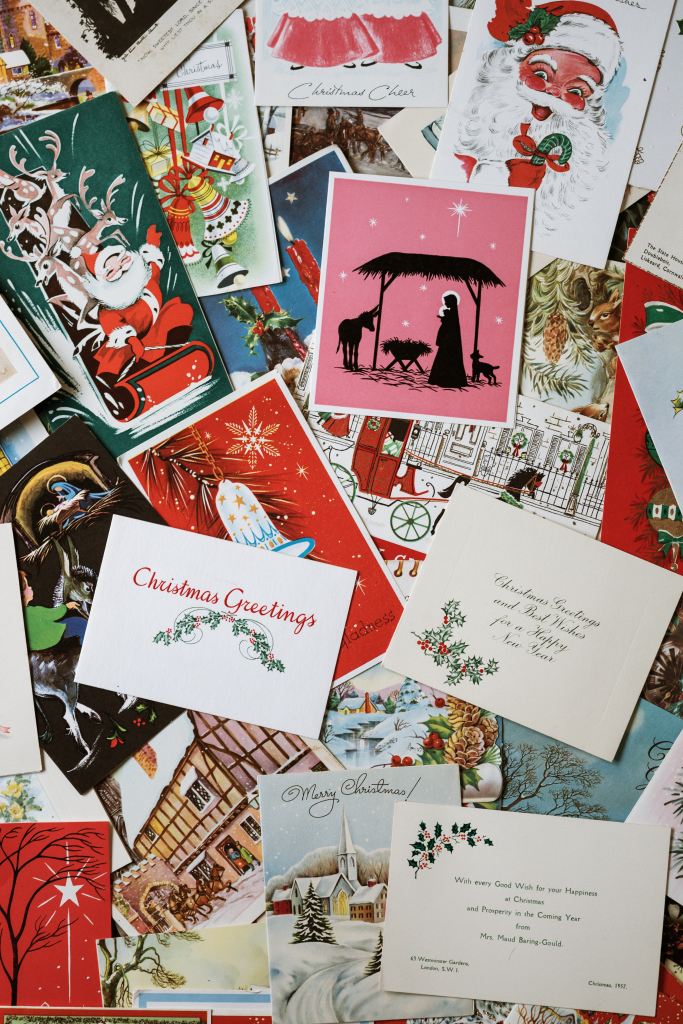
What do you do with Christmas cards after you pull them out of their cozy envelopes? Do you lay them in a basket on your table? Hang them up?

Early in our marriage, opening Christmas cards addressed to Mr. and Mrs. felt so very grown-up! The first couple of years, I kept each card in a photo album. Then I stopped. What would I do with all those albums?! Instead, I set the cards in a basket and then stored them away after Christmas, like time capsules.

These days, we hang the cards on a kitchen wall to savor. Later, they will enter the world of the recycling bin, but for now our friends and family hang out with us through Advent from the wall, their photos a collection of real-life stories intertwined with our own.

Christmas cards tell a story. The real story of life. The photos insist that amid the despair of real life, it is possible to lock eyes with a camera. It is possible, despite the real hardships of our lives, to appear in a photo as evidence of how life can go on. Through miscarriage and divorce, cancer and job loss, deep grief and fierce betrayal, one day stubbornly leads into the next. There is one more day, and then another.

The story of the Christmas cards is one of hope. We can put on our best clothes and smile at the camera, but the real hope comes in the mess of a manger birth. The real hope is the child who would not avoid the real hardships of life, but live them, one day stubbornly leading to the next.

Christmas cards can lure a person into believing that life can look perfect; we can all have our tidy lives. But there are no tidy lives. Every relationship is hard at times. Your relationship with your own self can be trying! Each and every person is touched by the messiness of life.

The story of Christmas is this: Immanuel (God-with-us) in the mess, in the hardship, in the despair – hope evident in the Christmas cards on your wall, in a basket, but I hope not in an album unless you have tons of space!

Photo by Annie Spratt on Unsplash

Slow-Growing Advent Hope

Here is a fable to illustrate hope.

Imagine a forest populated with ferns and bamboo.

Long before, a farmer had planted seeds to grow the lush ferns and abundant bamboo. The ferns grew quickly, covering the ground like the green shag carpet in the living room of my youth.

However, even after an entire year nothing came of the bamboo.

The following year, the fern continued to grow more vibrant and abundant, but nothing grew from the bamboo seed. This continued for five years, until a tiny bamboo shoot emerged from the earth. It could hardly be seen among the now plentiful fern.

In the sixth year, however, the bamboo sprung up an astounding 60 feet! It had spent five years growing the roots to sustain it.

Hope can be impossible to see. It may be hard to imagine that whatever you are hoping for might work out.

Advent is the time of hoping. In Advent we dare to hope beyond what we might see or even imagine. For instance, God squeezing into the body of a newborn in order to keep us company on earth? We could not begin to hope for God to come this close!

It took many centuries, many millennia, many failed kings, many broken dreams and many misplaced hopes for the slow-growing hope of God to break into the world in Jesus. The astounding mercy of God required an intense root system. Now it is established for eternity.

Do not lose hope, whatever your hopes may be. Roots are slow-growing and hidden. God’s work in your life is at times impossible to see and more impossible to comprehend. There is too much dirt in the way.

At this moment, God is rooting around to position the people you will need into the needed moments in your life. Connections are being made; growth is a quiet set of miracles. Once the roots are ready, you will see. Your hopes are of utmost importance to the God born into the world in the body of hope.

Photo by おにぎり on Unsplash

An American Advent: The Story That Leaves Us Hanging

You are a gingersnap away from An American Advent turning into Christmas. We have now sledded through Habakkuk, Esther and Isaiah.

  • First, we reflected on a word in which I encourage deeper reflection before you sit among differing opinions at the Christmas dinner table: justice. Justice happens when people work toward the same equitable goal. Justice is a touchy topic in America today, often confused with political positions.
  • We spent time with Esther, who bravely believed she need not wait for someone more important to make things better. On the news, America’s messes are the fault of politicians, which lets the rest of us off the hook. We complain as we wait for the important people to make it better. But Esther would not wait.
  • Last week we named how hard it is to begin a new tradition when we prefer old, familiar patterns. For example, how are the patterns of your family of origin troublesome when you gather for the holidays? When God’s people were caught in an old pattern of rebellion, Isaiah proclaimed the coming of a new pattern – one of love that would begin in a manger.

Finally, the Narrative Lectionary reading for the last Sunday in Advent is reserved for Joseph. We know so little of Joseph, it seems a strange way to conclude Advent. Only a dozen or so verses are dedicated to him in all the Gospels. The Bible calls Joseph “righteous.” We gather that he both knew the rules of his religion and followed them, as was expected. If we imagine Joseph’s religion to be a path, Joseph knew the way because he knew the rules.

What happened in Joseph’s dream in Matthew 1:18-25 might seem a likely prelude to Jesus’ birth in Bethlehem. An angel appeared to Joseph to explain Mary’s pregnancy. (Either Joseph caught on quick, or the angel’s words here are abbreviated. Explaining a virgin conception in a single verse?!) In his dream, Joseph needed to understand why his fiancé was suddenly pregnant, however, this dream is not only about Mary expecting! This dream is the beginning of Jesus upsetting the righteous.

Throughout his life, Jesus upset righteous people like Joseph. He stepped onto people’s religious paths and begged them to see God as more than a religion for the righteous. God loved God’s people dearly, more than God loved rules. God loved the people more than God could put into words. So, God squeezed God’s tender love into one Word: his own Son, who would later be executed by the righteous for not following all the rules.

But this is an Advent devotion! Let’s not speed ahead to Good Friday.

This is An American Advent devotion. You are reading this in a time when many Americans have mixed up our politics with our religions, neither of which proclaim the birth of God’s embodied love. Both your political party and your own religion at times will disappoint because both are human inventions. The Word made flesh is our only hope.

  • The leaders of your political parties are not your saviors and they will not set you free. Only the Word made flesh sets you free.
  • People who follow the political party that opposes yours are the very people you need to work together for justice. If you draw a line in the sand between you and those with whom you disagree, the Word will annoyingly erase it.
  • Sitting back and blaming the leaders tricks you into believing you have nothing to offer to make this nation better. The Word proclaims hope through ordinary people like you.
  • Old patterns, even deep divisions between people on the left and right, can change. For you, it might begin at the Christmas dinner table. The Word is present when we pass the peace along with the mashed potatoes and gravy.
  • Religion is more than rules. At its best, religion pushes the faithful to recognize God’s love for all people and all nations. This Word has no margins.

Your wait through Advent is but a few more days. Despite our political disagreements and the old relationship wounds acquired during the pandemic, a few songs will unite us in the week ahead. Together we will sing of the angels, the shepherds, and the little Lord Jesus, no crying he makes. Our own cries of blame and bitterness will quiet into a silent night while candles real and battery-operated outshine our divisions, if only for a moment.

Christmas is the story that leaves us hanging. The Word made flesh does not fix our America. The Word made flesh instead insists on hope: hope that justice calls us to work together; hope that ordinary people can heal extraordinary division; hope that peace can indeed be passed with the mashed potatoes and gravy.

Blessings on your Christmas, that the Word made flesh might make an appearance at your Christmas dinner table dressed like you. Amen.

Photo Credit: Nicole Michalou on Pexels.com

An American Advent: New Things I Now Declare

New traditions are a bugger. Early in our marriage, I had no idea. I imagined my husband and I would start some of our own traditions. Perhaps weekly movie nights would be our thing, and a predictable and seamless sharing of holidays with our families of origin. Each Fourth of July, host our friends and serve our own unique meal, and each night share highs and lows with our kids.

Why are new traditions such a bugger? Because human beings are creatures of habit and practitioners of patterns. It’s why long-term diets are next to impossible and saving or spending money differently only gets harder with age. We learn one way and tend to stick with it.

Family patterns are no different. If you spend time with your family of origin (the family in which you grew up) this Christmas, you will notice patterns if you are willing to pay attention. Arguments begin the very same way. The same person will exasperate you and you will react in the same way you always do. Family patterns are the deep ruts of country roads.

This weekend’s Narrative Lectionary reading for the third Sunday in Advent has to do with patterns. God’s relationship with God’s people had developed a deep rut kind of pattern. God loved the people, the people turned against God, God opened God’s arms and they returned to God. God loved the people, the people turned against God…wash, rinse and repeat.

Into this old, endless pattern, the prophet Isaiah breathed a new one. Speaking for the Lord, Isaiah said, “See, the former things have come to pass, and new things I now declare; before they spring forth, I tell you of them.”

The new pattern emerged several hundred years later with the birth of the one for whom we wait this Advent. The Messiah dared to break the pattern. God’s people could not turn away from a God who needed holding, needed feeding, needed loving. God stepped out of God’s power to step into your life for good. The pattern of humanity turning away from God was broken, not by God’s people finally getting it right, but by God declaring a new pattern.

If God can change the pattern of God’s relationship with God’s people, why in tarnation is it so hard to stick with a new tradition?

I’ll tell you why. Because the forces at work in our families of origin are powerful beyond measure. The traditions of our family and the habits that then become our own are forever our default. Like an addiction, those old habits take over the wheel whenever we feel too tired to steer ourselves.

But there is hope! In Isaiah 42, the Lord named the new pattern, which I think is the hardest step. Naming a new pattern challenges not only the existing pattern but everyone who has a stake in it. If you decide to host Christmas and cook lasagna when your family of origin has only EVER eaten ham, then you are in for it. But you’ve named the new pattern; you have the steering wheel: lasagna, baby!

New patterns are magnets for resistors. But if your new pattern matters to you, and you sincerely explain it to your family, then please keep driving. You must know the way, and eventually the others may come along. If they don’t because they insist on ham and only ham everlasting for Christmas, then more lasagna for you. You’ve created a new pattern because it matters to you, and although you would prefer that your family of origin enjoy it with you, not every new pattern continues that way.

The pattern God declared in Jesus Christ, however, cannot be discontinued. The pattern of God’s love wrapped in bands of cloth and lying in a manger smooths out the old ruts of our lives. No new tradition, or old and worn tradition can undo God’s desire to be with you.

Photo Credit: Marlin Clark on Unsplash

An American Advent: Esther

You will find them in the reeds when Moses floats down the river. She is the unseen young girl whose parents were taken during the war. Before anyone else finds out, the angel first proclaimed the good news for all the world to her.

The Bible is nothing if not shocking. When something big is about to happen, it does not first happen among the mighty and powerful. Elected leaders do not shape the story of Scripture. Those with political importance are only center stage when they have messed it up.

The infant Moses was saved when two young girls took charge. It is teenage Mary who first received the good news of Jesus’ coming. And no one suspected Esther.

Esther’s story is told in ten chapters that famously make no mention of God. She was a Jew raised by her Jewish cousin, Mordecai, after her parents were taken in the Babylonian Exile. When the non-Jewish king went on the hunt for a new pretty face, Esther won his favor. Later, Mordecai overheard a plot to exterminate the Jews and urged Esther to use her place in the king’s favor to stop it. He said, “Who knows? Perhaps you have come to royal dignity for just such a time as this.”

This Advent series challenges you to notice an Advent hope for our own nation. In America, the land of the divided and the home of finger-pointers, we tend to look for hope in all the wrong places. We look for hope among the wealthy, the mighty, and within our own political party. We blame and bicker, boo and belittle.

And no one suspects Esther.

Upon Mordecai’s urging, Esther went to work. When no one suspects you of changing the world, you have plenty of permission to do so. And she did.

As America waits for a better economy, a better selection of political candidates, a better nation, Esther is a story of what to do while you wait. She wasted no time blaming or bickering. She, a young woman in a man’s world, the unseen girl with tragedy as her backstory, hatched a Shakesperean plan that concluded: “…and if I perish, I perish.”

While we spend these Advent weeks waiting for the birth of a Savior and waiting for Jesus to come again and waiting for a better America, how are you waiting? Are you blaming the leaders you elected because America does not look how you want? Are you bickering with those who see the nation differently when all this time you could be the unsuspecting whisperer of hope?

Let’s move the spotlight from the nation to the Christmas dinner table that awaits you. You know, the table you may be dreading because the very people who bother you most will be seated beside you. People who see the nation differently, or your family history differently. People you successfully avoid most of the year. I recently listened to a podcast in which a listener asked if it is possible to just end it with her family because she’d had enough of them. If you are dreading the Christmas dinner table, it appears you are not alone.

Esther saved a nation, and perhaps you could save Christmas dinner. How did she do it? She believed that what made her unique was exactly what was needed. Out of love for her people, she was brave and honest. She did not wait for someone more important to make a difference, she understood the one who could make a change was her.

Photo Credit: Akira Deng on Unsplash

An American Advent: What Does Justice Have to Do with Advent?

Fighting for justice is the daily work of a mom of young kids.

While the word justice addresses big concerns such as hunger, poverty and racism, justice is also a concern at the Lego table. Years ago, the 19-month difference in my little boys’ ages nearly did me in, especially when Legos were involved! The more aggressive brother hoarded the Legos or disassembled his brother’s creation. Whatever each one had was never fair enough and the tantrums that erupted were Vesuvian. My job as a mom was to advocate for justice at the Lego table by asking questions of my two little boys:

  • Why can’t you at least let me shower before you fight?
  • But seriously, why are you so angry?
  • Can you tell your brother what you want?
  • How can you share what you have so the Lego table can be a fun place for both of you?

Justice is what happens when people work toward the same equitable goal. Justice is two little boys sharing Legos, even though it lasts only long enough for a mom to take a shower.

In America, justice is a touchy word. Currently, Americans are rather possessive of their notion of justice, applying the word only to their own political party – blaming the opposing party for threatening justice. But justice is not a partisan word, it is an Advent word.

The Narrative Lectionary reading for the first Sunday in Advent is spoken by the prophet whose name is pronounced more than one way. Habakkuk (HAB-ah-kuk or Hah-BAK-kuk) is advocating for justice. He is waiting for God to bring about equity for God’s people caught between the superpowers of the day: Babylon and Egypt. The future for God’s people is grim, so Habakkuk turns to God and says, “O Lord, how long shall I cry for help, and you will not listen?”

This is the faithful cry of Americans today, waiting for justice. How long, Lord, will our nation cling to their political parties? How long will we stand for the news to be delivered without integrity, deepening the divide between neighbors? How long will everything that’s wrong be the fault of everyone but our own selves? Lord, how long?

Next week, I will share the story of someone who believed it was her responsibility to advocate for justice. It was not the responsibility of the political powers of the day, or even the more powerful gender. She believed it was her own work to advocate for justice, which changes everything.

This week, consider your own understanding of justice.

  • In a journal or a conversation with a person or the Lord, what would justice in America look like and how much does your own political preference shape your understanding of justice?
  • Turning back to the questions at the Lego table, but seriously, why are you so angry?
  • Can you tell your brother and sister in Christ who may disagree with you how you want justice to look?
  • How can you share what you have so the Lego table America can be a fun place for both of you?

Eventually God responds to Habakkuk. In 2:1-5, God’s response threatens anyone who depends on wealth and pride. Wealth and pride do not bring about justice. Justice requires as much giving as getting, which is very difficult to teach both at the Lego table and in America. May justice begin in our own nation with your own honest reflection.

Photo credit: Markus Spiske on Unsplash