Holy Week: The unDead End

The human experience is often habitual. From our morning routine, to the route we take through the grocery store, to the way we choose to relax. If you were to zoom out on your life, you would notice other examples of habit. How you set goals (or don’t) and whether you expect to achieve them. How you respond to your self-criticism. How you dream (or don’t dream) about your future.

When we move comfortably in rhythm with our habits, we might wonder whether this is all there is. Is this the only way? Does your familiar habitual experience lead irreversibly in one direction? Do all roads close in on the one dead end at the very end?

I am wondering because some habits are not particularly life-giving. Whenever you feel stuck in a job or a relationship, it feels very much like moving toward a dead end; as if this truly is all there is and there is absolutely no other way.

If you want a ridiculous example, I can supply many from my own life. To offer you just one. I have been wearing disagreeable sunglasses for almost a year. They never quite fit properly and they have left a small scratch on the bridge of my nose that will not go away for the obvious reason that I keep wearing them. In the very center of one lens, there is a damning scratch that occurred when my kids were fighting like zoo animals in the car one day and I threw my glasses because…because…well, that was just a dumb thing I did.

For the past year, I have answered “yes” to the question, “Is this the only way I might protect my eyes from the sun? Is this scratched and scratching set of sunglasses my only option?”

Here is another example, this one from the Bible and not so petty. I give you, the story we call Palm Sunday.

When Jesus sat on a donkey and strode into Jerusalem, he was mimicking a Roman victory parade. If we were first century residents of Jerusalem, we would have known that after your country (always Rome in the first century) wins a war, a prominent military figure would sit on a fancy-pants horse and enter a city through a parade of worshippers. It was “the only way” to assure a city the victors would forever be the victors. There was no reason to doubt the men in charge because, can’t you see, military men like this one will forever rule the world and therefore be worthy of your praise.

But…Jesus was on a donkey, not a horse. His victory would be by death, not by inflicting death on others. Which means this “ruler” of ours would not promise to live, but be killed. Eek.

Jesus’ life-long sermon was, “Nope, this is not all there is.” Victors who rule by might alone? Not all there is. People who are weak, poor, lost, addicted, not religious, lonely, left in the gutters? Not all there is. Women whose proper place is wherever the men decide? Not all there is. Kids who are subjected to sexual abuse because their voices don’t matter? Not all there is. The rich buying their way through life? Nope.

On Palm Sunday, Jesus preached this sermon without words. His parade into the city was a colossal joke, a prank meant to light a fire under the church and city rulers. It worked.

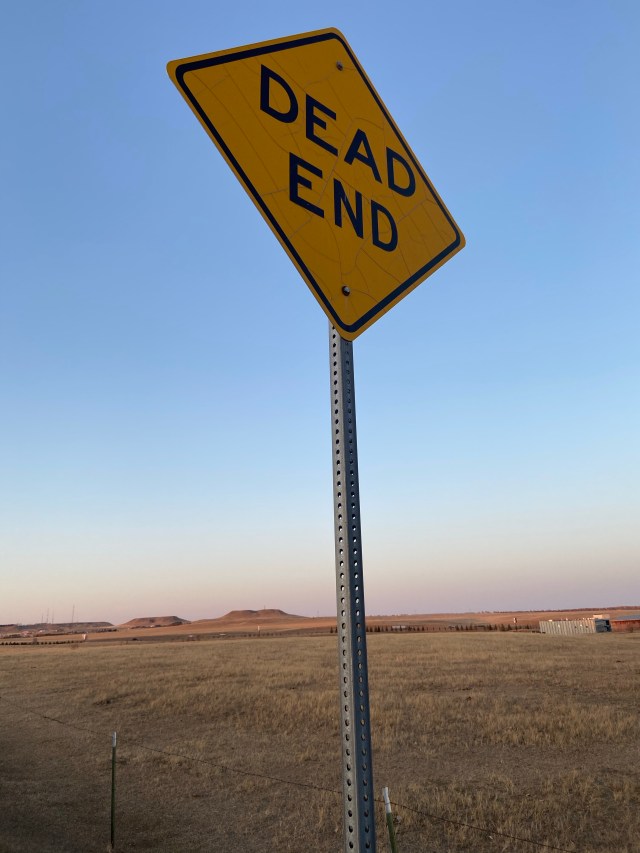
On Easter Sunday (and every single day) God preaches that sermon again and again. “This is not all there is.” Christians are brazen enough to look for the living among the dead because all roads, no matter how deep the ruts of our habits, do not lead to a singular dead end. The tomb was a most profound hoax of a dead end, revealing itself three days later to be an un-dead end.

I did order new sunglasses yesterday. Just in time for Easter.

A question for littles

Sometime when you are driving home and everyone is in a delightful mood and you are not in a hurry, take a different route. You could ask you kiddo to tell you where and when to turn. Ask them what they notice? What’s it like to take a different route?

A question for former littles

Do you feel stuck in any particular habit? (First, the grown-up must share an answer from her or his own life.)

A spiritual practice

When you have 5 extra minutes (or maybe during your shower) think of words you use to describe yourself. Be honest and let the words come to you. Notice whether the words are positive or negative. Are some of the words untrue? Do they lead you to dead ends in your life? How might the un-dead end of the empty tomb renew your sense of yourself?
Lent Week 4: Your Kiddo Really Prefers Store-Bought Granola Bars, So You Can Stop Making Them

If there is one thing I now know in the thick of the marathon that is parenting, it’s that I really don’t know much. And the things I do know have been learned only when I unlearned other things.

For example, my child will eat homemade baby food, and then homemade granola bars and mac and cheese, and then homemade everything because this is what I learned in parenting magazines (back when impressionable parents gleaned information from paper pages instead of web pages.) I unlearned much of what I had learned when my kids realized the world is much larger and in it exists a magical kind of Kraft Mac and Cheese and granola bars found in wrappers, like candy bars.

I learned from experienced parents the dream of being the parent who hosts the teenage gatherings in order to know kids’ friends. These wise parents taught me the importance of creating a welcoming, junk-food friendly home to attract teenagers like vape shops with their variety of cereal-flavored options. I unlearned such learning when I began to understand teenagers don’t always gather in the same room. I cannot offer said junk food to a teenager through an Xbox, even though I consider virtual gatherings valuable.

Parenting exists in a steady stream of learning, unlearning, and learning. It never ends. Ever. Which means there needs to be a space for the unlearning. We humans need space for the unlearning to lead to new learning. We learn to overschedule kids and shape our lives around their busyness. We learn to consume too much via cookies or Amazon or alcohol. We learn to work too much, complain too much, and accept the world for what it is too much.

I invite you to make space for the unlearning. In the unlearning, we make space to question what we think we know and let the Holy Spirit stir our imagination into new learning. What do you need to unlearn about the way you spend your time or your money? What might you unlearn about the way you understand your body or your neighbor or your nation or your religion or the world? What parenting practices might you unlearn to avoid making the marathon any freaking harder than it already is?

I have come to imagine Lent as a time when the church makes room for the unlearning to learn again the unlikely ending of the Jesus story. Based on all logic and reasoning and everything we have ever learned, the Jesus story should end on the cross with his last breath. The book should close with the power of death we learn all through life but of course it doesn’t. Instead, we learn an unlikely Easter awakening keeps the book from closing.

Unlearning death’s power means we live an entire life knowing the story doesn’t end as it should. So when I make a wrong parenting move, or realize what I’ve been doing was a sub-par idea, I can turn around (repent is the churchy word) and learn something new. New is the first and last word God speaks. New creation, new life, new wondering, new learning (after the unlearning).

A question for littles

What is one thing you know that grown-ups forget? (Kids can be great teachers of what to unlearn.)

A question for former littles

What is something you thought was true when you were little that doesn’t seem to be true after all?

A spiritual practice

Think back to a time in your life when you felt at peace, and comfortable with your self? Is there something you need to unlearn to return to that sense of peace?

Heavy Words & Little Ears

Lent begins on Ash Wednesday in a language of heavy words. In the Evangelical Lutheran Worship hymnal, we confess in words that would have done me in at an elementary-aged spelling bee, and might still give me trouble were it not for spell-check: self-indulgence, hypocrisy, exploitation of people, and self-examination.

The last phrase is both heavy and light all at once. When you look deeply at your own self, what do you find? I find all the heavy words at work. Am I self-indulgent? Let me think about it after I drink a third cup of coffee with a splash of cream. Hypocritical? Indeed. Do I exploit people when I buy cheap stuff on Amazon. Yikes. Let’s be done now.

Coupled with the heaviness of Lent’s language, however, is an airy lightness. Sure, you are bound to embody those words by nature of your humanity. They run in your blood and move to your heart. And yet, the 40 day self-examination moves us in a single direction: to Easter. Lent is a hard look at our own selves and a grateful look at what God has already done about it. You carry around heavy words and Jesus lifts them off your back. You are overwhelmed by your relationship with the aforementioned heavy words and Jesus erases them to scribble the one word “forgiven” all over you.

Lent gives us language to teach ourselves and our kids that the heavy words do not define us or own us. Jesus’ one word, however, does.

A question for littles

Forgiveness means there is nothing we can do to undo God’s love for us. It sticks to us like the stickiest glue ever invented. What sticky things can they find in the house? (For example: stickers, tape, the maple syrup on the kitchen table from breakfast.) Talk about God’s love as stickier than even that!

A question for former littles

Wonder together about self-indulgence. Be honest about what tempts you to self-indulge. (Hello, chocolate chip cookies.) What does it feel like when you self-indulge? Why is hard to be honest about it? How does Jesus’ word “forgiven” written all over you change how you feel about yourself?

A spiritual practice

Self-examination is indeed a heavy phrase. Let it also be a freeing phrase.

Sit still and scan your body from your toes to the top of your head. Remember God made your body out of love and in the image of God. Imagine examining your heart. What do you find there? Let your heart tell you. Take one deep breath and then another, as you say this prayer: “I am forgiven. Let my heart love my neighbor and myself.”

To Know and Be Known

(Photo by Gabby K on Pexels.com)

This is not a schmaltzy Valentine’s Day post, lest the photograph mislead you. Tomorrow is not my favorite day of the year, although I have found it to be a good excuse to buy my kids a new book and chocolate. The point of Valentine’s Day is to express our human love for one another, but with that comes heaps of opportunities for missed expectations (disappointment) which can lead to not loving moments on such a lovely day of the year. At least there is chocolate!

Because our staff is reading The Road Back to You: An Enneagram Journey to Self-Discovery, I better understand my relationship with Valentine’s Day. Turns out, Valentine’s Day, it’s not you, it’s me! Have you heard of this tool to understand our personalities? The Enneagram, as Ian Morgan Cron, co-author of the book explains, is “a tool that awakens our compassion for people just as they are, not the people we wish they would become so our lives would become easier.”

Yikes. Have you ever wished someone would be different and therefore easier to love? Guilty. Have you crossed your fingers hoping someone you love might change as the years go by? Guilty. Learning my enneagram number taught me that although I am a unique human being created in the image of God like no other human being, I am also like many other human beings in the world. We are people who avoid Valentine’s Day because it can be accompanied by disappointment. When we encounter disappointment on Valentine’s Day, we distance from the very person who is trying to love us.

Like other people who identify as a 5 (The Observer), I prefer to think more than feel. I have to work hard to process my feelings. I like learning and listening as long as it isn’t small talk, and when someone says, “Tell me about yourself”, I wish I had an invisibility cloak. I will know a hundred things about a friend or conversation partner before they know 10 things about me. Anyone who identifies as a 5 would describe themselves similarly.

This new understanding of myself has been clarifying in a life-giving way, just in time for Valentine’s Day. I know myself more truly as a pastor, mom, wife and friend. Most importantly, I know to be more gentle on myself and others, especially on Feb. 14th. I am a 5, my husband is a 2, and that could lead to a whole series of blogposts.

For now, remember you are known by the Maker as your true, broken, messy self, which makes slightly more sense when you know your own true, broken, messy self.

The Stowaways in My Backseat

Karis’ dolls named Grace, America, and Canada properly buckled up

One day when I parked my car at church after dropping kiddos off at school, I discovered these three stowaway passengers. Was it momentarily creepy, you ask? Why yes it was. Only momentarily. They are well-behaved and do not mind subzero temperatures while waiting for hours in the car for Karis.

Like I have done for eight years, Karis had made sure her dolls were snuggled into their seatbelts. Day after day kids watch and learn whether we are in our car, house, neighborhood, church, grocery store, or anywhere else. When I visit with parents whose child will soon be baptized, I love to remind them they are their child’s most prominent teachers about God. Again when a couple is preparing for marriage, I say a similar thing. You know what you know about marriage based on what you learned from your parents (or other adults who raised them) about relationships growing up. For good and for worse, kids learn what they know primarily from parents.

Karis buckled her dolls seatbelts. She also grows impatient all of a sudden. She wants to do things right and likes to help people. When her feelings get hurt she shrinks inward. All that she learned from me.

What is your kiddo or grandkiddo learning from you? You might ask them. I like to ask my kids once in a while, “What’s it like to have me as a mom?” Like any performance review, I often hear things I’d rather be oblivious to, but I truly need to know. Those truths are edifying, even if they are hard to swallow.

If you are unsure about asking your kids such a vulnerable question, you can also watch the backseat of your car to see who is lurking there.

A Break From All That

(Note by Karis about her favorite animal.)

It’s been five days since all of it happened at the U.S. Capitol. Five days of news, photos, posts, and tweets, slowly moving us from disbelief to a bit of muddy clarity. Five days and let’s take a break from all that.

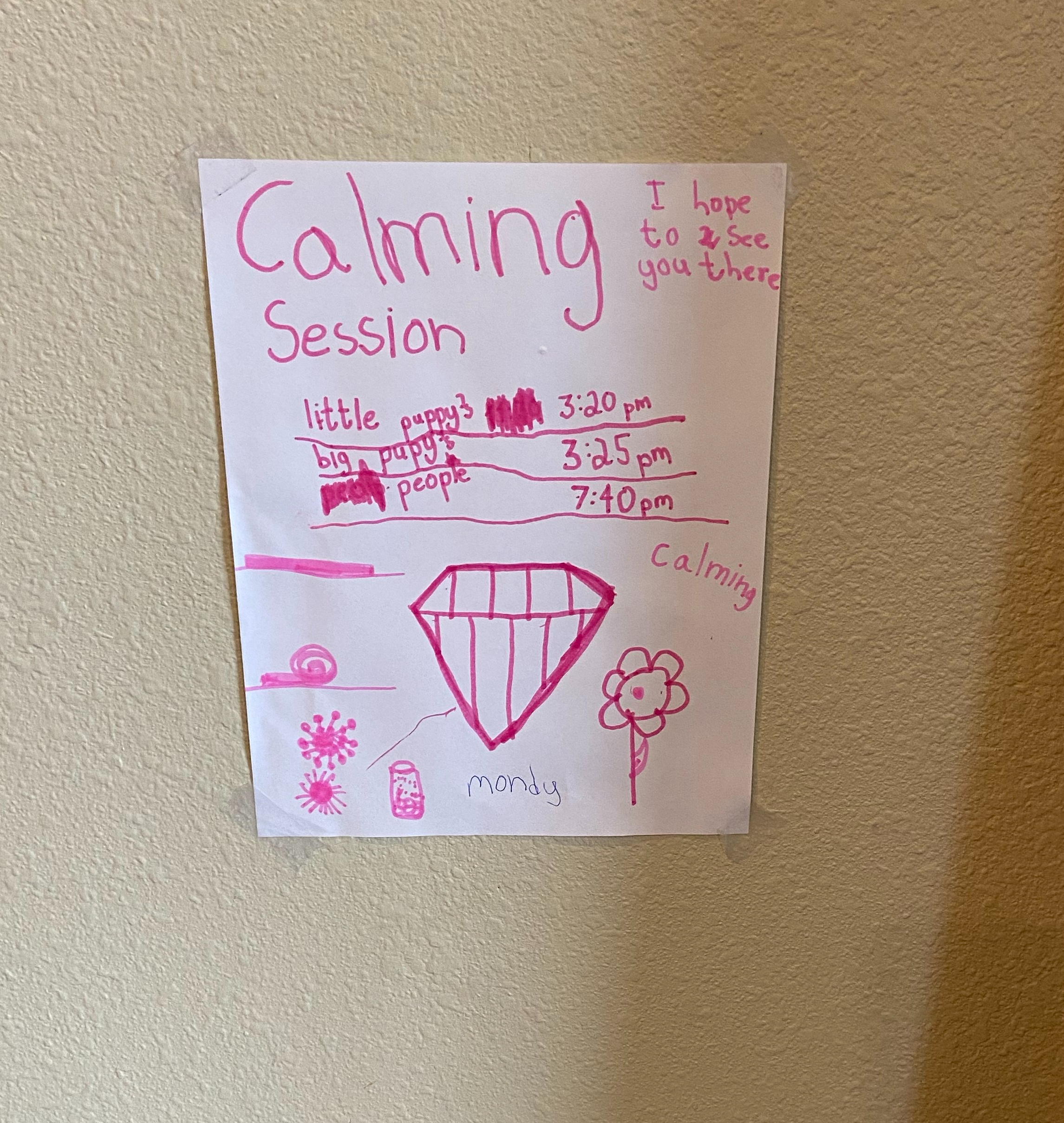
At my daughter’s elementary school, I am incredibly grateful to the teachers of Yoga Calm. She has several tools in her toolbelt to help her catch her breath and find some grounding when we need it, including calming bottles, deep breaths, and stretches.

Some evenings, she leads “calming sessions” with anyone in our house who wants to join in. Her dad and I both find it refreshing and we do actually sleep better! Her Yoga Calm skills have recently reached a new audience.

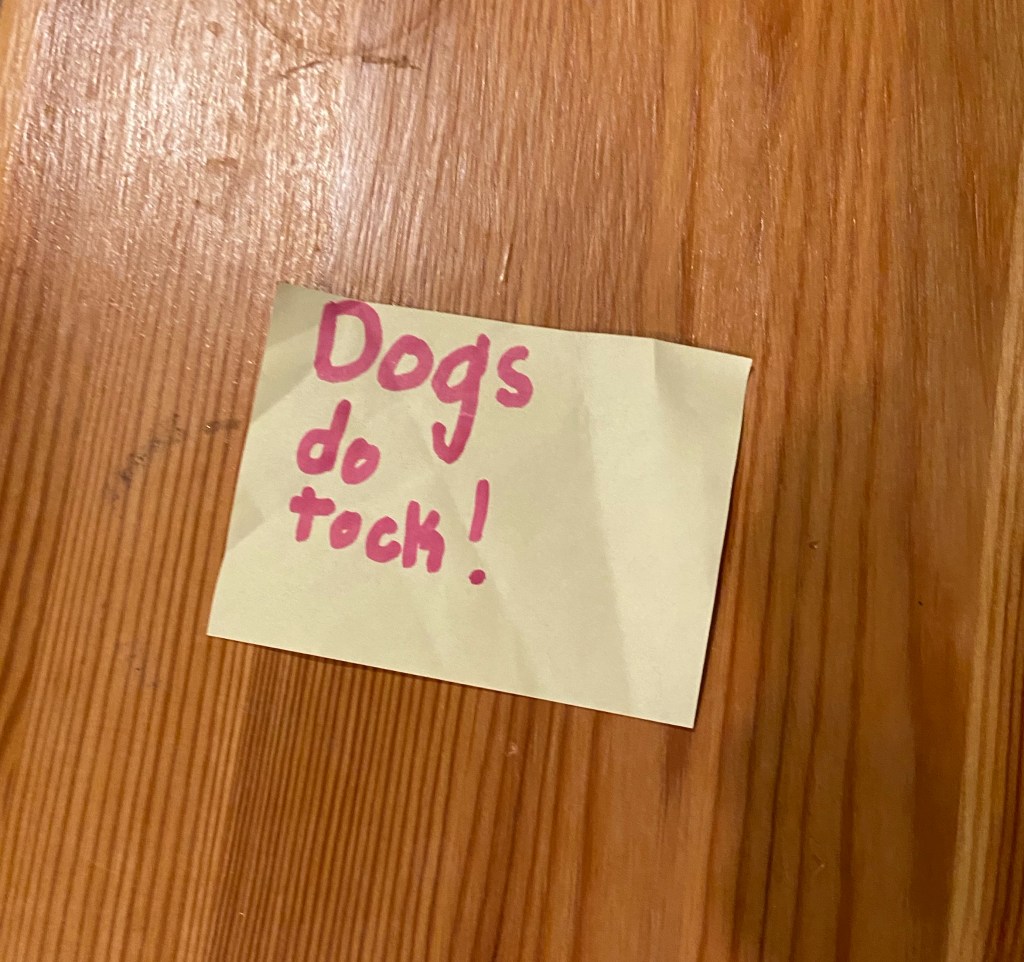
There are three dogs who live at our house. We call two of them the “big dogs”, whose hobby is bird hunting. And the “little dog” who only hunts for trouble. All three have been invited to calming sessions. Some time ago, she wrote the note insisting dogs do [talk]. If dogs can talk, of course they can do Yoga Calm. Today, she taught the class to all three dogs in the backyard, a feat equivalent to teaching 35 kindergarteners. In the unusually warm January air, she expanded their repertoire of calming tools. (She lures them in with treats, making her a very effective instructor. )

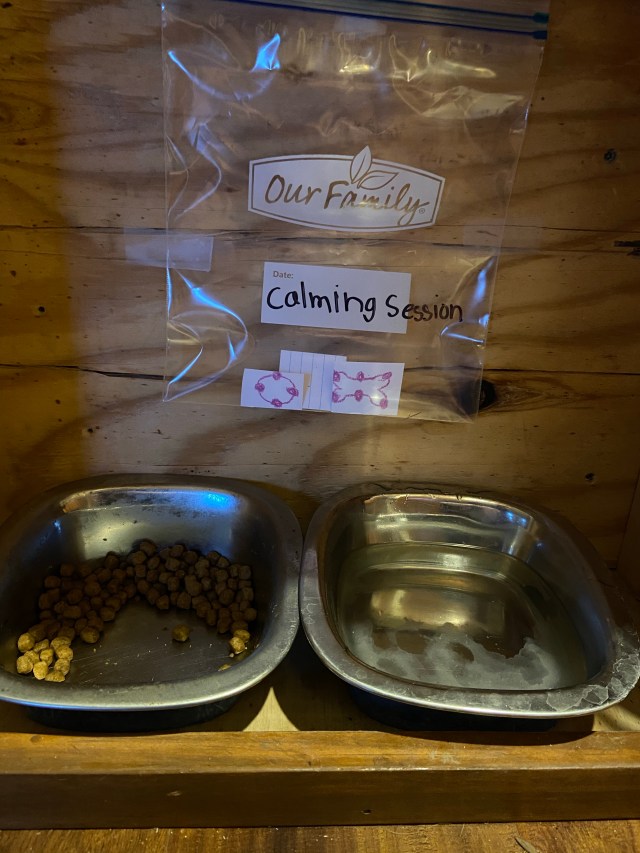
She also leaves tools where the dogs can easily see them, for example beside the little dog’s food and water. The tools in this bag encourage slower breathing, moving your finger (sorry, paw) from one dot to the next, one breath at a time.

The little dog hasn’t figured out how to open the bag yet, but I’m quite sure the sight of the bag is calming enough.

You should try it. On a piece of paper, draw a shape and scatter dots anywhere on the lines. Breath in from one dot to the next, exhale from that dot to the next one. And you, too, can be as calm as a Springer Spaniel, Yellow Lab, and Lassapoo.

Book Review: “Bless This Mess” *****

Beware of parenting books. They should all be read cautiously and with acute awareness that no parent is perfect, no two kids are the same, and we are all parenting with only our best guesses.

This book, however, is a breath of fresh air and an unfolding of wisdom. I’ve been a parent for quite a few years and I know stuff. After reading this book, I know more. I would love to hang out with these two witty and honest authors! Even the story of how a cool pastor and curious child psychologist became friends and united in the front line craziness of parenting and then co-wrote a book is Spirit-filled.

If you are wondering how to talk to your kids about money or sex or sexuality, read this book. If you are wondering whether to take kids to church and why you would even wonder whether to do that, read this book. You will find a healthy theology not based on protecting kids from everything “of this world”. The premise is to accompany kids rather than shield them. The answer isn’t “go to church” or “monitor screen time more”. I found both grace and guidance in these pages.

Parenting is an exercise in intensity. The younger years are intensely exhausting. The older years appear to be emotionally intense. It is so easy to sit back and cross my fingers, but much wiser to stay in the ring. The authors of “Bless This Mess” provide some of the moves and strength to do just that for each state of parenting preschoolers, middle schoolers and high schoolers.

Beware of parenting books, for sure. But this one is an exception.

#SpiritualLonging

A hunger for bread. A thirst only water can quench. A yearning for someone I love to hold my hand.

Our deepest needs are the least complicated.

Daily life, on the other hand, is mostly complicated. I am a wife, mom and pastor, making each day an exercise in meeting and missing expectations (my own, my family’s, my parish). We have expectations for ourselves and our work. Expectations are placed upon you by family members and your daily work, paid or unpaid. “To whom much is given, much will be required,” Jesus whispered in the ear of an overwhelmed woman. (Luke 12:48)

In the complicated seasons of life, what is required is overwhelming. At home, schedule the kids’ doctor appointments, sign up for baseball, buy her dance outfit in the size that fits (unlike last year), teach him how to drive, be available for conversation whenever a kid or partner is open to meaningful conversation, plan the meals, unclog the drain, surveil the screen time, fold the towels, check the homework, tell people to shower. And then there is your paid work if that’s your thing. And then there is joining your partner in caring for a marriage if that’s your thing. Maybe you care for aging parents or a sick kiddo, maybe you travel for work, maybe you are financially stressed, maybe, maybe, complicated, complicated.

I am convinced women today need to face the long list of what we expect of ourselves and what is expected of us and get real. Deep down, we do not long to administrate our families or “balance” time at home and work. Our true longing is much less complicated – as simple as bread, water, and the touch of a loved one’s hand.

These are spiritual longings, weaved into your very being. Spiritual longings are uncomplicated desires to set aside the unrealistic expectations you assume are required of you. Usually, the only person requiring unrealistic expectations of you is…you. Your family does not want you to work so damn hard. Your work does not need you to give up your well-being. You do not need to lose yourself in the dark woods of endless expectations.

When the message is to try harder to get through the woods, or to be your better self to find your way, I think that message is wrong and destructive. A better way might be to sit down wherever you are in the dark woods. Take a bite of bread and a sip of water and let Jesus hold your hand for a while. Take uncomplicated deep breaths. The drain will stay clogged and the towels will pile up. But you, beloved child of God, will hear Jesus whisper that you’ve gone too far into the woods. “To whom much freedom and life is given, trying harder is not required.”

That promise is my longing, filling my spirit with each deep, uncomplicated breath.

On Firsts and Lasts With Kids

Firsts are obvious as we lead and accompany kids through this one wild and precious life, as Mary Oliver described it. We pay attention to the first bath, first solid food, first friend, first day of school. My son bought his first vehicle a couple of weeks ago. It was both wild and precious.

Lasts are a different animal. We only notice them in hindsight if we notice them at all. The last time he needed me to tie his shoes. Last time she needed my help to give her a bath. Last book I read to him. Last time I cut her steak for her. Last time I picked them all up from school.

This week, I wonder whether this will be the last New Year’s Eve we spend together as a five-person crew. I planned a menu and a few goofy games in an attempt to stay awake until midnight, and I keep pondering whether this last day of the year is one of those hidden lasts. Kids are built to move on to bigger things that do not involve a mom making mocktails, but we never know when we have entered new territory until suddenly we have arrived. Suddenly there will be four of us, then three, then…

I do not dread the descending order, but I don’t want to completely miss the lasts, either.

You could say every last leads to a first. The last New Year’s Eve together will lead to his first New Year’s Eve with friends, without mom’s goofy games, without fighting with siblings, without the old comfortable routine. In the newness of the firsts and in the shedding of the lasts, life reveals its wild and precious self. Ready or not.

Advent Wondering: Can I Live Without Amazon for a Year?

If I set aside the downsides of every one of my Amazon purchases (extra packaging materials, more fuel burned by trucks, working conditions for underpaid and harried Amazon employees) what’s not to love about Amazon?!?

For the love of this busy culture, in two days my item arrives at my door! Socks for a kiddo, lotion for me, that cute pillow case for a living room throw pillow. Or, in two days an item arrives at the door of any address I enter into the shipping information. Need to send a gift? Amazon will do it! Need a toothbrush every six months to arrive without actually ordering it? Amazon can do that, too.

Amazon is like Tabitha from “Bewitched”, Santa Claus, the world’s best mom, and a little bit of Jesus all wrapped in one.

Which makes me wonder…when buying becomes so easy and automatic (“I’ll just order it on Amazon.com!”), what am I forgetting? The more automatic it is to order on Amazon, the less I actually consider what I’m buying. If what I “need” is but a click away, that’s just too fast for me to make a mindful purchase. I’m not looking at something at the store and comparing it with the items around it, which takes long enough for me to also wonder if I truly need to purchase it. A “click away” takes the think away. (I’m sorry.)

My Amazon Prime membership is up at the end of December and I wonder if Amazon and I need to take a short break. Will I miss out if I don’t click for 365 days? Will my kids go without socks and my couch look dreary? Both are entirely possible. I’ll also need to buy toothbrushes all on my own in six months.

Will I also be a little slower in my clicks? Will I end up with fewer things at the end of 2021?

The weeks of Advent lead me to wonder such things. How can I slow life down? How can I be intentional with choices that impact my neighbor and this earth? How much do I really need and have I noticed how many drop-offs I make at the thrift store? Am I being mindful with money or just clicking away?

Life tends to accelerate without our even noticing. Even in a global pandemic it moves quickly.

“Blessed are those who click wisely.”