Six Words to Avoid

Last year, the book Embodied: Clergy Women and the Solidarity of a Mothering God got me wondering. Pastor Lee Ann Pomrenke invites readers to notice the unique lens through which women who are clergy understand their work. (For simplicity’s sake, I’ll use the word “pastors” to include both deacons and pastors.)

Pastoring and mothering kids share more in common than I’d realized in the early years of my vocation. Both involve caring for people in a way that surrenders the course of our lives to other people’s lives. Pastors and mothers may plan their days, weeks, or years, but the trail is blazed by the people whom we love. For mothers, careers are temporarily set aside to care for family. (Less often but sometimes, fathers do this work.) For pastors, family vacations are shifted when a funeral comes up. For both mothers and pastors, holidays are self-sacrificing and labor-intensive in order to create memories for others. You carry around your own examples, pastors and moms, of the way your life has been shaped by your generous love for others.

Reflecting on the past couple of years, I am noticing something else pastors and mothers share in common. A less obvious commonality between pastoring and mothering can be found in the way we either empower or disempower the people whom we love. This is some of the hard, hard work of pastoring and mothering! If we peel back the layer of “It’s easier to do it myself”, we notice we are keeping other people from doing it themselves.

Time for an example! Preparing for a Sunday off this week made me realize I’m the one who turns on the sound system and sets up the Facebook Livestream even though there are ushers and techs who are perfectly capable and willing to do this quick and easy work. During the course of the pandemic, pastors did the majority of the volunteer work for a spell and I became accustomed to “it’s easier to do it myself.” But now, there are plenty of fingers to press the green button to turn on the sound and type in a welcome on the livestream.

At home, the more work I can teach my kids to do (laundry, cooking, cleaning), the easier my life is. But this is daily hard work! It’s finding a balance between encouraging and nagging, teaching and letting go, caring and not caring. Empowering others is messy, grinding work at the same time it is the most faithful work demanded of pastors and mothers.

I know the balance is off when I get crabby. When my kids don’t do their laundry or chores or the sound system doesn’t get turned on or something else gets missed. Crabby is like a warning light reminding us to step back and notice whom might we empower and rely upon. The truth is, it isn’t easier to do it myself again and again. It is easier if others know what to do and how to help.

I was sure by the time I’d been a pastor for 17 years and a mother for 15 that I would have a better grip on these things! But life is never like that. Humans aren’t wired to learn most things once and for all. We learn again and again and then once again. And in the learning, we learn (not once but again and again) to be gentle on ourselves, to loosen our grip on life, and to give thanks for the people whom we love who shape the course of our lives.

The Avoidable Question

Vegetables ready to flavor Marcus’ Chicken Noodle Soup and pears to sweeten a smoothie.

There are times when it is the question, not the answer, that is hard to come by. Questions can be asked or avoided, but first there must be a question. What question, tucked deep in your heart beneath a thick layer of pride or something else, lays waiting for you to ask?

Reading the novel Apples Never Fall this weekend, I was reminded of a question I asked late in my marriage. It took a decade for me to unearth this simple question that grew in urgency as the years accumulated. I won’t spoil Moriarty’s book when I tell you one of the characters struggled to find the same simple question!

I shared the story in my book about being called as senior pastor and needing to let go of some of my daily work. Among the hardest stuff we do as people (especially as women?) is to let go of some of our daily work. It is ridiculously hard for me to let go of the need to tidy up the kitchen and stay on top of the laundry. Honestly, who cares! But I sacrifice valuable sitting, playing or reading time with this ridiculous need to tidy up. But I digress.

Before I began my new call, I had asked my husband a question that began with an admission: “I need more help from you.” Marcus and I talked through the question, “What might I let go?” He immediately agreed to do the weekend cooking, leaving enough leftovers to stretch through most of the weekdays. For the last seven years, his response to my question has loosened the tension of work at church and at home. Had I not asked it, my kids would not be eating as well (last night he made homemade French Fries!) and I would be grumpy about cooking.

The question we tend to keep tucked away where no one can see it is some variation of: “What do I need?” Most of us find neediness to be a character flaw, so we avoid needing anything from anyone as best we can. We have complexes about keeping scores even and so we try to stay ahead by needing less. This, my friends, is dumb.

Pacing through Holy Week one day at a time, we should become poignantly aware of our neediness. “What do I need?”, we might ask our needy selves? The question is surely avoidable, but if we summon up the courage to inquire, we will be freed by our admission that we need help, forgiveness, a hug, a kind text, a meal, carpooling partners, a grocery run, coffee with a friend, a walk, a Savior who exchanged his life for our forgiveness. Without our neediness, there is no need for grace, the perpetually uneven score. Avoid the question and avoid the rich response of mercy. Peel back the layers of your life to find that question, and trust that the answer just might surprise you.

In the Noise and in the Silence

It took me years upon years to learn why parenting littles was absolutely exhausting. Aside from the sleep deprivation and the fact that often our most demanding work years fall in the same season, kids require every iota of an introvert’s energy. Did my sons, whose birthdays fall within twenty months, care that I identify as an introvert?

Toddler Sons: “Mom, play cars, trucks, tag, push me on the swing, read me that book, watch me, watch me, watch me!”

Mom: “Actually, the introvert that is me requires blocks of quiet time and alone time, so I’m just going to sit by myself for a while as you risk your life being a toddler.”

Toddler Sons: “We completely understand. Go and feed your soul while we sharpen knives in the kitchen.”

There is no “tv timeout” that allows for an introvert to recover from so much people time. Even time with our own family in our own home as any introvert knows, can be over the top exhausting.

I’ve been recalling this as my kids are older and do actually allow introvert recovery time. They do their own thing, have their own friends and do not demand, “watch me, watch me, watch me” all the live long day. I can sit and read chapters of a book. I can take a walk. I can drink a cup of coffee while it’s steaming hot.

It is easy for me, too, to do my own thing. And yet, a fundamental need for all humans beings requires sitting together some of the time. Even if no words are exchanged, each one of us needs someone to regularly look us in the eye to assure that we have not mistakenly put on an invisibility cloak. I need your eyes to assure me I matter to you.

I recently sat with an elderly dude whose entire world is about to change. He told me his story a few times in the half hour or so we sat together. I didn’t need to say anything, but my eyes (and I suppose my ears) assured him he was heard. Words matter less when the person you sit with knows he matters to you. I did not know him well, but I did know we are both beloved children of God who need someone else’s eyes to remind us God sees us, too.

In the noise of life with young kiddos, we assure them they matter with our songs and silly conversations and with pushes on the swings that surface the giggles. As we grow older, it is often in the silence that we come to know and remember someone notices we are still here. Hanging out in this life, as unsure as anyone else what comes next.

Pancake Tuesday

Flip the calendar to a new month and you find a new liturgical season! Hello March and Hello Lent!

Today is the eve of Ash Wednesday, the first day of Lent. Lent, for normal people who do not live by the liturgical seasons, includes six weeks of waiting and preparing for the big, beautiful day of celebrating Christ’s resurrection. It takes six weeks to get ready for the monumental moment when Jesus’ tomb was found…wait for it…six weeks later…empty.

But today is pancake Tuesday. Historically on this day, Christians uses up much of their food in order to begin a fast on Ash Wednesday. Any lard lounging around was made into pancakes. At our house tonight, we are enjoying pancakes sans the fasting. Because what a great way to mark the beginning of a season but pancakes? A food my whole family loves morning, noon or night. Pancakes can be boring, or they can be sweetened up with chocolate chips or sugar. They can take on a healthy look with a handful of blueberries swimming in the batter. Even better, pancakes can transform into a blanket for sausage. Who wouldn’t want to be a blanket for sausage?

Pancakes are a love language, maybe, and today they are a way of eating our way into Lent. We are eating extravagantly into the season that leaves behind extravagance. I do love Lent. As a pastor, Lent is a time I try to minimize meetings to make room for heavy listening to Jesus, stripping away what is not important as much as I can.

It could be Lent is the picture of how I could live every day and every season all year long, but of course I don’t. Lent is a kind of permission to say no to the shiny things, no to the busy things, no to the steady stream of things. Lent is a time to say yes to the one who gives us life. And it all begins with pancakes around a table with the people who matter so much to me. Possibly, these next six weeks will help them glimpse what matters most in our lives and what does not. Pancakes matter. Sitting around a table matters. Worshipping together tomorrow matters, even if it is one of the few days my whole family will worship together.

We mark this day, Ash Wednesday Eve, with fluffy and extravagant pancakes. We mark tomorrow with grimy ashes. No extravagance. Just Jesus.

Parenting is Both Loving and Not Caring

Kid: “Mom, blah blah blah.”

Mom: “I don’t care. But I do love you!”

Doesn’t that feel good? Not caring can feel so dang good! I don’t care about a lot of things. I don’t care if if I catch the news every day or if I’m a few minutes late for some things. Okay, for several things! And it’s not just me. My husband doesn’t care about the laundry on the floor or if the bed never ever ever gets made again.

I don’t care if my kids earn perfect grades or become impressive athletes. I don’t care if they stop going to church or never leisurely read another book. I will never stop loving these three young humans, but I will never care about absolutely everything they do or do not do.

Like two sides of the same coin, love and not caring go together. You could also say love and letting go, if that sits better. Or, parenting is as much hands off as it is hands on. No matter the words, this work is not for the faint of heart! It may be easy to love our own kid (most of the time), but it is a great challenge to know when not to care.

Straight up, here is the importance of not caring: you will not rest if you 100% care for every single detail of your kid’s life every moment of every day. You cannot be you, a full self, a healthy human, if all you do is care about your kid. Sometimes, it is best not to care.

Let me be clear. There are parents who literally do not care an iota, which is often related to mental health or trauma or addiction. I’m not advocating for that. Do not stop caring for your kid’s basic needs. That is not cool. This is what I mean: I am learning to care less and at times not at all when the timing is right.

Let’s start at the beginning. When a doctor hands a parent a brand new baby, or you receive a child through adoption, you do not promise to protect this child from every possible problem. You do not promise to raise that child to perfection, or become the most remarkable caregiver. Before and after becoming a parent, you are as human as ever. The writer of Ecclesiastes, perhaps the world’s first life coach, assured us there is a time for every season under heaven. I agree. There is a time to care and a time to not care.

I am slowly learning this complex parenting wisdom, which grows more complex as my kids add years to their ages. I feel it in their schoolwork, which I hope they do well and work hard and I will support them as best I can. However, as much as I love for them to do their best, it is perfectly fine that I do not care so much for the end result. I can point out their grades, but not take their work personally. I can remind them and be clear with my concerns, and after that I need to know where my own parental responsibility starts and stops. Their future is completely out of my hands, unlike when they were little.

When they were little, I chose my kids’ day cares and babysitters and often even their friends. Now, none of that is true. They will choose their post-high school path, just as they will choose their own friends. They will choose their hobbies and whether they care that they wear dirty-looking work jeans to school every dang day, making it appear that our family shops for clothes out of the trash bin outside the thrift store. Again, out of my hands.

I love them so much, and I refuse to care for all the details that shape their lives. If parenting is raising small humans to grow into independent and helpful adult humans, then at some point, I have to hand over the burden of caring so much.

Perhaps this is God’s way of loving us, too. In Isaiah 43, God loves us and we belong to God. This chapter is the only moment in the entirely of the Bible when God explicitly states: “I love you.” But like the stoic parent who does not say the words out loud every single day, you know it’s true. The absence of the words do not make the parent’s love for you any less, only quieter. From the first page of Genesis to the last page of Revelation, God’s love for you sings from each chapter.

I will fiercely love my kids as long as I live, and sometimes my love will be elevator music they can hardly hear as they learn to do life on their own. It will be there, my love for them, at times by way of quiet background noise, yet still they will know it is there. Lingering and steady; that I both love and do not care because fierce love risks stifling both our lives. The poet Rainer Rilke puts it this way: “We need, in love, to practice only this: letting each other go, for holding on comes easily; we do not need to learn it.”

Jesus Did What in the Temple?! Yep. (John 2:13-25)

(Photo by Jelle de Gier on Unsplash)

(John 2:13-25 NRSV) The Passover of the Jews was near, and Jesus went up to Jerusalem. 14 In the temple he found people selling cattle, sheep, and doves, and the money changers seated at their tables. 15 Making a whip of cords, he drove all of them out of the temple, both the sheep and the cattle. He also poured out the coins of the money changers and overturned their tables. 16 He told those who were selling the doves, “Take these things out of here! Stop making my Father’s house a marketplace!” 17 His disciples remembered that it was written, “Zeal for your house will consume me.” 18 The Jews then said to him, “What sign can you show us for doing this?” 19 Jesus answered them, “Destroy this temple, and in three days I will raise it up.” 20 The Jews then said, “This temple has been under construction for forty-six years, and will you raise it up in three days?” 21 But he was speaking of the temple of his body. 22 After he was raised from the dead, his disciples remembered that he had said this; and they believed the scripture and the word that Jesus had spoken.

23 When he was in Jerusalem during the Passover festival, many believed in his name because they saw the signs that he was doing. 24 But Jesus on his part would not entrust himself to them, because he knew all people 25 and needed no one to testify about anyone; for he himself knew what was in everyone.

http://www.biblegateway.com

While evolving into a new parent, I was not prepared for the exhaustion of my own kids’ emotional outbursts. Sure, I have feelings, too! They just don’t burst out and transform my entire being like a mogwai splashed with water. Or like a volcano spewing hot lava.

Emotional outbursts are part of being a kid. It’s what they do. I understand. Kids burst with emotion when and where they feel it is safe for them to do so. An uncontainable flood of feelings regularly courses through their little bodies and it takes a lifetime to know where to put the sandbags.

I was not at all prepared for the emotional bursts! I am an introvert who grew up in a quiet house. There was no yelling or drama, only Norwegians. When my first child began to demonstrate emotional out bursting, I was confounded. To this day, with my youngest a nine-year old, these emotional outbursts become like a tiny hole pierced in a balloon, slowly draining energy.

Did God the Father feel something like this, watching Jesus burst with emotion in the temple? Was it draining for God the Father to witness the only Son of God release fury, disappointment, and who can say exactly which particular feelings?

There must be nothing wrong with an occasional emotional outburst, even for an adult, if Jesus became a hot mess and made such a ruckus in the temple! When we feel certain feelings, anger is the go-to for most humans, even Jesus. If we feel afraid, ashamed, embarrassed, angry, disappointed, intimidated, or lost, it is anger that wins out. When someone is angry with you, or you are the one who feels angry, slow down and pay attention to the actual feelings hiding behind the anger. Are you feeling left out? Betrayed? Jealous? Or maybe you are really tired and simply need a nap. That’s so human, too! Jesus took his share of naps.

This weekend, I am grateful a St. John member will be doing the preaching. (I’ve previewed the sermon and it is lovely!) Like last week, I welcome your ponderings and wisdom around this text. Leave a comment on my blog or Facebook, or email me at lewtonwriter@gmail.com. Your words this week will shape the Prayers of the People.

Tell me, can you relate to Jesus in this story? Or can you imagine being one of the people who witnessed his outburst? What is it like for you to be the one who has to deal with other people’s emotional outbursts? Where do you see emotional outbursts going on in the world today?

Advent Week 2 – Expectations

(Photo by Kelly Sikkema on Unsplash)

(This week’s devotion is a letter written to the not-my-favorite-person who first added candy to Advent calendars.)

Dear Sir or Ma’am:

Why? Why did you take a perfectly lovely German Lutheran tradition and transform it into a mild nightmare for moms? Whoever you are, I suspect you are not a parent. You might be one of those beloved and sneaky aunts who spoils the kids and runs away before bedtime.

Excuse my annoyance. This is not entirely your fault. It’s just that each year I hope to invite my kids into the mystery of this season, only to find myself yelling over the yelling when one of my three kids might get one more piece of candy than another. Really, you should have seen this coming! What did you expect? You have messed with the expectations. Now my kids expect the wait for Jesus’ arrival to be a road paved with chocolate. You changed the Advent Calendar to a sweet milk chocolate countdown and I have to tell you I’m 95% cacao bitter about it.

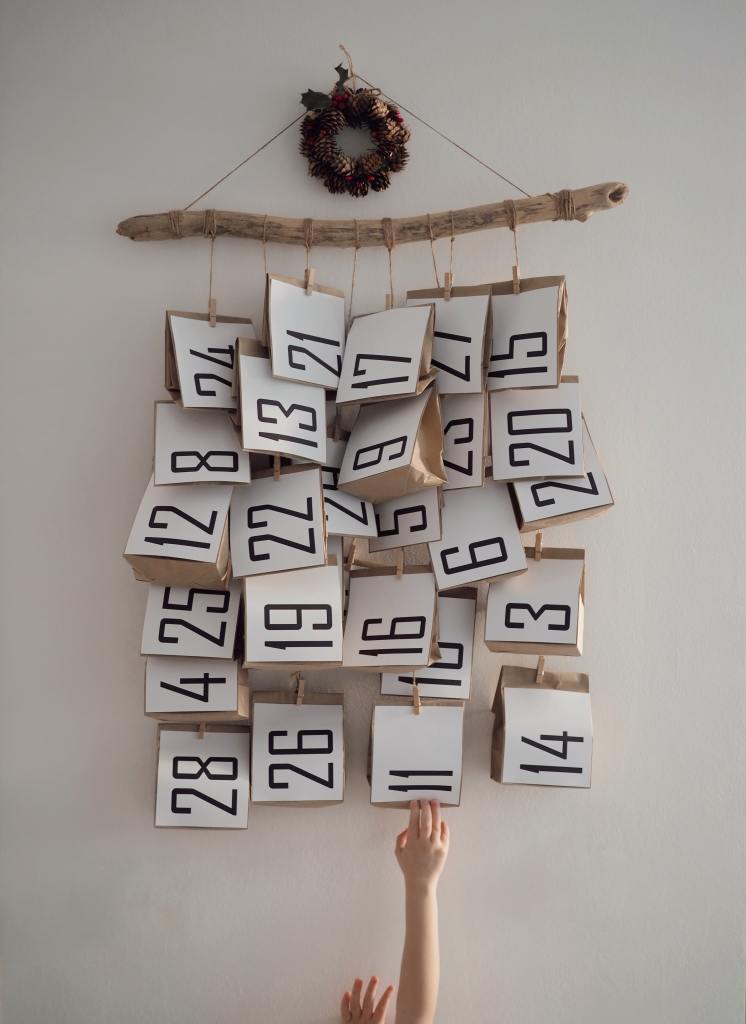
I’ve tried workarounds. Last year, I constructed a homemade Advent Calendar with a variety of surprises in individual paper bags. Each day, the kids opened a bag to discover a Bible verse they had to look up, with a small piece of candy (not always chocolate!) or instructions to do something kind for a sibling or a pair of socks or something silly. It was Pinterest-worthy and too much work to do a second time. It will live in my memory as that time I accomplished something Pinterest-worthy.

This year, I hunted for an Advent Calendar on Etsy…until I wondered what it meant that I might spent $50+ to help my kids get ready for the arrival of the Prince of Peace, when actually the calendar becomes a battleground?

Excuse me if I might be channeling too much Cindy Lou Who here, but oh my goodness it is a challenge to slow down the countdown to Christmas Eve! The sweet surprises in the Advent Calendar risk putting us in the fast lane when Advent is a slow lane kind of season. The slowness is necessary to absorb or breathe in the mystery of divine love packaged in a slippery infant body and delivered in an unseen corner of the world by an exceptionally young woman. The addition of chocolate, you see, sweetens the rugged and ragged mystery.

I expect chocolate makes everything better, including the Christmas story. But is it possible the daily dose of chocolate might forget this story is sweet enough without the candy? How sweet it is that God, so far away in the heavens, could not stand to be so far away from you. How sweet it is when God finally threw God’s arms up in the air when humanity kept messing it all up, and finally did what we could not: save ourselves. How sweet that we can expect radical hope every single day, beyond the rugged and ragged scene laid out before us in our everyday lives.

Sheepishly, I will admit to you, chocolate pusher, that in the end I stuffed some candy into 24 little bags and shoved them into a big Christmas cookie tin because it did not feel right to be missing an Advent Calendar! See what you’ve done? You have planted in my brain the expectation that candy must accompany all 24 days of Advent. <sigh>

I will choose to believe your intentions were good. You called attention to Advent using something ordinary and yummy. I will choose to believe you did not expect your idea would become so profitable. It can be tricky to know what to expect when something new is unleashed into the world. In the first century, no one expected a crying newborn to be God’s love unleashed into the world, but God does not adjust to any of our Advent expectations. God’s love for all the rugged and ragged among us does not fit in any of those tiny boxes or bags where sweet treats can be found for 24 days. Its sweetness outdoes all the chocolate in the world.

Signing off, slightly less bitter in North Dakota,

Lisa

PRAYER PRACTICE

  • Light a candle and make a list of expectations God might have for you this Advent season. God does not expect you to supply your children with daily surprises, or for you to locate the perfect present, or to make everyone else’s holiday a smooth ride. What God expects from you might invite you to be more gentle on yourself and stay in the slow lane.

Advent Week 1 – Promises

My daughter finds it funny to remind me of the time her principal called our home during the day to tell me she had fallen from the monkey bars and, we would later learn, fractured a bone in her arm. For whatever reason, Caller ID described the school’s number as “Private Caller,” ostensibly “Annoying Solicitation.” My choice to let the phone ring will be an everlasting tale for her to hold over my head. Forever and ever. “Whatever you do,” she instructs her brothers, “don’t call mom if you break your arm!”

In some way, I had broken an unspoken promise that whenever my six-year-old called or needed me, I would immediately answer the phone. Of course, it did turn out fine after the school called my husband who called me. She did not wait long for her mom to rush to her side! But it did seem the world shifted ever so slightly. She gained some awareness that our lives are not one life but two separate lives.

Parents make many promises to a child, perhaps each of them unspoken. There are basic promises to feed, clothe and show love. And there are social promises to equip a child to make friends and swim in the larger world of peers. There is a promise to be present for the conversation that needs to happen, to listen to a worry, to talk through a dilemma, to help navigate the tough spots, to keep the cookie jar from an empty state.

It could be that parents construct an entire foundation under kids with our promises. No parents keeps them all perfectly, so as we build the foundation with promises, we also build it with empathy and forgiveness. Promise-keeping happens to be the language of Holy Baptism. God promises to hold onto the baptized from this life into the next, and to love us even when we let God down. In turn, hearing God’s unconditional promise of love for us, we make promises, too. Our promises are designed for the well-being of our neighbor.

At weddings and baptisms, I take delight in disclosing to the people making promises (couples and parents/guardians) they are making promises that are impossible to keep. I assure them they will not keep every promise made in the rites of marriage or baptism. They giggle nervously, but I hope my disclosure relieves some pressure.

If we were meant to keep promises perfectly, God would have improved the prototype for humanity. But we are broken people who break the promises we make to one another, even though we know we should not. We act selfishly and out of resentment. We struggle with addiction or get tangled up in an abusive relationship. We get too busy and out of the routine to take our kids to church. Being human requires forgiveness and new starts, or to quote Ann Lamott, earth is forgiveness school. Which is why God’s promise of unconditional love will hang over your head like my daughter’s everlasting tale of the time I chose not answer the phone! This umbrella promise covers you and any mistake you make, including the small mistakes like neglecting to answer the phone, along with the bigger and heavier ones.

In this first week of Advent, we inch closer to a promise God had made long before Jesus was born. Throughout the Hebrew Scriptures, the promise of Jesus’ coming is whispered on each page. The patriarchs of the first book of the Bible tried to follow God and failed, just like the Israelites who entered the story later on, and the promise remained. Through creation and judges and prophets, through insignificant and unnamed people and rich and famous ones, the promise of a Savior is carried from page to page until finally, the promise is a child. On the page we discover an impoverished couple on an obligatory journey into Bethlehem because a king had promised to harm them if they didn’t.

God’s unending promise to love you can be, at times, difficult to hear. The whisper is too low, like a handful of lovely people in their seasoned years who have admitted to me after worship: “I can hear the man’s voice but not yours.” The Bible is like that, too. We can hear God’s promise loud and clear on some pages but not others. We hear it in Isaiah, but turn the pages back and the pitch is too low in the book of Judges (not bedtime reading, that book.) And yet the promise is on that dreadful page, too!

God’s promise cannot be erased or compromised, and I wonder if the is so gracious as to become hard to believe. Can you believe you cannot undo God’s promise of mercy? It is a wild and unwieldy promise, and it is yours to keep.

PRAYER PRACTICE

  • Light a candle and write a list of promises you are trying to keep. One by one, name them and remind yourself, beloved child of God, how God’s promise to love you is an unconditional promise of mercy. Let God’s forgiveness bring you to forgive yourself, too. With a marker, write “I Love You, I Promise. Love, God” over all of your words.

I Just Texted My Kid During School

Photo by fauxels on Pexels.com

Not so long ago, I could not fathom why a parent would send a text message to their own kid knowing that kid is at school. Can’t it wait until after school? I haughtily inner-commented. I mean really, they’re in school!

I remembered those haughty inner-comments this morning when I texted my kid a question related to Thanksgiving break…while he was at school. Thanksgiving is several weeks away, deeming this question non-urgent. And yet, texting often leads to quicker answers which leads to quicker knowing and isn’t that normal?!

Immediacy is the new normal. Would I wait eight hours to ask my son a quick question? If it meant avoiding disruptions in school, absolutely yes. The truth is, however, any number of people outside of the school building also have access to him via his phone. My not sending a quick text does not mean he won’t be disrupted.

Like so many phone-related shifts in our lives, this one happened fast. Suddenly, a student could be anywhere in the world and in a classroom at the same time. With peers inside and outside of the building all at once. Which sounds like most workplaces. We can simultaneously be in a work meeting with colleagues and in a family vacation text string. Digital life often allows/requires us to be in two places at once.

Perhaps texting my kid while he is at school is prepping him for the 21st century work world. Ours is a world unlike any worker or workplace has ever seen before. It requires the ability to maintain eye contact in a conversation happening in the room, and to know how to navigate the other perhaps dozens of conversations unfolding more slowly on your phone. You are constantly triaging which conversation requires your attention.

Exhausting!

But here we are. We live in this time with particular people doing particular work using a particular kind of technology. It isn’t perfect, but neither were telegrams, or the party line system, or any other kind of technology humans have invented. As always, kids adapt quicker than adults. My kids can probably help me learn how to better find my way, after he answers the non-urgent Thanksgiving question.

Do I Really Know My Kids?

Occasionally I wonder which conversations with me my kids will remember. Will they remember our conversation related to their grades or their friends? Will they remember telling me the story of what happened one day at school? Will our talk after they failed at something stick with them?

Parenting is basically hugs and a series of conversations, both of which become trickier as kids get bigger. At the same time hugs and conversations grow trickier, kids’ worlds rapidly widen. Their friends become more worldly and so do they. There are dangerous rabbit holes on their screens and in all of the places their freedom leads them into. In teenage-dom, there may be a direct proportion between how much kids need to talk and how little they actually do.

This is why I loved the latest podcast by Laura Tremaine called “10 Questions To Ask Your Kids”! Her kids are slightly younger than mine, but her 10 questions still fit. I wrote each down on an index card to park at our kitchen table. Will my kids be excited to discover these questions I will try to ask them? I am sure at least 1/3 of them will! Really, all that we ever do as parents is try things. We try to be present, try to be patient, try to serve vegetables, try to understand. And so, I can try to ask questions that I hope might help me better know these humans whom I see and usually eat with on a daily basis.

While her 10 questions are a tool to hear from kids, they are also a way for kids to get to know their parents (or grandparents). If you were to tell them who your best friends are these days, what might you say? As Tremaine points out, will your kids (or grandkids) know the answer? Maybe, maybe not. Maybe you stay connected with someone whom they do not know or haven’t met. You have a story to tell to explain the people with whom you are choosing to share your time.

You have plenty of stories to tell, and so do the younger people in your life. What an amazing moment for them to know you really want to hear their stories! I hope Tremaine’s questions inspire you, too.