Nature, Nurture, and Option #3

Perhaps it is because my son turned 16. Or because I am on vacation and have room for wonder. Or maybe it’s because my mom saw me write my age on a document and kindly reminded me, “45? You’re getting old!”

Whatever the reason, I am struck by the wonder of watching a kid transform into an adult. It reminds me of something I often heard when I was pregnant. Women would say some version of, “There is just no way to be ready for how amazing it really is.” That’s how this phase of life feels, too. More amazing than I could be ready for.

Don’t get me wrong. Right now I’m on vacation, which means I can see a wider view of our lives. We aren’t rushing out the door in the morning; I’m not pleading with anyone to do their chores. Offering you extra time and energy, vacation can help adjust your vision to see your actual life: the joys, challenges, hopes and dreams. In the thick of everyday life, we cannot see the wonder, only the chores left undone.

But right now I’m seeing it. The way the people who belong to God and are entrusted to my husband and I are growing up. I can see the nature of my husband and I in them. I can see our nurturing, far from perfect, but our best efforts. I can also see option #3, the Spirit, accompanying and caring for them now and always.

A person need not be a parent to be part of the holy work of shaping young humans. It is also the work of attentive neighbors, loving aunts and all the encouraging people the Spirit sets in their lives. I heard it once from who knows where, that a good goal is for a kid to have seven caring adults in his or her life. Seven adults who are there when needed, who remember the birthdays and other big days, who do not judge, only affirm, who are part of the Spirit’s nurturing work of growing beloved grown-ups.

Who are the teenagers you know? Are you one of the seven for some lucky teenager? Today, how might you be a part of the Spirit’s work of accompanying growing grown-ups as they move from kid to adult? How might you remind that as so much changes in their lives, the steady love of Jesus does not.

Photo Credit: https://unsplash.com/photos/TyQ-0lPp6e4

A Key Word to Parenting Teenagers (when they wake up)

When parenting littles, there is constant urging to go to sleep. At bedtime and at naptime, we beg the tiny creatures to please, please, please close little their eyes. In the morning when they get up at 5:30 am because the sun is awake, we plead with them to go back to bed as strategically as one might negotiate with a terrorist.

The opposite is true when parenting teenagers. There is constant urging to get out of bed! When they sleep through breakfast and yet require a late afternoon nap, we beg them to open their eyes and stay out of bed.

Parents are required to respond differently to their kids’ sleep patterns as littles morph into teenagers. Respond is a key word in the work of parenting, which you already know because I bolded the word, twice! Responding means something different than reacting. To respond is to have thought through how you want to proceed.

Here are teenage examples:

  • She sleeps until 2:00 pm even though you asked her to start doing her chores by 10:00 am. Do you yell, imply that she is lazy, and assign her more chores? Or, do you wait until you are both calm and talk through a better sleep schedule, explaining how rest makes us better humans? (true story)
  • He rushes through chores to get to gaming and forgets for most of the day to take his clothes out of the dryer so that other people in the house might also do their laundry. Do you take away the controller and imply gaming is a waste of time and why can’t you do your chore from start to finish? Or, do you dump the clean and dried laundry on his head while he’s gaming, gently reminding him he’s forgotten to finish his chore. (true story)

The humbling work of parenting all ages, and in this case teenagers, assures you that you are never in control. It is the one guarantee. You cannot will a teenager to be who you want them to be. Your teen will never be exactly who you thought he or she might be. In the wild and privileged work of shaping people’s lives, you can only be in control of your own response.

When you are tired or hungry, your response to your kiddo will be abysmal. Don’t respond quickly in those times. Take a breath and explain to your beloved teenager that you need a moment to consider how you want to respond. This might be one of the best life lessons you pass along. Most of our responses to another human being (unless 911 is the obvious response) need not be so quick.

I wonder if a mistake we make as parents is to assume we should know how to respond. I’ve been a parent for 17 years. Shouldn’t I know by now what to do? Um, no. I don’t. That’s why I often need time to consider my response. This is one way to love the people entrusted to you: don’t hurry. You waited nine long months to meet these creatures who at first refused to sleep and later refused to get their butts out of bed. Each day they remind you how little control you actually have, and some days you get to dump clean laundry on them.

Photo by Rehina Sultanova on Unsplash

Living Is Learning

Today marks the beginning of a new year of living and learning. Today I am grateful to say hello to 45! Even though last night my dad switched the numbers on my birthday cake and we were all confused, today is indeed the dawn of a new year which is not Year 54.

Isn’t it amazing that even after all the years you have lived in your own body, there is still more to learn about you? I find that to be wild. If anyone should know you, it is you. And yet, you are constantly living and learning what you need, how to articulate those unique needs, and how to move along when life falls apart, even for a few minutes.

Can you look back and notice what you have learned as you have lived these past few months or past year?

  • What have you learned about yourself? Does that surprise you?
  • Can you look further back in your family to see when you learned that? From whom?
  • What needs have you been able to articulate in order to live more openly and honestly?
  • What might you let go to free up your hands to let Jesus hold them?

Living has helped me learn how much I need one hour to myself nearly every day. This is a luxury not afforded to everyone. In seasons of caregiving for kids or adults, time to yourself is truly a luxury. And yet, for me time to myself is daily bread. I do need to be given this day and most days the daily bread of time wasted with Jesus. Time to write or read or soak up the stillness in prayer.

It surprises me that I didn’t realize this years ago, and that it has taken years to figure out how to meet this need. But once I could articulate that an hour to myself is necessary for my own well-being, everyone around me understood. The staff with whom I work know that from 8-9:00 am I am alone in my office. At home, when I am in a particular space with my journal or a book, people tend to let me be.

I come from a family of introverts, which means growing up I learned the importance of time alone. We do not need to be visiting or playing games to be together as family. We can simply share space, which I can see in my own kids now.

Living is learning. And paying attention, we also help the next generation in our families learn to live.

Photo by Rakesh Sitnoor on Unsplash

Our Kids

Imagine you are a spectator at a baseball or softball game in which you really want to watch the third baseman who is your niece/nephew/neighbor/grandkid/kid. Do you mostly cheer for the entire team or your favorite player?

Let’s say you attend a dance competition because you happen to be the chauffer of one of the dancers. In the three short minutes of the dance, do you watch the entire team or your favorite dancer?

Yes, I was my daughter’s chauffer over the weekend. If you have watched a group performance like dance, then you know it is slightly overwhelming to decide where to land your eyes. The whole performance goes by so quickly. Each movement has been thoughtfully choreographed by coaches and repeatedly practiced by each dancer. There is so much hard work to appreciate in any competition, including dance.

I want to watch my own hard-working kiddo kick, but if I focus only on her, I miss the movement of the entire team. I miss what a wonder it is when a team moves together. Watching a dance requires a spectator to appreciate the favorite dancer while at the same time zooming out to appreciate the team she is part of.

Watching my son play baseball over the years, the fans who cheer only for their own kid or grandkid slightly annoy me. Sure, each individual kid deserves a good shout out and encouragement. But that one kid is part of something larger. It is the something larger that is the point of the gathering. Not the individual, but the team.

My mom is a great cheerleader for the entire team. Each summer, she tries to memorize the names of all the baseball players and cheers for each one. She loves encouraging not only one kid but all the kids, including but not limited to her favorite, the right-fielder. Perhaps I’ve learned from her. In her cheering, my mom reminds kids they are part of something larger.

It’s been many years since I’ve been a kid, that’s for sure. My hunch is that is hard enough to be a kid competitor without a well-intentioned family fan cheering exclusively for her or him. This may be a stretch, but cheering for a team asks the adults to see all the kids as our kids. Spectating is a moment set apart when all our kids are encouraged, congratulated and forgiven, as needed.

And then maybe, maybe we might continue to practice encouragement, congratulations and forgiveness for all kids, even when no one is keeping score.

Photo by Kenny Eliason on Unsplash

The Anti-Chore List

I spent the better part of a couple of days this week in bed not feeling so great. Feeling unwell, although annoying and inconvenient, is simply a reminder of our humanness. Our mortality speaks up when our bodies do not do what we want them to do because of illness or aging.

Feeling crumby offers a gentle or abrupt invitation to be cared for, to admit we have needs, and to write an anti-chore list. This morning, I wrote an anti-chore list I’ll share with my family this week. In my many hours of rest, it slowly dawned on me that I’ve done what I sometimes (often) do at home: other people’s chores.

Writing an anti-chore list was very fun, and I suspect it will be helpful for the people with whom I live. Is it helpful or annoying that I sometimes (often) do their chores? Perhaps both.

It might be great when I do other people’s chores because, obviously, then they don’t have to do them! More leisure time for them! But it is also annoying. How does a person know what to expect when an overly helpful mom steps in? It would be like your co-worker sometimes (often) doing a task that belongs to you and not knowing whether it is even your responsibility anymore.

No longer will I feed the dogs, empty the dishwasher, and a few other tasks that belong to my kids. No longer will I step in when I can instead step aside. No longer will I ignore my own limits, no longer will a clean kitchen be more important than rest. No longer…until the next time! This lesson is not one-and-done with me, but rinse and repeat. And repeat.

Our days are a steady reminder that we are created both to love and be loved, to give and to receive.

Photo by Paico Oficial on Unsplash

Your Life as a Roadmap

A roadmap shows you the road to follow to get you from here to there. On some trips, you can choose between a scenic highway or faster interstate. On other trips, there is but one possible route.

If you have no idea where you want to go, that is, if you know the here but not the there, a roadmap can still be helpful. I can’t remember who told me their family vacations begin without a destination in mind. The family gets into the car and from the backseat the kids decide, “Which way, right or left?” until they find a place to stop!

I prefer plan – a designated route from here to there. But again, as I remember throughout these weeks of Lent, I am not in charge. The Lenten story will end exactly where I wish it would not, year after year. The destination of Lent is a deadly cross before an empty grave. In the Christian faith, there is no other route on the map but the one from death to life.

The roadmap of your life otherwise resembles leaving the kids in charge. Right or left? Who knows what you might see or learn, which roads will be closed or which will surprise you with beauty. What will you notice about people and poverty and privilege? How will you be awakened to our work as Christians in a world God loves?

We can follow a map without knowing the way from here to there. It is a great relief not to be in charge of the world. We can be open to “right or left” as Christ guides us through the scenic route or faster interstate. The Holy Spirit is a great travel companion.

Photo by Tabea Schimpf on Unsplash

What Can and Cannot Be Replaced

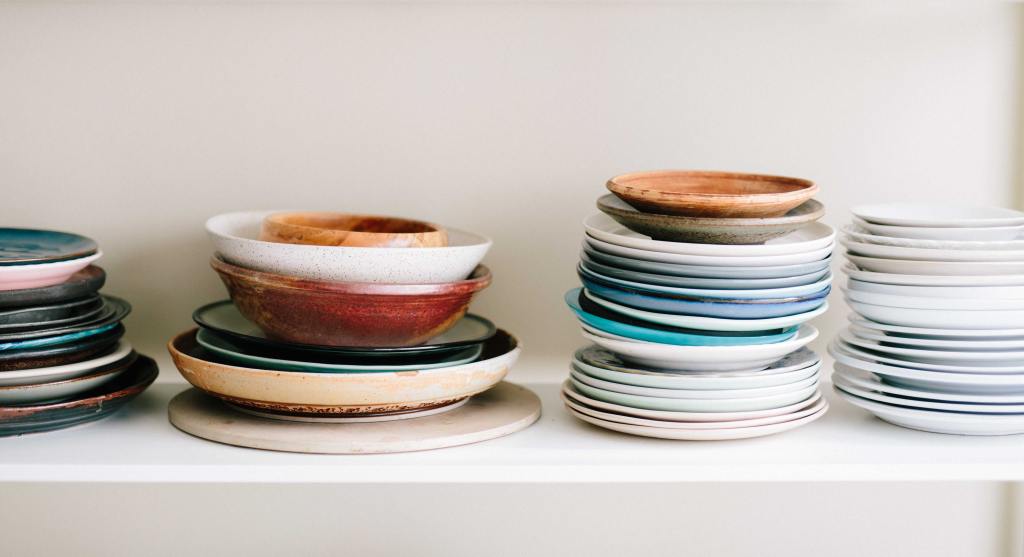
At the turn of the century, Marcus and I chose dishes for our wedding registry. Fact Check: I chose dishes for our wedding registry! I had spent roughly 9 months working in the home department at Herberger’s in Moorhead a couple of years before when I was a junior at Moorhead State University. The same year I began learning Greek, I learned Pfaltzgraff patterns. Both were magical in their own way.

Pfaltzgraff patterns are mesmerizing – maybe even hypnotic! You focus on the pattern and begin to picture your life with these dishes. You imagine who will sit at a table with you and these dishes. You picture the beautiful food you will eat and imagine the rich stories you might share. In your hypnotic state, you dream of how much love be passed around the table among the perfect family you have just made up in your head.

The Rio pattern caught my attention back in 1998. It is pottery dinnerware, which seemed casual and also grown-up. Two shades of blue and cream color these heavier dishes. I didn’t realize they are heavier dishes.

The truth is Rio was not the best choice. The dinner dishes have not fit well in some of our dishwashers and a heavy plate is not ideal for little kids. They have been sturdy, however, which is ideal for little kids. Even so, Rio is being replaced.

With a gift St. John gave me for my 15-year anniversary, I bought new dishes. Again, I chose the dishes! Marcus will place delicious food on them. Our roles have become clearer in 21 years! But the hypnosis wore off long ago. The Rio dishes were not set before a perfect family. I can only guess that never once have we enjoyed a perfect meal without any spilling of milk or careless words. The family I dreamed up has never once shown up for dinner!

Instead, the table is where we gather as human beings who have often had a long day, a tough conversation or two, friendships that were strained, and problems that were hard.

As the Rio pattern is replaced, I now have a better, non-hypnotic picture of the family that will use the new dishes. It is not the same family I had imagined! The same is true for you. The people who show up in our lives are not the ones we imagined. We can pick (and replace) the dinnerware pattern but not the people. We can set the table but not the cast of characters.

Which means you, unlike your dishes, are simply not replaceable.

Photo by Brooke Lark on Unsplash

Your Child’s Plate

Your child’s plate can be a conversation starter. With a plate of food in front of a hungry toddler, he might actually sit long enough for you to begin a conversation with the bigger people in your family.

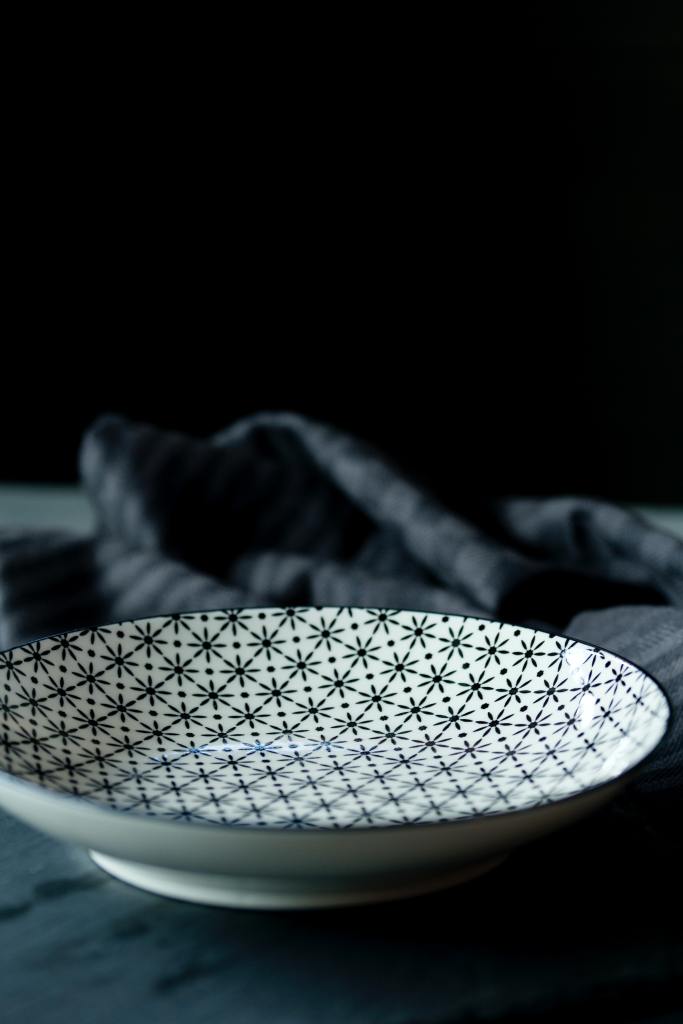
Or a plate might begin a conversation to decide what should be on it, usually more vegetables. The purpose of the food on the plate is to help a kid grow stronger.

The older kids get, daily weeknight meals become impossible, yet you can still find a kid with a plate in front of her. Pounce on that moment like Tigger, all ears, ready to hear anything the beloved teenager is willingly to say! Listening over a plate of food helps a kid grow stronger.

When kids become too busy, we might say, “Your plate is full.” This is a different conversation starter that has nothing to do with food and everything to do with getting stronger.

As the person who often dished up their food over the years, you are mostly responsible for what is on your child’s plate. You scoop up responsibility in the measure appropriate to that particular individual. Like estimating calories, there is no universal way of knowing how many spoonfuls of responsibility a kid needs to get stronger. This is the worst news for every parent. What worked for that kid will certainly not work for this kid. You will reinvent a million wheels in your vocation of parenting, and only you will notice.

Instead of negotiating vegetables, like in the early years, you will find yourself negotiating responsibility. Can you handle both your schoolwork and joining that team? How many nights of this sport is just right? Are you keeping up with chores at home or do you need to take something off your plate?

You watch to discourage them from overcrowding their plates, although in the end, you are no more than a coach on the sidelines. You are the director of the play who can only sit back and watch it unfold on opening night. You are the school cook who dishes up but does not monitor the eating.

Once in a while, you help your child carry her plate. It has become overcrowded, heavy, too full. And you assure her there are times when we all need help carrying our plate because it has become too full. This is life with Jesus. We dish up what matters in hopes of growing stronger, but some matters are heavier than others. And then the strongest act becomes the act of saying, “Hey you, parent on the other side of this plate, a little help over here.” Which is all practice for the daily act of prayer: “Hey you, Jesus, a little help over here.”

Photo by Lidye on Unsplash

The Best Parenting Analogy

The best parenting analogy I know came from a 7-8th grade school counselor several years ago. She described walking through a tall corn field as a kid and trying to find her way to her mom. When she couldn’t find her mom because the stalks were so tall, it was scary. As she grew older and taller, it became easier to find her way. She could see more of the field until finally she could see as far as the grown-ups.

Parents and guardians need to recognize the limited view of a kid. We cannot expect kids to see as far as the adults. Their limited view can sometimes be scary. Because they cannot see as broadly as the adults, we need to meet them where they are at any particular time in their lives.

I was remembering this analogy this morning when I wondered, in befuddlement, whether the prefrontal cortex of my teenagers will ever, ever, form into one developed brain. Their sleep patterns, morning routine, study habits, priorities and diets are an utter mystery to me. I had an entire conversation that luckily stayed in my head. “Why don’t you…?” “My Lord, it would be so much easier if you…” “Honestly, what the what…?” Time for more coffee.

I remembered then that they can only see so much of the corn field. For now, I will meet them where they are, which is just where they should be. I will keep the conversation in my head and love them with their glacial formation prefrontal cortexes because they are exactly who God needs them to be at this particular time in their lives.

Parenting is one long practice in self-restraint. My work isn’t to change my kids as much as it is to be aware of conversations that mostly need to remain in my head. It is getting more crowded up there, for sure, but I’ll keep making room.

An American Advent: The Story That Leaves Us Hanging

You are a gingersnap away from An American Advent turning into Christmas. We have now sledded through Habakkuk, Esther and Isaiah.

  • First, we reflected on a word in which I encourage deeper reflection before you sit among differing opinions at the Christmas dinner table: justice. Justice happens when people work toward the same equitable goal. Justice is a touchy topic in America today, often confused with political positions.
  • We spent time with Esther, who bravely believed she need not wait for someone more important to make things better. On the news, America’s messes are the fault of politicians, which lets the rest of us off the hook. We complain as we wait for the important people to make it better. But Esther would not wait.
  • Last week we named how hard it is to begin a new tradition when we prefer old, familiar patterns. For example, how are the patterns of your family of origin troublesome when you gather for the holidays? When God’s people were caught in an old pattern of rebellion, Isaiah proclaimed the coming of a new pattern – one of love that would begin in a manger.

Finally, the Narrative Lectionary reading for the last Sunday in Advent is reserved for Joseph. We know so little of Joseph, it seems a strange way to conclude Advent. Only a dozen or so verses are dedicated to him in all the Gospels. The Bible calls Joseph “righteous.” We gather that he both knew the rules of his religion and followed them, as was expected. If we imagine Joseph’s religion to be a path, Joseph knew the way because he knew the rules.

What happened in Joseph’s dream in Matthew 1:18-25 might seem a likely prelude to Jesus’ birth in Bethlehem. An angel appeared to Joseph to explain Mary’s pregnancy. (Either Joseph caught on quick, or the angel’s words here are abbreviated. Explaining a virgin conception in a single verse?!) In his dream, Joseph needed to understand why his fiancé was suddenly pregnant, however, this dream is not only about Mary expecting! This dream is the beginning of Jesus upsetting the righteous.

Throughout his life, Jesus upset righteous people like Joseph. He stepped onto people’s religious paths and begged them to see God as more than a religion for the righteous. God loved God’s people dearly, more than God loved rules. God loved the people more than God could put into words. So, God squeezed God’s tender love into one Word: his own Son, who would later be executed by the righteous for not following all the rules.

But this is an Advent devotion! Let’s not speed ahead to Good Friday.

This is An American Advent devotion. You are reading this in a time when many Americans have mixed up our politics with our religions, neither of which proclaim the birth of God’s embodied love. Both your political party and your own religion at times will disappoint because both are human inventions. The Word made flesh is our only hope.

  • The leaders of your political parties are not your saviors and they will not set you free. Only the Word made flesh sets you free.
  • People who follow the political party that opposes yours are the very people you need to work together for justice. If you draw a line in the sand between you and those with whom you disagree, the Word will annoyingly erase it.
  • Sitting back and blaming the leaders tricks you into believing you have nothing to offer to make this nation better. The Word proclaims hope through ordinary people like you.
  • Old patterns, even deep divisions between people on the left and right, can change. For you, it might begin at the Christmas dinner table. The Word is present when we pass the peace along with the mashed potatoes and gravy.
  • Religion is more than rules. At its best, religion pushes the faithful to recognize God’s love for all people and all nations. This Word has no margins.

Your wait through Advent is but a few more days. Despite our political disagreements and the old relationship wounds acquired during the pandemic, a few songs will unite us in the week ahead. Together we will sing of the angels, the shepherds, and the little Lord Jesus, no crying he makes. Our own cries of blame and bitterness will quiet into a silent night while candles real and battery-operated outshine our divisions, if only for a moment.

Christmas is the story that leaves us hanging. The Word made flesh does not fix our America. The Word made flesh instead insists on hope: hope that justice calls us to work together; hope that ordinary people can heal extraordinary division; hope that peace can indeed be passed with the mashed potatoes and gravy.

Blessings on your Christmas, that the Word made flesh might make an appearance at your Christmas dinner table dressed like you. Amen.

Photo Credit: Nicole Michalou on Pexels.com