Teaching “How Come” Not “I Know”

Let’s be honest. The country in which we live is quite…what? Unsettled? Angry? Confused? Thank goodness we all seem to have enough toilet paper! That’s one worry that no longer grips us.

What is going on? A pandemic not everyone believes is a pandemic. A vicious murder not everyone believes was a vicious murder. A president who teargassed peaceful protesters in order to hold up a Bible in front of a church for the camera.

What?

How do I explain to my kids what is going on when I’m not even sure? I am overwhelmed by the hatred, violence and anger, along with the certainty that only by leaning one way or the other, all the way, can someone be right.

And so I offer one response: curiosity.

Perhaps I don’t need to teach my kids in this moment as much as I need them to teach me. No one is better at curiosity than children. In the earliest years, a child’s world can only be understood through “how come” questions. “How come it is bedtime?” “How come birds fly and I don’t?” “How come vegetables don’t taste like cookies?” It is only when we have a few more candles on our birthday cake that we extinguish “how come” and replace it with the dark and lonely words: “I know”.

Nothing stops progress faster than an unequivocal “I know”. When “I know” a thing, curiosity withers away and there is no reason to wonder why poverty settles in every crack of particular neighborhoods. Or why girls who are brown-skinned more often grow up without a father. Or why moms of white boys don’t have to worry when our sons go for a run. “How come?” because “I don’t know.”

How come it is easier to teach our kids “I know” this or that instead of joining them in the land of curiosity. I want to live there forever. Then, maybe my kids will, too.
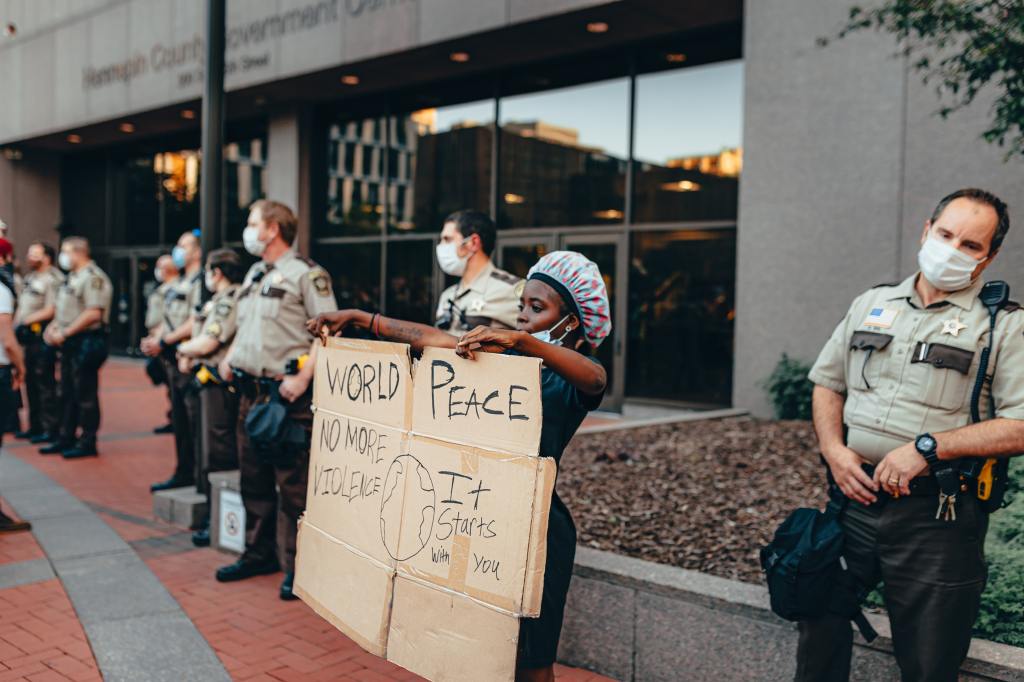
How Do I Explain #GeorgeFloyd to an 8-Year Old?

Photo Credit: @Joshhild

“What are you watching?” asked my daughter, as I stood in our kitchen staring at my phone.

In a moment, I had to decide how to explain racism and riots to an 8-year old. Or, I could turn off my phone and let the moment go. Isn’t that so much easier? To believe whatever is happening on a screen is far away and someone else has to live with it?

I was watching Pastor Ingrid C. A. Rasumussen on Facebook walk through the neighborhood of Holy Trinity Lutheran Church in South Minneapolis. Touring littered streets, she explained the true identity of the damaged buildings that exposed generations of anger. Like vapor, smoke rose up here and there, like injustice that rises up here and there and here and there.

“I am watching a pastor show us a neighborhood where there was a riot.”

“Did they wreck things?” she demanded to know. “Someone is going to owe a lot of money! Why did they do that?”

“His name,” I slowly began, “was George Floyd. And he was murdered by a police officer, and many people are angry about it.”

With my husband, we tried to explain there are police whose job is to keep people safe, and there are people who are black and there is an ugly history we can’t seem to shake off.

In the end, dear daughter, this world is not yet as it should be. People who happen to be black are not as safe as people who happen to be white. Last week was one of many moments the vapor of injustice rose up in a city we know well and love very much.

There is no perfect dialogue to explain George Floyd’s murder to an 8-year old. It would be perfectly easy to believe his story need not be tied up with our story. But I want my kids to know some hurts in the world are not easy to explain, and those hurts are our hurts, too.