Thank You For Endings & Beginnings

(Photo by Cathryn Lavery on Unsplash)

It is with a touch of embarrassment that I admit to you the podcast episode I chose the other day. Among the bazillions of entertaining, educational, and inspiring episodes, I chose to listen to…the episode all about paper planners.

Because I am a nerd.

Allow me to demonstrate.

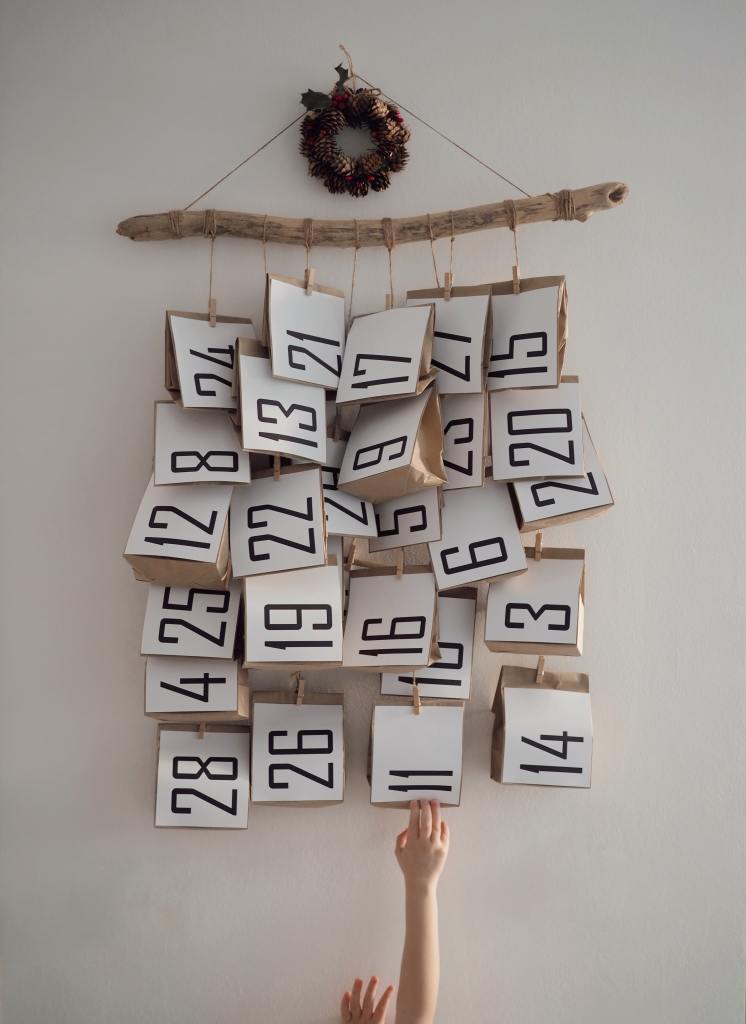
Every turn of the planner page to a new week or new month is delicious, like discovering a new blend of coffee or new trail to walk. Oh, the possibilities! New flavors, new sights and sounds to explore, blank pages on which to transcribe my day-to-day life as I expect it might unfold. Notice, a blank page can only be found when the previous page is finished. For a new thing to begin, another must end.

The end of December will be accompanied by another ending for myself and our congregation. We will say goodbye to my excellent pastoral partner and his excellent family. Together, St. John will bless them on the way to his next congregational call and to the place where God is calling their family to begin. The turn of the paper planner to 2022 will mark a significant ending and beginning for me as a pastor and for the church I serve.

I’ll admit with less embarrassment than my earlier admission that it wasn’t long ago I dreaded the idea of this particular ending. Pastors are human and we come and go and no goodbye comes as a complete surprise. Even so, transition and change you well know, can be tiring. Prior to my current pastoral partner, three pastors came and went in five years while I remained on staff. As trying as the changes were, those beginnings and endings, endings and beginnings, led to my current partner and a partnership that has been joyful and fun.

Goodbye might be no one’s favorite word, yet at the same time, it might be a word that turns the page to something new. To be clear, new is not always better or easier or more fun. New might fit like the wrong size of tights!

When someone retires, it often takes time for it to feel right. The new is confusing, like finding your way in a new school, or when the grocery store does this terrible thing and shuffles food around and all you want is your favorite box of crackers. Or when someone you love dies and the new page of that planner is missing entirely because you don’t even know how another day could begin.

What occurred to me as I listened to the paper planner people is the silly comfort I find in having words on the page of my planner. It brings such comfort when my daily plans and wider dreams are words on the page of a lovely Rifle Paper Co. spiral bound, for example. As though writing down plans and dreams will assure that they happen, as though the loveliness of the paper will protect me from the endings.

Life, of course, is more than plans and dreams. It is endings and beginnings, pages and pages of the planned and mostly unplanned. It pains me to admit that the unplanned may be the most valuable of all. Probably not in the thick of it, but looking in the rearview mirror, you can see growth and maturity and deeper faith is written where you expected ordinary, stable plans.

Which is why the type of paper planner you buy isn’t as important as using a pencil. At least the pencil might remind you that plans are subject to change, and beginnings follow endings.

Thank You, Friends

(Photo by Yutacar on Unsplash)

There are a handful of decisions that change everything. Looking in the rearview mirror of your life, you can spot a choice you made that led to this, while chances are a different choice would have led to a significantly different that. Where you live, how you spend your time, whether to work outside your home, whom you married or didn’t, whether to have kids, whether you go to church. Just as Annie Dillard sagely said, “How we spend our days is, of course, how we spend our lives,” the choices we make accumulate into a life.

Once upon a time, we moved to this town and settled into a house. After many months, Marcus and I made a decision to invite a few couples for a wine and cheese party. I vaguely remember handwriting invitations asking people to bring a favorite bottle of wine and dropping the invitations in the mail. I also vaguely remember a long Google search to learn how to pair wine and cheeses, due to the fact I knew nothing about either.

Roughly 14 years later, these friendships are like roots that keep us planted. Whenever my husband and I imagine life in a different town, we cannot imagine life without these friends. They have helped us move to a new house, they have cared for our kids, brought us homemade food in busy and stressful seasons, held us in prayer, vacationed with us, and have frankly made us better humans. It is a profound privilege to be welcomed into someone’s life, and a generous gift to discover mutual encouragement and grace.

We seem to be getting older, this group of friends. One by one, our kids graduate and move away and through each change, we are steadied by our friendship roots. Last night, we celebrated Friendsgiving. I saved time and stamps by texting them an invitation. I asked them to bring both food and a story. Using Priya Parker’s 15 Toasts, I nervously asked if they would come with an origin story from their own life, and suggested bonus points if it was a story their spouse hadn’t heard.

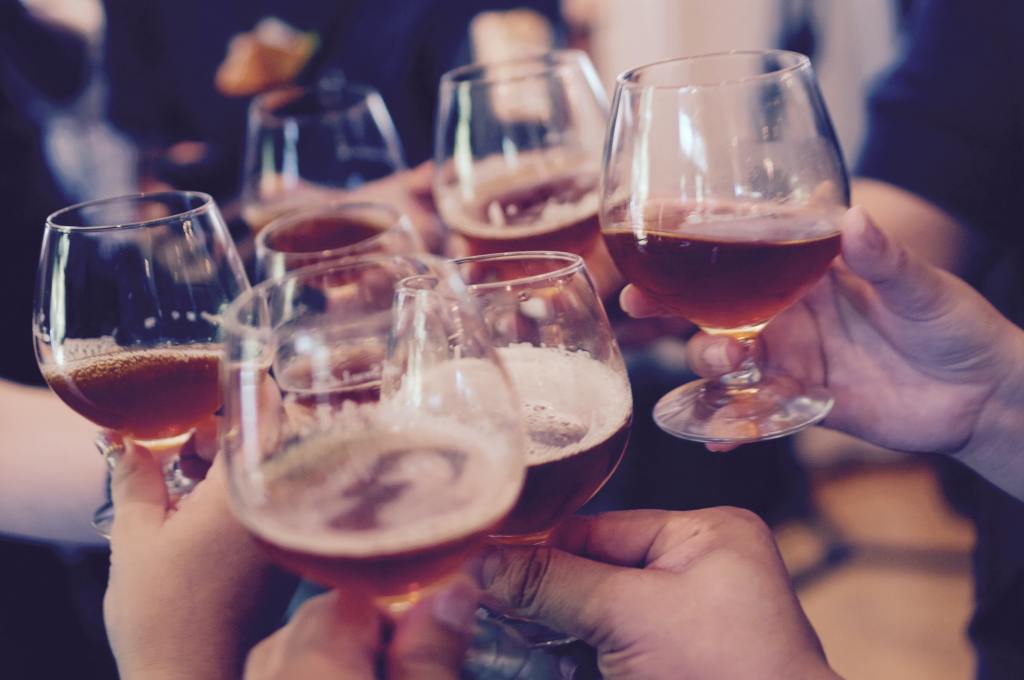
We drew back the curtain on our lives and raised our glasses to our moms, to healing, to choices that led to something good. And we raised our glasses to decisions that led to a moment of friends gathered around a table. I use the word decision, and yet I am not certain that word fits.

Another look in the rearview mirror suggests God has a way of surrounding you with the people you need at just the right time. Although we did make a decision to invite people to our home so long ago, a decision that fills me with gratitude, God had already brought these particular people to this town, just like us.

Trusted friends are worth more than anything money could ever buy, even though it is a risk to open the door and let them see your life for real. What you may discover in doing so is that life requires good company. And toasts.

Thank You, Saints

Fran shared a treasured recipe for Oatmeal Carmelita Bars. Morris taught me how not to drive a motorized wheelchair down a hallway. Jan upholstered a rocking chair before my first child was born. Dorothy gently suggested I needed a different sweater to go with my clergy shirt. Glen invited me to decorate wooden Christmas ornaments with him at a nursing home. Marilyn gave me voice lessons. And Jackie taught me never to guess a woman’s age based on her hair color.

After my seminary coursework was completed and I moved through internship and my first call, the lessons I learned were taught by the saints. Saints, as we remember them yearly in the church the first week of November, are not perfect people but human people. Saints are the broken and lovely sinners whom Christ redeems. And saints can be excellent teachers. If you close your eyes sometime and recall the saints who have shaped your life for the better, the reel might surprise you. One by one, you will recall moments when God provided comfort, levity, wisdom, or strength through someone who showed up in your life. The Spirit stirred up a conversation or set you in a particular place at a particular time, and there you were: the recipient of a holy moment.

Thank you, saints, for the holy moments.

I could not have been prepared for the level of trust people granted me in my mid- to late-20’s as I practiced being their pastor, but I can only assume such relationships are built when trust is mutual. I needed them as much as they may have needed me. I needed them to teach me the church is broken and lovely saints, and perhaps I could be one of them, too. I was made better by their food and wisdom, their forgiveness and invitations. In return, I offered the assurance that all we need has already been given to us in the unbreakable promise of Christ’s mercy.

It is helpful for me to reminisce back to these early saints and holy moments. In the 17 short years I’ve been a pastor, the church has dramatically changed. Even if these early saints are still around (a couple of them may be) they, too, would be part of a Christian church disrupted by a pandemic, in which mutual trust between leaders and parishioners has been tested. We (churches) have not made it this far into a pandemic unscathed, I think. We are still a wobbly bunch, forming our opinions and trying to discern what lines are being drawn.

We are still broken and lovely sinners, we who are church. We draw lines Christ has already erased. We confuse political opinions with religious ones. We share memes instead of recipes for Oatmeal Carmelita Bars. We too easily ignore how deeply we might influence one another’s lives for the better. Alas, one cannot be a saint without also being a sinner. And so, we wobble together, steadied only by that unbreakable and eternal promise of Christ’s mercy.

Why Do I Do That?

(Photo by Klim Musalimov on Unsplash)

Every Saturday begins with me believing I can get so much done and ends with me wondering why I didn’t get all those things done. It’s called planning fallacy. In 1979, I was a busy one-year old when Daniel Kahneman and Amos Tversky put a name to underestimating how long it takes to complete something. Although I’m aware that I underestimate how long things will take me (including this blogpost), I keep doing it every single Saturday.

So why do I do that!?!

For one thing, Wayfair.com, where an amazing deal might be a click away! I also love clearing out my email inbox, among other ridiculous and unnecessary tasks. But most of all, there is something about the liberty of moving from one thing to the next at a leisurely pace. You don’t need to know my husband well to know he manages to overcome the planning fallacy. He is efficient and determined and lets nothing get in his way, such as Wayfair.com.

I, on the other hand, slow down on Saturdays. Read a chapter of a book, take an extra walk with the dog, notice the leaves peeling off the trees, enjoy an episode of Schitt’s Creek while cleaning the kitchen, dream of a different color on the wall, bother my kids with questions.

And at the end of the day when few of my plans actually happened, wonder where the time went.

Do I Really Know My Kids?

Occasionally I wonder which conversations with me my kids will remember. Will they remember our conversation related to their grades or their friends? Will they remember telling me the story of what happened one day at school? Will our talk after they failed at something stick with them?

Parenting is basically hugs and a series of conversations, both of which become trickier as kids get bigger. At the same time hugs and conversations grow trickier, kids’ worlds rapidly widen. Their friends become more worldly and so do they. There are dangerous rabbit holes on their screens and in all of the places their freedom leads them into. In teenage-dom, there may be a direct proportion between how much kids need to talk and how little they actually do.

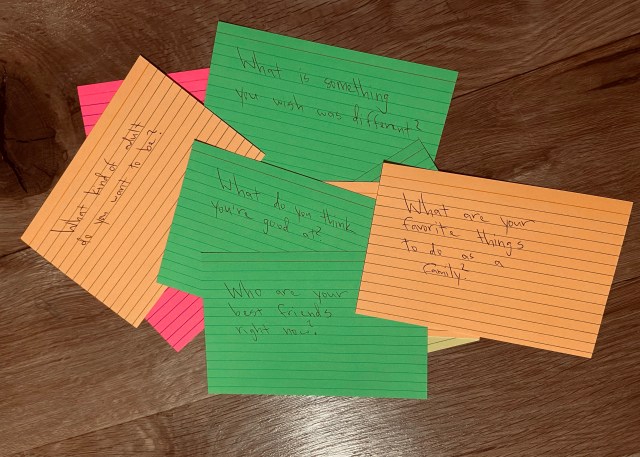
This is why I loved the latest podcast by Laura Tremaine called “10 Questions To Ask Your Kids”! Her kids are slightly younger than mine, but her 10 questions still fit. I wrote each down on an index card to park at our kitchen table. Will my kids be excited to discover these questions I will try to ask them? I am sure at least 1/3 of them will! Really, all that we ever do as parents is try things. We try to be present, try to be patient, try to serve vegetables, try to understand. And so, I can try to ask questions that I hope might help me better know these humans whom I see and usually eat with on a daily basis.

While her 10 questions are a tool to hear from kids, they are also a way for kids to get to know their parents (or grandparents). If you were to tell them who your best friends are these days, what might you say? As Tremaine points out, will your kids (or grandkids) know the answer? Maybe, maybe not. Maybe you stay connected with someone whom they do not know or haven’t met. You have a story to tell to explain the people with whom you are choosing to share your time.

You have plenty of stories to tell, and so do the younger people in your life. What an amazing moment for them to know you really want to hear their stories! I hope Tremaine’s questions inspire you, too.

Renaming Mondays

(Photo by Elena Mozhvilo on Unsplash)

If you could rename today because you believe “Monday” is a worn out word, what might it be? What would you call this day if you could call it anything you choose? Let’s pretend that next week on this day, you could invent a completely new name, and every week after. (I realize this would be confusing for Amazon deliveries, and would eventually get annoying. But for now, shed your practicality. We’re pretending!)

I might call today “Bake and Breathe Day”, which puts the word “Monday” to shame. Today might be your back-to-work/school day, but for me it is a day off. I would choose this clever name due to the way feeding teenage boys seems easier if I do some baking on my day off. And, I try to spend some of this day taking a deep breath and writing (like right now).

Even though you cannot rewrite the calendar, you can rename this day for yourself. You can look around your life and note what it is that you need today. If today is tough, could it be “Please More Coffee or Water Day”? “A Walk Might Help Day”? “Be Extra Gentle on Myself Day”?

Maybe you love Mondays because you return to the action of the week. “Bring It On Day” might work. Or just, “Ready Enough Day”.

Last Friday, what I needed most was a long walk by myself. That day could have been called “Long Lonely Walk Day”, except that sounds way too somber! Also it might already be the name of a Western. I can’t be sure.

This might be a chemo or radiation or dialysis day for you. “Healing Day” fits. It might be a day you have to face something you happily avoided all weekend. “Reckoning Day” is nicely dramatic. My Tuesdays often become “No More Freaking Cookies Day” after I’ve done all that baking (and sampling) the day before.

A day has a tendency to get away from you. But this is the only one like it you’ll ever get. You have a particular need today, you beautiful human, that you get to name. What might you rename this day? I hope you will think of one, and I’ll give you a few others. Today and every day (even Mondays) are your “God Is With Me” days. Or, “Covered In Mercy Day”. Or, “I Don’t Care To Name A Day, But I Do Care That God Names Me Beloved.” Hmmm, kind of long. Good luck.

The Snack Dilemma

(Photo by Lucian Alexe on Unsplash)

In the ever-expanding folder of mom-guilt is the quality of snacks my kids consume. Early in their lives this was easy. Their plates were exclusively healthy choices: fruit, vegetables, tiny bites of cheese, a handful of Cheerios. When faced with squash on their plate today, my husband and I remind them they used to love squash, among a variety of other foods they deny ever enjoying! Avocado? Yes! Sweet potatoes? Affirmative.

My oldest son loved Kashi oatmeal for breakfast. If you’ve never tried it , the taste resembled what you might imagine a woodpecker’s breakfast also tastes like. But he LOVED it. It’s all he knew.

And then his eyes were opened to all the snacks he now prefers.

Which is why every trip to the grocery store presents the dilemma of the snacks. My kids told Alexa to add Cheez-Its to the list. Now what?! There is no avocado version that might at least trick them into consuming a healthy version of Cheez-Its. But it’s the cereal aisle that deepens the dilemma. As Captain Crunch and Barney Rubble stare you down, you alone have to muster the strength to take an honest look at the grams of sugar now conveniently displayed on the front of the box. You can follow your nose or go cuckoo and come home to kids who call you Tony the Tiger’s famous line. Or, you can find 13 grams or less to be a fine cereal guide.

In the end, however, what matters more than what I buy is what my kids choose to eat. Like most of the reality of raising kids, I have very limited control. Regardless of my choices, their choices are really their own and not mine to make. Will I always be the one buying their groceries? Nope. The snack dilemma isn’t mine to solve, but rather it is mine to equip them to solve on their own.

Which should make the mom-guilt file stop expanding, right? Why doesn’t it work that way? Only the famous cereal aisle leprechaun knows. I do believe that regardless of the snacks I buy, the cookie jar should never be empty. This is wisdom from my mom. Healthy snacks are one thing; cookies keep us from worrying way too much about it.

So…What Does a Pastor Do?

My desk

A pastor writes words and words and words. Words for preaching, words for worship, words for prayers, words for thank you notes and words articulating something for the church newsletter. When we aren’t writing, we are listening to others and walking with them through terrible times and also joyful times. It is likely we are consuming coffee at the same time . When we aren’t writing or listening, or leading a worship service or a class or a meeting, or reading someone else’s words, we are probably planning worship.

Roughly 50% of my time is dedicated to worship planning. Lucky for me, this requires creative writing. I am a grateful girl to incorporate what I love to do with what I need to do for my work. Not all pastors love writing, so not all pastors worship plan the same. I deeply enjoy reading the texts for the month ahead to see where the Narrative Lectionary is taking us, which is what you see in the messy desk photo above. There is a tall glass of water, a bulletin in progress, and Exodus burning with possibilities (you’ll appreciate my pun if you hear next week’s story). Last spring, my colleague and I looked through the 2021-2022 (Year 4) texts to identify themes. So, I already know October texts pose the questions “What is God up to?” and “Where do I go looking for God?” Having named these questions made it easier to prayerfully write a relevant call to worship and various prayers.

Do you get to incorporate things you love to do into the paid work you do? This was a sabbatical learning for me. Why don’t I lean farther into what I love to do and find ways to do more of it in my daily work? Can’t this be an asset for an organization, whether it is a church or a business or even a family? Once you discover what you think you are good at, is it possible to focus more of your time doing that very thing?

If you are retired, how might that thing you love to do benefit someone else? If you aren’t sure what you are good at, ask someone who knows you well. In the blink of an eye that is life, how might you infuse a bit more joy into the day-to-day?

When One Feeling Isn’t Enough

(Photo by Tengyart on Unsplash)

Last week, I spent a few days with my colleagues in Western North Dakota at an annual theological retreat. We both retreated by resting and catching up, and engaged in theological learning and discussion. It’s no secret that Western North Dakota is not the most desirable location in the country to do ministry! Lutherans leaders often prefer to land in a metro area, and so what leaders in other areas might miss is a tight-knit collegial community. It is tight-knit because we know we need each other to survive! There is no sense of competition among churches, but instead a culture of support.

And so when the conversation at our retreat centered around processing the past year and looking ahead at the work yet to do, there was a flood of feelings. There was grief and hope, disappointment and gratitude, mercy and frustration, all at once.

Did you know you can feel at least two feelings at once? You do it all the time. You feel love for your spouse and also utter shock that the two of you are still married. You feel gratitude for your child and ongoing irritation that said child continues to leave a trail of messiness throughout the house. You feel content in your life at the same time you feel curious that there might be something more.

There are so many feelings in the world right now! It might be helpful to remember your neighbor may be as confused about her feelings as you are about yours. I live in one of the Covid-sickest parts of the country, so while I’m grateful people have started reconnecting at the church I serve, I feel deep concern for people’s health. Should we be gathering? I think, yes. Should we be cautious? Also yes. Is it good for our souls to gather in the same space? Absolutely yes. Even now? I think, yes.

Argh. It’s no small task to be human these days, with so many feelings bubbling inside of us. I encourage you today to take note of your feelings. Here is a link with a list of feelings if you need some help. Then, you might ask a friend or people in your family to do the same. My very favorite tool to engage you in conversation around feelings with your own self or with others feelings are GROK cards.

There is a lot going on in your life if you start to dig around a bit. As I learned in a room full of pastors, deacons and a flood of feelings, naming the truth of what we are experiencing is an invitation for Christ’s healing love.

Garden Variety Apocalypse

There is an impressive garden I pass by on my walks with Pippen. The couple who tend this garden have made a serious commitment to the earth. In the spring, they faithfully till and plant and then I get to witness the magical way seeds transform into food. Green, red, purple, and orange stain the growing garden until suddenly sections disappear. It is a vegetable apocalypse with raptured tomatoes! A cucumber diaspora and a scattering of green beans.

The apocalypse occurs in tandem with the first weeks of school. As vegetables disappear from gardens, kids disappear from home (or for homeschool or online students, kids disappear from their summer lives). I felt the change today, my designated day off, when I came home from the school drop off to a quiet house. Pippen greeted me with his eyes on the door in hopes that another human or two would follow me. Surely, he acknowledges the difference, too. A grown-up at home and no kids means his extensive naps will go uninterrupted.

The diaspora of vegetables and school-aged kids are clear evidence that our days are not meant to look the same for any long period of time. The rhythms of a school year and gardening might teach us to hold life lightly and expect it to change. Life is not built for white, clasping knuckles, but for loose grips.

If God is in the details, God is certainly in the plucking of cucumbers from their vines, and in the student’s march from the car or bus to the classroom. Garden apocalypses will continue as sure as your own life will change. There is a steadiness that comes when big and small changes invite you into a long conversation with God.

“God, this is different…”

“God, why can’t tomatoes taste this amazing all year long?”

“God, can you be more generous with the carrots and go easy on the zucchini? Just an idea.”

“God, this part is really nice and this part is hard…”

“God, what might change next?”

“I know, God, you will be there then, too.”