Parenting is Both Loving and Not Caring

Kid: “Mom, blah blah blah.”

Mom: “I don’t care. But I do love you!”

Doesn’t that feel good? Not caring can feel so dang good! I don’t care about a lot of things. I don’t care if if I catch the news every day or if I’m a few minutes late for some things. Okay, for several things! And it’s not just me. My husband doesn’t care about the laundry on the floor or if the bed never ever ever gets made again.

I don’t care if my kids earn perfect grades or become impressive athletes. I don’t care if they stop going to church or never leisurely read another book. I will never stop loving these three young humans, but I will never care about absolutely everything they do or do not do.

Like two sides of the same coin, love and not caring go together. You could also say love and letting go, if that sits better. Or, parenting is as much hands off as it is hands on. No matter the words, this work is not for the faint of heart! It may be easy to love our own kid (most of the time), but it is a great challenge to know when not to care.

Straight up, here is the importance of not caring: you will not rest if you 100% care for every single detail of your kid’s life every moment of every day. You cannot be you, a full self, a healthy human, if all you do is care about your kid. Sometimes, it is best not to care.

Let me be clear. There are parents who literally do not care an iota, which is often related to mental health or trauma or addiction. I’m not advocating for that. Do not stop caring for your kid’s basic needs. That is not cool. This is what I mean: I am learning to care less and at times not at all when the timing is right.

Let’s start at the beginning. When a doctor hands a parent a brand new baby, or you receive a child through adoption, you do not promise to protect this child from every possible problem. You do not promise to raise that child to perfection, or become the most remarkable caregiver. Before and after becoming a parent, you are as human as ever. The writer of Ecclesiastes, perhaps the world’s first life coach, assured us there is a time for every season under heaven. I agree. There is a time to care and a time to not care.

I am slowly learning this complex parenting wisdom, which grows more complex as my kids add years to their ages. I feel it in their schoolwork, which I hope they do well and work hard and I will support them as best I can. However, as much as I love for them to do their best, it is perfectly fine that I do not care so much for the end result. I can point out their grades, but not take their work personally. I can remind them and be clear with my concerns, and after that I need to know where my own parental responsibility starts and stops. Their future is completely out of my hands, unlike when they were little.

When they were little, I chose my kids’ day cares and babysitters and often even their friends. Now, none of that is true. They will choose their post-high school path, just as they will choose their own friends. They will choose their hobbies and whether they care that they wear dirty-looking work jeans to school every dang day, making it appear that our family shops for clothes out of the trash bin outside the thrift store. Again, out of my hands.

I love them so much, and I refuse to care for all the details that shape their lives. If parenting is raising small humans to grow into independent and helpful adult humans, then at some point, I have to hand over the burden of caring so much.

Perhaps this is God’s way of loving us, too. In Isaiah 43, God loves us and we belong to God. This chapter is the only moment in the entirely of the Bible when God explicitly states: “I love you.” But like the stoic parent who does not say the words out loud every single day, you know it’s true. The absence of the words do not make the parent’s love for you any less, only quieter. From the first page of Genesis to the last page of Revelation, God’s love for you sings from each chapter.

I will fiercely love my kids as long as I live, and sometimes my love will be elevator music they can hardly hear as they learn to do life on their own. It will be there, my love for them, at times by way of quiet background noise, yet still they will know it is there. Lingering and steady; that I both love and do not care because fierce love risks stifling both our lives. The poet Rainer Rilke puts it this way: “We need, in love, to practice only this: letting each other go, for holding on comes easily; we do not need to learn it.”


Change (John 4:46-54)

(Photo by Martin Lostak on Unsplash)

(John 4:46-54 NRSV) 46Then [Jesus] came again to Cana in Galilee where he had changed the water into wine. Now there was a royal official whose son lay ill in Capernaum. 47When he heard that Jesus had come from Judea to Galilee, he went and begged him to come down and heal his son, for he was at the point of death. 48Then Jesus said to him, “Unless you see signs and wonders you will not believe.” 49The official said to him, “Sir, come down before my little boy dies.” 50Jesus said to him, “Go; your son will live.” The man believed the word that Jesus spoke to him and started on his way. 51As he was going down, his slaves met him and told him that his child was alive. 52So he asked them the hour when he began to recover, and they said to him, “Yesterday at one in the afternoon the fever left him.” 53The father realized that this was the hour when Jesus had said to him, “Your son will live.” So he himself believed, along with his whole household. 54Now this was the second sign that Jesus did after coming from Judea to Galilee.

http://www.bibleoremus.org

Lately, I’ve taken to writing in the company of a lava lamp, a quirky re-gift that I scored a few years back in a white elephant gift exchange. The liquid is blue and the “lava” is a bright green, calling to mind the gurgling water in The Simpsons nearby radioactive lake with singular-eyed fish.

I love this lamp. In college, a similar lamp gently illuminated my dorm room, its mysterious liquid gracefully changing form again and again. One moment, four tiny balls of lava were bouncing around, the next, it had stretched into a piece of taffy, and then it became one enormous, satisfied glob.

Almost like a crystal ball, the lamp has given me assurance that change is an essential process to lead to the next thing. Change occurs only so that the another thing may mysteriously occur, so the lava can transform into something new.

This is true as Marcus and I talk through high school registration options for next year with our boys, reviewing forms labeled “sophomore” and “junior”. These new class labels preview changes that will occur so that our boys’ lives may continue to change, one year at a time. The changes are not as graceful as the mysterious liquid in my beloved lamp, (childhood is hard on everyone, if you recall) and yet they are mysterious changes that will transform our boys into something new.

Change is also Jesus’ thing. A few weeks ago, Jesus changed water into wine. Then, Jesus changed Nicodemus’ mind. Last week, he changed a woman from unacceptable to accepted. These changes are just as cool as the transforming lava substance in my lamp, and equally mysterious!

The story above is told when Jesus changed a sick and dying child into a healed and living child, which was sure nice of him. John’s gospel presents a mere three healing stories, far fewer than the other three gospels. In the other gospels, it is common to hear of Jesus changing sickness into health. John’s book is more frugal with these types of changes, and I find this to be refreshing. Sickness does not always change into health. Sickness can change into remission, can change into hospice, as is true this week for my dear friend, Terry. Change is a mysterious process, a sifting around of the lava so that a new transformation may occur.

For those raising kids, change is the air you breathe. Kids grow. They like you one day and dislike the next! They do the right thing and do the wrong thing and up and down and back and forth the changes go. I’m pinpointing the good news in this story not to the healing, but to the changing. Changing, as the lava lamp proclaims, is a steady promise. All things change and not always in the way we desire. But still they change.

For the father of the man in John’s gospel, his sorrow was changed into relief. For you and for me, all of our sorrows are finally changed into relief. Into hope. Into rejoicing. Jesus changes death into life, which is the change that holds us steady when the miracle we waited for does not come. When life unfolds unfairly and without much common sense.

What changes are you presented with in this season of your life? Are you walking your kids through big changes in their lives? Could you hold those changes alongside Jesus’ promise that change can look like four tiny balls changing into a piece of taffy changing into an enormous, satisfied glob because, in the end, change is Jesus’ mysterious, steady, and transforming good news.

When the Bucket Dropped (John 4:1-42)

(John 4:7, 10-15, 28, NRSV) 7A Samaritan woman came to draw water, and Jesus said to her, “Give me a drink.” 10Jesus answered her, “If you knew the gift of God, and who it is that is saying to you, ‘Give me a drink,’ you would have asked him, and he would have given you living water.” 11The woman said to him, “Sir, you have no bucket, and the well is deep. Where do you get that living water? 12Are you greater than our ancestor Jacob, who gave us the well, and with his sons and his flocks drank from it?” 13Jesus said to her, “Everyone who drinks of this water will be thirsty again, 14but those who drink of the water that I will give them will never be thirsty. The water that I will give will become in them a spring of water gushing up to eternal life.” 15The woman said to him, “Sir, give me this water, so that I may never be thirsty or have to keep coming here to draw water.” [v. 16-27] 28Then the woman left her water jar and went back to the city…

http://www.bible.oremus.org

These verses are tucked into the Samaritan woman at the well story that occupies most of chapter four. If it is not familiar, I encourage you to read John 4:1-42. The story begins when the woman went to the well to fill her bucket with water and it ends when the woman leaves the well with no water and no bucket. She does not, however, leave the scene emptyhanded. Between the beginning and the end, the woman has a conversation with Jesus.

What does a conversation with Jesus amount to? Enough to fill an empty bucket?

I recently remembered the month of January tends to be busy for me. Somehow, I’d forgotten! It is annual meeting season, nomination time, Lent planning, and this year, associate pastor call process. There have been many conversations with myself in my head. “Did I remember to…?” “When will I…?” “How would I like my coffee today?”

What conversations take place in your head when the days get busy? How do you sort through the questions? How do you listen for answers? The woman at the well, taking part in an actual conversation and not one confined to her busy mind, was deeply listening to Jesus. Jesus had something to offer, something she did not know she was looking for, something that required her to listen and let go.

Our minds are empty buckets we fill with so much conversation. “What will they think of me?” “What if I fail?” “Will they like me?” “Do they think I’m smart?” “Will I fit in?” These conversations unfold mostly in our heads. When we listen for the answers to these empty questions, we stop listening to Jesus. We hold tight to our genuine need to belong and be seen in the world, meanwhile Jesus’ part of the conversation goes unheard.

What does a conversation with Jesus amount to? Enough to convince you to unfurl your fingers and let go. Enough to loosen your grip on the empty questions and notice you are already tightly held in the grip of Christ’s love. When Jesus is finally heard in the conversations in your own head, there is at least a single moment when everything else falls away, your empty questions like her empty bucket. Do you belong? Are you seen? Yes and yes, answers Jesus.

I find the woman in this story to be an extraordinary teacher. She managed to listen to the words that mattered and to set aside the ones that did not. The odds were against her, if you pull back the curtain on the cultural norms of her day. She had every reason to hear only her side of the conversation, informed by a lifetime of bad experiences. Her circumstances had convinced her she belonged nowhere and was seen by nobody.

Was it that she listened so intently or that Jesus’ words were so piercing? Or both? What would it take for you to listen today for Jesus’ contribution to the busy conversation in your head? Perhaps I will give it a try.

I would love your thoughts on this story to shape the Prayers of the People this weekend. What empty questions and conversations fill your mind? Do you find it hard to hear Jesus’ part of the conversation? What do you hear when you do let him get a word in edgewise? You can post a comment on Facebook or email me at lewtonwriter@gmail.com to share your thoughts!

Jesus Did What in the Temple?! Yep. (John 2:13-25)

(Photo by Jelle de Gier on Unsplash)

(John 2:13-25 NRSV) The Passover of the Jews was near, and Jesus went up to Jerusalem. 14 In the temple he found people selling cattle, sheep, and doves, and the money changers seated at their tables. 15 Making a whip of cords, he drove all of them out of the temple, both the sheep and the cattle. He also poured out the coins of the money changers and overturned their tables. 16 He told those who were selling the doves, “Take these things out of here! Stop making my Father’s house a marketplace!” 17 His disciples remembered that it was written, “Zeal for your house will consume me.” 18 The Jews then said to him, “What sign can you show us for doing this?” 19 Jesus answered them, “Destroy this temple, and in three days I will raise it up.” 20 The Jews then said, “This temple has been under construction for forty-six years, and will you raise it up in three days?” 21 But he was speaking of the temple of his body. 22 After he was raised from the dead, his disciples remembered that he had said this; and they believed the scripture and the word that Jesus had spoken.

23 When he was in Jerusalem during the Passover festival, many believed in his name because they saw the signs that he was doing. 24 But Jesus on his part would not entrust himself to them, because he knew all people 25 and needed no one to testify about anyone; for he himself knew what was in everyone.

http://www.biblegateway.com

While evolving into a new parent, I was not prepared for the exhaustion of my own kids’ emotional outbursts. Sure, I have feelings, too! They just don’t burst out and transform my entire being like a mogwai splashed with water. Or like a volcano spewing hot lava.

Emotional outbursts are part of being a kid. It’s what they do. I understand. Kids burst with emotion when and where they feel it is safe for them to do so. An uncontainable flood of feelings regularly courses through their little bodies and it takes a lifetime to know where to put the sandbags.

I was not at all prepared for the emotional bursts! I am an introvert who grew up in a quiet house. There was no yelling or drama, only Norwegians. When my first child began to demonstrate emotional out bursting, I was confounded. To this day, with my youngest a nine-year old, these emotional outbursts become like a tiny hole pierced in a balloon, slowly draining energy.

Did God the Father feel something like this, watching Jesus burst with emotion in the temple? Was it draining for God the Father to witness the only Son of God release fury, disappointment, and who can say exactly which particular feelings?

There must be nothing wrong with an occasional emotional outburst, even for an adult, if Jesus became a hot mess and made such a ruckus in the temple! When we feel certain feelings, anger is the go-to for most humans, even Jesus. If we feel afraid, ashamed, embarrassed, angry, disappointed, intimidated, or lost, it is anger that wins out. When someone is angry with you, or you are the one who feels angry, slow down and pay attention to the actual feelings hiding behind the anger. Are you feeling left out? Betrayed? Jealous? Or maybe you are really tired and simply need a nap. That’s so human, too! Jesus took his share of naps.

This weekend, I am grateful a St. John member will be doing the preaching. (I’ve previewed the sermon and it is lovely!) Like last week, I welcome your ponderings and wisdom around this text. Leave a comment on my blog or Facebook, or email me at lewtonwriter@gmail.com. Your words this week will shape the Prayers of the People.

Tell me, can you relate to Jesus in this story? Or can you imagine being one of the people who witnessed his outburst? What is it like for you to be the one who has to deal with other people’s emotional outbursts? Where do you see emotional outbursts going on in the world today?

We Live Here in 2022

(Photo by Kelly Sikkema on Unsplash)

“Build houses and live in them; plant gardens and eat what they produce…But seek the welfare of the city where I have sent you into exile, and pray to the Lord on its behalf, for in its welfare you will find your welfare.” (Jeremiah 29:5&7)

     The two verses above need context. The surprising words are spoken by the prophet Jeremiah to God’s people who were displaced by the Babylonian army. Far from their homes in Jerusalem, they were now refugees in a foreign land: Babylon. The words are surprising because God’s people did not want to live in Babylon, they wanted to go home to their old, familiar routines.

   I have found myself returning to these verses ever since they showed up in the Narrative Lectionary in November. (If you happen to be a person who reads annual reports, and you know who you are, you will find these verses in mine!) We all wish to return to a pre-March 2020 world where we went in and out of gatherings without worry, and the medivac didn’t constantly traverse from Dickinson to a larger hospital day after day after day. I miss the days when vaccines weren’t so hard to discuss and masks were more about Halloween. I miss the faces of the folks in the congregation I serve parked in the same church pews week after week. I miss the old, familiar routines.

   And so did God’s people stuck in the unfamiliar land of Babylon! It comes as a surprise to me that Jeremiah did not tell God’s people to wait it out. He didn’t say to stay the course and cling to the future promise that they would return to their old, familiar routines. Nope. Jeremiah told them to settle in. Build houses in the unfamiliar land and move in. Plant a garden and wait for it to produce as you make this unfamiliar place your home.

   I can long for the old, familiar routine, or I can embrace these unfamiliar times because I live here now. I can spend time wishing for life to go back to pre-March 2020, or I can settle into this time I might not love and certainly do not understand. I do not understand the division and stubborn stances on both sides. I do not understand why a call to the common good cannot overcome the fences we have all built between one another, even within our own families. While it is true that fences create order in neighborhoods like mine with lots of dogs, fences can be dangerous for communities. Too many fences give us permission to disregard the welfare of the city. We can focus on our own fenced in area, make it beautiful, insulate ourselves in a comfy chair, and become indifferent to the needs of the people we cannot see over our fences.

    Jeremiah instructs God’s people to care for the welfare of the unfamiliar city in which they are now residents! This is strange. God is so caught up in neighborliness that God’s people are to care for their neighbors in a land in which they did not choose to live. They were not allowed to fence themselves in.

   Could this be a guiding verse for 2022? We did not choose to live in this time. We might not like how our society has responded to the pandemic. It is likely we all long for the old, familiar routines. But we live here, and we live here now. The needs of our neighbor matter as much today as they did when  Jeremiah preached these words in chapter 29. How might you peer over a fence and care for the welfare of your city? How might this be the year you settle into this time if only because your neighbor’s wellbeing matters more than your political opinions?

    Jeremiah, as far as we know, was not voted “most popular” in high school. He received no recognition for his community-building work. In fact, he likely had very few friends. But he knew the whole point of a city had to do with watching out for the welfare of the people, even in the time and place they did not choose. At our best, this is what churches do. We set aside our differences, “peace be with you”, and settle in for the sake of our neighbor. Here. Now.

Micah Weighs in on New Year’s Resolutions

It is the eve of New Year’s Eve and oh my the resolutions. So many possibilities to be better! Will I resolve to eat better, sleep better, clean better, shop better, organize better, read better, work better, exercise better, or be on time better?

Instagram shouts at me to get those resolutions down on paper and hold myself accountable with a pretty planner because how else will I become better?!? I need a new year, the world tells me. Last year is so last year and now a new year is presenting itself with the sparkly promise of newness.

I love a new year. A new planner. A new, better promise to myself.

And yet, I’m quite sure God cares not an ounce. God does not care whether I eat exactly all the right green things, or that my house is picked up, or how many push-ups I can do. (Oh Lord, how I despise push-ups!) God created my body and clearly cares what I do with it, but God did not invent New Year’s resolutions. God is not a fan of the many ways a healthy personal challenge becomes a shame game. God does not desire clean homes or push-ups. We desire such things whenever we compare our own homes or bodies to someone else’s. Social media makes this temptation unbearable. It is impossible to avoid comparisons when we scroll through window displays of other people’s lives.

What does God desire from us? “The Lord has told you, O mortal, what is good; and what does the Lord require of you but to do justice, and to love kindness (or mercy), and to walk humbly with your God.” (Micah 6:8).

There are no push-ups involved in justice, mercy, or humility! Although, when I try to do a push-up it is quite a humbling experience, actually. But it does no good for my neighbor. That’s the crux of the prophet Micah’s words. God desires that we look around, not to compare, but to spot injustice. God desires that we see our lives and our world from God’s angle of mercy. God asks that you be kind to yourself and to your neighbor. Even Micah’s verse can be turned into a “be better” New Year’s resolution if we are not kind to ourselves. We can put ourselves down for not doing enough for our neighbor and our world. I suspect that isn’t God’s desire for us, either.

And so, fellow human being, simply begin this day and in a couple of days begin a new year. The “be better” part has been accomplished for you in the death of the one who removed the impossible demand to “be better”. You need not “be better” if it means you can never “be better” enough. Forgiveness is stickier than a New Year’s resolution. And so much lovelier than push-ups.

Beginnings

Each of the four gospels begin differently. Mark hits the road of Jesus’ ministry running by beginning with his baptism. John begins in the very beginning with the Word that was there when the very first wind blew over the face of the earth. Luke begins with the Christmas story as we hear it each Christmas Eve in churches. And Matthew begins with a tree, a family tree that is.

At first glance, the first chapter of Matthew’s gospel is booooring. It resembles the terrible stretches you encounter if you’ve ever determined to read the Bible from cover to cover. Begat, begat, be-oring. Yet Matthew’s beginning, like all our beginnings, matters. In the long line of the faithful, the fearless, and the forgotten, Matthew draws a line from the beginning to Jesus. He establishes Joseph’s and then Jesus’ credibility as a member of the tribe of Judah. Like a bouncer perched at the door of the world’s most exclusive club, Matthew is letting Jesus in by uncovering the Messiah’s beginning.

Christmas is the story of Jesus’ beginning, which I find so interesting because your feelings around this holiday are profoundly shaped by your own beginnings. The way you celebrated Christmas (or didn’t) as a child shapes how you approach every single December 25th. Did you gather with few or far too many family members? Was it delightful or dreadful? Did you eat ham, turkey, or something nonconforming? How were gifts exchanged? Did you open them on the 24th or 25th or another day? Was church a part of your party? If so, was that delightful or dreadful?

These happen to be rich questions for pre-marriage counseling. They give each partner a glimpse of the other’s beginning. We can piece out expectations, hurts, and joys of each unique family, and conversation is carefully cracked open around the distinct dysfunction of each of our families.

Looking back to my own beginnings, I have fond memories of Christmases with cousins and cookies and my Grandma Florence’s outrageously oversized tree. I grew up in a small town where much of my family resided within three blocks of my house, including my grandparents. This meant we celebrated Jesus’ birth three times each year in under 24 hours: at each grandparent house and our own. There was a consistent and equitable routine to our Christmas celebrations. My husband’s memories are similar and yet different. It took a few years to recognize that the differences in our Christmas beginnings created differing gift-giving expectations. Gifts were a big deal in my family and not so much in his. Food was also a point of discussion. His family ate tiger meat (raw seasoned hamburger) and my family ate lefsa.

Once my husband and I understood the diverse rituals that marked our own beginning Christmases, we could establish some of our own. Remembering our beginnings clarified some of our feelings around this feelings-filled holiday. Christmas is filled with feelings. Like emptying a stocking (a big deal at my house and not so much at my husband’s), admire each feeling as it comes. What do you miss about your beginning Christmases? What are you thankful to shed?

The birth of a Savior, the beginning of Christmas, assures you the beginning matters less than the ending. Your ending is full of feelings of joy and joy alone for families of every level of dysfunction. Yes, even yours.

PRAYER PRACTICE

  • Light a candle. Tell God in writing or out loud a childhood memory that shapes your understanding of this season. Do you need to let it go? Create a new practice? Celebrate the memory? Share it with God, the Word who was in the beginning, who became flesh to write your ending.

Advent Week 3: Waiting and Waddling

(Photo by Phil Hearing on Unsplash)

A woman instinctively knows how to waddle. At a particular point in pregnancy after she can no longer see her toes, she finds herself sliding one heel forward and then the other while jutting out her hips. How does the waddler come to know such moves? It simply happens.

Suddenly, Mary the mother of Jesus began to waddle. We know so little of Mary from her brief appearances in the Gospels, but we can be sure she spent nine whole months waiting and some of those months waddling. She was human and therefore she carried her child in the most human of ways. For nine months, she experienced all the mysterious moments pregnant bodies experience: waddling, indigestion, and tiny elbows to the ribs, while waiting for her child to be born.

What is unique to Mary is how she only sort of knew what she was waiting for. She had no idea what a Messiah would look like or sound like. She had never been pregnant before, and no woman had ever been pregnant with the Son of God before. Would he have skin and bones or some divine substitute? Dark hair or blond and curly angelic locks? Would he cry? Would he nurse? Would his diapers be any less disgusting? Shortly before Mary pondered and treasured the words of the shepherds, she had practiced pondering and treasuring while she waited for the birth of the mystery inside her body.

Although Luke’s Gospel moves quickly from Gabriel’s announcement to Jesus’ birth, Mary endured nine whole months of waiting in between. Throughout the nine months, she knew almost nothing of what was to come. And there was no Google to help her out.

If you are like me, I am astonished at how often I turn to a search engine. Google is a quick fix for the discomfort of not knowing something. In my week at a hermitage, it took a couple of days to let go of my knee-jerk reaction to hastily Google any question that popped in my head. When will the sun go down tonight? What is that mean bird with the red feathers and are they all bullies or just this one? I wonder all the books this particular author has written and does she have an Instagram account? What supplies do I need to take up kayaking? How much sugar is in a naval orange? Why do I care how much sugar is in a naval orange? Why do I think I need to kayak when I mostly like to gaze at water from a distance?

In that one week, I Googled nothing. The multitude of questions I couldn’t answer myself went unanswered and I was just fine. I could wait until I was home to learn what I needed to Google, although I forgot most of my questions anyway.

Could it be that there are times when waiting helps us let go of the irrelevant questions? When we must wait: for a diagnosis, a family member to come home, a job interview, a pandemic to go away, do we become more focused on the questions that truly matter?

It seems significant that Mary pondered while she waited. She did not demand to know what was coming next. Pondering requires waiting and trusting that the answers will come when they will and no sooner. You do not ponder on Google, you ponder when Google is not an option. You ponder when you must endure the wait as you live in the genre of mystery.

We are constantly waiting for one thing or another. We wait to know or understand something, or we wait for the birth of something new. For nine months, God waited for the world to catch a glimpse of God’s intense love for the people who perpetually turned their backs on that love. God had pondered what love might look like dressed up as a baby. And then Mary waited and then she waddled. And finally, when the wait was over she held God’s love and then began a new wait, pondering the simple question of what would happen next.

PRAYER PRACTICE

Light a candle and picture the places and times you often wait. The next time you are waiting in a checkout line, or waiting to pick up a child from school, or waiting for your partner to be ready to go, or waiting for your appointment to begin, before you pick up your phone, repeat your phrase and say a prayer. What might you ponder for that one moment while you wait?

Advent Week 2 – Expectations

(Photo by Kelly Sikkema on Unsplash)

(This week’s devotion is a letter written to the not-my-favorite-person who first added candy to Advent calendars.)

Dear Sir or Ma’am:

Why? Why did you take a perfectly lovely German Lutheran tradition and transform it into a mild nightmare for moms? Whoever you are, I suspect you are not a parent. You might be one of those beloved and sneaky aunts who spoils the kids and runs away before bedtime.

Excuse my annoyance. This is not entirely your fault. It’s just that each year I hope to invite my kids into the mystery of this season, only to find myself yelling over the yelling when one of my three kids might get one more piece of candy than another. Really, you should have seen this coming! What did you expect? You have messed with the expectations. Now my kids expect the wait for Jesus’ arrival to be a road paved with chocolate. You changed the Advent Calendar to a sweet milk chocolate countdown and I have to tell you I’m 95% cacao bitter about it.

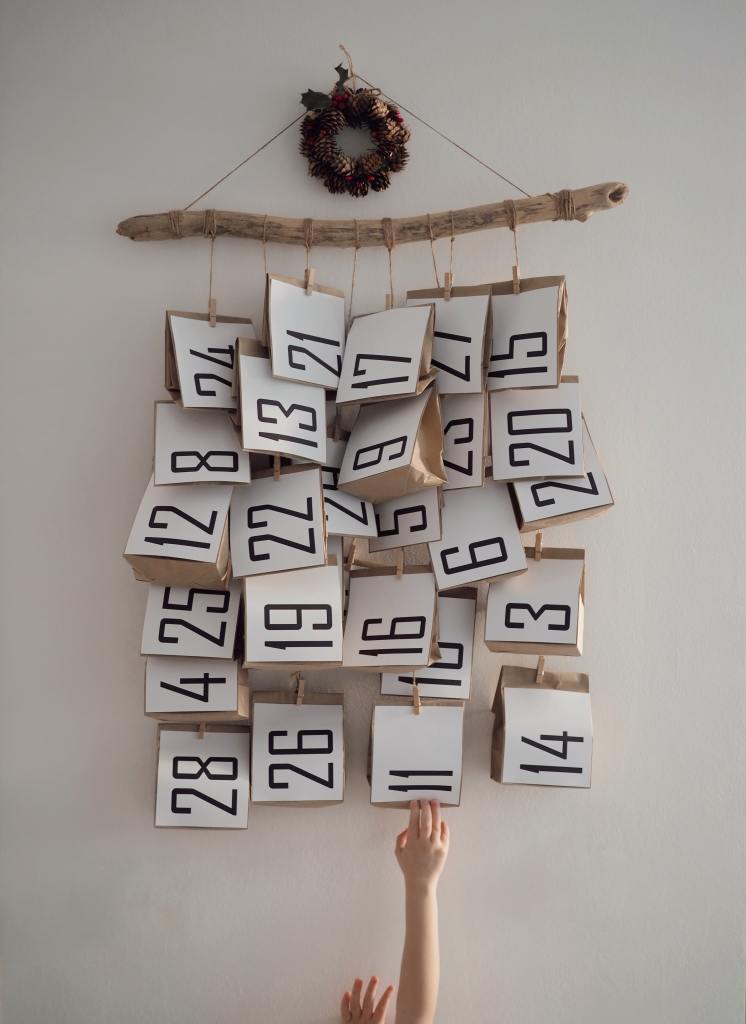
I’ve tried workarounds. Last year, I constructed a homemade Advent Calendar with a variety of surprises in individual paper bags. Each day, the kids opened a bag to discover a Bible verse they had to look up, with a small piece of candy (not always chocolate!) or instructions to do something kind for a sibling or a pair of socks or something silly. It was Pinterest-worthy and too much work to do a second time. It will live in my memory as that time I accomplished something Pinterest-worthy.

This year, I hunted for an Advent Calendar on Etsy…until I wondered what it meant that I might spent $50+ to help my kids get ready for the arrival of the Prince of Peace, when actually the calendar becomes a battleground?

Excuse me if I might be channeling too much Cindy Lou Who here, but oh my goodness it is a challenge to slow down the countdown to Christmas Eve! The sweet surprises in the Advent Calendar risk putting us in the fast lane when Advent is a slow lane kind of season. The slowness is necessary to absorb or breathe in the mystery of divine love packaged in a slippery infant body and delivered in an unseen corner of the world by an exceptionally young woman. The addition of chocolate, you see, sweetens the rugged and ragged mystery.

I expect chocolate makes everything better, including the Christmas story. But is it possible the daily dose of chocolate might forget this story is sweet enough without the candy? How sweet it is that God, so far away in the heavens, could not stand to be so far away from you. How sweet it is when God finally threw God’s arms up in the air when humanity kept messing it all up, and finally did what we could not: save ourselves. How sweet that we can expect radical hope every single day, beyond the rugged and ragged scene laid out before us in our everyday lives.

Sheepishly, I will admit to you, chocolate pusher, that in the end I stuffed some candy into 24 little bags and shoved them into a big Christmas cookie tin because it did not feel right to be missing an Advent Calendar! See what you’ve done? You have planted in my brain the expectation that candy must accompany all 24 days of Advent. <sigh>

I will choose to believe your intentions were good. You called attention to Advent using something ordinary and yummy. I will choose to believe you did not expect your idea would become so profitable. It can be tricky to know what to expect when something new is unleashed into the world. In the first century, no one expected a crying newborn to be God’s love unleashed into the world, but God does not adjust to any of our Advent expectations. God’s love for all the rugged and ragged among us does not fit in any of those tiny boxes or bags where sweet treats can be found for 24 days. Its sweetness outdoes all the chocolate in the world.

Signing off, slightly less bitter in North Dakota,

Lisa

PRAYER PRACTICE

  • Light a candle and make a list of expectations God might have for you this Advent season. God does not expect you to supply your children with daily surprises, or for you to locate the perfect present, or to make everyone else’s holiday a smooth ride. What God expects from you might invite you to be more gentle on yourself and stay in the slow lane.

Advent Week 1 – Promises

My daughter finds it funny to remind me of the time her principal called our home during the day to tell me she had fallen from the monkey bars and, we would later learn, fractured a bone in her arm. For whatever reason, Caller ID described the school’s number as “Private Caller,” ostensibly “Annoying Solicitation.” My choice to let the phone ring will be an everlasting tale for her to hold over my head. Forever and ever. “Whatever you do,” she instructs her brothers, “don’t call mom if you break your arm!”

In some way, I had broken an unspoken promise that whenever my six-year-old called or needed me, I would immediately answer the phone. Of course, it did turn out fine after the school called my husband who called me. She did not wait long for her mom to rush to her side! But it did seem the world shifted ever so slightly. She gained some awareness that our lives are not one life but two separate lives.

Parents make many promises to a child, perhaps each of them unspoken. There are basic promises to feed, clothe and show love. And there are social promises to equip a child to make friends and swim in the larger world of peers. There is a promise to be present for the conversation that needs to happen, to listen to a worry, to talk through a dilemma, to help navigate the tough spots, to keep the cookie jar from an empty state.

It could be that parents construct an entire foundation under kids with our promises. No parents keeps them all perfectly, so as we build the foundation with promises, we also build it with empathy and forgiveness. Promise-keeping happens to be the language of Holy Baptism. God promises to hold onto the baptized from this life into the next, and to love us even when we let God down. In turn, hearing God’s unconditional promise of love for us, we make promises, too. Our promises are designed for the well-being of our neighbor.

At weddings and baptisms, I take delight in disclosing to the people making promises (couples and parents/guardians) they are making promises that are impossible to keep. I assure them they will not keep every promise made in the rites of marriage or baptism. They giggle nervously, but I hope my disclosure relieves some pressure.

If we were meant to keep promises perfectly, God would have improved the prototype for humanity. But we are broken people who break the promises we make to one another, even though we know we should not. We act selfishly and out of resentment. We struggle with addiction or get tangled up in an abusive relationship. We get too busy and out of the routine to take our kids to church. Being human requires forgiveness and new starts, or to quote Ann Lamott, earth is forgiveness school. Which is why God’s promise of unconditional love will hang over your head like my daughter’s everlasting tale of the time I chose not answer the phone! This umbrella promise covers you and any mistake you make, including the small mistakes like neglecting to answer the phone, along with the bigger and heavier ones.

In this first week of Advent, we inch closer to a promise God had made long before Jesus was born. Throughout the Hebrew Scriptures, the promise of Jesus’ coming is whispered on each page. The patriarchs of the first book of the Bible tried to follow God and failed, just like the Israelites who entered the story later on, and the promise remained. Through creation and judges and prophets, through insignificant and unnamed people and rich and famous ones, the promise of a Savior is carried from page to page until finally, the promise is a child. On the page we discover an impoverished couple on an obligatory journey into Bethlehem because a king had promised to harm them if they didn’t.

God’s unending promise to love you can be, at times, difficult to hear. The whisper is too low, like a handful of lovely people in their seasoned years who have admitted to me after worship: “I can hear the man’s voice but not yours.” The Bible is like that, too. We can hear God’s promise loud and clear on some pages but not others. We hear it in Isaiah, but turn the pages back and the pitch is too low in the book of Judges (not bedtime reading, that book.) And yet the promise is on that dreadful page, too!

God’s promise cannot be erased or compromised, and I wonder if the is so gracious as to become hard to believe. Can you believe you cannot undo God’s promise of mercy? It is a wild and unwieldy promise, and it is yours to keep.

PRAYER PRACTICE

  • Light a candle and write a list of promises you are trying to keep. One by one, name them and remind yourself, beloved child of God, how God’s promise to love you is an unconditional promise of mercy. Let God’s forgiveness bring you to forgive yourself, too. With a marker, write “I Love You, I Promise. Love, God” over all of your words.