The Story of Things

Not long ago, I brought Holy Communion to a man in his assisting living apartment. Prior to settling there, he had moved several times, packing and unpacking boxes in a number of places throughout the years. His last few moves required fewer boxes.

Atop his kitchen cabinets sat a handful of interesting items. They were random and quite old. There had to be a reason he kept these particular things, packing and unpacking them again and again.

“Tell me about these things,” I asked.

He explained what he had kept and why: the first gift he gave to his mother at ten-years old, purchased downtown with his own money; a dish she often used in their kitchen when he was growing up…

I was riveted. That he had managed to hold onto these few special things for so many decades, each with its own story, was touching. Perhaps because I am not a keeper. What stories have I haphazardly left behind in my diligence to minimize?

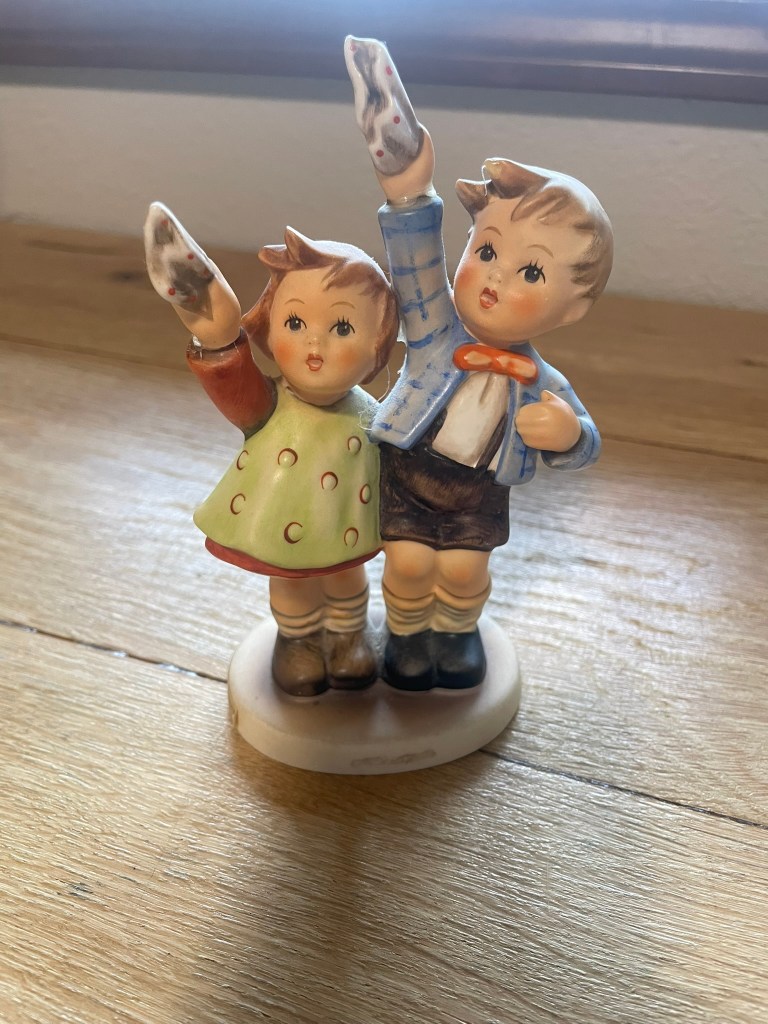
The two kids waving handkerchiefs and forever frozen as Hummels also tell a story. When my mom and I visited my aunt and uncle before they moved from their home to an assisted living apartment, my aunt handed me this story. She had babysat both my older brother and me when we were little. When I went off to kindergarten, she explained, my mom gave her this Hummel as a thank you gift. “Now you get to have it,” my aunt told me.

I promise to keep it.

Later on in that house, my cousins would discover this photo as they did the hard work of deciding what to keep…

and what not to keep! A time to keep and a time to throw away…

Your most special things tell a story that piece together your own story: gifts given and received, mementos, each a landmark in your life, each a reminder of a precious relationship or milestone. Each one evidence of God’s faithfulness to guide you through life.

Back in that man’s assisted living apartment, I shared with him the sacrament and the ancient story of God’s love for him in Jesus Christ. In bread and wine, he tasted the promise that God will keep him forever.


Why Confirmation?

‘Tis the season of fall sign-ups! Parents and guardians of teens and younger are at it again, working out the complex matrix of drop-offs and pick-ups that often stretch from dawn to well past dusk.

In a perfect world, the designated person operating the matrix is entitled to a personal assistant. Coordination of kid schedules can be that complicated! (I can’t remember my password! Did I really miss the deadline? Weeping and gnashing of teeth!)

There is an abundance of pressure to sign kids up for a plethora of activities to “keep them busy” or “help them find their thing” or whatever was suggested in the latest book we read or advice we took.

Some parents and guardians will sign a teenager up for faith formation. In mainline Protestant churches we name this animal Confirmation.

Why add Confirmation to the matrix, usually an extra night of every week throughout the school year? Why Confirmation?!? Here are 3 potential parent/guardian responses to this question:

  1. I had to go to Confirmation, so my kid should have to go to Confirmation, even though I’m not exactly sure the point.
  2. I want the pastors to peel open my kid’s brain and drop some Jesus in there. It can’t hurt.
  3. There was an open spot in the matrix and teenagers need to be busy, busy busy!

Would someone please hit the annoying game show buzzer? These answers are LAME! Even so, I suspect these lame answers are the most common.

Consider this: Practice.

Anyone who has ever formally competed understands that before a performance, practice is required. Skipping out on practice is a recipe for disaster and injury.

Practice teaches our body the proper way to warm up and to move: how to act out that one scene, hit that note, or swing, throw, kick, shoot or hurdle. By the time we arrive at competition, our bodies and minds are likely to know what to do, at least much of the time.

The Christian faith is practice for life.

We practice faith through rituals such as prayer, worship, Bible study, and Confirmation, for example. Memorizing Bible verses (peeling open brains and dropping in a little Jesus) is a poor substitute for practice. Dropping a kid off at worship is a poor substitute for practice. (This annoys me every time.)

Faith is a practice meant to steady your life when it gets rough, as life tends to do. Rituals are a steadying tool.

I pray for Confirmation to be a ritual that steadies a teenager’s life especially when that beloved one feels left out, or like a failure, or hopeless, or angry, which also happen to be storms that frequent an adult’s life. Rituals steady all ages.

Life can be so stormy! Faith can clear away the clouds and make room for the Son to move in.

Faith is not one more thing to keep a teenager busy, it is a practice to keep a teenager steady. Potentially, even a household steady.

Confirmation is practice for the Christian faith. Faith takes practice. So much practice, as well as coaches, like parents and guardians, pastors and mentors, and an entire congregation of people praying cloud-clearing steadiness in the lives of these beloved ones.

Photo by Tom Barrett on Unsplash

Round Tables

Churches have tables – oh so many tables!

There are the cumbersome rectangular tables that arrived in churches when people were unaware of back injuries. You can find tiny tables in classrooms, where grown-ups also squeeze in around from time to time when the grown-up tables are busy. There is, of course, the Lord’s Table, that most important where we feast with the saints in light.

And then there are the round tables. Pay attention to the round tables.

In the church I serve, the round tables may be akin to your dining room table at home. They are the place where everything happens: eating, crafting, homeworking, and visiting. Unlike most dinner tables, because of the superb custodial staff at staff at St. John, there are no piles on these tables. They are fully functional!

The round tables at this church have hosted family conversations, hopefully providing an on-ramp for parents and guardians to begin meaningful conversations about the tricky matters of life: money, relationships, body image. At these tables, families have gathered to grieve.

People sit at the round tables to imagine God’s desired future: planning weddings, holding meetings, and gathering with church partners.

Famously, the Knights of the Round Table used that very shape to ensure peace in the kingdom. At a round table, you come face-to-face with the people impacted by the conversation and decisions that are made. The table must be round, lest we lose sight of each individual member of the body of Christ.

Wherever you go, may your tables be round this week, that is, may you sit beside those who are impacted by the decisions you make, and together may you find peace. May you come face-to-face with those who accompany you through this life. May you draw near to those whom God has strategically placed in your life, not overlooking them in the busyness of your days, but refreshing your memory on the uniqueness of their eye color.

Photo by Allison Saeng on Unsplash

Cloud Shapes

Therefore, since we are surrounded by so great a cloud of witnesses, let us also lay aside every weight and sin that clings so closely, and let us run with perseverance the race that is set before us, looking to Jesus the pioneer and perfector of our faith, who for the sake of the joy that was set before him endured the cross, disregarding its shame, and has taken his seat at the right hand of the throne of God. Hebrews 12:1-2

Was this passage the inspiration for the touching scene in The Lion King? You know the one. Mufasa directed Simba’s attention up to the stars and in the Broadway musical sang, “They Live in You.”

Probably not, but I am going to pretend it was!

The stars in the sky, like clouds molded into a work of art, call our attention to those who have gone before us, to the great cloud of witnesses who shaped our lives on earth.

Who do you remember when you gaze at the clouds or the stars? Who lives in you? Who ran the race with perseverance and waits beside Christ for you?

Today I am remembering my internship supervisor, Tom Zarth, who died on Ash Wednesday re-membered with Christ and the great cloud of witnesses, ashes to ashes, dust to dust.

A requirement of ordained pastoral ministry in the ELCA is a year of internship, which I am grateful to have spent at Oak Grove Lutheran Church in Richfield, Minn. In those days, internship typically took place the third of four years of seminary. The fourth year, then, allowed students one more year or learning and processing after practicing ministry on internship.

My timeline had to be adjusted, however. When interviews took place for internships, I asked to stay in the Twin Cities because Marcus had a landscape business and was going to college. Like many others, I interviewed with a handful of pastors and deacons (mostly pastors). The seminary then assigned students to internship sites based on the preferences of both the students and pastors.

I had no offers. Nada. Although I sorted through all the feelings of rejecting, thankfully no congregation chose me as their #1 student. Thankfully because, had I interned my third year like all my classmates, I would have missed out on Oak Grove.

In these days of remembrance and grieving, people will recall Tom Zarth’s solid preaching, his gentle pastoral presence, his musical gifts and radical hospitality. He served at Oak Grove for decades.

The people in your cloud of witnesses are there because of the unique ways they shaped your life. Tom was a formative witness for pastoral ministry for me because he was genuinely human. You can think of pastors who lead with personality, who can mistakenly convert worship into a show. Tom led with authenticity. He preached, sang, and loved the neighbor with the gentle justice Marty Haugen sings of.

Distinctly, I remember when he played his guitar and sang “My Soul Cries Out,” the new rendition from the emerging ELW, at a conference gathering among his colleagues. I had no idea at the time how incredibly brave that was. The Twin Cities include a competitive culture for ELCA pastors and singing along is vulnerable. That song was a mark of his ministry.

I remember one Council meeting when he was almost late. He explained how their three-year-old was excited to hang out with him and not her mom for once, and he didn’t want to miss out. He may have been the first pastor to tell me the perk of the work is its flexibility. Ministry is incredibly intense at times, and at other times it allows you to go to your kids’ events at school.

Who might you remember with thanksgiving this week as you gaze at the clouds or the stars? Who has shaped your life?

Thank you, Lord, for Tom Zarth and for all the cloud of witnesses who have run with perseverance and now rest in you. Amen.

Photo by Jelleke Vanooteghem on Unsplash

The Way

As a seminary student, I remember discussing with classmates how long a pastor should serve a congregation. The lore was that a pastor’s call should conclude around seven years, seven being a number that reflects completion in the Bible.

Growing up, one of my pastors practiced the seven-year model. My Methodist colleagues are often transferred at the seven-year mark. If God created everything and even rested within seven days, seven years as a pastor in the same congregation should do it. Marcus and I entered this life of pastor/teacher expecting to move if not every seven years than at least every so often.

And yet, here I am in the same congregation for 17 years, long past not only one seven-year mark but two. Perhaps this is on my mind because it was 18 years ago, around this time of year, when Marcus and I travelled from our home in the Twin Cities to Dickinson to interview. I interviewed at a congregation that astoundingly had called only two senior pastors within a stretch of 50 years. They had completely rebelled against the unwritten seven-year rule! Who were these people?!?

Any long-term pastor can tell you the gift of a long-term call is that relationships grow deeper, which can serve to further a congregation’s mission to follow Christ. You become more aware of someone’s quiet gifts and someone else’s profound wisdom. You learn who has a genuine desire to learn or to serve in Jesus’ name. You have the privilege of entering into multiple generations of a family’s life and proclaim God’s hope through Christ.

On the flipside, the goodbyes get harder as the relationships grow deeper. You must witness more people join the communion of saints, people you have grown to love as you serve alongside them. It becomes like watching the introduction to a television show. The intro moves you through the years to give you a flashback of all that has happened in the lives of the characters. This way, by the time the episode begins, the characters are more familiar.

Being a pastor for a long time is like that. God brings new staff members to a congregation, yet you are the one who has lived through much of the introduction.

  • You can see the group of people who once gathered for coffee before worship on Sunday mornings. Now, they are no longer living, or no longer able to come to the church building to worship. Their absence is felt each week.
  • You can see that group of people who served in leadership roles. Their wisdom continues to be beneficial, but you have to know who they are.
  • You can hear the sounds of worship that both changed and stayed the same from one generation to the next. You endured some of the trials and tribulations through the changes and the sameness; you felt the impact on the community of faith; you have lost enough sleep over the years to know what is at stake.

How long should a pastor serve a congregation? Like perhaps any question in the universe that relates to relationships, the answer is less important than the question.

The question is not how long, but how now?

This question is not reserved for pastors. How does a pastor, a deacon, a lay person, a young person, an old person, a new person, a seasoned person, serve a congregation now? What difference does it make that God gathered these people at this time for this community of faith, which ever community it might be?

The answer is less important the question, the question is less a question than a prayer.

Lord, you are the way, the truth, and the life. Guide our feet, you who are the way. Instill in us wisdom, you who are the truth. Renew us by your grace, you who are life. Amen.

Photo by Aron Visuals on Unsplash

Hey, Don’t You Live Up There?

One Wednesday night at St. John is an adventure story. Within three hours, there is an intensity to the volume of delightful, multi-generational conversation, mishaps, tears and giggles. I love how this gathering reflects life as it truly is: imperfect.

Luther described a theology of the cross as God meeting us not in the positive, perfect moments, but in the thick of life. Call a thing what it is, Luther instructed. And so, we call our lives what they are: hurried and haggard at times, each day our best effort and nothing more. Christ did not die for our sins because we have our lives together, but because we do not.

I love Wednesday nights because this is what we live out – a theology not based on rewards for how well we are living, but a theology that solidly trusts in God’s grace through Christ. This gift of grace is enough. You do not need to do more, try harder, or get better.

Where you live, with your weariness and wondering, is exactly where God meets you. In the adventure story of Wednesday nights, we live out our imperfect lives fully trusting in God’s perfect grace.

The number of stories manifested on a single Wednesday night could fill a book, that is, if you could be on all three floors and in every corner of the building at the same time. Since I cannot, I can only report this small chapter.

I sat behind a young, conversational kiddo at worship. I was doing my best to listen to Christina preach, but my worship neighbor has not yet perfected the art of whispering.

“Hey, what’s your name?” she wanted to know.

“Lisa,” I whispered quietly, dropping a hint.

She gave me a hard look and then threw a glance toward the front of the church where Christina was speaking.

“Hey, don’t you live up there?”

“What?” I whispered, trying to set an example and failing.

“Don’t you live? Up there? Why aren’t you up there?”

Oh, I realized! She thinks my home is the chancel. That I make my bed beside the altar and eat bread and wine for breakfast, lunch and dinner. That I had left my home up front to sit in the back of the church.

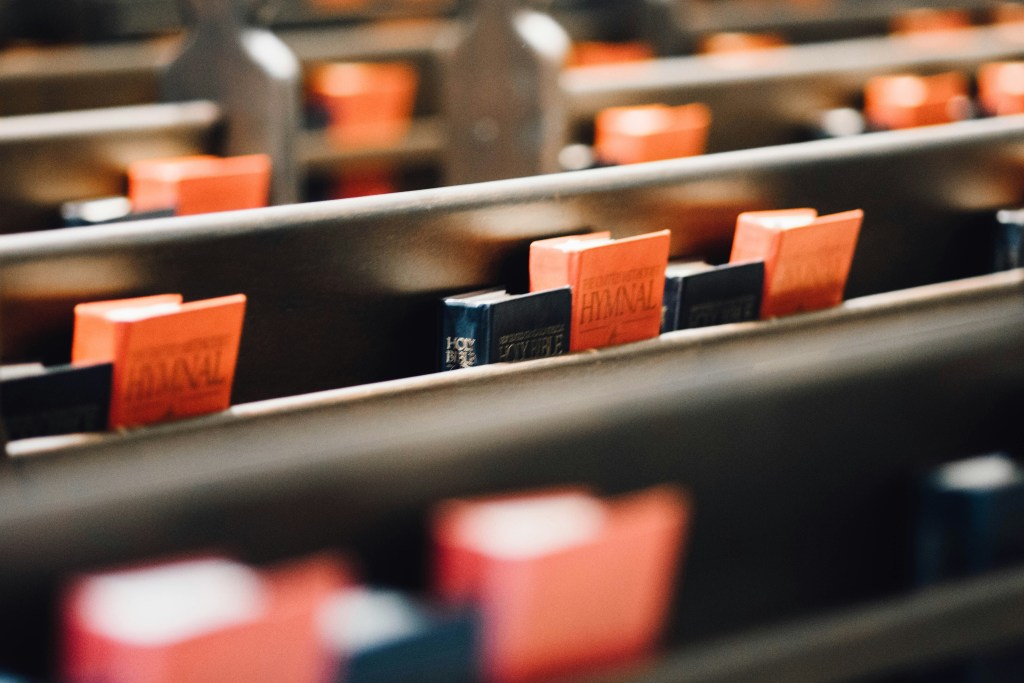
She accepted my whispered answer, that it wasn’t my turn to be “up there,” and the night went on. During Communion distribution, she had one more thing to say to me, as she paged through the heavy hymnal.

“I like this book,” she announced. “And this is my church.”

There she was in a community of people who astound me each week. Parents and grandparents who have decided that passing along the Christian faith is worth the work of getting a young family to church, which can be a great deal of work. Many of these parents wear their fatigue on their faces, their time at church a brief intermission from running between kids’ activities.

Because my worship neighbor’s family almost never misses worship, this little girl may not be proficient at whispering, but she is wise enough to know St. John is her church.

The adventure book would capture other moments: grandparents teaching grandkids how to hold their hands for Communion; single parents who visit with their kiddos over supper with no cell phone in sight; a cook who lets nothing get in the way of her dedication to the ministry of the Wednesday night meal; kids who woke up that morning and announced to their moms that they can’t wait to eat at church; ordinary people who extraordinarily teach, mentor, sing, wash tables, bring dessert…

We do none of this perfectly. Perfect is not the goal, not the requirement, indeed not even a helpful aspiration. Perfect is the love of God, who also does not live “up there,” but here, among us, now and always.

Photo by CHUTTERSNAP on Unsplash

If Only the Disciples Were the Dwarves

It isn’t right to compare the 12 disciples with Snow White’s 7 dwarves, however, I do wish the disciples had been assigned descriptive names. Surely there was a Sleepy or a Clumsy among the 12. Was there a Grumpy or a Bashful? There had to be!

We only know there was a Peter, John, James, Andrew, Philip, Thomas, Bartholomew, Matthew, another James, Simon (not Peter), Judas, and “the” Judas. (Acts 1:13). “The” Judas was replaced by Matthias.

We know Peter is called The Rock, John and his brother James were Power-Hungry, and Thomas has been called Doubter. Beyond these descriptors, the Gospels tell us very little about these followers.

The Gospel text for World Communion Sunday this weekend is the feeding of the 5,000 in Luke 9:10-17, which has me wondering whether there was a disciple who could be called Curious.

Uniquely, this story is told by each of the four Gospel writers. In Luke, the disciples make the assumption that those who gathered to hear Jesus should be in charge of their own lunches. They tell Jesus, “Send the crowd away, so that they may go into the surrounding villages and countryside, to lodge and get provisions, for we are in a deserted place.” (Luke 10:12)

I find this instruction mystifying! By now in Luke’s Gospel, Jesus has healed the sick, cleansed the outcast and calmed a stormy sea. And they have the audacity to tell Jesus what to do? I would name them all Ridiculous.

“You give them something to eat,” Jesus replied, if only the Gospel writer would have clued us in on his tone.

The disciples go on to explain they have only 2 fish and 5 loaves of bread, pointing to the thousands of hungry people.

If I were to watch this scene unfold in real time, I would begin to look for Curious. Was there one disciple, just one, who was suspicious that Jesus was up to something? Was there a single disciple who had a hunch that whatever they had was more than enough for Jesus to satisfy the crowd? Did one of them raise his brows and wonder what more this teacher could do?

Jesus already knew he would have enough to feed the crowd. Eventually, the disciples knew it, too, along with the crowd. The Curious disciple, if there was one, had a head start. It had already occurred to him that anything is possible.

With God, beginnings are disguised as endings and hope masquerades as despair. Power and might turn out to be foolish and the greatest of these is not money or status, but love. With enough curiosity, we recognize abundance in 2 fish and 5 loaves of bread.

I hope to be the Curious disciple as I follow Jesus around in this life. Would I have raised my brows when Jesus broke the loaves, itching to know what he might do next? Or would I have furrowed my brows with the certainty that his meager offering would never be enough?

Will you open your eyes to the wonder of God’s mysterious abundance in your life? Will you set aside your certainty that there is not enough of whatever you worry might run out? Raise your brows, Curious disciple, and watch the bread that is broken satisfy the crowd.

Photo by Yulia Khlebnikova on Unsplash

What Do Preachers Do When They Get Together?

Haven’t you always wondered? Aren’t you dying to know what happens when preachers gather in the same space?

Okay then, then humor me for a moment!

When people whose livelihood is proclamation, that is, a public telling with words and deeds the true story of Jesus Christ, the in-breaking of God into our messy lives and world, we almost certainly do one thing.

We who hover in hospital rooms with quiet prayers, who wrestle for hours and hours with ancient words on a page, who beg God to show up already, gather together and sing.

We sing the old, old story that we love so much. We sing petitions for the lost stranger, the beaten-up creation, the broken governing systems that populate the world. We harmonize the same songs preachers have been singing for hundreds of years, thousands when the songs we sing are psalms.

At the Festival of Homiletics last week, I sang “Every Time I Feel the Spirit,” belting out the lyrics with preachers of a variety of denominations, part of a magical moment when music blurs doctrinal boundaries and we are one in Christ, if only for a moment.

Then we went our separate ways with songs in our hearts to carry us along. And wouldn’t you know, the sending song chosen by our Worship and Music Director on Sunday was “Every Time I Feel the Spirit.” Same song, different crowd. And I belted out the lyrics, unconcerned with hitting the notes exactly right and more caught up in the negro spiritual I had just sung with preachers from around the nation, whose work, like mine, is a constant yearning to feel the Spirit. “Every time I feel the Spirit moving in my heart, I will pray.”

When preachers get together, we sing. We sing a prayer masquerading as a song, for when the song ends, we keep feeling for the Spirit and the prayer goes on.

Sermons and Reels

Hanging out in front of the tv with my daughter last night, I watched what she likes to watch. Often it’s Mr. Beast on the screen, essentially a slightly awkward game show host who gives away exorbitant amounts of money. Or Hopescope, who tries out products she sees on social media.

Last night, she was watching video clips on Youtube called Youtube Shorts. This version of social media reels are, as the name implies, short, lasting 15-60 seconds. They feature ordinary people providing quick entertainment. One person impressively sang and played the piano. Another explained a video that had gone viral, posing as a news reporter. Someone else painted herself green and pretended to marry Duolingo.

The videos went by quickly, one after another after another. And I noticed this was not relaxing for me! There was no time to enjoy one video before the next one started up; no room to get to know the entertainer or appreciate the person’s talent. Perhaps my attention span is too long for Youtube Shorts? Who knows.

I’ve been pondering attention span since listening to an episode of The Ezra Klein show called “Tired, Distracted, Burned Out? Listen to This.” Parents in my generation were among the first to hand their kids a smartphone and then wonder what the heck just happened! It is now normal for a kid to carry around a smartphone by 6th grade. Like many parents, I quickly learned the content and restrictions, adding screen time and downtime limits. My kids signed a covenant before they could enter their first passcodes. I did my best with what I knew at the time.

And now I know I cannot sit through Youtube Shorts! But my kids sure can. The speed of the clips does not bother them like it bothers me. They adapt more quickly and maybe even process what they are seeing more quickly.

It’s important for parents to note that just because something is different and makes me feel slightly uncomfortable does not necessarily mean it is wrong. It’s not wrong that my kids adapt more quickly. This difference in processing does not mean my kids are doing something wrong because I grew up without the same technology.

It does mean that preachers like me need to wonder what will happen with sermons. Unlike 15-60 second clips, sermons are (among Lutherans) 12-15 minutes long, that’s 720-900 seconds.

My sermons are not entertaining like Youtube Shorts, nor are they meant to be. And the Lutheran church is not known for its entertaining light shows. Never has someone left a Lutheran worship service to say, “That was so entertaining.”

Worship, including preaching, is not intended to be entertainment for the consumer. Instead, it is meant to draw a person into a deeper trust in the God who calls us to share Christ’s love by serving our neighbor. To do that, sermons rely on words. Will words, even profound ones, be enough to engage a generation that processes technology incredibly fast?

It may be the first preacher to ask this question was reacting to the invention of the radio! This is not a new question for the church. For now, Youtube Shorts are not my favorite even though my kids enjoy them. I will keep discerning how to faithfully proclaim the ancient promise of God’s saving love in Christ to a people whose brains may be changing, but whose need of this good news is not.

Photo by S O C I A L . C U T on Unsplash

Fear, Community and the Church’s Voice

Recently at a conference, my colleague shared her experience moving to a new community. As a pastor, she knew her community well – not only the people, but practical things like the clinic phone number, her dentist, the way around the grocery store. When she moved, she explained, she felt like she knew nothing. Nothing at all! Well, she went on, she did know things. But what she knew no longer applied.

Communities are unique. Like families, communities have a dynamic. The size of the community is irrelevant. Small towns or large towns can be connected or disconnected. Urban areas or rural can be progressive or resistant to progress. Medium-sized cities or big cities can be fun and exciting or dull. I’ve lived in a very small town, a big city, a really big city, a suburb and a large town/small city, where I’ve lived now for nearly 17 years.

Yesterday, my city approved a bond to renovate and expand the public high school (particularly to replace the 1960’s original boiler which has broken down and requires parts that are now obsolete) and enhance security in the city’s public elementary schools. Perhaps because my role with a Congregation Council is to steward an old property for generations to come, I am confused why this was a difficult question in our community. Would you replace the boiler in your own home if the people who built the boiler explained they can no longer repair it?

I’ve reflected on the uniqueness of my community, which is impacted by the not-so-unique toxic presence of fear. There was fear that passing a bond would raise property taxes. Maybe there was fear of admitting that our community has grown and is projected to keep growing. Growth means change and change tends to make us fearful. Was there fear that city leaders don’t understand financial struggles experienced by some in our community – do those individuals fear they are invisible?

A common phrase in the Bible is “Do not fear.” Spoken by angels to surprised and fearful recipients of God’s important message, spoken by Jesus to the disciples: “Do not let your hearts be troubled and do not let them be afraid.” (John 14:27c) Jesus did not say this to one disciple, but to the community of disciples. If the community became fearful, it would break apart. Fear sends us in different directions and brings out our worst. Facebook rants and Thanksgiving dinner arguments generally stem from fear, when we have let our hearts be troubled and afraid.

Gil Rendl is a leader in the Methodist denomination whose latest book calls the church to attention. How might the whole church find its voice in this time of toxic fear and vulnerable communities? What, Church, do you have to say to a people who are being sent in different directions by fear? My colleague reflected upon what she knew, that it no longer applied to her new community. But the church has been here before. We’ve struggled through cultural divides over the centuries. We have heard Jesus caution the community not to be afraid. What we know applies to this moment, when the voice of fear bemoans the problems of a community without calling us to be caring citizens of that community.

I gingerly perused some social media last night, waiting for a word on the vote count. It is encouraging to see the courageous few speak truth into the untruths that enflame social media followers. The gift of truth is that it disarms fear. It invites all of us into a higher level of maturity to rely on facts and not fear. This, of course, is much less exciting. But best for a community, or even, it is the way we are a community built on hopes and dreams, facts and figures, refusing to let fear take the lead.

Photo by Riley Edwards on Unsplash