I Wrote a Book When Few People Read Books

A year ago I wrote a book even though reading books is a rarity. If you are reading this, perhaps you also read books. Or, maybe not. It is possible you used to read many books and now you pick up a book only once in a while.

I recently read (in an actual book!) that reading fiction broadens our perspectives of other people. A book is like someone else’s shoes we get to slip in and out of. A story parks us briefly in another person’s mind.

Because of books, I have at least a slightly more honest understanding of people who grew up on a Native American reservation, or raised a child within inner-city poverty, or battled addiction or contended with a family member’s addiction. None of these scenarios are my own. Without fiction, I would remain ignorant and probably judgmental – certainly less understanding of people whose lives differ from mine.

The book I wrote is an Advent daily devotional called Wait, An Advent of the
Familiar
. Although few people read books, we all live among people whose stories differ from our own. There is a variety of footwear for us to try on. I wrote the book in hopes of making life with so many other people slightly more honest and understanding.

In the book, I often invite you to imagine you are a character in a play. Family members join you on stage, for example at the holiday dinner table. What part do you play? What family member is the antagonist? Is there a hero on stage? Who is helpful – annoyingly helpful? Which character goes mostly unnoticed?

If these questions are uninteresting, this might get you to turn the page.

The way you play your part “on stage” will influence the next generation of your family, the next cast of characters whom you may never meet.

Think about it, how did the decisions your parents and grandparents make shape which family you are now closest with, or distant from? The book is a tool to walk in other family members’ stories, and to take a more neutral look at your own.

The 24 devotions in the Advent devotional book lead to the story you know very well, regardless of your relationship with books. You need not be an avid reader to get swept up in the story of the God who put on sandals to understand your life.

Happy (almost) Advent! May this season offer clarity and healing to your relationships, lighten your heart and broaden your footwear.

Photo by Kimberly Farmer on Unsplash

Who Will You Avoid at Thanksgiving By Scrolling on Your Phone?

(This is an excerpt adapted from a chapter that didn’t make it into my Advent devotional book. The book is meant to offer you a new perspective on your own self, and on your relationships with family.)

I may forever question my parenting decisions in regard to devices. Our second son, born the same year as the iPhone, has never known an app-less world. Before the creation of the iPhone, I explain to these space-age creatures who are my kids, the word apps referred exclusively to appetizers. They still don’t believe me.

I love what my phone and tablet do for me. My Christmas shopping list is safely tucked away from nosy children. The recipe I am excited to try for a holiday meal is bookmarked. And all the Christmas music!  

It is ironic that by definition a phone, meant to be a tool for connection, has a way of blocking connection. Phones and tablets hold hostage our attention like neurotic Christmas lights, jumping ahead in the line of our priorities. Try the spiritual practice of eye contact and then struggle when your watch or phone call out for you like a needy toddler, “look at me!”

A week from Thursday, you may be required to set down your device and face a room full of humans, many of whom are related to you. It is possible you may prefer the company of your device to the company of at least one or two of those humans. It’s okay, you can keep that a secret!

To dial back the dread you may feel, one of my favorite writers and thinkers, Kathleen Smith, offers this uncomplicated tip: person-to-person relationships.

The idea is to sit down with one person at the gathering and strike up a conversation. Your conversation need not be deep. No need to address a sticky point in your relationship. “But short, personal inquiries about each other are an important glue in our society, families, and organization. They bolster mental health and create trust in relationships.”[1]

Can you set aside your phone and ask someone about the dish he brought to the meal? Or sit beside the person who seems left out of the conversation and simply say hello? What might happen if you ask her the highlight of the past year? What was great? What was rough?

Families so often make the mistake of assuming they know each other, or that it might be too vulnerable to get to know one another. What if, dear Lord, the person asks you a question back?! Yes, this is a risk of person-to-person contact.

Each day, there is a temptation to rely on a device to pass the time, entertain, even distract us. What connection might you miss next week if you scrutinize over the Wordle instead of sharing caring words with the person beside you?

As soon as you finish the last turkey sandwich, it will be Advent. Advent is the assurance that nothing can distract God from loving you. In the birth of Christ, God did not communicate such love from far away, but up close up, person-to-person.

If God came all this way, join me in wondering what might happen at Thanksgiving if we ignore our distracting devices and travel across the room to sit beside someone we’d rather not? Moving helps with digestion, so it would be a win-win.

Reflection

When does your phone distract you from your relationships with loved ones? And, think this one through: who is one person you could get to know better over the holiday?

Thank you, Lord, for your deep connection with us. Hold my attention, that I might receive the abundance of your life to share with my family. Amen.

Photo by Priscilla Du Preez 🇨🇦 on Unsplash


[1] The Power of Contact – by Kathleen Smith (substack.com)

A Time for Every Matter…But Not Every Matter Matters

If you were to ask me what a pastor does, I would say we tend to the matters named in Ecclesiastes, chapter three: birth and death, planting and harvesting, weeping and laughing, tearing (broken relationships) and sewing (mending relationships), love and hate, war and peace.

I was 26 when I was ordained at Holy Nativity Lutheran Church in New Hope, Minnesota, a most welcoming and gracious first call congregation. With them, I tended to the chapter three matters: walked with the grieving, celebrated the new births, prayed with those tearing or mending relationships, and prayed for peace in this forever war-torn world.

Twenty-six!!!??!!! Good Lord, who was I to walk with people through these matters that matter so much in our lives? “You are a pastor? You look like a teenager.” I did! Who was I to help people comprehend life matters?

The privilege of seeing all at once so many matters that mattered shaped my understanding of what matters. Not every matter matters. Some do, some do not.

My spiritual director might point out here that I am speaking of letting go. What matters in life is what we keep and what we throw away (Ecclesiastes 3:6b). We tend to keep matters that do not matter.

What matter matters so much to you when perhaps you should let it go?

  • It is a physical matters matter? Are you holding onto possessions that get in your way? Or spending money on things that serve little purpose in your life? Are you keeping house more than you are keeping relationships with the people who live with you or near you?
  • Is it a relationship matter? Does an old grudge matter so much that it gets in the way of your other relationships? Or are you so swept up in work matters that you go home without truly connecting with another human being?
  • Is it a faith matter? Imagine your life as though you could trust God more than anything or anyone else. Imagine your life as though the things that don’t really matter, really do not matter! This gives you margin to tend to the matters that do matter.

Perhaps there are few things that do matter, once we sift through what doesn’t matter.

  • What we have does not matter as much. What matters is that we take care of what we do have.
  • Where we live does not matter. What matters is that we live with love for our neighbors.
  • The one to whom you belong matters – the one in whom you can put your trust, who has claimed you as one who matters.

To God, your every matter matters.

Photo by Jorgen Hendriksen on Unsplash

Around the Corner in 41 Days

You may already know. Advent begins in 41 days. Of course you know ! Who doesn’t have an Advent countdown? (Everyone. Everyone does not have an Advent countdown!)

You have to look past Halloween, All Saints Day, the end of Daylight Savings (a day savored by church leaders), and finally Thanksgiving to land in the liturgical season hovering just around the corner: Advent.

A year ago, I shared the news that with the help of Amazon I published my second book, Wait: an Advent of the Familiar. I was overjoyed to get the book out into the world! So overjoyed, in fact, that I overlooked mistakes I had managed to slip in after the proofreader did her good work. Oy vey.

Since then, I rewrote and reworked parts of the book, smoothed the rough edges and sent it right back out into the world, all spiffed up. You can purchase a paperback on Amazon or at our local bookshop, Faith Expressions. If you like e-books like I do, I will warn you the formatting here and there had a mind of its own. A few times I had to throw my hands in the air and admit defeat. If you like e-books, it is still a great option.

I wrote this book in an effort to help us all (me first) manage our own selves in relationships. By which I mean, move toward the Christmas holiday feeling a bit lighter. Perhaps an old hurt has made a relationship difficult, or political differences, or an episode of a soap opera actually took place in your own family generations ago. Maybe all three of these scenarios apply to you. (If so, this makes you normal.)

When a relationship gets tricky, we tend to react in one of three ways:

  1. Put your head down and ignore the problem. (distance)
  2. Fight, fight, fight. (conflict)
  3. Find an ally who agrees exclusively with you and avoid actually dealing with the issue. (triangling)

These tactics only get you so far down the road before you find yourself stuck in a roundabout, going round and round, repeating the same old relationship pattern, as though you are on stage with a familiar cast of characters performing a play you know all too well. Here you are, an advent of the familiar.

The holiday dinner table is often the set for this familiar play. This book is for you if you would like to find a way out of the roundabout toward a more pleasant Christmas Eve with family and friends.

These 24 short daily devotions will not quickly fix your relationships, but they may offer a new perspective. You may notice that what ticks you off about that family member or friend may not actually be the problem. Perhaps there is more to your feelings than first meets the eye.

The book begins with “wait,” a word that weaves its way through the pages. Because relationships are precious, they deserve a thoughtful pause, which is the meaning behind the liturgical season of Advent.

Slow down your breathing, your rushed words, and your hurried thoughts. Wait here. How might you see that one relationship with a touch of tender mercy, as you wait for the arrival of tender mercy in the manger?

A Cookie Contradiction

My daughter baked these lovely sprinkle cookies. She is a near-master of the Crumbl knock-off recipes, which was the answer to my husband’s question a few months ago: “Why in the world do we have so much flour?”

The cookies are as good as they look…most of the time.

Always the willing taste-tester, she handed me one after it had cooled. At first, I could not describe what I was tasting. It looked sweet, yet the taste did not match. A weird contradiction clung to the roof of my mouth.

“You should try these,” I told her, or warned her, before she took them over to her grandpa for his birthday.

“What do you mean?”

“Just…try one.”

When she did, her face matched my perplexed tastebuds. What was this odd, perhaps even savory flavor competing with the rainbow specks of sweetness?

After some deliberation, we realized the culprit was the cutting board. She had asked if I thought it was okay to set the cookies to cool on the cutting board instead of dragging out the cooling racks, an act of injustice we will never again commit.

I did not consider the onions and garlic that had been chopped up for something, probably soup, just a few days before. Those savory flavors rose up in delight, invading the warm sweetness of the cookies like a sneak-attack, flavor-massacre.

Luckily, setting them back on the baking sheet for an hour or so seemed to undo the disaster. I did appreciate the lesson.

Human beings, like those cookies, are absorbent. Without realizing it, we soak up the sweet or spicy flavor of the spaces in which we gather. We can easily absorb both loving and unloving attitudes toward the world and our neighbor from those with whom we spend our time in-person and online.

“You are what you eat,” is perhaps a simpler way to say all of this. Hang out with angry people and we absorb that anger. Hang out with joyful people and we absorb that joy. Hang out with people who are curious, or kind, or bitter, or hateful and we will find ourselves like that cookie: one thing on the outside and another on the inside.

The slipperiest part of being human is that you think you can change another person, but you cannot. You can try to make the angry person less angry, or the bitter person less bitter, however, without even noticing, those exact flavors have a way of sneaking in from the cutting board and shaping who you are and how you see the world and your neighbor.

What flavors would you like to absorb as you live your life with people?

For years, I have prayed with this New Zealand Prayer Book, a prayer book my internship supervisor first introduced. The ELCA lacks in prayer books, unlike our friends in Christ who are Roman Catholic or Episcopalian, which is the source of this prayer book. A few months ago, I tried to be more disciplined in reading the morning and evening prayers daily. As these things go for me, most days I remembered and other days I did not. I am no champion of perfection.

I can tell you that on the days I start and end with these prayers, it feels as though the day fully begins and ends with the Lord. Dare I say it is absorbing! The morning and evening prayers of each day are tied together and somehow, each prayer has spoken directly to my life, as the Holy Spirit has a habit of doing.

Here are two wonderings for you to absorb:

  • Consider the people with whom you spend your time at home, work, and wherever you go for fun. What might you be absorbing? What is the same or different in each setting?
  • What are you absorbing in the time you spend online? Does it make life sweeter when you spend time wherever you do online? Or would you like to reconsider what you prefer to absorb when you travel around the internet?

Imaginary Enemies

I hope I wasn’t the only one who grew up with imaginary friends. I also had real live friends, but my two imaginary friends were the most reliable. Always there when I needed them!

Since then, both of them have moved on, or I have moved on. Perhaps both.

There comes a time when the imaginary people must move on, and we must move on. Definitely both.

Just as there are reliable, imaginary friends, there are reliable, imaginary enemies. People we have pitted against us, even though they may not even exist. Imagined enemies we have learned to hate.

I noticed when our president spoke against imaginary enemies in his eulogy for Charlie Kirk. His words reminded me of Fredrick Backman’s definition of hate in his novel, “Beartown.”

Hate can be a deeply stimulating emotion. The world becomes much easier to understand and much less terrifying if you divide everything and everyone into friends and enemies, we and they, good and evil. The easiest way to unite a group isn’t through love, because love is hard. It makes demands. Hate is simple.

At about minute 24 of the eulogy, the president referred to debates he’d had with Charlie Kirk. According to the president, Kirk did not hate his opponents. That, the president explained, was where they disagreed. “I hate my opponent, and I don’t want what’s best for them,” the president proclaimed to a cheering funeral crowd.

Like any president ever, ours has a long line of opponents, enemies he has made here and there. And yet, I’m not sure all of his enemies are real. I wonder if his love for having an enemy can threaten to create imaginary enemies, enemies that invite people to hate even further.

Hate is so powerfully stimulating, it can baptize a crowd of Christians in an amnesia bath, foregoing a substantial pillar of the Christian faith: love thine enemies (real or imagined), do good to those who hate you, offer the other cheek, and so on.

When there is tension in the air in our society, in your family, or in your work, you are in charge of only one person: You. You cannot change the people around you, especially your enemies, but you can decide how you will move through the tension.

  • How do I want to show up in this anxious time of our country?
  • What emotion do I need to notice in myself, so that it does not get the best of me?
  • Am I watching too much news? (I appreciated Danielle Webster’s words in this episode of The Prairie Beat podcast.)

Blessed are you as you wrestle with your place in this anxious time, for you will be filled with the real live love of the God who came to live among you in a real live body simply to love. Love. Love.

Photo by Gaelle Marcel on Unsplash

The Story of Things

Not long ago, I brought Holy Communion to a man in his assisting living apartment. Prior to settling there, he had moved several times, packing and unpacking boxes in a number of places throughout the years. His last few moves required fewer boxes.

Atop his kitchen cabinets sat a handful of interesting items. They were random and quite old. There had to be a reason he kept these particular things, packing and unpacking them again and again.

“Tell me about these things,” I asked.

He explained what he had kept and why: the first gift he gave to his mother at ten-years old, purchased downtown with his own money; a dish she often used in their kitchen when he was growing up…

I was riveted. That he had managed to hold onto these few special things for so many decades, each with its own story, was touching. Perhaps because I am not a keeper. What stories have I haphazardly left behind in my diligence to minimize?

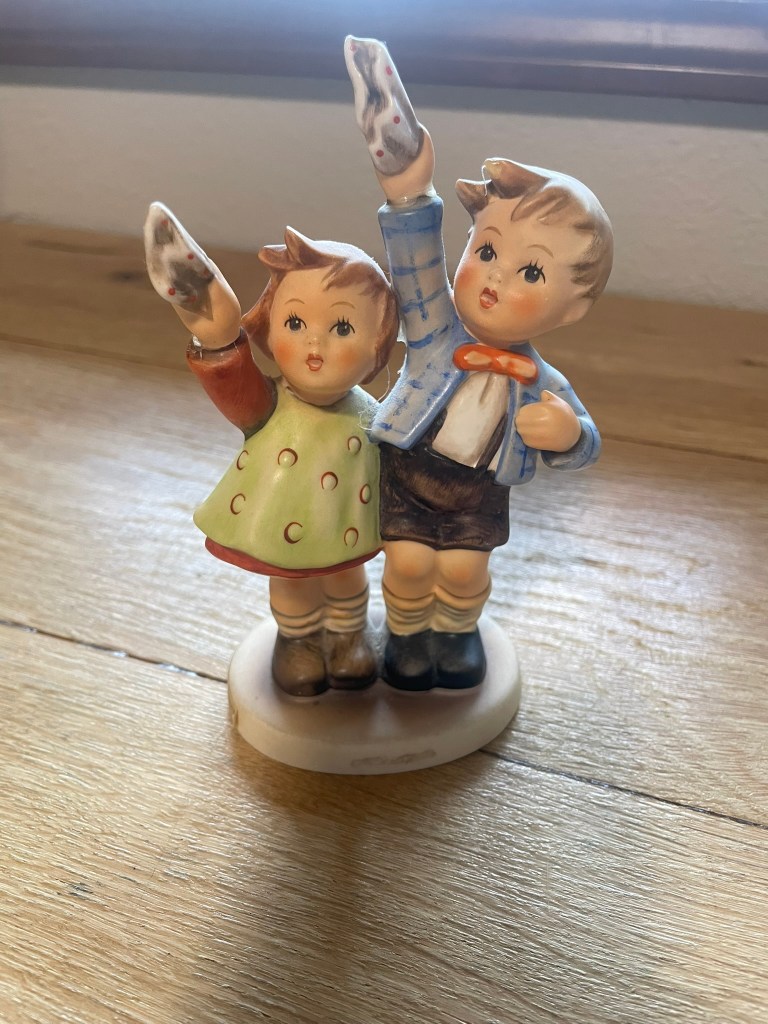
The two kids waving handkerchiefs and forever frozen as Hummels also tell a story. When my mom and I visited my aunt and uncle before they moved from their home to an assisted living apartment, my aunt handed me this story. She had babysat both my older brother and me when we were little. When I went off to kindergarten, she explained, my mom gave her this Hummel as a thank you gift. “Now you get to have it,” my aunt told me.

I promise to keep it.

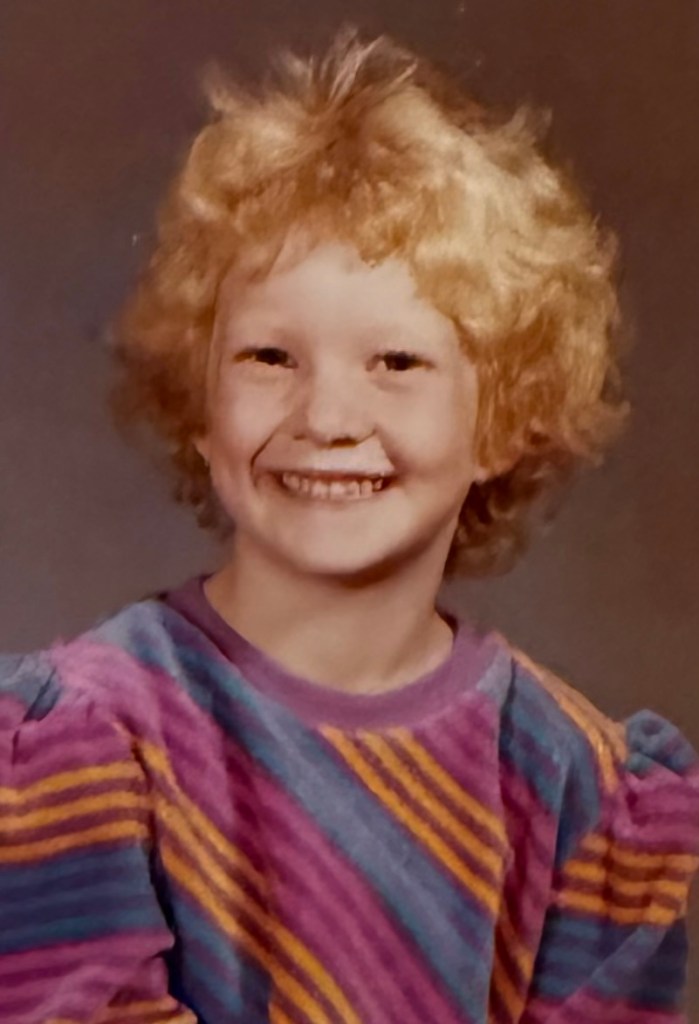
Later on in that house, my cousins would discover this photo as they did the hard work of deciding what to keep…

and what not to keep! A time to keep and a time to throw away…

Your most special things tell a story that piece together your own story: gifts given and received, mementos, each a landmark in your life, each a reminder of a precious relationship or milestone. Each one evidence of God’s faithfulness to guide you through life.

Back in that man’s assisted living apartment, I shared with him the sacrament and the ancient story of God’s love for him in Jesus Christ. In bread and wine, he tasted the promise that God will keep him forever.

Why Confirmation?

‘Tis the season of fall sign-ups! Parents and guardians of teens and younger are at it again, working out the complex matrix of drop-offs and pick-ups that often stretch from dawn to well past dusk.

In a perfect world, the designated person operating the matrix is entitled to a personal assistant. Coordination of kid schedules can be that complicated! (I can’t remember my password! Did I really miss the deadline? Weeping and gnashing of teeth!)

There is an abundance of pressure to sign kids up for a plethora of activities to “keep them busy” or “help them find their thing” or whatever was suggested in the latest book we read or advice we took.

Some parents and guardians will sign a teenager up for faith formation. In mainline Protestant churches we name this animal Confirmation.

Why add Confirmation to the matrix, usually an extra night of every week throughout the school year? Why Confirmation?!? Here are 3 potential parent/guardian responses to this question:

  1. I had to go to Confirmation, so my kid should have to go to Confirmation, even though I’m not exactly sure the point.
  2. I want the pastors to peel open my kid’s brain and drop some Jesus in there. It can’t hurt.
  3. There was an open spot in the matrix and teenagers need to be busy, busy busy!

Would someone please hit the annoying game show buzzer? These answers are LAME! Even so, I suspect these lame answers are the most common.

Consider this: Practice.

Anyone who has ever formally competed understands that before a performance, practice is required. Skipping out on practice is a recipe for disaster and injury.

Practice teaches our body the proper way to warm up and to move: how to act out that one scene, hit that note, or swing, throw, kick, shoot or hurdle. By the time we arrive at competition, our bodies and minds are likely to know what to do, at least much of the time.

The Christian faith is practice for life.

We practice faith through rituals such as prayer, worship, Bible study, and Confirmation, for example. Memorizing Bible verses (peeling open brains and dropping in a little Jesus) is a poor substitute for practice. Dropping a kid off at worship is a poor substitute for practice. (This annoys me every time.)

Faith is a practice meant to steady your life when it gets rough, as life tends to do. Rituals are a steadying tool.

I pray for Confirmation to be a ritual that steadies a teenager’s life especially when that beloved one feels left out, or like a failure, or hopeless, or angry, which also happen to be storms that frequent an adult’s life. Rituals steady all ages.

Life can be so stormy! Faith can clear away the clouds and make room for the Son to move in.

Faith is not one more thing to keep a teenager busy, it is a practice to keep a teenager steady. Potentially, even a household steady.

Confirmation is practice for the Christian faith. Faith takes practice. So much practice, as well as coaches, like parents and guardians, pastors and mentors, and an entire congregation of people praying cloud-clearing steadiness in the lives of these beloved ones.

Photo by Tom Barrett on Unsplash

The Case of the Missing Lids

It happens to you.

You finish a meal and you are left with the leftovers. You reach into the drawer or cupboard where containers and lids take up residence. You find the perfect container but cannot locate the lid. You know it was just there! How do containers and lids separate? It is madness!

If you live alone, you wonder what you did with the lid and investigate, or give up, depending on the day and how much you want to bother with a missing lid.

If you live with other people, however, you open the case of the missing lid and go looking for someone to blame! At our house, the list of suspects includes the teenager who leaves a trail of containers and lids throughout the house, the old guy Marcus visits each week and delivers a meal in these containers, the dishwasher (you never know), or the dog who has been known to mistake a lid for a frisbee.

Blame is a lovely distraction. In fact, the missing lid will never be found, I know this to be true. The time we spend distractedly looking for someone to blame could be better spent reorganizing the system to make it less likely for lids to go missing in the first place.

If I zoom out a bit, I can see this fact: we toss lids into a drawer and hope for the best. Because multiple people do the dishes at our house, not everyone files lids (or containers) in exactly the same drawer. Also, lids crack and get tossed before a replacement is found, like benching a basketball player without sending in a sub, leaving only four on the floor, an incomplete team.

Blame will not get to the bottom drawer of any of this, it will instead stifle creative wondering and problem-solving. Blame keeps me frustrated instead of curious. Blame also makes a person crabby, which is no fun.

Blame for me extends beyond the lid drawer to relationships, just as it does for you.

Kathleen Smith has me considering blame after reading “Blame is a Giant Penguin.” (This is a subscriber-only article.)

“Moving past blame isn’t about letting people off the hook or excusing bad behavior. It’s about not needing a villain to steady the ship or make sense of one’s current functioning, a feat for the uber-narrative brain.”

This is to say, blame distracts us from the actual facts. It keeps us from thinking through the relationship to be honest with our own part in the problem.

  • Who are you blaming instead of zooming out to see the problem differently? Maybe more honestly?

Zooming out offers you a Christ-like view of your relationships, adding mercy to the question. It keeps you from being distracted by blame and reorients you to the everyday wonder of being alive.

  • What blame are you carrying that needs letting go?
  • How does blame melt away when you prayerfully define how you want to live? How you invite people to treat you?

When I zoom out and see my own part in a relationship problem, I often recognize that I have not been clear with how I want to be treated. I distractedly let someone else shape a relationship that needed more input from me.

Blaming is easy and so often it leaves us stuck. God’s gift of your life deserves a wider, zoomed out view of how you want to define your relationships (even with the lids.)

Case closed.

Photo by Luke Peterson on Unsplash

The Dog Who Walks (Only Sometimes)

Most mornings involve a walk with this dog. In fact, a primary reason I negotiated with Marcus a few years to get the dog in the first place was to get myself outside and walk, which I was unmotivated to do without a four-legged friend.

And so, in the mornings I am forced to play a game where I go looking for this dog who may be sleeping beside any one of three teenagers. Usually when I get to Door #3 I find him curled up and hopeful that I will forget our daily ritual. Like the student who avoids eye contact with the teacher posing a question, he hopes I will move on.

On this particular morning, he had chosen a couch for his sleeping quarter over a kid’s bedroom and went all chameleon, aiming to blend in with one pillow while hiding behind another.

Seriously. What dog passes on the famous invitation to go for a walk, a thing that is good for both of us? Who chooses not to do the very thing that is good for him, but instead the thing that is less good for him? I’ll tell you who: Paul. (and us)

I do not understand my own actions. For I do not do what I want, but I do the very thing I hate…I can will what is right, but I cannot do it. (Romans 7:15 & 18b)

The dog tries to get himself out of a morning walk. The rest of us try to get ourselves out of other things that are good for us.

  • Vegetables instead of cookies.
  • The hard conversation with someone we love instead of the small talk question.
  • Going next door to meet the next-door neighbor instead of keeping to ourselves.
  • Trying to direct a spouse or child instead of hearing them out.
  • Saving money instead of spending it – darn you, Prime Days!

Human beings, like this little slightly lazy dog, are not expected to be perfect. We are all creatures inclined toward sin, that is, we will do the very thing we do not want to do.

Now hold on. I am not scolding us for making bad choices, or telling you to revise your habits, although you very well may.

Instead, take a gentle look at your life and admit where you are doing the very thing you wish you would not do.

  • It is your human nature to avoid what is good for you. What does that look like today? Who might encourage you to reconsider?

Eventually, I coax the dog into a walk. Before we are ten steps down the driveway, his tail wags and h4 remembers he is a dog who, in fact, loves walks. I just need to remind him every single ridiculous morning.

We follow a Savior who does not wait for us to make the right choice, or to do what is good for us. Sit on the couch and try to blend in every day and you will not undo God’s love for you, a love that is unconditional and frankly quite stubborn.

There are days when the dog does not drag his feet, so to say, but willingly agrees to walk. That’s nice and all, both of us doing what is good for us, walking our way into a new day.