Mom, wife and pastor relying on the gentle love of Jesus. Writing about being in relationships, not losing yourself in them, and Bowen theory. Author of Spiritual Longing in a Woman’s World and Wait: An Advent of the Familiar.
Birthdays shmirthdays, some might say. But not me! I love the gift of a birthday. Adding another year to a person’s age is nothing short of a miracle.
Walking with people in their faith, I witness both the joys and the trickiness of adding another year. It might mean one more year without that beloved person whom you miss. Or one more year moving through the deep waters of depression. It might mean one more year unemployed or less physically able.
I remember hearing a mom explain to her little kids that each year we get older we move one year closer to death which is one year closer to heaven. I think it was meant to be encouraging, but yikes!
A birthday, however, is a way to keep us honest. This life on earth will end. None of us gets out alive. Each day is precious just as you are precious in God’s sight.
Today my husband adds one more year to his age. Who better to remind him of his mortality than his wife/pastor!
A birthday is an invitation for each of us to wonder.
How might the fragility of this life shape your decisions? Are you doing the work you feel called to do? Are you using God’s precious gift of time to connect with your beloved people? Are you hanging out with Jesus each day?
The best part of birthdays, of course, is not the mortality wondering but the cake. Or the pie. Or whatever it is that marks the occasion. It is a sweet gift to add that extra year.
At this moment (along with many other moments) one of my neighbor kiddos is swinging in her backyard. She spends hours swinging – up and down, again and again. And again.
It has to be peaceful for her, which is ironic because it is the squeakiest, most annoying-sounding swing in the entire universe! It’s enough to drive a neighbor into insanity. Don’t believe me? Play this soundtrack in your head: squeak, squeak, squeak, eighty-five thousand more times! Perhaps tonight I can sneak over with some WD-40, like a thief in the night to steal the squeak.
And yet, the squeaking swing and the person on it are part of my neighborhood and part of my community. They both belong, despite the irritating squeak. My neighbor loves to swing and I love my neighbor (so do you if you do what Jesus says) and so all manner of things shall be well.
Neighborhoods and communities include squeaky sounds and squeaky voices. Bring people together, whether there are two or two hundred or two million and it quickly becomes a challenge to be next-door neighbors who belong to the same community.
We might forget that we belong to the same community. We might stick with our own tribe of people, live life through a Facebook group, or imagine that the community and the world were better years ago.
Associating only with people who are like us, communicating heavily through a screen, or betting on nostalgia are guaranteed ways to hinder community-building.
The people of God who had been exiled to Babylon were not interested in their new community. (Jeremiah 29) When they preferred to stick with their own people and recall their days back at home in Jerusalem, God gave this instruction:
"But seek the welfare of the city where I have sent you into exile, and pray to the Lord on its behalf, for in its welfare you will find your welfare." (Jeremiah 29:7)
God breaks the news that this is their community, even with its squeaky swings and voices.
When we pray to the Lord on the community’s behalf and work toward the well-being of the community, we work toward our own well-being.
This can only mean that whenever we neglect to work toward the well-being of the community, we neglect our own well-being. When your neighborhood suffers, so do you. When the community is not well, nor are you, so connected are neighbors in a neighborhood even if we do not know/speak/or appear to care for one another.
Daily, the Spirit issues invitations for you to be a conductor of well-being in your neighborhood.
Meet a next-door neighbor you haven’t yet met. Chocolate chip cookies are an excellent ice breaker.
Go somewhere in your community you’ve avoided because it might feel uncomfortable. Talk to someone who isn’t like you to see your community from a different angle.
And that Facebook group – Lord help us all. What might you do to work toward community well-being in the toxic Facebook groups? I tend to avoid it, but fortunately not all of you do. Some of you with great courage speak truth into lies.
Pray to the Lord on its behalf, God instructed God’s people. May our prayers lead us to actions that bring healing, presence that brings peace, and squeaky, persisting sounds of mercy. Again. And again.
When families gather, each person plays his or her part. There is the wild and crazy one, the organized and orderly one, and the peacemaker in between. Throw in the matriarch and patriarch, the family member who keeps his or her distance, and the perpetually embittered and you may have a complete cast of characters for any family.
If you think your family is uniquely dysfunctional, open the curtain to see an audience of all the other uniquely dysfunctional families, which is to say, all families. At least God was consistent in creating families the same!
In the Christian faith, another word for dysfunction is brokenness. All families are broken because all humans are broken. We are, each of us, an assortment of broken pieces reset each day by the gluey grace of God. We are not perfect clay jars, but by God’s grace we are “afflicted in every way, but not crushed; perplexed, but not driven to despair.” (2 Corinthians 4:8) Humans and their families are broken and beloved clay jars through and through.
Being part of a family is unavoidable. A family member can move away but cannot move on. The relationship system in which we grew up, even if not for an entire childhood, even if we never again see those family members, will forever shape who we are.
Look around your family. Who is among the cast of characters? What part do you play? What are your starring and supporting roles?
If you have harsh words for the cast, or if there are scenes you play in your mind on repeat that portray you as victim, perhaps you do this: take yourself to a thrift store, find an old jar, take it home, wrap it in a towel, and break it into a few pieces with a rubber mallet. You can leave the jar in pieces, but if you put it back together, you witness the daily work of the potter. We are afflicted but not crushed. Each piece has its place, like a character with its own part to play. Each piece is valuable, but not on its own.
Your broken family, your broken self, is never beyond repair for the potter and the potter’s gluey grace.
The reflection questions in the previous post turn your early-days-of-the-school-year attention away from your kiddo and onto you. Yes, you! Parents and guardians tend to focus heavily on our kids when something exciting is about to happen. We ask them:
How are you feeling? Are you nervous?
You’re a senior! What are you going to do next year?
We might forget that focusing on an anxious kiddo only increases the anxiety and pressure in your relationship. I am guilty as a mom of trying to be helpful only to become obnoxious. This is not something I intend to do, I just happen to be good at it!
It tends to lighten up your relationship with your child if you give your child a break and pose these questions to yourself.
Am I feeling anxious? How might I manage my own anxiety?
Life is changing for my kid. What amI going to do next year?
I suspect we direct questions to our kids and grandkids with the intention of helping them. Our questions are, as far as we can tell, indicators of how much we care. When actually, question-overload is like keeping the heat on high under a boiling pot of macaroni. It works just as well, even better, to turn the heat down.
In the Bible when life heated up, when the pressure was high, when people may have felt like an overcooked macaroni noodle, the writers offered images as encouragement. With words, they drew pictures of God:
God holds back the waters so they do not overwhelm you. (Isaiah 43:2)
God dries your tears and wraps you in joy. (Psalm 30:11)
You cling to God, and God holds you with one hand. (Psalm 63:8)
God is your forever lookout to help you when you need it. (Psalm 121:1)
To you encourage you, beloved parent or guardian, here is an image for you:
Accompanist
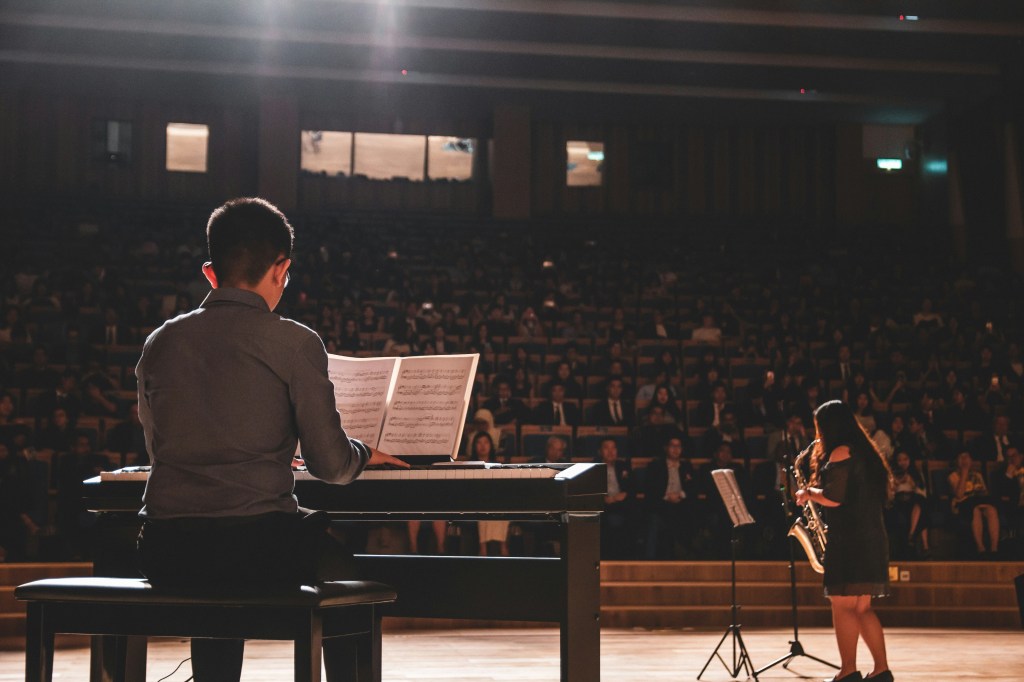
A parent or guardian who softly plays the chords for the child to make his or her own solo music. present in the background, the accompanist is practiced. This isn’t her or his first day on the piano. an accompanist is positioned to bring out a child’s unique and best.
I’ve not been an actual accompanist, but I know some brilliant ones. They have a remarkable way of knowing the soloist well enough to draw out his or her best sound. Once in a while, they might discreetly play an intro twice when the soloist misses the entrance. An accompanist is not a director, not the boss of the soloist, but more like a guide through the music.
Accompanists know they are not the soloists. This is not their first day. Instead, they offer steady and supportive roles to grow the confidence of the soloist.
Here is a blessing for the accompanists to send you on your way:
Accompanying is a privilege, may you sit in the Spirit’s presence as you play.
Keep your hands on the keyboard, may Christ be the director of this song.
Let the music carry, may the soloist shine with the light of Christ.
Teachers and school staff do not need a calendar to recognize August. Even teachers who retired years ago feel the start of a school year roll in like a storm system. Similar to a change in the pressure system pronounced by the ache in your elbow, former teachers feel the arrival of August in their bones.
Both new and seasoned teachers are walking storybooks, living records of generations of families that have come and gone through their classrooms. Ask one to tell you a story of an anxious parent on “meet-the-teacher” night who organized her 1st grader’s desk, lining up the glue sticks in perfect order. Or the dad who could be mistaken for the anxious student if he wasn’t so tall, projecting his own first-day-jitters.
A parent carries more than the bag of school supplies on the eve of a kiddo’s first day. That parent also brings his or her own baggage: memories of her anxious need for perfection as a student; memories of his fear that he might look weak in front of the other boys. For some parents and guardians, walking into a school might be slightly terrifying. Certain memories, like a change in the pressure system, run deep and make uncomfortable return visits. We are what’s happened to us, perhaps.
This may surprise you, but your child’s first day may benefit from your reflections on your own first days of school. By looking back on your own life, you become a little clearer on your thoughts, feelings, and values, which helps you parent with extra grace for your child and for yourself.
Below are questions to get you reflecting. You might talk through one or two with a friend or partner or scribble a few notes in a journal. Part Two of this series will take those questions one step deeper. How might what you know about yourself both (always both) help and hinder the excitement of your child’s first day? I’ll share an image that has guided my own parenting.
For now, here is your homework:
What comes to mind when you recall your own first days of school?
Is there a word or phrase that captures how you felt as a student?
What did your parents or family expect from you in school? What happened if you fell short?
What did you expect of yourself?
What was your favorite activity at recess? (This may not be a helpful question – but it might be fun! Playgrounds have changed since you were there!)
As you reflect, pay attention to what happens inside of you. Notice the tender spots, the feelings that bubble up. And then take a breath that fills you with the peace of the Spirit, making all things new. Even you.
Behold, I am doing a new thing; now it springs forth, do you not perceive it? I will make a way in the wilderness and rivers in the desert. (Isaiah 43:19)
Please could it be berry season forever? Could all lands be lands of perpetual strawberry and blueberry harvest? I wouldn’t mind. I’d trade it for root vegetable season any day of the week! Potatoes and parsnips are no fun in yogurt parfaits.
This world is not as it should be. Berry season is temporary, much to my dismay.
On the list of complaints you will hear today, this is on the low end. Better that you tend to war refugees, among them thousands of Ukrainian children snatched up by the Russian army, an injustice that should get all our hearts racing. Could you, Lord, deal with corrupt governments, the production of opioids, and the disproportionate number of foster kids to foster parents? Your to-do list is long, I get it. My list is mostly laundry.
One human response to your long to-do list is fear, as though the world only recently became broken and the way through is to be afraid for the future, afraid of our neighbor, afraid of losing assets, afraid you’ve jumped ship and found another universe you like better.
Another response requires the long view, a look at your creation that takes the viewer back to the beginning. This response is more work, thus less desirable. We’re human, you made us, you get it. The long view reveals a season and a time for all things: a time for sweet berry harvests and another for hearty root vegetables; a season for peace but not for everyone, everywhere at the same time; a season for long days, another for long nights.
Like us, you long for the world to be as it should, to match your original dream. Out of love, you create scientists to contend with disease. You raise up an agency to fight for the safety of children and another to set up refugee camps. You call prophets and poets to speak truth. Again, your to-do list is lengthy and I see only in part, as Paul writes.
For today, I will enjoy the berry season. I will miss it when the days grow shorter. Then, the sun will set earlier and I will go to bed at a decent time and so will the rest of us, except for the teenagers. Lord, why did you make them so weird?
Thank you for berries, Lord, and all the ways you add sweetness to this life. Amen.
Today is a 17th birthday at our house – the season of passing through the last step toward independence. In other words, there is a chance my grocery bill may be bearable in the foreseeable future!
Even this far into the wilderness of parenting, it is impossible to remember the millions of moments now filed away as history. The scoop after scoop of sand in the sandbox, so many pushes on the swing, reading words, watching games, thousands of “goodnights” to end the day. And later, negotiating responsibilities, sitting fearfully in the passenger seat beside them, witnessing the changes impacted by friendships. And more changes amid the ever-changing teenager’s ever-changing interests and tastes.
The image of parenting that sticks with me today takes me back to the sandbox, sitting beside the kid and his plastic shovel as he loads sand into a plastic bucket. He will scoop and scoop, then carry the bucket across the sandbox and dump it out, then go back and repeat. If he scoops too much into his bucket, it will be too heavy to carry. Too light and he will get bored going back and forth the extra times.
Parenting, perhaps, has something to do with hanging around enough to encourage him to fill the bucket, but not too much. It is scooping responsibilities into his life just enough for him to carry, not so heavy to be crushing.
You can only know how much a kid can carry by challenging them and by getting to know them, which in itself is an endless job. Kids change and thus they require the constant effort of getting to know them. They deserve your willingness to do this, as they, too, continue to get to know their own selves.
The kids I love to visit with are the ones whose parents refuse to do the talking for them. These parents sit back and watch their kid practice conversation, stumbling at times, yet finding their way into their lives, into their own selves. These are tiny scoops of sand filling a manageable bucket.
And what an incredible, formidable gift to oversee the measurements of sand one year at a time.
Warning: Nostalgic Mom of High School Graduate Ahead
“Tom, stay away from the edge.”
“Tom, you’re closing in on danger over there.”
“Tom, you’re raising your mom’s heart rate to a dangerous level.”
He has always been the one to test the limits. One walk with him at Wind Canyon in the Theodore Roosevelt National Park was one walk too many! Even at 15 years old, I had to tell him to stop going up (not down) the hotel waterslide because he was creating a following with the impressionable littles in the pool.
It’s a week of double graduations for this dare devil. Tomorrow is his graduation from high school and five days later his graduation from basic training and AIT for the Army, continuing with his service for the National Guard.
Stepping out to the edge and raising his mom’s heart rate is not unfamiliar territory. I’ve had lots of practice watching and turning away – a mom can only take so much, after all!
Graduation is meant to be one careful and well-supported step over the edge, a release and catch situation. The God who walked with God’s people through the wilderness will be there this time, too, the soft landing of grace catching him as he finds and sometimes fumbles his way to the other side.
Haven’t you always wondered? Aren’t you dying to know what happens when preachers gather in the same space?
Okay then, then humor me for a moment!
When people whose livelihood is proclamation, that is, a public telling with words and deeds the true story of Jesus Christ, the in-breaking of God into our messy lives and world, we almost certainly do one thing.
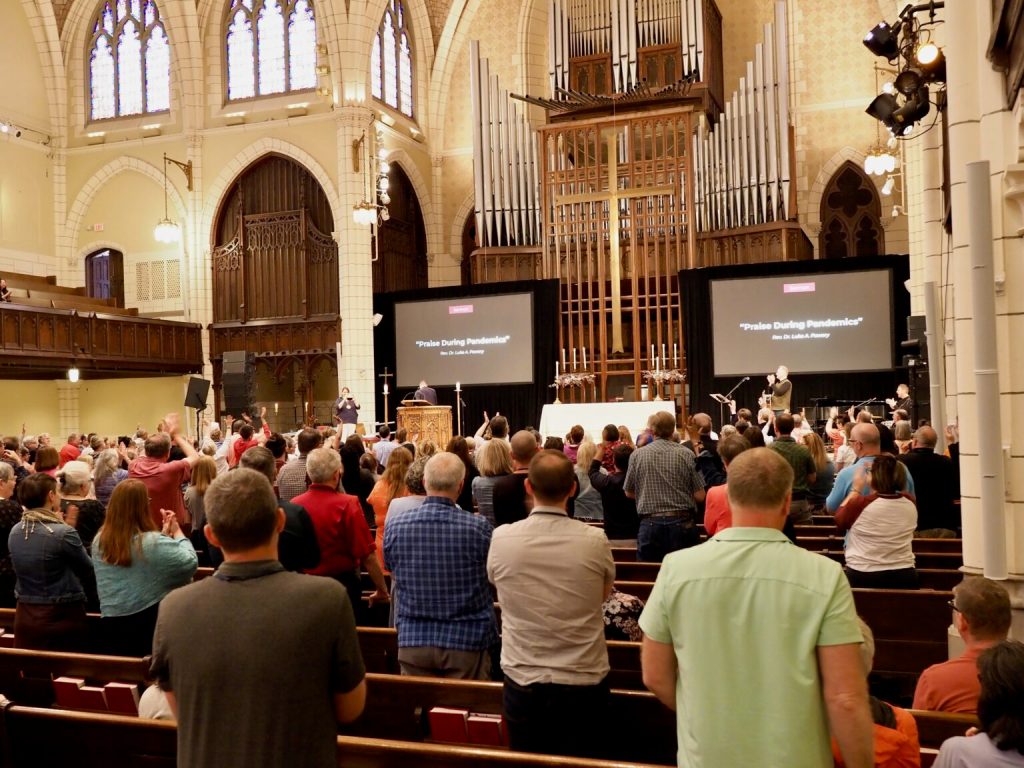
We who hover in hospital rooms with quiet prayers, who wrestle for hours and hours with ancient words on a page, who beg God to show up already, gather together and sing.
We sing the old, old story that we love so much. We sing petitions for the lost stranger, the beaten-up creation, the broken governing systems that populate the world. We harmonize the same songs preachers have been singing for hundreds of years, thousands when the songs we sing are psalms.
At the Festival of Homiletics last week, I sang “Every Time I Feel the Spirit,” belting out the lyrics with preachers of a variety of denominations, part of a magical moment when music blurs doctrinal boundaries and we are one in Christ, if only for a moment.
Then we went our separate ways with songs in our hearts to carry us along. And wouldn’t you know, the sending song chosen by our Worship and Music Director on Sunday was “Every Time I Feel the Spirit.” Same song, different crowd. And I belted out the lyrics, unconcerned with hitting the notes exactly right and more caught up in the negro spiritual I had just sung with preachers from around the nation, whose work, like mine, is a constant yearning to feel the Spirit. “Every time I feel the Spirit moving in my heart, I will pray.”
When preachers get together, we sing. We sing a prayer masquerading as a song, for when the song ends, we keep feeling for the Spirit and the prayer goes on.
After ten weeks at Fort Leonard Wood, Missouri, our son completed basic training for the Army National Guard. When exactly did this milestone occur? I don’t know. This is one of my basic training learnings.
#1) You do not get to know when things happen. For example, he arrived at the base the same day he left the airport back in February. But when did ten weeks of basic training begin? One week later? Two weeks later? Somewhere in between? Because the start date was a mystery, so was the end date. One Sunday in April, he told us without fanfare, “We finished basic training.”
#2) The sequel to basic training is Advanced Individual Training (AIT). When AIT occurs at the same base, units might move directly from basic into AIT with graduation at the very end. This is our son’s situation and why the conclusion of basic training was literally nothing to write home about.
#3) There is an acronym for everything. When a sweet veteran at church asks how our son is doing, I am thankful he remembers the acronyms so he can tell me what he is doing! It’s really an IYKYK situation.
#4) When you miss your kiddo and want to write him a letter because you have only a few minutes with him on the phone most Sundays, you need to think carefully. Each piece of mail will cost him 25 push-ups. Not a big deal until the one day he received not one, not five, but nine letters! This kid rocks at push-ups. But for the record, I could do a longer plank than him back in 2016. We will not rematch.
#5) When basic began, so did the end of knowing what my kid was doing much of the day. So did checking in with him now and then. It was like pre-cell phone days! We parent with devices that allow quick visits and location sharing. It’s easy to forget it was not long ago that kids drove away to college with very little access to communication. I miss checking in with him, and I also appreciate the reminder that he is his own person and so am I. Devices can blur those lines.
“This is like basic training for parents,” my husband said a couple months ago. Yep, we are learning the basics: knowing less about his life, trusting elders for wisdom, keeping myself in check when I want to reach out. As long as there are no push-ups, I think I’ll be ok.