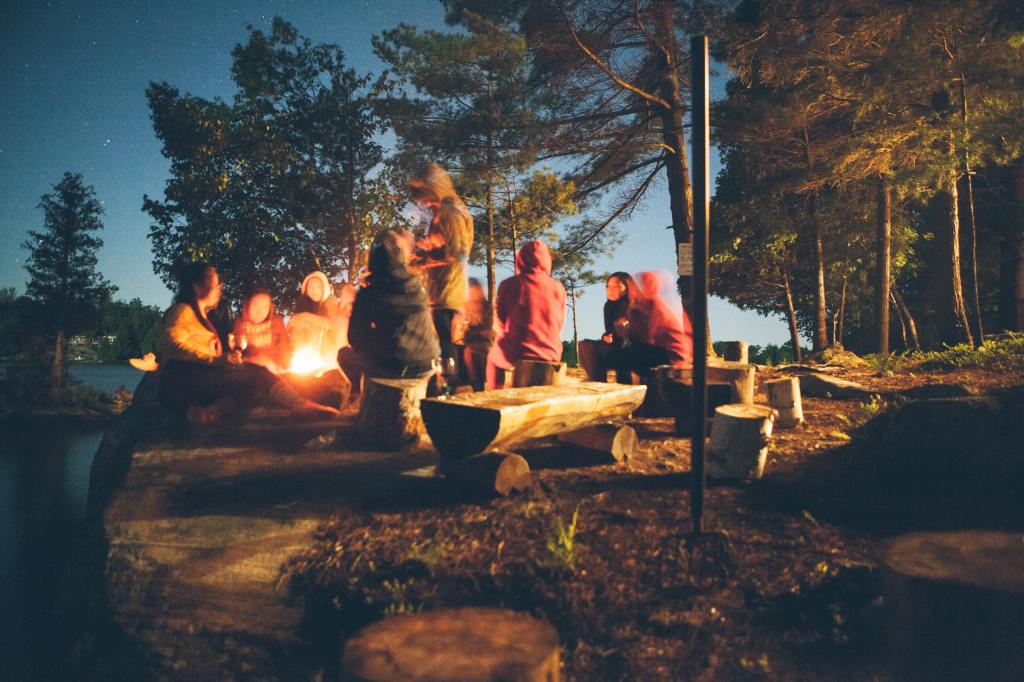
Seats around a campfire are sacred. Since the invention of fire, humans have encircled them to swap stories, learn from one another, and stay warm. I recently read Tish Harrison Warren describe their backyard firepit as the place her family has felt particularly connected since the beginning of the pandemic. Campfires illuminate the dark night with pops and crackles, often a soundtrack of belonging. Add an additional soundtrack of your favorite Bible Camp campfire tune and you have discovered the best summer job!
The denomination to which I belong, the ELCA, has a strong tradition of outdoor ministry. It is likely some of the most unique and creative pastors you know were once counselors at a Bible Camp. No job description for a camp counselor could capture all the job entails, but a simple phrase might suffice: “Be ready for anything, including exhaustion and elation in the very same minute!”
I had zero desire to be a Bible Camp counselor. My singular experience as a camper was the summer between 7th and 8th grade when I went to camp knowing almost no one and mistakenly hoping junior high girls would be kind and welcoming. You can imagine how that went!
But by the time I finished my second year of college, the sting had gone away. A beloved professor at my college was married to the Executive Director of Metigoshe Ministries. His need for additional counselors converged with my lack of summer employment, so off I went to camp, again knowing almost no one. This time, however, I would not leave camp sad, but changed.
Camp staff often explain their work by saying the days are long, and the weeks go quick. A day of camp is filled to the brim, making your daily life a constant pouring out of Jesus’ love. This work is not easy, but no work that truly matters ever is. Work you do that changes lives requires your whole life, not a few hours of it, not a little bit of your energy or time, but all of you. Your heart, your mind, the very self God has created is meant to be shared.
My own experience as a camper sharpened my vision for campers who felt left out. In fact, that very camp skill has followed me around, keeping an eye out for the forgotten ones. Much of the skills I acquired at camp, however, are not all directly transferable. I don’t get to give mud facials even though I wasn’t too bad at that. I don’t dress up in crazy outfits, chase children at night, shingle a roof, toss greasy watermelon, or help construct outhouses in my work as a pastor. Those remarkable skills have gone untapped.
So much of what I learned took place in the same type of circle in which people have been learning since the invention of fire:
- One fire is enough for everyone, even better if you have to squeeze together.
- Whether or not you can sing, music gets to you with the promise that you belong right where you are.
- Life is not lived in your own seat but in a gathering of seats among people meant to be different from you.
The nightly campfire tradition of Bible Camps is perhaps what makes the transition from Bible Camp to whatever is next for camp staff profoundly difficult. Outside of camp, days rarely end around the sacred space of something equivalent to a campfire.
Right now, there is a young adult whom you know (or maybe are) who is waffling about summer plans. Tell that person there is a seat at a campfire just for them, as long as they desire to do work that matters. If money gets in the way of their decision, could you do what I know a camp staff dad often did, and subsidize that person’s income with a little of your own money? That’s an investment in the work of the Spirit, I assure you. Maybe you could get a mud facial in exchange! Maybe.

 Lisa Lewton